Unit 1 · Topic 1.8 · about 30 minutes · 7 parts · 12 scored checks, 3 of them multiple choice
AP Calculus AB 1.8: Determining Limits Using the Squeeze Theorem
Unit 1: 10 to 15% of the multiple-choice section
What you'll be able to do
- Determine the limit of a function with the squeeze theorem by trapping it between two functions that have the same limit, after checking that each condition of the theorem holds.
Key vocabulary
| Term | What it means | The exam trap |
|---|---|---|
| Squeeze theorem | A theorem that finds the limit of a function at by trapping it between two other functions near . | Find the limit of both bounds before you conclude anything about . |
| Bounds | The two functions and that sit below and above for every near . | A bound has to hold for every near , on both sides, not only where it is easy to check. |
| Hypotheses | The conditions a theorem needs before its conclusion can be used. | A justification states that each hypothesis holds before it states the conclusion. |
 Tap to open the picture full size
Part 1 Think first Where is the robot arm headed?
Guess before you learn. A wrong guess still makes the answer stick.
Predict first
A robot arm jitters as it moves its tip into place at time seconds. Its sideways offset from the target, millimeters, swings back and forth with no simple formula. The controller does guarantee one thing: for every time within one second of 0. As gets close to 0, what does get close to?
In short. The squeeze theorem finds the limit of a function at by trapping it between two functions that approach the same value at .
- The inequality has to hold for every near , on both sides, except possibly at .
- Both bounds have to approach the same number . Bounds with different limits give no conclusion.
- When both conditions hold, , and a justification names the theorem and both conditions.
Part 2 Learn it Three short ideas, each checked as you go
8a. Trapped between two functions
Some limits will not give way to substitution or algebra. Substituting into gives , and there is no factor of to cancel. The squeeze theorem gets around that by trapping the function between two easier ones.
Squeeze theorem. Suppose that for every in an open interval containing , except possibly at itself,
and that and . Then .
Think of a floor and a ceiling that meet at one height. Near , the values of are caught between them, so they have to approach that height too.
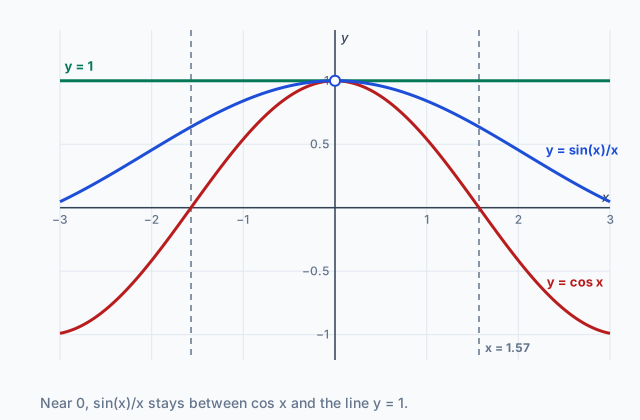
The graph at the top shows this for . For , comparing areas in the unit circle gives , a fact you can take as given. Both bounds approach 1 as , so .
The theorem never uses . The inequality only has to hold near , and does not even need a value at .
Quick check · Calculate
No calculator. For every , the function satisfies . Find .
8b. Check every condition first
The theorem gives a conclusion only when all of its conditions hold, so write them down before you use it. There are three.
- The inequality holds for every near , on both sides, except possibly at .
- exists. Call it .
- exists and is the same number .
The third is the one to watch. Take . It is true that for every , but those bounds approach and , two different numbers. The floor and the ceiling never meet, so the theorem gives no conclusion at all.
The first condition can fail more quietly. Bounds that are promised only for between 5 and 6 say nothing about a limit at 0, however neatly their limits agree there.
When all three hold, a complete justification names them: since for near and both bounds approach , the squeeze theorem gives .
Quick check · Sort it
No calculator. On each card, the inequality is all you know about . Tap a card, then say whether the squeeze theorem, using that inequality, finds the limit named on the card.
Gives the limit
Gives no conclusion
8c. Building the floor and the ceiling
Often you have to find and yourself. The usual source is that sine and cosine never leave : for any input , and .
Take . For , . Multiply through by , which is positive for , so the inequality keeps its direction:
Both bounds approach 0 as , so the limit is 0.
Watch the sign of what you multiply by. A factor of is negative to the left of 0, and multiplying by a negative number reverses an inequality. Bound the absolute value instead: since , you get , so on both sides of 0.
A constant added to the function moves both bounds by the same amount. sits between and .
Quick check · Fill the statement
No calculator. Tap a blank, then tap an answer.
To find , start from for . The factor is for , so multiplying by it keeps the direction of the inequality: . Both bounds approach as , so that is the limit.
Part 3 Watch it done A factor that changes sign
Watch each step, then do the last one yourself.
Use the squeeze theorem to find .
Step 1 · Bound the part that swings
For , , so .
Step 2 · Bound the product
Multiplying by gives , so for .
Why this step?
Why bound with instead of multiplying the first inequality by ?
For , is negative, and multiplying by a negative number reverses the inequality. is never negative, so the bounds hold on both sides of 1, which the theorem needs.
Step 3 · Add 4 to every part
For , .
Your step · Calculate
No calculator. Finish it. For , . What is ?
Part 4 Try it A value, and a guarantee
Try it · Decide and justify
No calculator. A function satisfies for every . A classmate concludes that . Does that conclusion follow?
Which reason supports your answer?
Try it · Calculate
No calculator. A bottling machine has a valve setting . At setting it fills each bottle with milliliters of juice, and the maker guarantees for every setting between 3 and 5. Find , in milliliters.
Part 5 Explain it Write it the way the exam asks
Free response is handwritten on paper on the exam, so work on paper first. Nothing you type here leaves this page. Then compare with the model answer and score each point.
Free response is 50% of the exam score. This one is shaped like Question 5, from free-response Part B (calculator not permitted).
Free-response practice · Question 5 style
No calculator. A pressure gauge is being calibrated. When its dial is set turns from the calibration mark, the gauge reads kilopascals, where
(a) Verify that for all .
(b) Use the squeeze theorem to find . Justify your answer. Using correct units, interpret this value in the context of the problem.
(c) For all , . Explain why the squeeze theorem cannot use these bounds to find .
Model answer
(a) For , . Since for , multiplying by keeps the direction: . Adding 30 to every part gives for all .
(b) and . Since for all , the squeeze theorem gives . As the dial is set closer and closer to the calibration mark, the gauge's reading approaches 30 kilopascals.
(c) As the bound has limit and the bound has limit . These are different numbers, so the condition that both bounds have the same limit fails, and the squeeze theorem gives no conclusion about .
Score your own answer. This is a self-check, not a grade. Tick each point your answer makes.
Part 6 Check yourself A function known only by its bounds
The two case questions use the same bounds. Answer them from the formulas for and ; the table only shows values near 2.
For every with except , the functions , and satisfy , where and . There is no formula for , but , and some values of all three functions are in the table.
| 1.5 | 2.75 | 2.9 | 3.25 |
|---|---|---|---|
| 1.9 | 2.99 | 3.004 | 3.01 |
| 2.1 | 2.99 | 2.993 | 3.01 |
| 2.5 | 2.75 | 3.12 | 3.25 |
Case question 1 · Calculate
No calculator. What is the exact value of ?
Case question 2 · Multiple choice
No calculator. What do the squeeze theorem and these bounds tell you about ?
The rest stand on their own and do not use the case.
Check yourself · Spot the error
No calculator. A student uses the squeeze theorem to find . Tap the first line with a mistake.
Check yourself · Match
No calculator. Each function is defined for . Tap a function, then its limit as .
Part 7 Keep it Bring back earlier ideas
This lesson leans on two earlier limit ideas. Pulling them back up now is what makes them last.
Bring it back · Multiple choice
No calculator. Suppose and . What is ?
Bring it back · Multiple choice
No calculator. Why does not exist?
In three lines
- If near and and have the same limit at , then has limit at .
- Check every condition first: the inequality near on both sides, and the same limit for both bounds.
- Bounds usually come from , multiplied by a factor that is never negative, such as or .
Exam strategy for this topic
- Section I Part A, Multiple Choice (calculator not permitted): 29 questions in 62 minutes.
- Section I Part B, Multiple Choice (graphing calculator required): 13 questions in 38 minutes.
- Section II Part A, Free Response (graphing calculator required): 2 questions in 30 minutes.
- Section II Part B, Free Response (calculator not permitted): 4 questions in 60 minutes.
When a question says to use the squeeze theorem, or a function has a factor such as with no limit of its own, write three things in order: the inequality and where it holds, the limit of each bound, and the conclusion with the theorem named. A bare value with no inequality is not a justification.
Questions students ask
Do I have to prove an inequality like ?
Not in this topic. When a question gives you the bounds, check that their limits agree and apply the theorem. When you build bounds yourself, start from or and multiply by a factor that is never negative.
Does the squeeze theorem work for one-sided limits?
Yes. If the inequality holds just to the right of and both bounds have the same limit from the right, then has that limit from the right too. The same goes for the left.
What if the two bounds approach different numbers?
Then the theorem says nothing. The limit of might exist or might not, and you need different bounds or another method to decide.
Why not take the limit of each factor of ?
The rule for the limit of a product needs both factors to have limits, and has none at 0. The squeeze theorem only needs the factor to stay between and 1.
Is the squeeze theorem the same as the sandwich theorem?
Yes. Some books call it the sandwich theorem or the pinching theorem. This course calls it the squeeze theorem, so use that name in a written justification.
Course alignment, for teachers
AP Calculus AB topic 1.8, Unit 1: Limits and Continuity.
- Skill 3.C: Confirm whether hypotheses or conditions of a selected definition, theorem, or test have been satisfied.
This lesson maps the one essential knowledge statement of the topic to the part that teaches each one: 1 is checked by a scored question. The map is in the lesson file.