Unit 2 · Topic 2.10 · about 30 minutes · 7 parts · 12 scored checks, 3 of them multiple choice
AP Calculus AB 2.10: Finding the Derivatives of Tangent, Cotangent, Secant, and/or Cosecant Functions
Unit 2: 10 to 15% of the multiple-choice section
What you'll be able to do
- Calculate the derivatives of tangent, cotangent, secant and cosecant, and of products and quotients built from them, by rewriting with identities.
Key vocabulary
| Term | What it means | The exam trap |
|---|---|---|
| Tangent function, | The quotient , defined wherever . | The quotient rule's numerator has a fixed order, bottom times the derivative of the top first; swapping the order flips the sign of the whole answer. |
| Cotangent function, | The quotient , the reciprocal of , defined wherever . | Before you differentiate, check that you wrote cosine on top; a function written upside down sends every later step wrong. |
| Secant function, | The reciprocal , defined wherever . | Secant goes with cosine and cosecant goes with sine, the opposite of what the names suggest. |
| Cosecant function, | The reciprocal , defined wherever . | Cosecant has no value where , such as , so neither does its derivative, even though secant is defined there. |
| Pythagorean identity | The identity , true for every . | Look for inside a numerator after the quotient rule; leaving it unsimplified hides a short answer. |
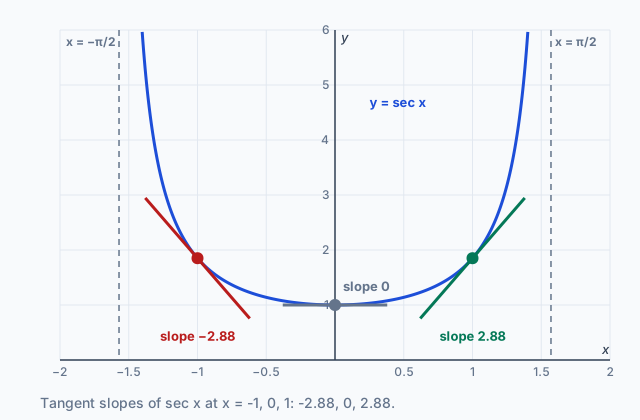 Tap to open the picture full size
Part 1 Think first How fast is the helicopter climbing, per radian?
Guess before you learn. A wrong guess still makes the answer stick.
Predict first
A rescue helicopter lifts straight up from a helipad. A tracking station on level ground 100 meters from the pad measures the angle of elevation , in radians, and the helicopter's height is meters. At it is 100 meters up. At that angle, how fast is the height changing with respect to the angle?
In short. The derivatives of , , and come from writing each one in sines and cosines and using the quotient rule, with to simplify tangent and cotangent.
- and .
- and .
- Rewriting a function with an identity before you differentiate often turns a long quotient into terms whose derivatives you already know.
Part 2 Learn it Four new derivatives from rules you have
2a. Tangent and cotangent are quotients
You already know the derivatives of and , and you know the quotient rule. The other four trigonometric functions are quotients of sine and cosine, so rewrite first, then differentiate.
Start with . The quotient rule (bottom times the derivative of the top, minus top times the derivative of the bottom, all over the bottom squared) gives
Now an identity does the work. Since , the numerator is 1, and
This holds wherever , which is everywhere is defined. At , , so the slope of the graph of there is .
Cotangent works the same way, starting from . Watch the signs: the derivative of the top, , is , and that minus sign survives to the end.
Quick check · Fill the statement
No calculator. Tap a blank, then tap an answer.
To differentiate , first write it as the quotient . The quotient rule gives the numerator , which the identity turns into . So the derivative of is .
2b. Secant and cosecant are reciprocals
Secant and cosecant are reciprocals: and . A reciprocal is a quotient whose top is the constant 1, and the derivative of a constant is 0.
For secant,
That is correct, and it is usually split into two familiar pieces:
Cosecant follows the same steps with sine on the bottom. The numerator is , so
Set the four results side by side and a pattern shows. The two co-functions, cotangent and cosecant, have derivatives with a minus sign, and those derivatives are built from the co-functions: for against for , and for against for . The pattern helps you remember them. The quotient rule is how you check one you are unsure of.
Quick check · Match
No calculator. Tap a function, then its derivative.
2c. Rewrite first, then differentiate
The identities run both ways. A function written in sines and cosines can often be rewritten in tangents, secants and their co-functions, whose derivatives you now know.
Take . The quotient rule works, but splitting the fraction is shorter:
so .
Two answers can look different and still be the same function. Divide by and you get . So and are one derivative written two ways. When your form differs from a classmate's, check whether an identity turns one into the other before you decide either is wrong.
Each of these derivatives exists only where its function is defined. Tangent and secant are not defined where , such as , and neither are their derivatives. Cotangent and cosecant are not defined where , such as .
Quick check · Multiple choice
No calculator. Let . Which expression is ?
Part 3 Watch it done Rewrite, then use the product rule
Watch each step, then do the last one yourself.
Let . Find .
Step 1 · Rewrite with secant and tangent
.
Why this step?
Why rewrite before differentiating, when the quotient rule could be used on it as given?
The quotient rule would need the derivative of , which is a product of its own. The rewritten form is a product of two functions whose derivatives you already know, and , so there are fewer steps and fewer signs to lose.
Step 2 · Write the product rule's structure
.
Step 3 · Use the two derivatives
.
Step 4 · Find the values at the angle
, so , and , so .
Your step · Calculate
No calculator. Finish it. For , , with and . What is ?
Part 4 Try it Two new functions
Try it · Calculate
No calculator. Let . Find .
Try it · Decide and justify
No calculator. A classmate says that and have the same derivative at every where both are defined. Is the classmate right?
Which reason supports your answer?
Part 5 Explain it Write it the way the exam asks
Free response on the exam is handwritten, so write your answer on paper first. Nothing you type here leaves this page. Then open the model answer and score yourself on each point.
Free response is 50% of the exam score. This one is shaped like Question 6, from free-response Part B (calculator not permitted).
Free-response practice · Question 6 style
No calculator. A spotlight sits on level ground 20 meters from a vertical wall and is tilted up at an angle of radians, for . The bright spot on the wall is meters above the ground, and the beam from the light to the spot is meters long.
(a) Write in terms of and , and use that form to show that .
(b) Find . Using correct units, interpret the meaning of this value in the context of the problem.
(c) Justify that for every with .
Model answer
(a) . By the quotient rule, , because .
(b) , so . Then meters per radian. When the light is tilted at radians, the length of the beam is increasing at meters per radian of tilt.
(c) . For , , so the numerator is positive, and . The difference is positive, so .
Score your own answer. This is a self-check, not a grade. Tick each point your answer makes.
Part 6 Check yourself One function, a table of values
The two case questions use the same table. Answer them from it.
A function is differentiable for all . The table gives some values of and its derivative .
| 3 | ||
| 2 | 4 |
Case question 1 · Calculate
No calculator. Let . Find .
Case question 2 · Multiple choice
No calculator. Let . What is ?
The rest stand on their own and do not use the case.
Check yourself · Spot the error
No calculator. A student finds the derivative of and its value at . Tap the first line with a mistake.
Check yourself · Sort it
No calculator. Rewrite each function with an identity, wherever it is defined. Tap a card, then tap its derivative.
Part 7 Keep it Bring back earlier ideas
This lesson stands on the quotient rule and on the sine and cosine rules. Pulling them back up is what makes them last.
Bring it back · Calculate
No calculator. A function is the quotient , where and are differentiable, , , and . Find .
Bring it back · Multiple choice
No calculator. Let . Which expression is ?
In three lines
- Tangent, cotangent, secant and cosecant are quotients of sine and cosine, so the quotient rule differentiates each one.
- For tangent and cotangent, collapses the numerator to or ; for secant and cosecant, splitting the fraction gives and .
- Rewrite with an identity before you differentiate when it turns a quotient into terms whose derivatives you know.
Exam strategy for this topic
- Section I Part A, Multiple Choice (calculator not permitted): 29 questions in 62 minutes.
- Section I Part B, Multiple Choice (graphing calculator required): 13 questions in 38 minutes.
- Section II Part A, Free Response (graphing calculator required): 2 questions in 30 minutes.
- Section II Part B, Free Response (calculator not permitted): 4 questions in 60 minutes.
When a function is given in sines and cosines, look for an identity that rewrites it with tangent, cotangent, secant or cosecant before you reach for the quotient rule. When you evaluate a derivative at an angle, write the rule's structure first, then substitute exact values such as and .
Questions students ask
Do I have to memorize all four derivatives?
Knowing them saves time on the exam, and the pattern in this lesson makes that easier. If you blank on one, rebuild it from sine and cosine with the quotient rule; it takes two or three lines.
Why is the derivative of written and not with sines and cosines?
The quotient rule first gives , and is the same thing written shorter. Either form is correct.
Do these rules work if the angle is in degrees?
No. They come from the derivatives of and , which hold only when is in radians. Every angle in AP Calculus is in radians.
What about or ?
Those have a function inside the tangent or secant, so they need the chain rule, which comes in the next topic. In this lesson the input is always plain .
Course alignment, for teachers
AP Calculus AB topic 2.10, Unit 2: Differentiation: Definition and Fundamental Properties.
- Skill 1.D: Identify an appropriate mathematical rule or procedure based on the relationship between concepts (e.g., rate of change and accumulation) or processes (e.g., differentiation and its inverse process, anti-differentiation) to solve problems.
This lesson maps the one essential knowledge statement of the topic to the part that teaches each one: 1 is checked by a scored question. The map is in the lesson file.