Unit 2 · Topic 2.9 · about 30 minutes · 7 parts · 11 scored checks, 2 of them multiple choice, plus 1 from earlier lessons
AP Calculus AB 2.9: The Quotient Rule
Unit 2: 10 to 15% of the multiple-choice section
What you'll be able to do
- Calculate the derivative of a quotient of two differentiable functions with the quotient rule, from formulas or from a table of values.
Key vocabulary
| Term | What it means | The exam trap |
|---|---|---|
| Quotient rule | The rule that the derivative of is , for differentiable and wherever . | Write the rule's structure with the function names before you put in any formulas or numbers. |
| Quotient of functions | The function , defined at each input where and are defined and . | Before differentiating, find where : the quotient and its derivative do not exist there. |
| Differentiable function | A function whose derivative exists at each input being considered. | A function can be continuous at a point without being differentiable there, so check differentiability before using any derivative rule. |
 Tap to open the picture full size
Part 1 Think first Sweeter or weaker?
Commit to a guess first. Even a wrong one makes the reveal easier to remember.
Predict first
A drink machine is filling a jug. Right now the jug holds 4 liters of liquid with 200 grams of sugar dissolved in it, so the sugar concentration is 50 grams per liter. Sugar water is flowing in at 0.5 liter per minute, and it carries 10 grams of sugar per minute. What is the concentration in the jug doing right now?
In short. The quotient rule says that if and are differentiable and , then .
- The derivative of a quotient is not the quotient of the derivatives.
- The numerator is a difference, so its two terms keep a fixed order: the bottom times the derivative of the top comes first.
- The bottom of the derivative is the original bottom squared, and the rule applies only where the original bottom is not 0.
Part 2 Learn it The rule, then the two ways you will use it
2a. The quotient rule
If and are differentiable and , the derivative of their quotient is
In words: the bottom times the derivative of the top, minus the top times the derivative of the bottom, all over the bottom squared.
Two things trip people up. The numerator is a difference, so its order matters: swap the two terms and the answer changes sign. And the derivative of a quotient is not the quotient of the derivatives, in the same way that the derivative of a product is not the product of the derivatives.
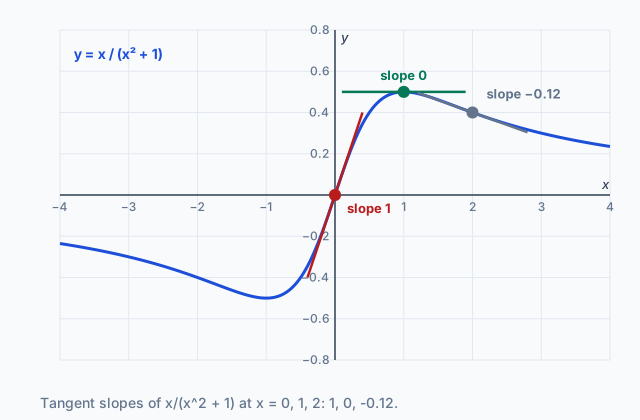
The graph at the top is . The top is , with derivative 1, and the bottom is , with derivative , so
At this is , the flat tangent line in the picture. Dividing the derivatives instead gives , which is at , and the picture shows that cannot be the slope there.
Quick check · Multiple choice
No calculator. Which expression is the derivative of ?
2b. Values from a table: write the structure first
Often you get no formulas at all, only the values of two functions and their derivatives at one input. That is enough. Write the rule with the function names, then put in the numbers.
Suppose , with , , and . Then
The first expression, the rule written in terms of , , and , is the line that shows anyone reading your work which rule you used. Write it before any arithmetic.
Keep every value in parentheses, and keep the second product together. The minus sign in the middle applies to the whole product . Suppose instead . Then the numerator is . Writing there, by losing the parentheses around , is the slip that turns a right setup into a wrong answer.
Quick check · Calculate
No calculator. Let , where , , and . What is ? Give an exact decimal.
2c. Any differentiable top and bottom, wherever the bottom is not 0
The rule works for any differentiable top and bottom, including the functions whose derivatives you learned in 2.7. For , the top's derivative is and the bottom's is 1, so
The rule needs . Where the bottom is 0 the quotient has no value, so it has no derivative there either. Here and are both not defined at .
When the bottom is a constant, the quotient rule still works, but you do not need it. is , and the constant multiple rule gives at once; the quotient rule gives , the same thing. A constant top works the same way: , and the power rule gives , which is what the quotient rule's simplifies to.
Quick check · Fill the statement
No calculator. Tap a blank, then tap an answer.
Let for . The derivative of the top, , is , and the derivative of the bottom, , is . So the quotient rule gives as a fraction over whose numerator is the bottom times the top's derivative, minus the top times the bottom's derivative. That numerator simplifies to .
Part 3 Watch it done A quotient rule derivative, start to finish
Open the steps one at a time, then finish the last one on your own.
Let . Find .
Step 1 · Name the top and the bottom
The top is , with derivative . The bottom is , with derivative 1. Both are differentiable everywhere, and the bottom is 0 only at , so the rule applies at .
Step 2 · Write the rule's structure
.
Why this step?
Why does come first in the numerator, and not ?
The numerator is a difference, and a difference changes sign when its two terms swap. The rule puts the bottom times the derivative of the top first. With the terms the other way around, every value of would have the wrong sign.
Step 3 · Simplify the numerator
, so for .
Your step · Calculate
No calculator. Finish it. For , the quotient rule gives . What is ? Give an exact decimal.
Part 4 Try it A rate in context, and a shortcut that fails
Try it · Calculate
No calculator. The concentration of a medicine in a patient's blood hours after a dose is milligrams per liter. At what rate, in milligrams per liter per hour, is the concentration changing at ? Give an exact decimal.
Try it · Decide and justify
No calculator. Let for . A classmate says , found by dividing the derivative of the top by the derivative of the bottom. Is the classmate right?
Which reason supports your answer?
Part 5 Explain it Write it the way the exam asks
Free response is written by hand on the exam, so do this one on paper. Nothing you type here leaves the page. When you are done, open the model answer and give yourself each point you earned.
Free response is 50% of the exam score. This one is shaped like Question 5, from free-response Part B (calculator not permitted).
Free-response practice · Question 5 style
No calculator. A town's total water use is thousand gallons per day, and its population is thousand people, years after the start of 2020. Both and are differentiable, and . Selected values are in the table. The town's per capita water use, in gallons per person per day, is .
(a) Find . Show the work that leads to your answer, and indicate units of measure.
(b) A council member says that because and are both increasing at , per capita water use must also be increasing at . Use the quotient rule to explain why this reasoning is wrong.
(c) Is per capita water use increasing or decreasing at ? Justify your answer.
Model answer
(a) gallons per person per day per year.
(b) The denominator is positive, so has the sign of its numerator, . Both and are positive, but is larger than , so the numerator is negative. Citing from part (a) also answers this part. The population is growing fast enough, compared with water use, that use per person falls even though both totals rise.
(c) . The numerator 210 and the denominator are both positive, so , and per capita water use is increasing at .
Score your own answer. This is a self-check, not a grade. Tick each point your answer makes.
Part 6 Check yourself Two functions in a table
Both case questions read from one table, so keep it in view while you work.
The functions and are differentiable for all real numbers. The table gives their values and the values of their derivatives at two inputs.
| 1 | 4 | 2 | 3 | |
|---|---|---|---|---|
| 3 | 6 | 1 | 2 |
Case question 1 · Calculate
No calculator. Let . What is ?
Case question 2 · Multiple choice
No calculator. Let . What is ?
The rest stand on their own and do not use the case.
Check yourself · Spot the error
No calculator. A student finds the derivative of . Tap the first line with a mistake.
Check yourself · Match
No calculator. Tap a function, then its derivative.
Part 7 Keep it Bring back earlier ideas
One question from the lesson just before this one, and one from Unit 1. Recalling them now is what keeps them.
Bring it back · Calculate
No calculator. Let . What is ?
From 1.12 Confirming Continuity over an Interval · Multiple choice
No calculator. On which of these intervals is continuous?
In three lines
- The derivative of is , wherever and are differentiable and .
- The numerator's order is fixed and the bottom is squared, and the result is never just divided by .
- From a table, write the rule with function names first, then substitute with every value in parentheses.
Exam strategy for this topic
- Section I Part A, Multiple Choice (calculator not permitted): 29 questions in 62 minutes.
- Section I Part B, Multiple Choice (graphing calculator required): 13 questions in 38 minutes.
- Section II Part A, Free Response (graphing calculator required): 2 questions in 30 minutes.
- Section II Part B, Free Response (calculator not permitted): 4 questions in 60 minutes.
When a table gives values of , and their derivatives, write the rule's structure with the function names, such as , before you substitute, and put every negative value in parentheses. That line shows which rule you used before any arithmetic can go wrong.
Questions students ask
How do I remember the order of the numerator?
Say it the same way every time: bottom times derivative of top, minus top times derivative of bottom. If you are unsure, test it on , which is for and has derivative 1. The right order gives ; the reversed order gives .
Do I need the quotient rule when the bottom is a number?
No. is , so the constant multiple rule gives . The quotient rule gives the same answer with more writing.
Can I write the quotient as a product and use the product rule instead?
Yes, , and both ways give the same derivative. But differentiating for a general takes the chain rule, which comes in Unit 3, so for now the quotient rule is the tool.
Should I simplify the derivative?
To find its value at one input, you can substitute straight into the structure line; every extra step of algebra is another chance for a slip. Simplify when you need the derivative as a function, for example to see where it is 0.
Where does the quotient rule not apply?
Where the bottom is 0, because the quotient has no value there, and where the top or the bottom is not differentiable.
Course alignment, for teachers
AP Calculus AB topic 2.9, Unit 2: Differentiation: Definition and Fundamental Properties.
- Skill 1.E: Apply appropriate mathematical rules or procedures, with and without technology.
This lesson maps the one essential knowledge statement of the topic to the part that teaches each one: 1 is checked by a scored question. The map is in the lesson file.