Unit 3 · Topic 3.1 · about 30 minutes · 7 parts · 12 scored checks, 3 of them multiple choice, plus 2 from earlier lessons
AP Calculus AB 3.1: The Chain Rule
Unit 3: 5 to 10% of the multiple-choice section
What you'll be able to do
- Use the chain rule to differentiate a composition of differentiable functions, from its formula or from tables of values.
Key vocabulary
| Term | What it means | The exam trap |
|---|---|---|
| Composite function | A function of the form , in which is applied to the output of . | A positive power written on a function's name, as in , applies to the function's output, so read the notation closely before you name the layers. The exponent is the exception you will meet in 3.4. |
| Inner and outer function | In , is the inner function, applied first, and is the outer function, applied to the result. | The inner function is the step you would evaluate first by hand, which is not always the piece written first. |
| Chain rule | If is differentiable at and is differentiable at , then . | Before you move on, check that each layer of the function has added exactly one factor to your answer. |
| Leibniz form of the chain rule | With and , . | A derivative with respect to is finished only when it is written in terms of , so put the inner function back in place of . |
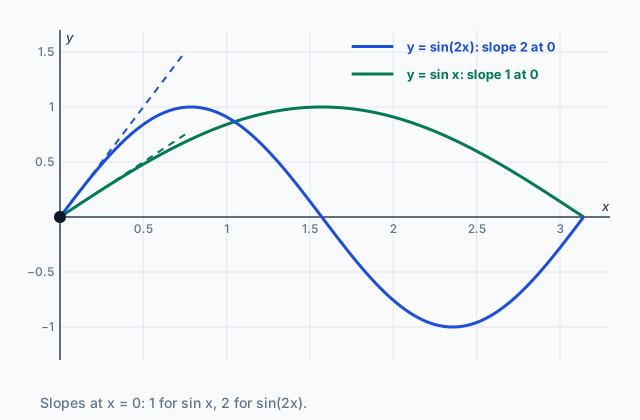 Tap to open the picture full size
Part 1 Think first How fast is it getting colder?
Commit to a guess before the lesson starts. Even a wrong guess makes the explanation easier to remember.
Predict first
A weather balloon rises at a steady 5 meters per second. In the layer of air it is climbing through, the temperature drops 0.006 degrees Celsius for every meter of height. How fast is the temperature around the balloon changing?
In short. The chain rule differentiates a composite function: the derivative of is , wherever is differentiable at and is differentiable at .
- Name the inner function, the one applied first, and the outer function, the one applied last.
- Differentiate the outer function with the inside left unchanged, then multiply by the derivative of the inside.
- In Leibniz notation , so in a context the units of the two rates multiply.
Part 2 Learn it Inside and outside, one idea at a time
3a. Composite functions: the inside and the outside
A composite function is one function applied to the output of another. In , the function acts on first, and acts on whatever produces. Call the inner function and the outer function.
To find them, imagine evaluating by hand. For at , you would work out first and raise it to the fifth power last. So the inner function is , and the outer function is .
The notation needs a careful read, because the same pieces can be put together in two orders:
- squares first and takes the sine last: inner , outer .
- means . It takes the sine first and squares last: inner , outer .
An inner function can look very plain. In the exponent is the inner function, and in it is . Only when the input is itself, as in or , is there no inner function to deal with.
Quick check · Match
No calculator. Each function is a composition . Tap a function, then its inner function .
3b. The chain rule
If is differentiable at and is differentiable at , the chain rule says
In words: the derivative of the outside, with the inside left as it is, times the derivative of the inside. The first factor never touches the inside; only the last factor differentiates it.
For , the outer function has derivative , and the inner function has derivative :
The rule works with any outer function whose derivative you know. For example, , and wherever .
In Leibniz notation, with and ,
The looks as though it cancels, and in a context the units really do: degrees per meter times meters per second is degrees per second, as in the balloon. Finish every use of the rule by saying "times the derivative of the inside", and the last factor will not go missing.
Quick check · Multiple choice
No calculator. Which expression is the derivative of ?
3c. Values from a table, and rates in context
Often you know the functions only through some of their values. At one input , the chain rule for reads
Write that structure with the function names before any number. Then read the values in order: first, then at that output, then .
Suppose , , and . Then
The value is there to catch you. The outer derivative is taken at the inside value , not at the input 1.
In a context, each factor is a rate with its own units. Suppose a pond's temperature at depth meters is degrees Celsius, and a sinking probe is at depth meters after seconds. The temperature the probe reads is , and it changes at
degrees Celsius per second: degrees per meter, at the probe's current depth, times meters per second.
Quick check · Calculate
No calculator. A truck has used gallons of fuel after driving miles, and it has driven miles hours after it leaves the depot. At , and . Also and . At what rate, in gallons per hour, is the truck using fuel at ?
3d. Spotting a composition, and chains with three links
The chain rule applies whenever an inner function is anything other than itself, even a very simple one. The derivative of is , and the derivative of is .
The composition can also hide in the notation. is , so its derivative is , not .
A product such as is not a composition, because neither factor is put inside the other. It takes the product rule, and it takes the chain rule only if one of its factors is a composition, as in .
Some functions have three layers. For , work from the outside in, and let each layer add one factor:
Stop when the innermost function is , whose derivative is 1. That is also why and need no extra factor: their inside is already .
Quick check · Sort it
No calculator. Decide whether each function is a composition, one function applied to the output of another. Tap a function, then a bin.
A composition: use the chain rule
Not a composition
Part 3 Watch it done The chain rule on a square root
Watch each step, then do the last one yourself.
Let . Use the chain rule to find .
Step 1 · Name the two layers
To evaluate you work out first and take the square root last. Inner function ; outer function .
Step 2 · Differentiate the outside, inside unchanged
, so the outer derivative at the inside is .
Step 3 · Multiply by the derivative of the inside
, so .
Why this step?
Why does the factor belong in the answer?
The square root reacts to changes in , and changes times as fast as does. In Leibniz form, , so the rate with respect to is the product of the two rates.
Step 4 · Simplify
.
Your step · Calculate
No calculator. Finish it. For , the chain rule gives . What is ? Give an exact decimal.
Part 4 Try it A cooling cup and a classmate's claim
Try it · Calculate
No calculator. A cup of coffee is set on a counter. Its temperature minutes later is degrees Celsius. At what rate is its temperature changing at , in degrees Celsius per minute?
Try it · Decide and justify
No calculator. Let . A classmate says , because the 4 is a constant and comes out in front. Is the classmate right?
Which reason supports your answer?
Part 5 Explain it Answer it as a free-response question
On the exam you write free response by hand, so work this one on paper. Nothing you type here leaves the page. Then open the model answer and check your work against each point.
Free response is 50% of the exam score. This one is shaped like Question 3, from free-response Part B (calculator not permitted).
Free-response practice · Question 3 style
No calculator. A runner's heart rate depends on how fast she runs. When she runs at meters per second, her heart rate is beats per minute. During a 20-minute workout, her speed minutes after she starts is meters per second, where is differentiable. Selected values of and are given in the table.
Let be her heart rate minutes after she starts.
(a) Write an expression for in terms of and .
(b) Find . Using correct units, interpret the meaning of this value in the context of the problem.
(c) Is her heart rate increasing or decreasing at ? Justify your answer.
Model answer
(a) By the chain rule, . Since , .
(b) . Ten minutes into the workout, her heart rate is increasing at 2.4 beats per minute per minute.
(c) . Her heart rate is decreasing at , because .
Score your own answer. This is a self-check, not a grade. Tick each point your answer makes.
Part 6 Check yourself Two functions in a table
The three case questions use the same table. Answer them from it.
The functions and are differentiable for all real numbers. The table gives values of each function and its derivative at selected inputs.
| 1 | 2 | 3 | 3 | -1 |
|---|---|---|---|---|
| 2 | 5 | -2 | 1 | 4 |
| 3 | 4 | 6 | 4 | 2 |
| 4 | 1 | 5 | 2 | 3 |
Case question 1 · Calculate
No calculator. Let . What is ?
Case question 2 · Multiple choice
No calculator. Let . What is ?
Case question 3 · Multiple choice
No calculator. Let . What is ?
The rest stand on their own and do not use the case.
Check yourself · Spot the error
No calculator. A student finds for . Tap the first line with a mistake.
Check yourself · Fill the statement
No calculator. Tap a blank, then tap an answer.
Let and , so . Then is , and , written in terms of , is .
Part 7 Keep it Bring back earlier ideas
The chain rule leans on every derivative rule from Unit 2. Pulling two of them back now keeps them quick.
From 2.9 The Quotient Rule · Calculate
No calculator. Let , where , , and . What is ? Give an exact decimal.
From 2.5 Applying the Power Rule · Calculate
No calculator. Let . Find . Give an exact decimal.
In three lines
- A composite function has an inner function , applied first, and an outer function , applied last.
- The chain rule gives : the outer derivative at the unchanged inside, times the derivative of the inside.
- With values, look up first; in a context, the units of the two rates multiply.
Exam strategy for this topic
- Section I Part A, Multiple Choice (calculator not permitted): 29 questions in 62 minutes.
- Section I Part B, Multiple Choice (graphing calculator required): 13 questions in 38 minutes.
- Section II Part A, Free Response (graphing calculator required): 2 questions in 30 minutes.
- Section II Part B, Free Response (calculator not permitted): 4 questions in 60 minutes.
When a question gives values of two functions and their derivatives, write the structure first, such as , and then look up before anything else. Free-response answers are expected to show that structure, not only the number. In a context, give the units of the rate, which come from multiplying the units of the two rates.
Questions students ask
How do I tell which function is the inside one?
Evaluate the function at a number in your head. The step you do first is the inner function, and the step you do last is the outer one. For you add first and raise to the fifth power last.
When do I stop multiplying factors?
When the innermost layer is itself. Each layer adds the derivative of its inside, and an inside of adds a factor of 1, which changes nothing.
Is the same function as ?
No. means , and its derivative is . is the sine of , and its derivative is .
Can the chain rule show up inside the product or quotient rule?
Yes, often. For , the product rule gives , and the chain rule supplies , so the derivative is .
Do the 's in really cancel?
A derivative is a limit, not a fraction, so nothing literally cancels. The notation was chosen so the chain rule reads that way, and it is a reliable memory aid. In a context the units do cancel, which is a good check on your setup.
Course alignment, for teachers
AP Calculus AB topic 3.1, Unit 3: Differentiation: Composite, Implicit, and Inverse Functions.
- Skill 1.C: Identify an appropriate mathematical rule or procedure based on the classification of a given expression (e.g., Use the chain rule to find the derivative of a composite function).
This lesson maps the one essential knowledge statement of the topic to the part that teaches each one: 1 is checked by a scored question. The map is in the lesson file.