Unit 2 · Topic 2.4 · about 30 minutes · 7 parts · 10 scored checks, 2 of them multiple choice, plus 2 from earlier lessons
AP Calculus AB 2.4: Connecting Differentiability and Continuity: Determining When Derivatives Do and Do Not Exist
Unit 2: 10 to 15% of the multiple-choice section
What you'll be able to do
- Explain how differentiability and continuity are related, and use that relationship to decide whether a derivative exists at a point.
Key vocabulary
| Term | What it means | The exam trap |
|---|---|---|
| Differentiable at a point | A function is differentiable at when exists, that is, when the limit of the difference quotient at exists. | Where a formula changes at , work out the difference quotient from each side separately before you say anything about . |
| Continuous at a point | A function is continuous at when exists, exists, and the two are equal. | Before you use continuity in a justification about a derivative, be sure which way the link between the two runs. |
| Domain of | The set of inputs at which exists. | Write down the domain of itself before you look for the inputs where exists. |
| Vertical tangent line | A graph of a function continuous at has a vertical tangent line there when the difference quotient at goes to infinity from both sides, or to negative infinity from both sides. | A very steep line on a calculator screen can look vertical; work out the difference quotient to know. |
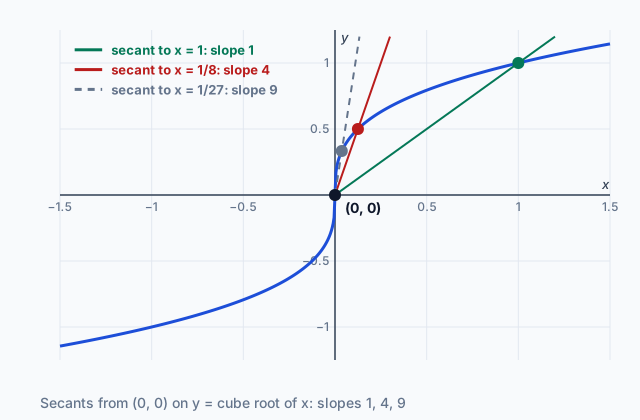 Tap to open the picture full size
Part 1 Think first How steep is a sharp ridge at its top?
Guess before you learn. A wrong guess still makes the answer stick.
Predict first
A hiking trail climbs one side of a ridge in a straight line, rising 1 meter for every 4 meters it moves forward. At the sharp top it turns and runs straight down the other side, dropping 1 meter for every 2 meters forward. How steep is the trail at the exact top of the ridge?
In short. A function that is differentiable at a point is continuous there, but a function can be continuous at a point and still have no derivative there.
- If exists, then is continuous at , so a function with no value at , or a break there, has no derivative at .
- A derivative also fails to exist where the left-hand and right-hand limits of the difference quotient are different numbers.
- It fails, too, where is continuous and the difference quotient grows without bound the same way from both sides, a vertical tangent line, or in opposite ways, a cusp.
Part 2 Learn it Three short ideas, each checked as you go
2a. A derivative needs continuity
A function is differentiable at when exists, that is, when has a limit as .
That says something about itself. For every ,
As , the quotient approaches the number and approaches 0, so the right side approaches . Then approaches , which is what it means for to be continuous at .
If a function is differentiable at a point, then it is continuous at that point.
The useful way to turn it around: if is not continuous at , then does not exist. A jump or a vertical asymptote at settles the question at once.
The quotient also needs the number . So if is not in the domain of , then is not in the domain of either. For there is no , and so there is no .
The statement runs in one direction only. It does not say that a continuous function is differentiable.
Quick check · Multiple choice
No calculator. Let . Which statement about is true?
2b. Continuous, with a corner
Continuity is not enough for a derivative. Take at . It is continuous there: , and approaches 0 from both sides.
Now the difference quotient. Since , it is , which is 1 for every and for every . So
The left-hand and right-hand limits of the difference quotient are not equal, so the quotient has no limit and does not exist. The graph has a corner at the origin: slope coming in, slope 1 going out.
The same test works where two pieces of a piecewise function meet at :
- Check that is continuous at . If it is not, stop: does not exist.
- For , write with the piece to the left of . For , use the piece to the right. In both quotients, subtract the true value .
- Find both one-sided limits. If they are equal, is that number. If they differ, has a corner at and no derivative there.
Quick check · Calculate
No calculator. Let for and for , so is continuous at . What is ?
2c. Continuous, with a vertical tangent line
A continuous function can fail to have a derivative in a second way. Take at , the graph at the top of this lesson. It is continuous there.
For the difference quotient is . At , and it is 1, 4 and 9, the slopes of the three secant lines in the picture, and the same values come back for negative . As from either side the quotient grows without bound, so does not exist.
The secant lines get steeper and steeper, and the tangent line at the origin is vertical. A vertical line has no slope.
So far you have seen four ways a derivative at can fail to exist:
- is not continuous at , which includes not being in the domain of ;
- the left-hand and right-hand limits of the difference quotient are different numbers, a corner;
- is continuous at and the difference quotient grows without bound, going to infinity (or to negative infinity) from both sides, a vertical tangent line;
- the difference quotient heads to infinity from one side and to negative infinity from the other, a cusp, as for at 0.
Continuity at rules out only the first. That is the whole relationship: differentiable at guarantees continuous at , and continuous at guarantees nothing about .
Quick check · Sort it
No calculator. Each card is a statement about a function and an input . Tap a card, then whether the statement is true for every function or false for some function.
True for every function
False for some function
Part 3 Watch it done Where two pieces meet
Watch each step, then do the last one yourself.
Let for and for . Is differentiable at ? Justify your answer.
Step 1 · Continuity first
. From the left, , and from the right, . So , and is continuous at .
Why this step?
Why check continuity before working out any difference quotient?
A function that is differentiable at a point is continuous there. If were not continuous at 3, could not exist and the question would be over. Since it is continuous, the derivative might exist, and only the difference quotients can say.
Step 2 · The quotient from the left
For , , so . Then for , and .
Your step · Fill the statement
No calculator. Finish it. For , . Tap a blank, then tap an answer.
From the right, the limit of is . Compared with the limit from the left, this means at .
Part 4 Try it Two new functions
Try it · Calculate
No calculator. Let for and for , where is a constant. What value of makes differentiable at ?
Try it · Decide and justify
No calculator. Let . A classmate says exists, because is continuous at . Is the classmate right?
Which reason supports your answer?
Part 5 Explain it Write it the way the exam asks
Free response is handwritten on the exam, so work this on paper first. Nothing you type here leaves this page. Then compare with the model answer and score each point.
Free response is 50% of the exam score. This one is shaped like Question 5, from free-response Part B (calculator not permitted).
Free-response practice · Question 5 style
No calculator. A robot moves along a straight track. Its distance from the start of the track, in meters, seconds after it begins moving is given by for and for .
(a) Justify that is continuous at .
(b) Find and . Show the work that leads to your answers, and give units.
(c) Does exist? Justify your answer, and explain why your conclusion in part (a) does not by itself answer this question.
Model answer
(a) and , so . Also . The limit equals , so is continuous at .
(b) For , , so , and the left-hand limit is 3 meters per second. For , , so the quotient is , and the right-hand limit is 4 meters per second.
(c) No. The one-sided limits of the difference quotient at are 3 and 4, which are not equal, so the limit does not exist and does not exist. Part (a) does not settle it: a function differentiable at a point must be continuous there, but a continuous function can still fail to be differentiable. Here the robot moves at 3 meters per second just before , and its rate is close to 4 meters per second just after, so no single rate fits the instant .
Score your own answer. This is a self-check, not a grade. Tick each point your answer makes.
Part 6 Check yourself One function, four pieces
The two case questions use the same table. Answer them from it.
A function is defined for by four pieces. The table gives the rule for each interval of inputs.
| Inputs | |
|---|---|
Case question 1 · Calculate
No calculator. What is ?
Case question 2 · Multiple choice
No calculator. At which of the inputs , and is differentiable?
The rest stand on their own and do not use the case.
Check yourself · Spot the error
No calculator. Let for and for . A student tests whether exists. Tap the first line with a mistake.
Check yourself · Match
No calculator. Tap a function and an input, then what is true of the function there.
Part 7 Keep it Bring back earlier ideas
This lesson stands on the definition of the derivative as a limit of difference quotients, and on the definition of continuity. Pulling them back up is what makes them last.
From 2.1 Defining Average and Instantaneous Rates of Change at a Point · Spot the error
No calculator. A student finds for from the definition. Tap the first line with a mistake.
From 1.11 Defining Continuity at a Point · Multiple choice
No calculator. Let for and for . Which statement about at is true?
In three lines
- If a function is differentiable at a point, it is continuous there, and an input outside the domain of is outside the domain of .
- A continuous function can still have no derivative at a point, at a corner, a cusp or a vertical tangent line.
- To decide, check continuity first, then compare the left-hand and right-hand limits of the difference quotient.
Exam strategy for this topic
- Section I Part A, Multiple Choice (calculator not permitted): 29 questions in 62 minutes.
- Section I Part B, Multiple Choice (graphing calculator required): 13 questions in 38 minutes.
- Section II Part A, Free Response (graphing calculator required): 2 questions in 30 minutes.
- Section II Part B, Free Response (calculator not permitted): 4 questions in 60 minutes.
To justify that a derivative does not exist where a formula changes, show the limits rather than describe the picture: check continuity with the one-sided limits of , then write both one-sided limits of and say they are not equal. A sentence like "the graph has a corner" states the conclusion without the reason.
Questions students ask
If a function is continuous at a point, is it differentiable there?
Not necessarily. and are both continuous at 0, and neither has a derivative there: the first has a corner and the second a vertical tangent line.
Can a function be differentiable at a point where it is not continuous?
No. If exists, then , which is the difference quotient times , approaches , so is continuous at .
What is the difference between a corner, a cusp and a vertical tangent line?
At a corner the difference quotient approaches two different numbers from the two sides. At a vertical tangent line it grows without bound in the same direction from both sides, and at a cusp it goes to infinity on one side and to negative infinity on the other. In every case it has no limit, so the derivative does not exist.
Does a sharp point on a calculator graph prove there is no derivative?
No. A screen shows a picture, and in a window zoomed far out a smooth bend can look like a sharp point. The difference quotient from each side is what decides it.
If both pieces of a function have the same slope where they meet, is the function differentiable there?
Only if the pieces also meet at the same height. If they do not, the function jumps, is not continuous, and so has no derivative there.
Course alignment, for teachers
AP Calculus AB topic 2.4, Unit 2: Differentiation: Definition and Fundamental Properties.
- Skill 3.E: Provide reasons or rationales for solutions and conclusions.
This lesson maps all 2 essential knowledge statements of the topic to the part that teaches each one: 2 are checked by a scored question. The map is in the lesson file.