Unit 2 · Topic 2.5 · about 30 minutes · 7 parts · 11 scored checks, 3 of them multiple choice, plus 1 from earlier lessons
AP Calculus AB 2.5: Applying the Power Rule
Unit 2: 10 to 15% of the multiple-choice section
What you'll be able to do
- Calculate the derivative of for any constant , either from the definition of the derivative or with the power rule.
Key vocabulary
| Term | What it means | The exam trap |
|---|---|---|
| Definition of the derivative | The derivative of is the function whose value at is , provided this limit exists. | Expand completely before you subtract; a dropped middle term changes the answer. |
| Power rule | A rule that gives the derivative of a power of with a constant exponent in one step, without working the limit each time. | With a negative or fractional exponent, write the subtraction out with the number in it before you simplify. |
| Negative exponent | For , , so a reciprocal of a power of is a power with a negative exponent. | Rewrite a reciprocal as a power before you differentiate, not after. |
| Fractional exponent | An exponent that is a fraction, as in , which turns a root into a power of . | Check a rewrite by trying a number such as in both forms before you differentiate it. |
 Tap to open the picture full size
Part 1 Think first A garden plot that grows
Guess before you learn. A wrong guess still makes the answer stick.
Predict first
A square garden plot has sides meters long, so its area is square meters. Right now each side is 6 meters. If the sides start to lengthen, how fast is the area growing, in square meters per meter of side, at the moment each side is 6 meters?
In short. The power rule says that for any constant , the derivative of is at every where is defined, the same result the definition of the derivative gives.
- Rewrite roots and reciprocals as single powers of , such as and , before you differentiate.
- The exponent comes down in front and the new exponent is one less, for negative and fractional exponents as well as whole numbers.
- Expanding inside the definition of the derivative leads to the same pattern.
Part 2 Learn it From the definition to a rule you can use at once
2a. The definition, applied to a power of x
The definition of the derivative works on any function, so start with :
Expand first: . The cancels, which leaves on top. Every term there has a factor of , so for
As the last two terms go to 0, and . At that is 12. The difference quotients at 2 with , and are 12.61, 12.0601 and 12.006001, closing in on it.
The same work on gives . Look at the exponent both times. It came down in front as a factor, and the power dropped by one: became , and became .
Quick check · Put it in order
No calculator. Put the lines that find for from the definition of the derivative in order. Tap them in sequence.
2b. The power rule, for any constant exponent
That pattern holds for every constant exponent. It is the power rule: for any constant ,
In the other notation, .
For whole numbers it is quick: , and , the slope of the line .
Negative exponents work the same way once the function is written as a power. A reciprocal such as is , so
Watch the arithmetic in the exponent. is , one step further from zero, not . Write out with the number in it every time, because that is where this slip hides.
The check you just ordered fits the rule too. , and the power rule gives , the same answer the definition gave.
Quick check · Calculate
No calculator. Let . Find . Give an exact decimal.
2c. Roots are powers too
A root is a power with a fraction for its exponent: , and in general . Rewrite first, then use the same rule:
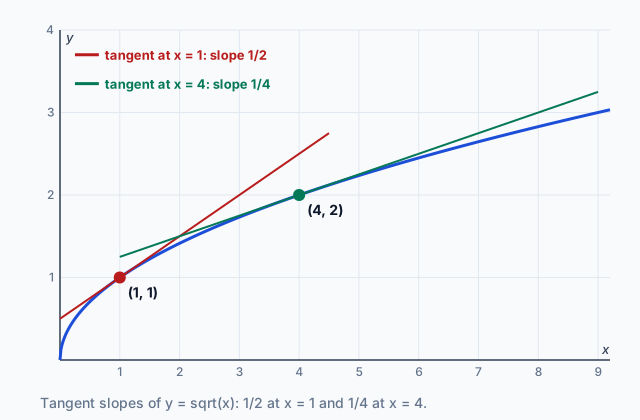
The graph at the top shows what that formula says. The tangent line to has slope at and at , so the graph keeps rising, more and more slowly.
For the rule gives , which at is .
Two habits keep this clean. The index of the root goes in the denominator of the exponent, so is . And a product or quotient of powers of becomes one power before you differentiate: , and .
The formula is not defined at , and has no derivative there: its difference quotient at 0, , grows without bound as . That is the rule's condition at work: is not defined at 0.
Quick check · Multiple choice
No calculator. Let . Which expression is ?
Part 3 Watch it done A product of powers, made into one power
Watch each step, then do the last one yourself.
Let . Find .
Step 1 · Rewrite as one power of x
. The power rule works on one power , so combine the factors first.
Why this step?
Why not find the derivatives of and and multiply them?
The derivative of a product is not the product of the derivatives. Here that would give , which is 1 at , while the difference quotient is about 2.502. Products get their own rule later in this unit; for now, make one power.
Step 2 · Apply the power rule
With , .
Your step · Calculate
No calculator. Finish it. For , the power rule gives . What is ?
Part 4 Try it A quotient, and a function the rule does not fit
Try it · Calculate
No calculator. Let . Find .
Try it · Decide and justify
No calculator. A classmate applies the power rule to and writes . Is the classmate right?
Which reason supports your answer?
Part 5 Explain it Write it the way the exam asks
Free response is handwritten on the exam, so work on paper first. Nothing you type here leaves this page. Then compare with the model answer and score each point.
Free response is 50% of the exam score. This one is shaped like Question 3, from free-response Part B (calculator not permitted).
Free-response practice · Question 3 style
No calculator. For an object orbiting the Sun, such as a planet or an asteroid, Kepler's third law gives its orbital period as approximately years, where is the object's average distance from the Sun in astronomical units (AU).
(a) Find .
(b) Find . Using correct units, interpret the meaning of in the context of the problem.
(c) Determine the average distance at which . Show the work that leads to your answer.
Model answer
(a) By the power rule with , .
(b) years per AU. At an average distance of 4 AU, the orbital period increases at a rate of 3 years per AU of average distance: an orbit slightly farther out has a longer period, by about 3 years for each extra AU.
(c) , so and AU.
Score your own answer. This is a self-check, not a grade. Tick each point your answer makes.
Part 6 Check yourself Cube-shaped boxes
The two case questions use the same boxes. Answer them from the formulas and the table.
A company makes cube-shaped storage boxes. A box whose edges are feet long holds cubic feet. The company also lists each box by its volume: a box that holds cubic feet has edges feet long. Some sizes are in the table.
| Edge (feet) | Volume (cubic feet) |
|---|---|
| 1 | 1 |
| 1.5 | 3.375 |
| 2 | 8 |
| 3 | 27 |
Case question 1 · Calculate
No calculator. Find , the rate at which a box's volume changes with respect to its edge length when the edge is 2 feet, in cubic feet per foot.
Case question 2 · Multiple choice
No calculator. Use the table to find the volume of the box whose edges are 2 feet long. What is at that volume, the rate at which a box's edge length changes with respect to its volume, in feet per cubic foot?
The rest stand on their own and do not use the case.
Check yourself · Spot the error
No calculator. A student finds for . Tap the first line with a mistake.
Check yourself · Fill the statement
No calculator. Tap a blank, then tap an answer.
For , the top of the difference quotient is . Dividing it by is allowed for , and it leaves . As , every term with an in it approaches , so is .
Part 7 Keep it Bring back earlier ideas
The power rule rests on two earlier ideas: a derivative needs continuity, and a limit of a quotient often needs rewriting first.
Bring it back · Multiple choice
No calculator. Which statement is true for every function and every number ?
From 1.6 Determining Limits Using Algebraic Manipulation · Calculate
No calculator. Find .
In three lines
- For any constant , the derivative of is wherever is defined, and the definition of the derivative gives the same result.
- Rewrite roots, reciprocals, products and quotients of powers of as one power before using the rule.
- The rule needs a constant exponent, and the new exponent is always one less, even when it is negative or a fraction.
Exam strategy for this topic
- Section I Part A, Multiple Choice (calculator not permitted): 29 questions in 62 minutes.
- Section I Part B, Multiple Choice (graphing calculator required): 13 questions in 38 minutes.
- Section II Part A, Free Response (graphing calculator required): 2 questions in 30 minutes.
- Section II Part B, Free Response (calculator not permitted): 4 questions in 60 minutes.
On a no-calculator question, rewrite each root or reciprocal as a power of on its own line before you differentiate, so whoever reads your work sees the exponent you used. Evaluate a power such as root first, as , to keep the numbers small.
Questions students ask
Does the power rule work for every exponent?
It works for every constant exponent: positive or negative, whole number or fraction. It does not apply when the exponent itself contains the variable.
Do I have to use the definition of the derivative, or can I use the power rule?
If a question tells you to use the definition, write the limit and work it out. Otherwise the power rule is faster, and it gives the same answer; the definition is where the rule comes from.
Why does the derivative of have a square root in the denominator?
Because the new exponent, , is negative, and . So .
Is the derivative of really 1?
Yes. , and the power rule gives . That matches the graph of , a line with slope 1 everywhere.
What about or ?
Those need the constant multiple and sum rules, which come in the next topic. They let you use the power rule on each term.
Course alignment, for teachers
AP Calculus AB topic 2.5, Unit 2: Differentiation: Definition and Fundamental Properties.
- Skill 1.E: Apply appropriate mathematical rules or procedures, with and without technology.
This lesson maps the one essential knowledge statement of the topic to the part that teaches each one: 1 is checked by a scored question. The map is in the lesson file.