Unit 2 · Topic 2.6 · about 30 minutes · 7 parts · 11 scored checks, 3 of them multiple choice, plus 1 from earlier lessons
AP Calculus AB 2.6: Derivative Rules: Constant, Sum, Difference, and Constant Multiple
Unit 2: 10 to 15% of the multiple-choice section
What you'll be able to do
- Find the derivative of a sum, a difference or a constant multiple of functions you know, including any polynomial, one term at a time.
Key vocabulary
| Term | What it means | The exam trap |
|---|---|---|
| Constant function | A function whose output is the same number at every input, such as . | A constant can be written with a symbol, such as or a letter the problem fixes, like ; read which letter is the variable before you differentiate. |
| Constant multiple | A function multiplied by a fixed number, such as , or , which is . | Rewrite a fraction before you differentiate it, so you can see which part is the fixed number and which part holds the variable. |
| Sum and difference of functions | Functions such as and , made by adding or subtracting the outputs of and at each input. | On a written answer, show which rule you used by writing the derivative in terms of and before you put in any numbers. |
| Polynomial function | A sum of constant multiples of whole-number powers of , such as . | Each coefficient carries its own sign: is , so the sign travels into that term's derivative. |
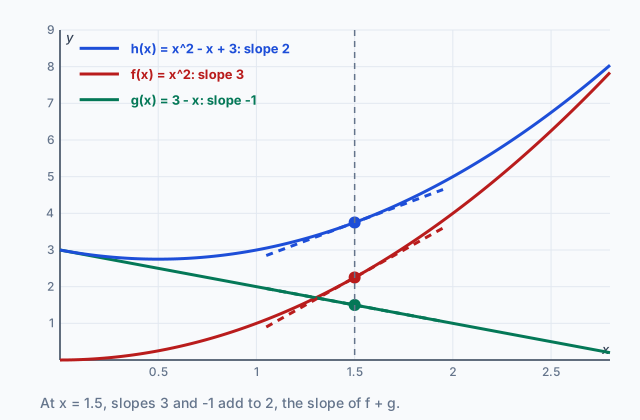 Tap to open the picture full size
Part 1 Think first Two scales, one afternoon
Guess before you learn. A wrong guess still makes the answer stick.
Predict first
A weather station measures temperature in degrees Celsius, and its display converts each reading to degrees Fahrenheit with . One afternoon the Celsius reading is rising at 2 degrees Celsius per hour. How fast is the Fahrenheit reading on the display rising?
In short. The constant, constant multiple, sum and difference rules let you differentiate a combination of functions one piece at a time, and with the power rule they give the derivative of any polynomial.
- and : a constant term drops out, and a constant factor stays.
- , so a sum or a difference is differentiated term by term.
- A polynomial is differentiated term by term with the power rule; a product of polynomials is multiplied out first.
Part 2 Learn it Three rules, each checked as you go
2a. Constants and constant multiples
A constant function has the same output at every input. Its graph is a horizontal line, and a horizontal line has slope 0 everywhere:
That is the constant rule. A constant term in a formula adds nothing to the derivative.
A constant multiple is a function times a fixed number, such as . Multiplying every output by 5 stretches the graph vertically by 5, and every slope stretches with it:
wherever is differentiable. The constant stays as a factor. You do not differentiate it, and you do not drop it. With the power rule:
- .
- is , so its derivative is .
- is , so its derivative is .
Rewrite before you differentiate. A number dividing the function is a constant multiple, and a power of in a denominator becomes a negative exponent. Neither one is a fraction you differentiate top and bottom.
Quick check · Match
No calculator. Tap a function, then its derivative.
2b. Sums and differences
The derivative of a sum is the sum of the derivatives, and the same goes for a difference:
$
Both hold at any where and are differentiable. Slopes add because rises add. Over a short step in , the rise of is the rise of plus the rise of . The graph at the top shows it at , where slopes 3 and make 2.
With constant multiples, these rules take any combination apart one piece at a time. Suppose and , and . Then
Keep a negative value in parentheses when you substitute it, as does here.
A minus sign in front of a group applies to every term in the group. In the group's derivative is , so the whole derivative is . Drop those parentheses too early and the comes out as .
Quick check · Calculate
No calculator. The functions and are differentiable, with , , and . Let . What is ?
2c. Any polynomial, term by term
A polynomial is a sum of constant multiples of whole-number powers of . The power rule and the constant multiple rule handle each term, and the sum and difference rules let you take the terms one at a time.
For ,
so . The term becomes 1, because and its derivative is . The constant term disappears.
To find the derivative at a point, differentiate first and substitute second: . Substituting first gives , a single number, and the derivative of a number is 0.
A polynomial does not always arrive as a sum. Multiply out a product such as before you use these rules. They split a derivative across sums, differences and constant multiples, and they say nothing about products.
Quick check · Multiple choice
No calculator. Let . Which expression is ?
Part 3 Watch it done A product of polynomials, multiplied out first
Watch each step, then do the last one yourself.
Let . Find , then .
Step 1 · Multiply out
.
Why this step?
Why multiply out first instead of differentiating each factor?
No rule from this lesson splits a derivative across a product. Differentiating the factors and multiplying gives , which is a different function from the true derivative. Written as a sum of powers, is a polynomial, and the sum, difference and constant multiple rules apply to it term by term.
Step 2 · Differentiate term by term
.
Step 3 · Simplify
.
Your step · Calculate
No calculator. Finish it. For , the derivative is . What is ?
Part 4 Try it Rewrite, then differentiate
Try it · Calculate
No calculator. Let for . What is ?
Try it · Decide and justify
No calculator. Let . One classmate says . Another says . Is the first classmate right?
Which reason supports your answer?
Part 5 Explain it Write it the way the exam asks
On the exam free response is handwritten, so work on paper first. Nothing you type here leaves this page. Then compare with the model answer and score each point.
Free response is 50% of the exam score. This one is shaped like Question 6, from free-response Part B (calculator not permitted).
Free-response practice · Question 6 style
No calculator. Water flows into and out of a storage tank. The amount of water in the tank, in gallons, hours after noon is modeled by for .
(a) Find . Show the derivative of each term.
(b) Find the value of . Using correct units, interpret the meaning of this value in the context of the problem.
(c) A second tank holds gallons of water at time , where is differentiable and . Let be the total amount of water in the two tanks. Find . Is the total amount of water in the two tanks increasing or decreasing at time ? Explain your reasoning.
Model answer
(a) , so .
(b) . At 4 p.m. (), the amount of water in the tank is increasing at a rate of 12 gallons per hour.
(c) By the sum rule, gallons per hour. Because , the total amount of water in the two tanks is increasing at time .
Score your own answer. This is a self-check, not a grade. Tick each point your answer makes.
Part 6 Check yourself Two functions from a table
The two case questions use the same table. Answer them from it.
The functions and are differentiable for all real numbers. The table gives values of each function and its derivative at three inputs.
| 1 | 4 | 3 | 5 | |
|---|---|---|---|---|
| 2 | 7 | 3 | 4 | |
| 3 | 6 | 0 |
Case question 1 · Calculate
No calculator. Let . What is the slope of the line tangent to the graph of at ?
Case question 2 · Multiple choice
No calculator. Let . What is ?
The rest stand on their own and do not use the case.
Check yourself · Spot the error
No calculator. A student finds for . Tap the first line with a mistake.
Check yourself · Fill the statement
No calculator. Tap a blank, then tap an answer.
Let , where is differentiable. Then is , because the derivative of the constant 10 is .
Part 7 Keep it Bring back earlier ideas
These rules rest on the power rule and on the limit theorems from Unit 1. Pulling them back up is what makes them last.
Bring it back · Multiple choice
No calculator. Let . Which expression is ?
From 1.5 Determining Limits Using Algebraic Properties of Limits · Calculate
No calculator. Suppose and . Find .
In three lines
- The derivative of a constant is 0, and a constant factor stays as a factor of the derivative.
- The derivative of a sum or a difference is the sum or the difference of the derivatives.
- With the power rule, these rules differentiate any polynomial term by term, once it is written as a sum.
Exam strategy for this topic
- Section I Part A, Multiple Choice (calculator not permitted): 29 questions in 62 minutes.
- Section I Part B, Multiple Choice (graphing calculator required): 13 questions in 38 minutes.
- Section II Part A, Free Response (graphing calculator required): 2 questions in 30 minutes.
- Section II Part B, Free Response (calculator not permitted): 4 questions in 60 minutes.
Show the structure before the numbers. For a function built from others, write its derivative in terms of and , as in , and only then substitute values from a table. For a polynomial, write the derivative as a function first and evaluate it at the point second.
Questions students ask
Why is the derivative of a constant 0?
A constant function has the same output everywhere, so its graph is a horizontal line. A horizontal line has slope 0 at every point, and the derivative is that slope.
Does the constant multiple rule work when the number is in the denominator?
Yes. is , so its derivative is . When the power of is in the denominator instead, as in , rewrite it as ; its derivative is .
Can I differentiate a product of two polynomials one factor at a time?
No. Multiply the product out into a sum of powers first, then differentiate term by term. A later topic in this unit gives the product rule, which handles a product without multiplying it out.
Do the sum and difference rules work for more than two functions?
Yes. Use them again and again: the derivative of is . That is why a polynomial with any number of terms can be differentiated one term at a time.
Do I have to write in front of every term?
No, but on a written answer it helps a reader follow your work. At the least, write the derivative as a function, or in terms of and , before you substitute any numbers.
Course alignment, for teachers
AP Calculus AB topic 2.6, Unit 2: Differentiation: Definition and Fundamental Properties.
- Skill 1.E: Apply appropriate mathematical rules or procedures, with and without technology.
This lesson maps all 2 essential knowledge statements of the topic to the part that teaches each one: 2 are checked by a scored question. The map is in the lesson file.