Unit 2 · Topic 2.7 · about 30 minutes · 7 parts · 12 scored checks, 3 of them multiple choice, plus 1 from earlier lessons
AP Calculus AB 2.7: Derivatives of cos x, sin x, eˣ, and ln x
Unit 2: 10 to 15% of the multiple-choice section
What you'll be able to do
- Find derivatives of , , and , and of sums and constant multiples of them, with the rule for each.
- Evaluate a limit by recognizing it as the definition of the derivative of a function whose derivative you know.
Key vocabulary
| Term | What it means | The exam trap |
|---|---|---|
| Radian measure | Angle measure in which one full turn is , so one radian is degrees, about 57.3 degrees. | radians is a half turn, 180 degrees, so read as the cosine of a half turn, not of about 3 degrees. |
| Natural exponential function, | The exponential function whose base is the number . | Do not confuse , a fixed base with a variable exponent, with , a variable base with a fixed exponent. |
| Natural logarithm, | The logarithm with base , defined only for . | has no value at or below, so neither does its derivative; check the domain before you evaluate. |
| Definition of the derivative | , or equally , when the limit exists. | A limit with this shape may write as a plain number, so ask whether the number on top is a value of the function. |
 Tap to open the picture full size
Part 1 Think first How fast is the buoy moving?
Guess before you learn. A wrong guess still makes the answer stick.
Predict first
A buoy rides up and down on ocean swells. Its height above its resting level, in meters, seconds into the motion is . Over the short interval from to , its average rate of change is 1.000 meter per second at , about 0 at , at and 0.540 at . Which function of gives the buoy's rate of change at each instant?
In short. Sine, cosine, the exponential function and the natural logarithm each have a derivative rule of their own, and a limit shaped like the definition of the derivative can be evaluated with those rules.
- The rules for and hold only with in radians, and the derivative of cosine carries a minus sign.
- is its own derivative, and , defined for , has derivative .
- A limit shaped like for a function you can differentiate equals .
Part 2 Learn it Three short ideas, each checked as you go
7a. Sine and cosine, in radians
In Think first, the buoy's average rates matched at every input tried. That pattern holds at every :
The minus sign belongs to the cosine rule, and you can see why. The graph of is at its highest value, 1, at , so just to the right of 0 it is falling and its slope is negative. is negative for small positive , so the sign fits.
Both rules assume is measured in radians. They rest on the limit , which is true only in radians. On a calculator in degree mode, the slope of at comes out near 0.0175, not 1, because one degree is only of a radian. Every angle in this course is in radians, so keep the calculator in radian mode.
The rules from 2.6 still apply: a constant multiple comes along, and a sum is differentiated term by term. For example,
Quick check · Match
No calculator. Tap a function, then its derivative.
7b. The exponential and the natural logarithm
The number is the base that makes an exponential function its own derivative:
At every point of , the slope equals the height. At both are 1, and at both are .
Do not reach for the power rule here. It is for , a variable raised to a fixed number. In the base is fixed and the variable is the exponent, so is not its derivative.
The natural logarithm is the logarithm with base . It is defined only for , and there
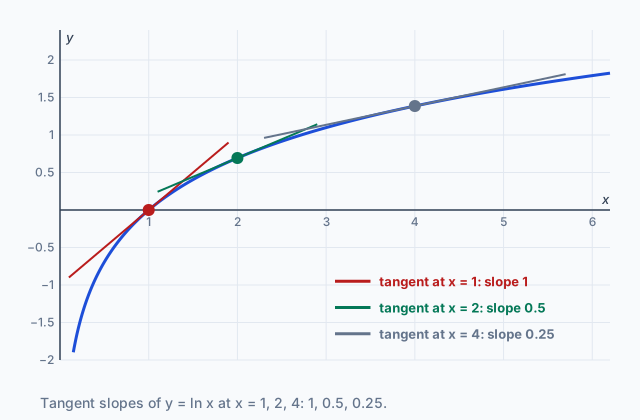
The graph at the top shows it: the tangent lines to at , 2 and 4 have slopes 1, 0.5 and 0.25.
With the rules from 2.6, has , so .
Differentiate first, then substitute. , but the slope of at is 1, not 0. A term whose value is 0 at a point can still be changing there.
Quick check · Multiple choice
No calculator. Let . What is ?
7c. Limits that are derivatives in disguise
The definition of the derivative from 2.1 says
This holds provided the limit exists.
Read it backward and it evaluates limits. Take . Substituting gives , which settles nothing. But the expression has exactly the shape of the definition, with and . So the limit is , and the rule gives , with no algebra at all.
Sometimes is written as a plain number, and you have to recognize it. In
the top is , and . So this is , the derivative of at , which is .
To spot one, look for the same function at two inputs on top, one of them the fixed point , and the difference of those two inputs underneath. Then the limit is the value of a derivative you already know.
Quick check · Fill the statement
No calculator. Tap a blank, then tap an answer.
The limit is for the function at the point , so the limit equals .
Part 3 Watch it done A limit that is a derivative
Watch each step, then do the last one yourself.
Evaluate .
Step 1 · Name the number on top
, so the top is .
Why this step?
Why rewrite as ?
The definition needs the same function at two inputs on top, . As a bare number, hides that the second term is the sine at , the same point that appears in the first term.
Step 2 · Match the definition
The limit is with and , so it equals .
Step 3 · Differentiate by the rule
, so the limit is .
Your step · Calculate
No calculator. Finish it. The limit equals . What is its value? Give an exact decimal.
Part 4 Try it New functions, both ideas
Try it · Sort it
No calculator. Tap a function, then the sign of its derivative at .
Positive
Zero
Negative
Try it · Multiple choice
No calculator. What is ?
Part 5 Explain it Write it the way the exam asks
On the exam free response is handwritten, so work on paper first, with your graphing calculator in radian mode. Nothing you type here leaves this page. Then compare with the model answer and score each point.
Free response is 50% of the exam score. This one is shaped like Question 1, from free-response Part A (graphing calculator required).
Free-response practice · Question 1 style
Graphing calculator required. The depth of the water at the end of a dock, in feet, is modeled by , where is measured in hours after midnight and . Your calculator is in radian mode. Give each decimal answer to three decimal places.
(a) Find .
(b) Find the value of . Using correct units, interpret the meaning of this value in the context of the problem.
(c) Find all times , for , at which the depth of the water is increasing at a rate of 1 foot per hour. Show the equation you solve.
Model answer
(a) .
(b) The limit is the definition of the derivative of at , so it equals . At , 5 a.m., the depth of the water is increasing at a rate of 0.767 feet per hour.
(c) The depth is increasing at 1 foot per hour where , so solve on the calculator for . The solutions are and hours after midnight (truncated, 1.421 and 5.126).
Score your own answer. This is a self-check, not a grade. Tick each point your answer makes.
Part 6 Check yourself A ride on a Ferris wheel
The three case questions use the same model and table. Answer them from it.
A car on a Ferris wheel passes its lowest point at . Its height above the ground, in meters, minutes later is . Some values are in the table.
| (minutes) | (meters) |
|---|---|
| 2 | |
| 12 | |
| 22 | |
| 12 |
Case question 1 · Calculate
No calculator. Find , the rate at which the car's height is changing at , in meters per minute.
Case question 2 · Multiple choice
No calculator. Which statement describes the car at minutes?
Case question 3 · Calculate
No calculator. Use the table. What is ?
The rest stand on their own and do not use the case.
Check yourself · Spot the error
No calculator. A student finds for . Tap the first line with a mistake.
Check yourself · Decide and justify
No calculator. A classmate's calculator is in degree mode. It estimates the derivative of at as 0.017453. The classmate says the rule must be wrong, because . Is the classmate right?
Which reason supports your answer?
Part 7 Keep it Bring back earlier ideas
Every rule in this lesson combines with the rules of 2.6, and the sine and cosine rules rest on a limit that the squeeze theorem of Unit 1 settles. Pulling them back up is what makes them last.
Bring it back · Calculate
No calculator. Let . Find .
From 1.8 Determining Limits Using the Squeeze Theorem · Calculate
No calculator. For every , the function satisfies . Find .
In three lines
- With in radians, and .
- , and for ; differentiate before you substitute.
- A limit shaped like the definition of for a known is evaluated by finding with a rule.
Exam strategy for this topic
- Section I Part A, Multiple Choice (calculator not permitted): 29 questions in 62 minutes.
- Section I Part B, Multiple Choice (graphing calculator required): 13 questions in 38 minutes.
- Section II Part A, Free Response (graphing calculator required): 2 questions in 30 minutes.
- Section II Part B, Free Response (calculator not permitted): 4 questions in 60 minutes.
Write the derivative you found by the rules, such as , before you substitute or use the calculator, so a reader sees the rule and not only the number. Set the calculator to radian mode before any trigonometric work. When a limit has the shape of the definition of the derivative, say which function and which point it is the derivative of before you give its value.
Questions students ask
Why do the sine and cosine rules need radians?
They come from , which holds when is in radians. Measured in degrees, the same limit is , and every slope of sine and cosine picks up that factor.
Why can't I use the power rule on ?
The power rule is for a variable raised to a fixed number, such as . In the base is the fixed number and the variable is the exponent, a different kind of function with its own rule: is its own derivative.
What is the derivative of at or at negative ?
There is none. is defined only for , and a function has no derivative where it has no value. The rule is for .
How do I know a limit is a derivative in disguise?
Look for one function evaluated at two inputs on top, one of them a fixed point , with the difference of those inputs underneath and the limit taken as they come together. A plain number on top may be in disguise, as is .
Does the minus sign go with the derivative of sine or of cosine?
Cosine: . To check, picture the cosine graph just to the right of 0, where it falls from its highest value. A falling graph has a negative slope.
Course alignment, for teachers
AP Calculus AB topic 2.7, Unit 2: Differentiation: Definition and Fundamental Properties.
- Skill 1.E: Apply appropriate mathematical rules or procedures, with and without technology.
This lesson maps all 2 essential knowledge statements of the topic to the part that teaches each one: 2 are checked by a scored question. The map is in the lesson file.