Unit 2 · Topic 2.8 · about 30 minutes · 7 parts · 11 scored checks, 3 of them multiple choice, plus 1 from earlier lessons
AP Calculus AB 2.8: The Product Rule
Unit 2: 10 to 15% of the multiple-choice section
What you'll be able to do
- Find the derivative of a product of two differentiable functions with the product rule, as a formula or as a value at one input.
Key vocabulary
| Term | What it means | The exam trap |
|---|---|---|
| Product rule | If and are differentiable, the derivative of is . | Count the derivatives in each term of your answer: every term should have exactly one. |
| Differentiable function | A function whose derivative exists at each input being considered. | The product rule is stated for differentiable factors, so check that each factor has a derivative at the input you need. |
| Product of functions | The function with , whose output at each input is the output of times the output of . | The value and the rate are different numbers; a question about change wants the rate. |
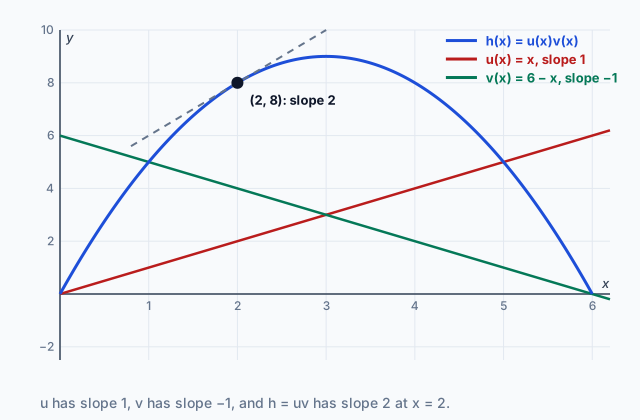 Tap to open the picture full size
Part 1 Think first How fast is the pen growing?
Make a guess first. Committing to an answer, even a wrong one, makes the explanation stick.
Predict first
A rancher is moving the fences of a rectangular pen outward at steady speeds. The length grows by 2 meters per minute and the width by 1 meter per minute. At the moment the pen is 10 meters long and 6 meters wide, how fast is its area growing?
In short. The product rule says that if and are differentiable, the derivative of is .
- The derivative of a product is not the product of the derivatives: each of the two terms differentiates one factor and keeps the other as it is.
- At one input the structure is the same, , and it is written before any numbers go in.
- When one factor is a constant, the constant multiple rule is enough.
Part 2 Learn it Three short ideas, each checked as you go
8a. The product rule
In the pen, the area grew from two edges at once. The extra length added a strip as wide as the pen, and the extra width added a strip as long as the pen. Multiplying the two rates, 2 times 1, misses both strips.
The same thing happens with any product. Take , which is , so its derivative is . Multiplying the two derivatives gives , a different function. The derivative of a product is not the product of the derivatives.
The product rule gives the right answer. If and are differentiable and , then
Each term differentiates one factor and leaves the other alone. For that is , which matches.
You need the rule only when both factors change with . In or , one factor is a constant, and the constant multiple rule is enough. The product rule would give the same answer there, because the derivative of a constant is 0.
Quick check · Calculate
No calculator. Let . What is ?
8b. Products with , , and
A product of polynomials, such as , can be multiplied out, so there the product rule is a shortcut. A product such as cannot be multiplied out, and the product rule is the way in.
Name the factors, differentiate each with the rules you already have, then put the two terms together:
For , the derivative of the second factor is , and its minus sign stays inside its own term:
Keep a factor with more than one term in parentheses when you put it into the rule. For , the second term is . Written as , only the 4 is multiplied, and the result is a different function.
Addition does not care about order, so is the same derivative. What matters is that each term has exactly one derivative in it.
Quick check · Multiple choice
No calculator. Let . Which expression is ?
8c. The product rule at one input
Sometimes you are not given formulas for and at all, only their values at one input. The rule works one input at a time. If , then
Write this structure first, with the function names, and only then put in the numbers. Free-response answers are expected to show it.
Suppose , , and . Then
Do not find first and differentiate that. is a single number, its derivative is 0, and that says nothing about how is changing.
A function you know can be one of the factors. For , the first factor is , which is its own derivative, so .
Quick check · Fill the statement
No calculator. Tap a blank, then tap an answer.
Let , where , , and . By the product rule, is times , plus times . With these values, is .
Part 3 Watch it done The product rule at a point
Watch each step, then do the last one yourself.
Let . Find .
Step 1 · Name the factors
and , so .
Step 2 · Differentiate each factor
and .
Step 3 · Write the structure
.
Why this step?
Why not just multiply by ?
The derivative of a product is not the product of the derivatives. Each factor's change counts in proportion to the size of the other factor, so has two terms, and each term has one derivative in it.
Step 4 · Find the four values
, , and .
Your step · Calculate
No calculator. Finish it. For , with , , and , what is ? Give an exact decimal.
Part 4 Try it A new function and a new context
Try it · Calculate
No calculator. Let . What is the value of at ?
Try it · Decide and justify
No calculator. A grain elevator holds thousand bushels of wheat days after harvest, and wheat sells for dollars per bushel, so the wheat is worth thousand dollars. At , , , and . Is the value of the wheat increasing or decreasing at ?
Which reason supports your answer?
Part 5 Explain it Answer it as a free-response question
Free response is written by hand on the exam, so answer on paper first. Nothing you type here leaves this page. Then open the model answer and score yourself point by point.
Free response is 50% of the exam score. This one is shaped like Question 4, from free-response Part B (calculator not permitted).
Free-response practice · Question 4 style
No calculator. A city has thousand residents, and each resident uses an average of gallons of water per day, where is measured in years since the start of 2020. The city's total water use is thousand gallons per day. The functions and are differentiable, and selected values are given in the table. is in thousand residents per year, and is in gallons per resident per day, per year.
(a) Find . Show the work that leads to your answer.
(b) Using correct units, interpret the meaning of in the context of the problem.
(c) Is the city's total water use increasing or decreasing at time ? Give a reason for your answer.
Model answer
(a) .
(b) At the start of 2022, the city's total water use is increasing at a rate of 118 thousand gallons per day per year.
(c) . Since , the city's total water use is decreasing at , even though its population is still growing.
Score your own answer. This is a self-check, not a grade. Tick each point your answer makes.
Part 6 Check yourself Two functions in a table
The two case questions use the same table. Answer them from it.
The functions and are differentiable for all real numbers. The table gives values of , and their derivatives at three inputs.
| 1 | 3 | 4 | 1 | |
|---|---|---|---|---|
| 2 | 5 | 3 | ||
| 3 | 1 | 4 | 3 |
Case question 1 · Calculate
No calculator. Let . What is ?
Case question 2 · Multiple choice
No calculator. Let . What is ?
The rest stand on their own and do not use the case.
Check yourself · Spot the error
No calculator. A student finds the derivative of . Tap the first line with a mistake.
Check yourself · Sort it
No calculator. Decide what each derivative needs. Tap a function, then a bin.
Both factors change with x: product rule
One factor is a constant: constant multiple rule
Part 7 Keep it Bring back earlier ideas
The product rule is built from derivatives you already know. Recalling them now keeps them ready.
Bring it back · Multiple choice
No calculator. Let . What is ?
From 2.1 Defining Average and Instantaneous Rates of Change at a Point · Calculate
No calculator. Let . What is the value of when ? Give an exact decimal.
In three lines
- The derivative of is , not .
- At one input, write before putting in the values.
- Keep each factor in parentheses, and use the constant multiple rule when one factor is a constant.
Exam strategy for this topic
- Section I Part A, Multiple Choice (calculator not permitted): 29 questions in 62 minutes.
- Section I Part B, Multiple Choice (graphing calculator required): 13 questions in 38 minutes.
- Section II Part A, Free Response (graphing calculator required): 2 questions in 30 minutes.
- Section II Part B, Free Response (calculator not permitted): 4 questions in 60 minutes.
When a question asks for the derivative of a product at one input, write the structure with the function names first, such as , and then substitute. Free-response answers are expected to show that structure, so a correct number on its own is not the whole answer. In a context, give the units of the rate.
Questions students ask
Can I multiply the factors out instead of using the product rule?
Yes, when you can, and both ways give the same derivative. For , multiplying out gives , whose derivative is , and the product rule gives , the same thing. A product such as cannot be multiplied out, so there you need the rule.
Does the order of the two terms matter?
No. Addition does not depend on order, so is the same derivative. The quotient rule in the next topic subtracts, and there the order does matter.
What if there are three factors?
Treat two of them as one factor and use the product rule twice. For that gives : each term differentiates one factor and keeps the other two.
Why isn't the derivative of a product just the product of the derivatives?
Test it on , which is with derivative . The product of the derivatives is , which is wrong for every except . The product rule gives .
Course alignment, for teachers
AP Calculus AB topic 2.8, Unit 2: Differentiation: Definition and Fundamental Properties.
- Skill 1.E: Apply appropriate mathematical rules or procedures, with and without technology.
This lesson maps the one essential knowledge statement of the topic to the part that teaches each one: 1 is checked by a scored question. The map is in the lesson file.