Unit 3 · Topic 3.2 · about 30 minutes · 7 parts · 12 scored checks, 3 of them multiple choice, plus 1 from earlier lessons
AP Calculus AB 3.2: Implicit Differentiation
Unit 3: 5 to 10% of the multiple-choice section
What you'll be able to do
- Find for a function defined implicitly by an equation in and , using the chain rule on every term that contains , and evaluate it at a point of the curve.
Key vocabulary
| Term | What it means | The exam trap |
|---|---|---|
| Implicitly defined function | A function of given by an equation in and , such as , instead of by a formula . | You do not need to solve the equation for before you differentiate it, and often you could not. |
| Implicit differentiation | Differentiating both sides of an equation in and with respect to , treating as a differentiable function of , and then solving for . | Differentiate both sides, including a side that is a constant, whose derivative is 0. |
| Chain rule | The rule : the derivative of the outer function at the inside, times the derivative of the inside. | Before you differentiate a term, name its inside function, then multiply by that inside's derivative. |
| Derivative | The derivative of with respect to , also written . | When you solve for it, treat it as one unknown: get its terms together, factor it out, then divide. |
 Tap to open the picture full size
Part 1 Think first The slope of a circle at one point
Make a guess first. Committing to an answer, even a wrong one, helps the lesson stick.
Predict first
A round pond is drawn on a map with its center at the origin, and its edge is the circle , in meters. A bench sits on the edge at . What is the slope of the line tangent to the edge at the bench?
In short. Implicit differentiation finds from an equation in and by differentiating both sides with respect to , treating as a function of , so the chain rule applies to every term that contains .
- By the chain rule, , and a product such as also needs the product rule.
- After differentiating, collect the terms with on one side, factor it out and divide.
- The result can contain both and , so its value at a point uses both coordinates.
Part 2 Learn it Three steps to an implicit derivative
3a. Every y term gets the chain rule
An equation such as ties to without ever saying . Near most points of its graph, though, behaves as a function of : on the top half of that circle . A function given this way, inside an equation instead of by a formula for , is implicitly defined.
To differentiate such an equation, treat as a differentiable function of that you never write out. Then a term like is a composition: cubing is the outer function and is the inside. The chain rule gives
The factor is the derivative of the inside. Any function of works the same way: and . Even on its own has derivative .
A term with only in it differentiates as it always has, , with no extra factor. The chain rule is still there in principle, but the inside is , and the derivative of with respect to is 1.
Quick check · Sort it
No calculator. Here is a differentiable function of . Sort each expression by its derivative with respect to . Tap an expression, then a bin.
Its derivative has a dy/dx factor
Its derivative has no dy/dx factor
3b. Differentiate both sides, then solve
To find from an equation, differentiate both sides with respect to , then solve the result for .
Take . The term is a constant times a product of two functions of , namely and . So it needs the product rule, and the chain rule turns the derivative of into :
The right side, 8, is a constant, so its derivative is 0. Altogether,
Now solve, as you would for any unknown. Move the term without to the other side, factor out of what is left, and divide:
The answer has in it as well as . That is normal for implicit differentiation, and it is why you never needed a formula for .
Quick check · Multiple choice
No calculator. The equation defines as a differentiable function of . Which expression is ?
3c. A slope at a point needs both coordinates
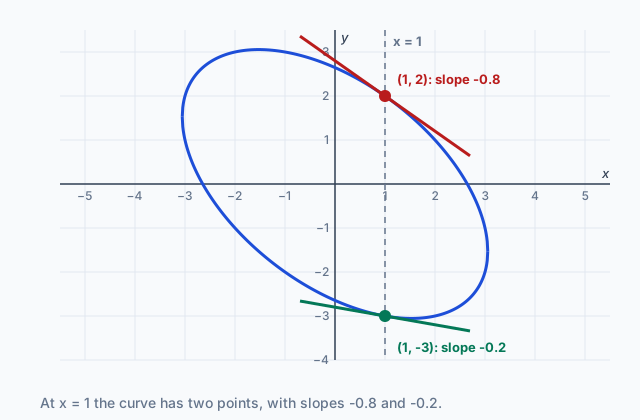
Because usually contains both and , its value at a point needs both coordinates, and a value of alone may not be enough. On the graph at the top, the line meets the curve twice, at and . Implicit differentiation gives , which is at the first point and at the second. Same , different slopes.
So to find the slope of a curve at a point:
- Check that the point is on the curve, by putting both coordinates into the equation.
- Put both coordinates into .
For , the point is on the curve, since . There , the slope of the line tangent to the curve at .
The formula gives a slope only where its denominator is not 0, and only where is a differentiable function of near the point. Every point in this lesson's questions is one where both hold.
Quick check · Calculate
No calculator. The point lies on the curve . What is the slope of the curve at ?
Part 3 Watch it done The slope of a curve, start to finish
Watch each step, then do the last one yourself.
The curve passes through the point . Find , and then the slope of the curve at .
Step 1 · Check the point
, so is on the curve.
Step 2 · Differentiate both sides
, which gives .
Why this step?
Why does need the product rule, and why does each term pick up a factor of ?
is a product of two functions of , and , so it takes the product rule. Each derivative of a term is a chain rule derivative with as the inside function, and the derivative of that inside is .
Step 3 · Collect and factor
Move to the right side and factor: .
Step 4 · Solve
.
Your step · Calculate
No calculator. Finish it. For the curve , . What is the slope of the curve at ? Give an exact decimal.
Part 4 Try it Two new curves
Try it · Calculate
No calculator. The point lies on the curve . What is the value of at ?
Try it · Decide and justify
No calculator. For the curve , implicit differentiation gives . A classmate says the curve has slope 2 wherever . Is the classmate right?
Which reason supports your answer?
Part 5 Explain it Write it the way the exam asks
Free response is handwritten on the exam, so work on paper first. Nothing you type here leaves this page. Then compare with the model answer and score each point.
Free response is 50% of the exam score. This one is shaped like Question 5, from free-response Part B (calculator not permitted).
Free-response practice · Question 5 style
No calculator. On a map of a state park, a hiking trail follows the curve , where and are measured in kilometers east and north of the ranger station. Along the trail, is a differentiable function of .
(a) Show that .
(b) The point is on the trail. Write an equation for the line tangent to the trail at .
(c) The trail passes through exactly one point with . Find the -coordinate of that point and the value of there. Using correct units, interpret the meaning of that value in the context of the problem.
Model answer
(a) Differentiate both sides with respect to : . Then , so .
(b) At , . The tangent line is .
(c) With the equation is , and satisfies it, since . There . At the point , the trail's distance north of the ranger station is decreasing at a rate of kilometer per kilometer the trail moves east.
Score your own answer. This is a self-check, not a grade. Tick each point your answer makes.
Part 6 Check yourself One curve, several points
The first two questions use the curve and the table. Answer them from it.
A curve is given by . Near each point in the table, is a differentiable function of . The last column shows that each point satisfies the equation.
| 7 | 3 | 6 |
|---|---|---|
| 7 | -1 | 6 |
| 7 | -2 | 6 |
| -5 | 1 | 6 |
| 1 | 2 | 6 |
Case question 1 · Calculate
No calculator. What is the slope of the curve at the point ? Give an exact decimal.
Case question 2 · Match
No calculator. Use the curve and the table. Tap a point, then the slope of the curve there.
The rest stand on their own and do not use the case.
Check yourself · Spot the error
No calculator. A student finds for the curve . Tap the first line with a mistake.
Check yourself · Fill the statement
No calculator. Tap a blank, then tap an answer.
In , the term is a product of two functions of , so differentiating it takes the rule. After both sides are differentiated, the terms with go on one side, and is out before dividing.
Check yourself · Multiple choice
No calculator. Here is a differentiable function of . Which expression is ?
Part 7 Keep it Bring back earlier ideas
Implicit differentiation runs on the chain rule and the product rule. These two questions bring them back.
Bring it back · Multiple choice
No calculator. Let . Which expression is ?
From 2.8 The Product Rule · Calculate
No calculator. Let . What is ?
In three lines
- Treat as a function of , so every term with in it gets a factor of from the chain rule.
- Differentiate both sides of the equation, collect the terms, factor and divide.
- Evaluate at a point with both of its coordinates, after checking the point is on the curve.
Exam strategy for this topic
- Section I Part A, Multiple Choice (calculator not permitted): 29 questions in 62 minutes.
- Section I Part B, Multiple Choice (graphing calculator required): 13 questions in 38 minutes.
- Section II Part A, Free Response (graphing calculator required): 2 questions in 30 minutes.
- Section II Part B, Free Response (calculator not permitted): 4 questions in 60 minutes.
When a question asks for from an equation in and , write the line where you differentiate both sides before you solve, so each chain rule factor and each product rule term can be seen. For a slope at a point, show the substitution of both coordinates before the number.
Questions students ask
Do I have to solve the equation for first?
No. Implicit differentiation works on the equation as it stands. Solving for is often impractical, as with the cubic , and sometimes impossible with the functions you know, as with . Where it is possible, as with a circle, it splits the curve into pieces and gives the same slopes.
Why is the derivative of not just ?
Because you are differentiating with respect to , and changes with . is a composition with inside, so the chain rule multiplies by . The derivative is only with respect to .
Is it wrong for my answer to have in it?
No. An implicit derivative usually depends on both and . To get a number, put in both coordinates of a point on the curve.
Is the same as ?
Yes. Both name the derivative of with respect to . Use one of them consistently in a solution.
What if the denominator of is 0 at a point?
Then the formula gives no value there, so you cannot read a slope from it at that point. Every slope you report should come from a point where the denominator is not 0.
Course alignment, for teachers
AP Calculus AB topic 3.2, Unit 3: Differentiation: Composite, Implicit, and Inverse Functions.
- Skill 1.E: Apply appropriate mathematical rules or procedures, with and without technology.
This lesson maps the one essential knowledge statement of the topic to the part that teaches each one: 1 is checked by a scored question. The map is in the lesson file.