Unit 3 · Topic 3.3 · about 30 minutes · 7 parts · 12 scored checks, 3 of them multiple choice
AP Calculus AB 3.3: Differentiating Inverse Functions
Unit 3: 5 to 10% of the multiple-choice section
What you'll be able to do
- Calculate the derivative of an inverse function, at a point or as an expression, from the chain rule and the definition of an inverse, and recognize where that derivative does not exist.
Key vocabulary
| Term | What it means | The exam trap |
|---|---|---|
| Inverse function, | The function that reverses : exactly when , so for every in the domain of . | Read the in as the name of the inverse, never as an exponent. |
| Chain rule | The rule for differentiating a composition: the derivative of is . | It applies to every composition, including one whose inner function is an inverse with no formula. |
| Derivative of an inverse function | For the inverse of a differentiable function , the rate of change , provided the derivative exists. | The rule involves two different inputs, one for and one for ; decide which number goes where before you substitute. |
 Tap to open the picture full size
Part 1 Think first Minutes per kilometer from kilometers per minute
Guess before you learn. A wrong guess still makes the answer stick.
Predict first
Twelve minutes into a ride, a cyclist has covered 5 kilometers and is riding at 0.4 kilometer per minute. Her bike computer can also show the time on the clock as a function of the distance covered. At the 5 kilometer mark, how fast is that time changing, in minutes per kilometer?
In short. If is the inverse of a differentiable function , applying the chain rule to gives , provided the derivative of exists.
- Differentiating both sides of gives , and no formula for is needed.
- At a point, if , then , and the input comes from solving .
- Where , the inverse has a vertical tangent at and no derivative there.
Part 2 Learn it Three short ideas, each checked as you go
3a. Differentiate the equation that defines an inverse
Suppose has an inverse function , so . By the definition of an inverse, undoes and undoes :
for every in the domain of .
Both sides are functions of , so their derivatives are equal. The left side is a composition, so it takes the chain rule: the outer derivative evaluated at the inner function, times the inner derivative. The right side has derivative 1.
Provided the derivative of exists, divide by :
You never needed a formula for . That matters, because a function such as has an inverse whose formula is far too messy to use, and its derivative is still within reach.
You can confirm the rule on a pair you already know. The natural logarithm is the inverse of , so take and . Then , and the rule gives , the derivative of you learned before.
Quick check · Fill the statement
No calculator. Tap a blank, then tap an answer.
Let be the inverse function of , so . By the chain rule, the derivative of the left side is times . The derivative of the right side is . So, provided the derivative of exists, is .
3b. At a point, the input and the output trade places
Most questions ask for the derivative of an inverse at one number. Say . Then , because sends back to . Put into the rule:
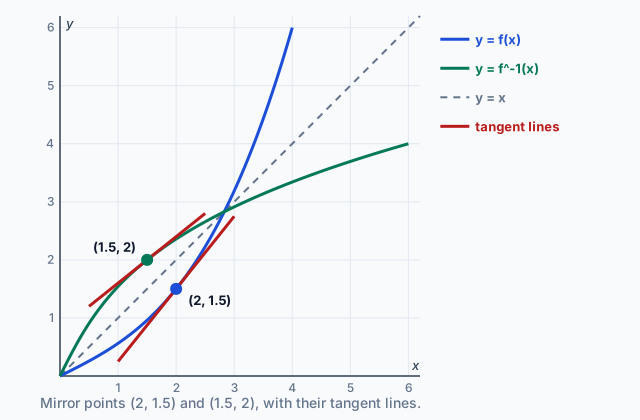
So the slope of at is 1 over the slope of at . On the graph at the top, the point on and the point on its inverse are mirror images across , and so are their tangent lines. The tangent to at has slope 1.25, and the tangent to the inverse at has slope 0.8, which is . Reflecting swaps rise and run, which is why one slope is 1 over the other.
The real work is finding . You are handed , an output of , so solve .
Take and find . Solve : works, since . Then , so and .
Notice what was never computed: . That is the slope of where its input is 10, a different point of the graph, far from .
Quick check · Calculate
No calculator. Let , and let be the inverse function of . Find . Give an exact decimal.
3c. Where the inverse has no derivative
The rule divides by , so it says nothing where . In fact the inverse has no derivative there. If existed, the chain rule step would give , and 0 times any number is 0, never 1.
The graph shows the same thing. Where has a horizontal tangent at , its mirror image across has a vertical tangent at , and a vertical line has no slope.
Take . It is increasing, so it has an inverse, . But , so has no derivative at : its graph stands straight up at the origin. At every other input is positive, and exists.
That is what the condition "provided the derivative exists" protects you from. Before you divide, check the slope you are dividing by. For a differentiable function with an inverse, the derivative of the inverse at exists exactly when , where .
Quick check · Decide and justify
No calculator. Let . Then , is increasing, and , so has an inverse function with . A classmate says . Is the classmate right?
Which reason supports your answer?
Part 3 Watch it done The derivative of an inverse with no formula
Watch each step, then do the last one yourself.
Let . The function is increasing, so it has an inverse function . Find .
Step 1 · Check the slope you will divide by
, which is at least 5 for every . So is never 0, and the rule for never divides by 0.
Step 2 · Write the rule from the chain rule
, so and , provided . Since , that holds.
Step 3 · Find the matching input
is the input with : , so . Trying gives , so . It is the only solution, because is increasing.
Why this step?
Why not put 7 into ?
7 is an output of , not an input. The tangent line of at is the mirror image of the tangent line of at , so the slope that matters is . is the slope at , a different point.
Your step · Calculate
No calculator. Finish it. For with inverse function , you have and . What is ? Give an exact decimal.
Part 4 Try it A table and a new function
Try it · Match
No calculator. The function is differentiable and increasing, so it has an inverse function . Some values of and are in the table.
Tap an expression, then its value.
Try it · Calculate
No calculator. Let for , and let be the inverse function of . Find . Give an exact decimal.
Part 5 Explain it Write it the way the exam asks
Free response is handwritten on the exam, so work this on paper with your graphing calculator ready, and write the equation you solve beside every calculator result. Nothing you type here leaves this page. Then compare with the model answer and score each point.
Free response is 50% of the exam score. This one is shaped like Question 2, from free-response Part A (graphing calculator required).
Free-response practice · Question 2 style
Graphing calculator required. Water is pumped into an empty tank. The volume of water in the tank, in gallons, minutes after pumping starts is for . is increasing on this interval, so it has an inverse function : is the time, in minutes, at which the tank holds gallons. Give decimal answers to three decimal places.
(a) Find .
(b) Find . Show the setup of your calculator work.
(c) Find . Using correct units, interpret the meaning of in the context of the problem.
Model answer
(a) By the chain rule, .
(b) is the time at which . Solving on the calculator gives minutes (16.625 truncated).
(c) By the chain rule applied to , . With stored from (b), gallons per minute (2.314 truncated), so minute per gallon (0.431 truncated). When the tank holds 25 gallons, the time since pumping started is increasing at 0.432 minute per gallon of water.
Score your own answer. This is a self-check, not a grade. Tick each point your answer makes.
Part 6 Check yourself A tank filling up
The two case questions use the same table. Answer them from it.
A tank is filling. The depth of the water is centimeters, minutes after a valve opens, for . is differentiable and increasing, so it has an inverse function : is the time, in minutes, at which the depth is centimeters. Some values of and are in the table.
| (minutes) | (centimeters) | (centimeters per minute) |
|---|---|---|
| 0 | 10 | 2 |
| 2 | 16 | 4 |
| 4 | 28 | 8 |
| 6 | 40 | 5 |
| 8 | 46 | 1.25 |
Case question 1 · Calculate
No calculator. Find , in minutes per centimeter. Give an exact decimal.
Case question 2 · Multiple choice
No calculator. Which statement gives the value of and its meaning, with correct units?
The rest stand on their own and do not use the case.
Check yourself · Spot the error
No calculator. A student finds , where is the inverse function of . Tap the first line with a mistake.
Check yourself · Fill the statement
No calculator. The function is differentiable and has an inverse function . The line tangent to the graph of at is . Tap a blank, then tap an answer.
The line tangent to the graph of at passes through the point and has slope .
Part 7 Keep it Bring back earlier ideas
This lesson runs on the chain rule, as implicit differentiation did, and on derivative rules from Unit 2. Pulling them back up is what makes them last.
Bring it back · Multiple choice
No calculator. The point is on the curve . What is at ?
Bring it back · Multiple choice
No calculator. Let . What is ?
In three lines
- Differentiating with the chain rule gives for the inverse of .
- At a point, solve first; then the derivative of the inverse at is .
- Where , the inverse has a vertical tangent at , and its derivative does not exist.
Exam strategy for this topic
- Section I Part A, Multiple Choice (calculator not permitted): 29 questions in 62 minutes.
- Section I Part B, Multiple Choice (graphing calculator required): 13 questions in 38 minutes.
- Section II Part A, Free Response (graphing calculator required): 2 questions in 30 minutes.
- Section II Part B, Free Response (calculator not permitted): 4 questions in 60 minutes.
When a question asks for the derivative of an inverse at a value , write first, then find by solving . On a calculator part, write that equation as your setup before you report its solution, store the solution, and use the stored value in .
Questions students ask
Do I need a formula for the inverse to find its derivative?
No. You need , and the matching input with . That is why the rule is useful: many inverses, like the inverse of , have no formula you can write.
Is the same as ?
Only by accident. The rule is : is evaluated at , the input that sends to , not at itself.
How do I know a function has an inverse?
It must take each output only once. A function that is increasing on its whole domain, or decreasing on it, does. Showing that from the sign of the derivative comes in Unit 5; in this lesson, each function is given as increasing or as having an inverse.
Why is the inverse's slope 1 over the original slope?
The graph of is the graph of reflected across , which swaps every rise with its run. A tangent line with slope becomes one with slope .
What if solving has no algebraic solution?
On a calculator question, solve it numerically, write the equation as your setup, and store the result. On a no-calculator question, try simple inputs such as 0, 1 and 2 first, or look for the value in a table you were given.
Course alignment, for teachers
AP Calculus AB topic 3.3, Unit 3: Differentiation: Composite, Implicit, and Inverse Functions.
- Skill 3.G: Confirm that solutions are accurate and appropriate.
This lesson maps the one essential knowledge statement of the topic to the part that teaches each one: 1 is checked by a scored question. The map is in the lesson file.