Unit 3 · Topic 3.5 · about 30 minutes · 7 parts · 10 scored checks, 3 of them multiple choice, plus 2 from earlier lessons
AP Calculus AB 3.5: Selecting Procedures for Calculating Derivatives
Unit 3: 5 to 10% of the multiple-choice section
Key vocabulary
| Term | What it means | The exam trap |
|---|---|---|
| Composite function | A function that uses one function's output as another's input, , where is the inside function and the outside function. | A composition can hide in shorthand notation; rewrite with full parentheses to see which function acts last. |
| Chain rule | : the derivative of the outside function, evaluated at the inside, times the derivative of the inside. | Keep the inside function unchanged inside ; the factor is the only new piece. |
| Product rule | for differentiable functions and . | Write the two-term structure before substituting any values, so neither term goes missing. |
| Implicit differentiation | Differentiating both sides of an equation in and with respect to , treating as a differentiable function of . | Solve for only after every term on both sides has been differentiated. |
 Tap to open the picture full size
Part 1 Think first How fast is the medicine level changing?
Make a guess before the lesson starts. Even a wrong guess helps the right answer stick.
Predict first
After a dose, the concentration of a medicine in a patient's blood is milligrams per liter, hours after the dose. One hour after the dose, how fast is the concentration changing?
In short. Selecting a procedure for calculating a derivative means reading how a function is built and choosing the rule, or the rewrite, that matches the last operation in it.
- The last operation names the first rule: term by term for a sum, the product or quotient rule, or the chain rule for a composition.
- Rewriting with powers, identities or a split fraction can replace a long rule with a short one, and every correct route gives the same derivative.
- When no earlier rule fits directly, as with an implicit equation, an inverse function or an inverse trigonometric function, the chain rule still does the work.
Part 2 Learn it Read the function, then choose the rule
5a. The last operation names the first rule
Each derivative rule answers one question: how was this function built? Imagine evaluating the function at a number. The operation you would do last tells you which rule to start with.
- A sum, difference or constant multiple: differentiate term by term.
- A product : the product rule, .
- A quotient : the quotient rule, .
- A function of a function, : the chain rule, .
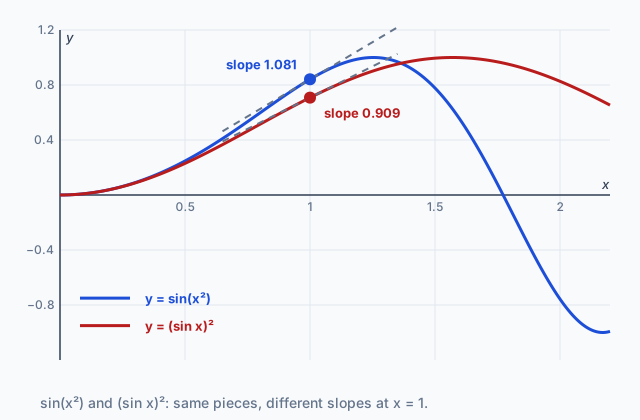
Compositions are the ones that hide. means , so squaring comes last and is inside: the derivative is . In the exponent is a function of , so the derivative is , not . In the input is , which brings a factor of 4.
Most functions need more than one rule, in layers. For the last operation is multiplication, so the product rule comes first, and the chain rule shows up inside it when you differentiate :
Quick check · Sort it
No calculator. Sort each function: is it a composition, one function inside another, so that the chain rule is needed? Tap a card, then tap its bin.
A composition: chain rule needed
Not a composition
5b. Rewrite when it saves work
The way a function is written is not always the easiest way to differentiate it. A little algebra first can turn a long rule into a short one.
Roots and reciprocals as powers. is , so its derivative is . A constant on top never needs the quotient rule.
A fraction over a single term splits. For , , and its derivative is . The function and its derivative are still not defined at ; rewriting does not change the domain.
Trigonometric functions through identities. and hand the work to the quotient rule, or to the power and chain rules, using derivatives you already know.
Every correct route gives the same derivative. Rewriting only shortens the algebra, and a shorter route has fewer places to drop a sign or a factor. What no rewrite allows is differentiating the top and the bottom of a fraction on their own: the derivative of is not .
Quick check · Calculate
No calculator. Let for . Find . Enter your answer as a decimal.
5c. When no basic rule fits directly
Some derivatives start from an equation or an inverse rather than a formula built from the basic rules. The chain rule still does the work; what changes is the setup.
An equation in and . Differentiate both sides with respect to , treating as a function of . For , the derivative of is , so and wherever . Every term with in it picks up , and a term like is a product.
An inverse function. If is the inverse of and , then , provided . Find the input first; is the wrong slope.
An inverse trigonometric function. for , and . With an inside function, the chain rule multiplies by its derivative: .
Quick check · Multiple choice
No calculator. The differentiable function of satisfies . Which expression is , at points where ?
Part 3 Watch it done Choosing the rules, one layer at a time
Open the steps in order. The last one is yours to finish.
Let . Find .
Predict first
Before the steps open: which rule should you write down first for ?
Step 1 · Name the last operation
To evaluate you would find , find , and then multiply them. Multiplication is last, so the product rule comes first, with and . The factor is itself a composition: raised to the inside function .
Step 2 · Write the rule's structure
, with .
Step 3 · Differentiate the composition
The outside function is the exponential, which is its own derivative, and the inside function has derivative . So , and
Why this step?
Why does carry the factor , when the derivative of is just ?
Because the exponent is , not . The chain rule multiplies the outside derivative, , by the derivative of the inside, . Without that factor you would have the rate of change with respect to , not with respect to .
Your step · Calculate
No calculator. Finish it. For , what is ?
Part 4 Try it Two derivatives with no formula to start from
Try it · Decide and justify
No calculator. Let . Since , is increasing and has an inverse function . A classmate says cannot be found without first finding a formula for . Is the classmate right?
Which reason supports your answer?
Try it · Multiple choice
No calculator. For , what is ?
Part 5 Explain it Write it out, then check it
On the exam, free response is written by hand, so work this one on paper. Nothing you type here leaves the page. Then open the model answer and mark yourself against each point.
Free response is 50% of the exam score. This one is shaped like Question 6, from free-response Part B (calculator not permitted).
Free-response practice · Question 6 style
No calculator. A drone's height above the ground is modeled by meters, where is measured in seconds and .
(a) Find . Show the work that leads to your answer, and name each derivative rule you use.
(b) Find . Indicate units of measure.
(c) A classmate writes and uses the quotient rule. Verify that the classmate's method gives the same expression for as your answer to part (a).
Model answer
(a) is a product of and , so the product rule comes first. is a composition, so by the chain rule . Then
(b) meters per second.
(c) The top is , with derivative 8, and the bottom is , with derivative by the chain rule. The quotient rule gives
which is the expression from part (a).
Score your own answer. This is a self-check, not a grade. Tick each point your answer makes.
Part 6 Check yourself Two functions known only by a table
Both case questions use this table. Write the rule's structure first, then look up each value it asks for.
The functions and are differentiable for all real numbers. Selected values of , , and are given in the table.
| 1 | 3 | -2 | 2 | 4 |
|---|---|---|---|---|
| 2 | 1 | 5 | 3 | -2 |
| 3 | 4 | 3 | 1 | 2 |
| 4 | 2 | 3 | 4 | 5 |
Case question 1 · Calculate
No calculator. Let . Find .
Case question 2 · Multiple choice
No calculator. Let . What is ?
The rest stand on their own and do not use the case.
Check yourself · Spot the error
No calculator. A student finds by rewriting it as a power. Tap the first line with a mistake.
Check yourself · Match
No calculator. Each function below is built from , but they call for different rules. Tap a function, then tap its derivative.
Part 7 Keep it Earlier ideas this lesson stands on
Every rule here works only where the derivative exists, and that rests on limits. Both come back now.
From 2.4 Connecting Differentiability and Continuity: Determining When Derivatives Do and Do Not Exist · Decide and justify
No calculator. Let . A classmate says exists, because is continuous at . Is the classmate right?
Which reason supports your answer?
From 1.10 Exploring Types of Discontinuities · Calculate
No calculator. Let for , and . The function has a removable discontinuity at . What is ?
In three lines
- Name the last operation first: it says whether the product, quotient or chain rule leads.
- Rewrite roots, reciprocals and trigonometric functions when it shortens the work; every correct route gives the same derivative.
- Implicit equations, inverse functions and inverse trigonometric functions all run on the chain rule.
Exam strategy for this topic
- Section I Part A, Multiple Choice (calculator not permitted): 29 questions in 62 minutes.
- Section I Part B, Multiple Choice (graphing calculator required): 13 questions in 38 minutes.
- Section II Part A, Free Response (graphing calculator required): 2 questions in 30 minutes.
- Section II Part B, Free Response (calculator not permitted): 4 questions in 60 minutes.
On a no-calculator derivative, write the rule's structure before you substitute: for a composition, or for a product. The structure shows which table value goes where, and a missing factor is easy to see.
Questions students ask
Is it wrong to use the quotient rule when a rewrite would be shorter?
No. Any correct rule gives the same derivative; the rewrite just has fewer steps. Two correct answers can look different before they are simplified, so if you want to compare them, evaluate both at the same input.
How do I spot a composition?
Ask whether some function's input is something other than alone. and are compositions; is a product of two functions of , not a composition.
When do I need implicit differentiation?
When and are related by an equation you cannot easily solve for , such as . Some equations can be solved for first, but differentiating implicitly avoids that work.
Do I have to simplify a derivative before I use it?
Only as far as the question needs. To find a value at one input, substitute into the unsimplified derivative; every extra line of algebra is another place to lose a sign.
Why does the derivative of come with a restriction?
is defined only for , and at the bottom of is 0. So the derivative exists only for .
Course alignment, for teachers
AP Calculus AB topic 3.5, Unit 3: Differentiation: Composite, Implicit, and Inverse Functions.
- Skill 1.C: Identify an appropriate mathematical rule or procedure based on the classification of a given expression (e.g., Use the chain rule to find the derivative of a composite function).
This lesson maps the topic's 0 learning objectives, since the course framework gives it no essential knowledge statements, to the part that teaches each one: 0 are checked by a scored question. The map is in the lesson file.