Unit 4 · Topic 4.5 · about 30 minutes · 7 parts · 12 scored checks, 3 of them multiple choice
AP Calculus AB 4.5: Solving Related Rates Problems
Unit 4: 10 to 15% of the multiple-choice section
What you'll be able to do
- Solve a related rates problem in context, and interpret the rate you find, its sign and its units, in the words of the problem.
Key vocabulary
| Term | What it means | The exam trap |
|---|---|---|
| Related rates problem | A problem that finds the rate at which one quantity is changing by relating it to other quantities whose rates of change are known. | Before you start, write down which rate the question asks for and which rates it gives; they are easy to swap in a long stem. |
| Rate of change with respect to time | For a quantity that depends on time , the derivative : how fast is changing at one instant. | "How fast" and "at what rate" both ask for a derivative with respect to , not for the quantity's value. |
| Independent variable | The one variable every related quantity depends on, which in most related rates problems is time . | Differentiate every quantity with respect to that same variable, even the ones whose rates the problem does not mention. |
 Tap to open the picture full size
Part 1 Think first A tank that drains at a steady rate
Commit to a guess first. Being wrong now still helps the answer stick.
Predict first
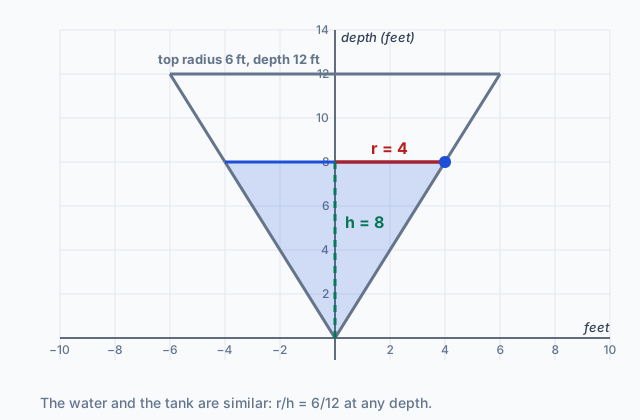
Water drains from the cone-shaped tank in the picture, vertex down, at a steady 2 cubic feet per minute. As the tank empties, what happens to the water level?
In short. A related rates problem finds how fast one quantity is changing from the known rates of other quantities, through an equation that relates the quantities at every instant.
- Write the relating equation first, then differentiate both sides with respect to time.
- A value that holds only at the instant in the question goes in after you differentiate, never before.
- A rate's sign says whether its quantity is increasing or decreasing, and its units are the quantity's units per unit of time.
Part 2 Learn it How a related rates problem is solved
5a. An equation that holds at every instant
A related rates problem gives you how fast some quantities are changing and asks how fast another one is. The derivative connects them, but first you need an equation that links the quantities themselves.
Work in this order.
- Draw the situation. Give every quantity that changes a letter, and give every fixed quantity its number.
- Write an equation relating the quantities that holds at every instant, not only at the one the question asks about.
- Differentiate both sides with respect to time . Each changing quantity brings its own rate, such as .
- Put in the values at the instant in the question, and solve for the rate you want.
- Say what the answer means, with units.
A 17-foot ladder leans against a wall. Let be the distance from the wall to its foot and the height of its top. At every instant , so . The foot slides out at 3 feet per second. When , the equation gives , and , so . The top is sliding down the wall at 1.6 feet per second.
Quick check · Put it in order
No calculator. A gas is kept at a constant temperature, so its pressure , in pounds per square inch, and its volume , in cubic inches, satisfy at every instant. The volume is increasing at 2 cubic inches per second. Tap the steps in order to find how fast the pressure is changing when the volume is 20 cubic inches.
5b. Which facts may go in early
Step 4 comes after step 3 for a reason. A value such as is true at only one instant. Put it into the equation before you differentiate and you have treated a changing quantity as a constant, and the derivative of a constant is 0. For the ladder, would say the top stays 15 feet up forever, so would come out 0 while the ladder is plainly sliding.
So sort what you know by when it is true. A fact that holds at every instant may go in before you differentiate: a fixed length, such as the ladder's 17 feet, or a shape relation such as for the water in the tank in the picture, which holds at every depth. Using it early can remove a variable whose rate you do not know. A value that holds only at the instant in the question goes in afterward.
A rate that stays constant, such as water pumped in at a steady 5 cubic feet per minute, is true at every instant too. It still goes in after you differentiate, because only then does a rate appear in the equation.
Sometimes the problem leaves out one value at the instant. Find it from the original equation, as the ladder's came from .
Quick check · Calculate
No calculator. A kite flies at a constant height of 40 feet and moves horizontally away from the person holding its string at 6 feet per second. The string is straight. How fast is the string being let out when 50 feet of string are out? Give your answer in feet per second.
5c. Reading the sign and the units
The sign of a rate tells you which way its quantity is moving. A positive means is increasing at that instant, and a negative one means it is decreasing.
Watch the sign on the way in, too. Words such as draining, leaking, melting, shrinking or sliding down describe a decreasing quantity, so its rate goes into the equation as a negative number. A tank that drains at 2 cubic feet per minute has , even though the problem printed the 2 with no sign. The ladder's came out negative because its top moves down.
The units of are the units of per unit of time: cubic feet per minute for a volume, square centimeters per second for an area, radians per second for an angle.
Then say what the number means in the problem's own words. "The top of the ladder is sliding down the wall at 1.6 feet per second when its foot is 8 feet from the wall" answers the question. A bare does not. Name the quantity that is changing; do not call a rate of change of volume a velocity.
The rate you find holds at that one instant. A moment later the values have moved, and so has the rate.
Quick check · Multiple choice
No calculator. A spherical snowball melts so that its radius decreases at 0.2 centimeter per minute. Its volume is . Which statement is true at the instant the radius is 5 centimeters?
Part 3 Watch it done Draining the cone-shaped tank
Open the steps one at a time, then finish the problem yourself.
Water drains from the cone-shaped tank in the picture, vertex down, 12 feet deep with a top radius of 6 feet, at 2 cubic feet per minute. How fast is the depth of the water changing when the water is 4 feet deep?
Step 1 · Name and relate
Let be the depth of the water, the radius of its surface and its volume, all functions of in minutes. At every instant .
Step 2 · Remove r with similar triangles
The water's triangle and the tank's are similar, so and at every depth. Then .
Why this step?
The rule is to substitute after differentiating. Why may go in before?
Because is true at every depth, not only when , so the equation still holds at every instant. It also removes , whose rate the problem never gives. Putting in now would not be allowed: that value holds at one instant only.
Step 3 · Differentiate with respect to t
.
Step 4 · Put in the instant
The tank is draining, so , and : .
Your step · Fill the statement
No calculator. Finish it from . Tap a blank, then tap an answer.
At the instant the water is 4 feet deep, is feet per minute, so the water level is .
Part 4 Try it Two new situations
Try it · Calculate
No calculator. A streetlight sits at the top of an 18-foot pole. A woman 6 feet tall walks straight away from the pole at 5 feet per second. How fast is the length of her shadow changing when she is 20 feet from the pole? Give your answer in feet per second.
Try it · Decide and justify
No calculator. A cylindrical candle with a radius of 2 centimeters burns down, losing wax at 3 cubic centimeters per minute. To find how fast its height is changing when the candle is 10 centimeters tall, a classmate writes , so , puts in , gets , and says the height is increasing at centimeter per minute at that instant. Is the classmate right?
Which reason supports your answer?
Part 5 Explain it Answer it the way free response asks
Free response on the exam is handwritten, so answer on paper, with the triangle drawn and labeled as part of your work. What you type here stays on this page. Then open the model answer and score yourself against each point.
Free response is 50% of the exam score. This one is shaped like Question 5, from free-response Part B (calculator not permitted).
Free-response practice · Question 5 style
No calculator. A hot-air balloon rises straight up from a point on level ground. An observer stands on the ground 300 feet from the launch point. Let be the balloon's height, its distance from the observer and the angle of elevation from the observer to the balloon, all functions of time in minutes. At the instant the balloon is 400 feet high, it is rising at 25 feet per minute.
(a) Write an equation that relates and at every instant, and find at that instant.
(b) Find the rate at which the distance between the observer and the balloon is changing at that instant. Indicate units of measure, and interpret the sign of your answer in the context of the problem.
(c) Find the rate at which is changing at that instant. Indicate units of measure.
Model answer
(a) The ground and the balloon's path meet at a right angle, so at every instant. When , feet.
(b) Differentiating with respect to , . At that instant , so feet per minute. The rate is positive, so the distance between the observer and the balloon is increasing at 20 feet per minute at that instant.
(c) at every instant, so . At that instant , so and radian per minute.
Score your own answer. This is a self-check, not a grade. Tick each point your answer makes.
Part 6 Check yourself A runner heading for first base
Both case questions use the table above. Read every value you need from it.
A baseball diamond is a square 90 feet on a side. A runner sprints along the line from home plate to first base. Let be the runner's distance from home plate, in feet, at time seconds after the hit. The table gives the runner's position and speed at two instants.
| (seconds) | (feet) | (feet per second) |
|---|---|---|
| 2 | 42 | 25.5 |
| 3 | 67.5 | 25 |
Case question 1 · Calculate
No calculator. Third base is 90 feet from home plate, and the line from home to third meets the line from home to first at a right angle. At what rate is the distance between the runner and third base changing at , in feet per second?
Case question 2 · Multiple choice
No calculator. Second base is 90 feet beyond first base, at the corner of the diamond across from home plate. Which statement describes the distance between the runner and second base at ?
The rest stand on their own and do not use the case.
Check yourself · Spot the error
No calculator. Each edge of a cube grows at 0.5 centimeter per second. A student finds how fast the cube's volume is changing when each edge is 4 centimeters. Tap the first line with a mistake.
Check yourself · Sort it
No calculator. A boat is pulled toward a dock by a rope that runs through a ring 5 feet above the water. The rope is pulled in at a constant 3 feet per second. Let be the length of rope from the ring to the boat and the boat's distance from the point on the water directly below the ring. At one instant 13 feet of rope are out. Tap a fact, then tap when it is true.
True at every instant
True only at that instant
Part 7 Keep it Bring back two derivative skills
Every related rates problem leans on the product rule for changing quantities, and on the derivative rules behind it. Pulling them back up keeps them ready.
Bring it back · Calculate
No calculator. A theater's weekly ticket revenue is dollars, where is the price of a ticket in dollars and is the number of tickets sold each week. At one instant and , the price is rising at 0.5 dollar per week, and sales are falling at 10 tickets per week. Find at that instant, in dollars per week.
Bring it back · Multiple choice
No calculator. If , what is ?
In three lines
- Relate the quantities with an equation that holds at every instant, then differentiate it with respect to time.
- Put in values that hold only at the instant asked about after differentiating, with a negative rate for any quantity that is decreasing.
- Report the rate in the problem's words: which quantity, increasing or decreasing, and its units per unit of time.
Exam strategy for this topic
- Section I Part A, Multiple Choice (calculator not permitted): 29 questions in 62 minutes.
- Section I Part B, Multiple Choice (graphing calculator required): 13 questions in 38 minutes.
- Section II Part A, Free Response (graphing calculator required): 2 questions in 30 minutes.
- Section II Part B, Free Response (calculator not permitted): 4 questions in 60 minutes.
Write the relating equation, and then its derivative with respect to , before you put in any value that holds only at the instant asked about. End with a sentence that names the quantity, says whether it is increasing or decreasing at that instant, and gives units, such as feet per minute.
Questions students ask
How do I tell which quantities are constants?
Ask whether the quantity could change while the situation plays out. A ladder's length, a pole's height and a tank's shape stay fixed. Distances, depths and angles that move with something are variables, even when the problem gives their value at one instant.
Why is my answer negative when the problem never wrote a minus sign?
Usually because a word in the problem described a decreasing quantity: draining, leaking, sliding down, shrinking. That rate goes in as negative, and the rate you find may come out negative too. A negative rate is a fine answer; say that the quantity is decreasing.
Can anything be substituted before I differentiate?
Yes: a relation or a value that holds at every instant, such as a fixed length or a cone's fixed ratio of radius to depth. Only values that hold at the one instant in the question have to wait until after you differentiate.
Do I need to draw a picture?
It is the quickest way to find the right triangle or the similar triangles that give the equation. Label it with your letters, and it also makes plain what each letter stands for.
What if I do not know the value of one variable at the instant?
Find it from the original equation at that instant, before you put values into the differentiated one. A ladder's height comes from the Pythagorean theorem once you know how far its foot is from the wall.
Course alignment, for teachers
AP Calculus AB topic 4.5, Unit 4: Contextual Applications of Differentiation.
- Skill 3.F: Explain the meaning of mathematical solutions in context.
This lesson maps the one essential knowledge statement of the topic to the part that teaches each one: 1 is checked by a scored question. The map is in the lesson file.