Unit 4 · Topic 4.7 · about 30 minutes · 7 parts · 13 scored checks, 3 of them multiple choice
AP Calculus AB 4.7: Using L’Hospital’s Rule for Determining Limits of Indeterminate Forms
Unit 4: 10 to 15% of the multiple-choice section
What you'll be able to do
- Determine limits of quotients that result in the indeterminate forms and , using L'Hospital's Rule after checking that it applies.
Key vocabulary
| Term | What it means | The exam trap |
|---|---|---|
| Indeterminate form | The form of a limit of a quotient whose numerator and denominator both approach 0, or both become infinite, written or . | The form is a label for a situation, not a value, so never write it after an equal sign. |
| The form | A quotient whose numerator and denominator both approach 0. | Say the limit has the form ; never write as its value. |
| The form | A quotient whose numerator and denominator both grow without bound, toward or . | Do not read the form as a number; compare how fast the two parts grow. |
| L'Hospital's Rule | If has the form or as , with and differentiable and near , then whenever the second limit exists. | Show that the rule applies before you use it, and differentiate the numerator and the denominator separately. |
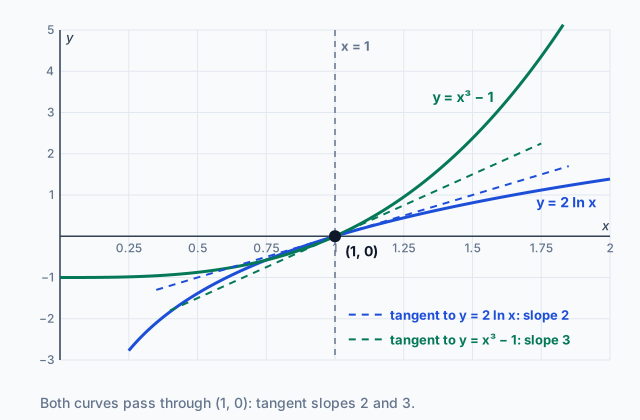 Tap to open the picture full size
Part 1 Think first Two puddles drying out
Make a guess before the lesson starts. Even a wrong guess makes the answer easier to remember.
Predict first
After a rain shower, two puddles dry in the sun. At noon puddle A covers 36 square feet and puddle B covers 12. Their areas hours after noon are and square feet, so both are gone at . In the last moments before they vanish, about how many times the area of puddle B is puddle A?
In short. A limit of a quotient whose top and bottom both approach 0, or both become infinite, has an indeterminate form, and L'Hospital's Rule evaluates it as the limit of the derivative of the top over the derivative of the bottom.
- The forms and are labels, not numbers: the form alone does not determine the limit.
- Check the form and the rule's conditions before using it; on any other form it can give a wrong value.
- Differentiate the top and the bottom separately, then check the new form; if it is still indeterminate, check the conditions and use the rule again.
Part 2 Learn it The form, the rule and the second look
2a. Two indeterminate forms: and
Some limits of a quotient cannot be found by substituting. If the top and the bottom both approach 0, the quotient tends to . If both grow without bound, toward or , it tends to . These two are called indeterminate forms, because the form by itself does not determine the limit.
Three quotients near show why. Each one tends to , yet approaches 1, approaches 0 and approaches 5. Same form, different limits.
A quotient that tends to anything else is not indeterminate. As , tends to , and its limit is 0. A top that approaches a number other than 0 over a bottom that approaches 0 is not indeterminate either: the quotient becomes unbounded, so the limit does not exist as a number.
The symbols and describe a situation; they are not values. Say "the limit has the form " in words, and never write after an equal sign.
Quick check · Sort it
No calculator. Substitute, or think about where the top and the bottom are headed. Tap a card, then tap whether its limit has an indeterminate form.
Indeterminate form
Not an indeterminate form
2b. The rule: differentiate the top and the bottom separately
L'Hospital's Rule evaluates a limit with one of these two forms. Suppose that near , though not necessarily at itself:
- and are differentiable, and ;
- and , or both limits are infinite;
- exists.
Then
The rule holds the same way for limits as or .
The new quotient is the derivative of the top over the derivative of the bottom. It is not the derivative of the quotient, so the quotient rule plays no part.
The picture at the top shows why the rule works for . Near each curve stays close to its tangent line, so is about and is about . Their quotient is then about , the quotient of the two slopes.
For : both parts approach 0 and both are differentiable, and the derivative of is 1, never 0. The derivatives give , which approaches 3, so the limit is 3.
Quick check · Multiple choice
No calculator. The limit has the form . Which limit does L'Hospital's Rule say is equal to it?
2c. Check the form before the rule, and again after it
The rule is only for and . Used on any other form, it can give a wrong answer. By substitution, , but the quotient of the derivatives is . So name the form before you differentiate anything.
Then look again. The new quotient can still be indeterminate, and is not 0 or 1 or any other answer. If the new top and bottom meet the conditions, use the rule again.
For , the form is . One use gives , still . A second use gives . Now the top stays at 2 while the bottom grows without bound, so this limit is 0 and the form is no longer indeterminate. Stop there: .
Each use needs its own indeterminate form, so a written answer names the form at every step. And each equal sign holds only because the last limit exists.
Quick check · Decide and justify
No calculator. Maya finds with L'Hospital's Rule and writes . Jordan says the rule does not apply to this limit. Is Jordan right?
Which reason supports your answer?
Part 3 Watch it done A limit that needs the rule twice
Watch each step, then do the last one yourself.
Find .
Step 1 · Name the form
At the top is and the bottom is , so the limit has the form . Both parts are differentiable everywhere, and the bottom's derivative, , is not 0 for .
Step 2 · Use the rule once
, provided the new limit exists. The chain rule gives the 2 in front of .
Step 3 · Name the form again
At the new top is and the new bottom is . The form is still , so there is no answer yet. The new top and bottom are differentiable, and the derivative of is 2, never 0.
Why this step?
Why is it all right to use the rule a second time?
The new quotient meets the same conditions the first one did: its top and bottom are differentiable, both approach 0, and the derivative of the bottom is not 0. Each use of the rule needs only its own check, so it can be used as many times as those checks pass.
Your step · Calculate
No calculator. Finish it. Use L'Hospital's Rule on . What is ?
Part 4 Try it A limit at infinity, and a worked solution to check
Try it · Calculate
No calculator. Find .
Try it · Spot the error
No calculator. A student finds . Tap the first line with a mistake.
Part 5 Explain it Answer it as a free-response question
Free response on the exam is written by hand, so work this on paper first. Nothing you type here leaves this page. Then open the model answer and score yourself against each point.
Free response is 50% of the exam score. This one is shaped like Question 3, from free-response Part B (calculator not permitted).
Free-response practice · Question 3 style
No calculator. Three drones fly along a straight north-south track that passes a beacon. Their positions, in meters north of the beacon, are , and at time seconds; a negative position is south of the beacon. Each of the three functions is twice differentiable, and its second derivative is continuous. All three drones are at the beacon at seconds, and
(a) Explain why tends to an indeterminate form as .
(b) Use L'Hospital's Rule to find . Interpret the meaning of this value in the context of the problem.
(c) Find . Show the work that leads to your answer, and give its units.
Model answer
(a) and are differentiable, so they are continuous, and and . The quotient tends to , an indeterminate form.
(b) The form is and and are differentiable. and are continuous and , so near and exists. By L'Hospital's Rule, . At times close to seconds, drone A is about 1.6 times as far from the beacon as drone B, on the same side of it.
(c) and , so the form is . and are differentiable, and the derivative of , , is not 0 for . One use of the rule gives . Since is continuous, while , so the form is still . is differentiable and the derivative of is , so the rule applies again: , because is continuous. So meters per second squared.
Score your own answer. This is a self-check, not a grade. Tick each point your answer makes.
Part 6 Check yourself Two functions in a table
The three case questions use the same table. Answer them from it.
The functions and are twice differentiable for all , and and are continuous. The table gives their values and the values of their first two derivatives at three inputs.
| 1 | 0 | 2 | 4 | 2 | ||
|---|---|---|---|---|---|---|
| 2 | 0 | 1 | 0 | 3 | ||
| 3 | 0 | 0 | 0 | 0 |
Case question 1 · Multiple choice
No calculator. What is ?
Case question 2 · Calculate
No calculator. What is ? Give an exact decimal.
Case question 3 · Calculate
No calculator. What is ? Give an exact decimal.
The rest stand on their own and do not use the case.
Check yourself · Match
No calculator. Each limit has an indeterminate form. Tap a limit, then its value.
Check yourself · Fill the statement
No calculator. Tap a blank, then tap an answer.
L'Hospital's Rule can be used on when and both approach , or both become infinite, and . The original limit then equals .
Part 7 Keep it Bring back earlier ideas
This lesson leans on the chain rule and on limits at infinity. Recalling them now keeps them ready.
Bring it back · Calculate
No calculator. Let . Find .
Bring it back · Multiple choice
No calculator. Which line is a horizontal asymptote of the graph of ?
In three lines
- A limit of a quotient whose top and bottom both approach 0, or both become infinite, has an indeterminate form.
- L'Hospital's Rule replaces such a quotient with the derivative of the top over the derivative of the bottom, once its conditions are checked.
- After each use, name the new form: stop when it is not indeterminate, and use the rule again when it is.
Exam strategy for this topic
- Section I Part A, Multiple Choice (calculator not permitted): 29 questions in 62 minutes.
- Section I Part B, Multiple Choice (graphing calculator required): 13 questions in 38 minutes.
- Section II Part A, Free Response (graphing calculator required): 2 questions in 30 minutes.
- Section II Part B, Free Response (calculator not permitted): 4 questions in 60 minutes.
Show that L'Hospital's Rule applies before you use it: write the limit of the numerator and the limit of the denominator, say in words that the form is or , and then write the quotient of the derivatives. An equation such as is wrong, because the form is not a value.
Questions students ask
Is L'Hospital's Rule the same as the quotient rule?
No. The quotient rule finds the derivative of . L'Hospital's Rule finds a limit, using over , each found on its own.
Can I use the rule more than once on the same limit?
Yes, as long as each new quotient is still indeterminate and meets the conditions. Check the form every time, and stop as soon as it is not indeterminate.
Do I have to use L'Hospital's Rule on a limit?
No. Any correct method works. Factoring and canceling, from Unit 1, is often quicker for a polynomial quotient such as .
Why can't I write that a limit equals ?
Because is not a number. It names what the top and the bottom are doing, so write "the limit has the form " instead.
Does the rule work for limits as x goes to infinity?
Yes. If the quotient tends to or as or , the rule applies in the same way.
Beyond the AP Exam
College Board sets this limit on what the AP Exam asks about this topic. Anything past it is not on the exam.
There are many other indeterminate forms, such as ∞ − ∞, for example, but these will not be assessed on either the AP Calculus AB or BC Exam. However, teachers may include these topics, if time permits.
Course alignment, for teachers
AP Calculus AB topic 4.7, Unit 4: Contextual Applications of Differentiation.
- Skill 3.D: Apply an appropriate mathematical definition, theorem, or test.
This lesson maps all 2 essential knowledge statements of the topic to the part that teaches each one: 2 are checked by a scored question. The map is in the lesson file.