Unit 5 · Topic 5.1 · about 30 minutes · 7 parts · 12 scored checks, 3 of them multiple choice
AP Calculus AB 5.1: Using the Mean Value Theorem
Unit 5: 15 to 20% of the multiple-choice section
What you'll be able to do
- Justify a conclusion about a function by applying the Mean Value Theorem over an interval, after checking that its hypotheses hold.
Key vocabulary
| Term | What it means | The exam trap |
|---|---|---|
| Mean Value Theorem | If is continuous on and differentiable on , there is a point in where the instantaneous rate of change equals the average rate of change over . | The conclusion is about a derivative, a rate, not about a value of the function. |
| Continuous on | The function is continuous at every point of the closed interval, endpoints included. | Look for any input in the interval where the function has no value or jumps, not only at the endpoints. |
| Differentiable on | The function has a derivative at every point strictly between a and b. | A graph can be unbroken and still fail here, so check for sharp points as well as breaks. |
| Average rate of change | The change in a function's output over an interval divided by the change in its input, . | Divide by the change in the input; the change in the output alone is not a rate. |
| Instantaneous rate of change | The rate at one input, the derivative . | Read whether a question is about one input or a whole interval before you pick a formula. |
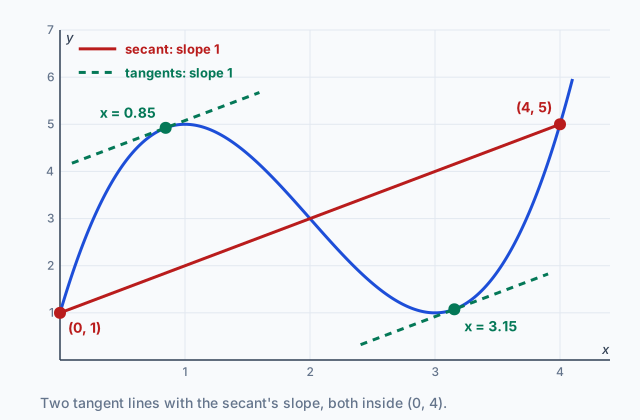 Tap to open the picture full size
Part 1 Think first Two cameras, one ticket?
Guess before you learn. A wrong guess still makes the answer stick.
Predict first
A car passes a highway camera at mile marker 12 at 2:00 p.m. and a second camera at mile marker 42 at 2:24 p.m. The speed limit is 65 miles per hour, and nobody saw the car's speedometer. Must the car have been going exactly 75 miles per hour at some instant between the two cameras?
In short. The Mean Value Theorem says that if is continuous on and differentiable on , then for at least one with .
- Check both hypotheses first: continuous on the closed interval , differentiable on the open interval .
- The conclusion is about the derivative: the instantaneous rate at some equals the average rate over the whole interval.
- The theorem says such a exists, strictly between and ; it does not say where, or that there is only one.
Part 2 Learn it Three short ideas, each checked as you go
5a. What the theorem promises
The Mean Value Theorem joins the two rates from Unit 2. Suppose is continuous on the closed interval and differentiable on the open interval . Then there is at least one number with at which
The right side is the average rate of change of over . The left side is the instantaneous rate of change at . So somewhere strictly inside the interval, the rate at an instant equals the average rate over the whole interval.
On a graph, the average rate is the slope of the secant line through the endpoints, and is the slope of the tangent line at . The theorem says some tangent line inside the interval is parallel to that secant line. The cubic at the top of the page has two of them.
Read carefully what it does not say. It does not say where is; the midpoint is not special. It does not say there is only one . And it is a statement about , a rate. A statement about a value lying between and belongs to a different theorem, the Intermediate Value Theorem from Unit 1.
Quick check · Multiple choice
No calculator. A function is continuous on and differentiable on , with and . Which statement does the Mean Value Theorem guarantee?
5b. Check the hypotheses before you use it
The theorem promises nothing unless both hypotheses hold, so check them before you use it.
- Continuous on , endpoints included. A jump, a hole or a vertical asymptote anywhere in breaks it.
- Differentiable on , the open interval. A corner, a cusp or a vertical tangent anywhere strictly between and breaks it. Nothing is asked about the derivative at or themselves.
Polynomials, , and are differentiable at every real number, so they pass on any interval. A rational function passes on any interval that contains no input where its denominator is 0.
When a hypothesis fails, the conclusion can fail with it. Take on . The average rate is , but is only ever or , so no works. The corner at 0 is the reason. (Sometimes the conclusion happens to hold anyway; the theorem just no longer promises it.)
Recall from Unit 2 that a function that is differentiable at a point is continuous there. So if you are told is differentiable on all of , both hypotheses hold at once.
Quick check · Sort it
No calculator. Tap a function on an interval, then tap whether the Mean Value Theorem applies to it there.
Both hypotheses hold
A hypothesis fails
5c. Writing the justification
When a question says justify, a complete answer using this theorem has three parts. State the hypotheses and why they hold. Work out the average rate of change. Then state the conclusion about the function by name, on the open interval, with units if there is a context.
Suppose is the volume of water in a tank, in gallons, minutes after noon, and is differentiable for . You know only that and . A full justification reads:
is differentiable on , so it is continuous on and differentiable on . . By the Mean Value Theorem, there is a time with at which gallons per minute.
That is how the theorem works on a table of values: the problem tells you the function is differentiable, and you choose two rows. Without that sentence, a table tells you nothing about what happens between its rows, and the theorem cannot be used.
Name the function every time. "It has a slope of " leaves a reader guessing whether you mean or , or the graph of either.
Quick check · Decide and justify
No calculator. A function is continuous on , with and . Nothing else is known about . Must there be a number in at which ?
Which reason supports your answer?
Part 3 Watch it done Finding the number the theorem promises
Watch each step, then do the last one yourself.
Let . Show that the Mean Value Theorem applies to on , and find the value of it guarantees.
Step 1 · Check the hypotheses
is a polynomial, so it is continuous on and differentiable on . The Mean Value Theorem applies.
Why this step?
Why is "polynomial" enough to settle both hypotheses?
A polynomial has a derivative at every real number, and a function that is differentiable at a point is also continuous there (Unit 2). So one fact covers both conditions on any interval.
Step 2 · Find the average rate of change
and , so .
Step 3 · Set the derivative equal to it
, so solve . Then , , and or .
Your step · Calculate
No calculator. Finish it. The equation has solutions and . Which value of does the Mean Value Theorem guarantee for on ?
Part 4 Try it A new function and a cyclist
Try it · Calculate
No calculator. Let . Find the value of in at which equals the average rate of change of over . Give an exact decimal.
Try it · Multiple choice
No calculator. A cyclist's velocity , in meters per second, is a differentiable function of time , in seconds. Her velocity is 2 meters per second at and 8 meters per second at . Which statement must be true?
Part 5 Explain it Write it the way the exam asks
On the exam free response is handwritten, so work on paper first. Nothing you type here leaves this page. Then compare with the model answer and score each point.
Free response is 50% of the exam score. This one is shaped like Question 6, from free-response Part B (calculator not permitted).
Free-response practice · Question 6 style
No calculator. A pot of soup sits on a stove, and the cook adjusts the heat as it cooks. The soup's temperature, in degrees Celsius, is given by a differentiable function of time , in minutes, for . Selected values: , , , and .
(a) Explain why there must be a time , with , at which .
(b) Must there be a time , with , at which the soup is cooling? Justify your answer.
(c) The cook says the soup's temperature never rose faster than 5 degrees Celsius per minute. Use the Mean Value Theorem to explain why the cook's statement is false.
Model answer
(a) is differentiable, so it is continuous on and differentiable on . . By the Mean Value Theorem, there is a time with at which degrees Celsius per minute.
(b) Yes. is continuous on and differentiable on , and . By the Mean Value Theorem, for some with . At that time the temperature is decreasing at 1 degree Celsius per minute, so the soup is cooling.
(c) meets the hypotheses on , and . By the Mean Value Theorem, for some with . At that time the temperature was rising at 6 degrees Celsius per minute, which is faster than 5, so the cook's statement is false.
Score your own answer. This is a self-check, not a grade. Tick each point your answer makes.
Part 6 Check yourself A drone over a hill
The two case questions use the same table. Answer them from it.
A delivery drone climbs over a hill and then descends toward a landing pad. Its altitude above the pad is feet, seconds after a timer starts, and is differentiable for . Some values are in the table.
| (seconds) | (feet) |
|---|---|
| 0 | 20 |
| 2 | 26 |
| 5 | 23 |
| 9 | 11 |
| 12 | 10 |
Case question 1 · Calculate
No calculator. Applying the Mean Value Theorem to the interval guarantees a time , with , at which equals what value, in feet per second?
Case question 2 · Multiple choice
No calculator. Applying the Mean Value Theorem to which interval guarantees a time at which the drone's altitude is changing at a rate of feet per second?
The rest stand on their own and do not use the case.
Check yourself · Spot the error
No calculator. A student applies the Mean Value Theorem to on . Tap the first line with a mistake.
Check yourself · Match
No calculator. For each function on its interval, find every in the open interval where equals the average rate of change. Tap a function, then its result.
Part 7 Keep it Bring back earlier ideas
The theorem leans on the meaning of a derivative in context and on its older cousin from Unit 1. Pulling them back up is what makes them last.
Bring it back · Fill the statement
No calculator. Tap a blank, then tap an answer.
A tank holds liters of water minutes after it starts to drain. The unit of is , and means that at the amount of water in the tank is .
Bring it back · Decide and justify
No calculator. A function is continuous on , with and . Must there be a number in at which ?
Which reason supports your answer?
In three lines
- The Mean Value Theorem needs continuous on and differentiable on ; check both before using it.
- It then promises at least one in where equals the average rate .
- A justification states the hypotheses, the average rate and the conclusion about the named function, with units.
Exam strategy for this topic
- Section I Part A, Multiple Choice (calculator not permitted): 29 questions in 62 minutes.
- Section I Part B, Multiple Choice (graphing calculator required): 13 questions in 38 minutes.
- Section II Part A, Free Response (graphing calculator required): 2 questions in 30 minutes.
- Section II Part B, Free Response (calculator not permitted): 4 questions in 60 minutes.
When a question says "justify" and the Mean Value Theorem fits, write three things: the hypotheses with a reason (" is differentiable, so it is continuous on and differentiable on "), the average rate with its arithmetic shown, and the conclusion naming the function, the open interval and the units. Saying "by the MVT" without the hypotheses leaves the argument unfinished.
Questions students ask
Does the theorem tell me where c is?
No. It only says at least one exists in . When you have a formula for , you can find by solving equal to the average rate; with only a table, you cannot.
Why does it need differentiable only on the open interval?
The tangent line it promises sits strictly inside the interval, so the derivative only has to exist there. on has no derivative at 0 and still meets the hypotheses.
Can I use the theorem on a table of values?
Yes, if the problem says the function is differentiable (or continuous and differentiable) on the interval. Pick two rows, compute the average rate between them, and the theorem gives a point between those two inputs where the derivative equals it.
How is this different from the Intermediate Value Theorem?
The Intermediate Value Theorem needs only continuity and is about values: hits every number between and . The Mean Value Theorem also needs differentiability and is about the derivative: equals the average rate.
What if the solution for c lands on an endpoint?
Then it is not a value the theorem promises, because the theorem's is strictly between and . Keep only the solutions inside .
Course alignment, for teachers
AP Calculus AB topic 5.1, Unit 5: Analytical Applications of Differentiation.
- Skill 3.E: Provide reasons or rationales for solutions and conclusions.
This lesson maps the one essential knowledge statement of the topic to the part that teaches each one: 1 is checked by a scored question. The map is in the lesson file.