Unit 5 · Topic 5.12 · about 30 minutes · 7 parts · 12 scored checks, 3 of them multiple choice
AP Calculus AB 5.12: Exploring Behaviors of Implicit Relations
Unit 5: 15 to 20% of the multiple-choice section
What you'll be able to do
- Find the critical points of a curve given by an equation in and , the points where is zero or does not exist.
- Justify conclusions about a function defined implicitly, such as where it increases, how it bends and where it has a relative maximum or minimum, from its first and second derivatives.
Key vocabulary
| Term | What it means | The exam trap |
|---|---|---|
| Implicit relation | An equation in and , such as , that is not solved for . | One -value can go with two or more -values, so name each point by both coordinates. |
| Critical point of an implicit relation | A point on the relation where the first derivative equals zero or does not exist. | Put each candidate point back into the original equation before you call it a critical point. |
| Implicitly defined function | The function of whose graph is the part of the curve near a given point, used without solving the equation for . | Near a vertical tangent the curve is usually not the graph of a function of , so say which point you are working near. |
| Second derivative of an implicit relation | The derivative of , found by differentiating implicitly again; it may be a relation of , and . | It needs the point's , its and the value of there, not alone. |
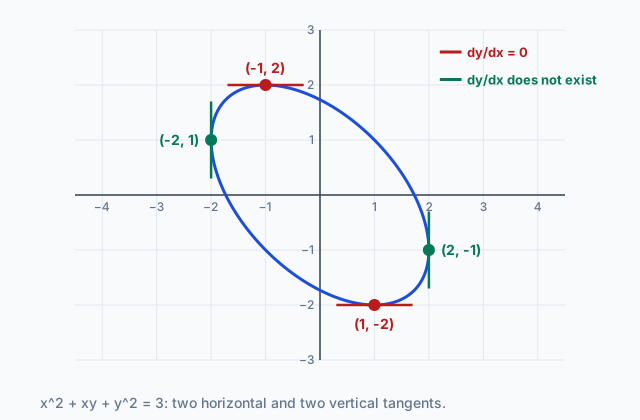 Tap to open the picture full size
Part 1 Think first The north end of a tilted flower bed
Guess before you learn. A wrong guess still makes the answer stick.
Predict first
A gardener plans an oval flower bed. On her plan, is meters east of the center and is meters north, and the edge of the bed is . Where is the edge farthest north?
In short. A critical point of an implicit relation is a point on the curve where is 0 or does not exist, and the derivative tests then describe the function the curve defines near that point.
- Find by implicit differentiation, set its numerator or its denominator equal to 0, and keep only the points that satisfy the original equation.
- Whether changes sign at a critical point decides between a relative maximum, a relative minimum and neither. Where , a positive or negative decides between the first two, and a zero one decides nothing.
- A second derivative found implicitly is usually a relation of , and , so all three values go into it.
Part 2 Learn it Three short ideas, each checked as you go
5a. Critical points of a curve given implicitly
Earlier in this unit a critical point of was an input where is 0 or does not exist. A curve given by an equation in and , an implicit relation, works the same way with in place of : a point on the relation where equals zero or does not exist is a critical point.
Take the curve at the top, . Differentiating, , so
- where the numerator is 0 and the denominator is not: . In the curve's equation that gives , so or , and the points are and . The tangent is horizontal there.
- does not exist where the denominator is 0: , which gives and . The tangent is vertical there.
Two habits matter. A point counts only if it is on the curve, so put every candidate back into the original equation. And usually contains , so a critical point is named by both coordinates, not by alone.
Quick check · Sort it
No calculator. For the circle , implicit differentiation gives . Tap a point, then tap where it belongs.
Critical point,
Critical point, does not exist
Not a critical point
5b. The derivative tests work on implicit functions too
Near most points, a curve given implicitly is the graph of a function of , even if you never solve for . Everything this unit taught about carries over to . Where that function is increasing, where it is decreasing, and the first derivative test classifies a critical point by whether changes sign there.
Go back to near . The denominator is close to 3 there, so it is positive. The numerator is negative just to the left of on the curve and positive just to the right. With the minus sign in front,
changes from positive to negative at . The function the curve defines near has a relative maximum there, and the picture agrees: is the top of the curve.
Read the sign of the whole fraction, numerator and denominator together. On some curves the denominator is negative, and then has the opposite sign to its numerator.
Quick check · Decide and justify
No calculator. The relation defines as a function of near the point , with . At , . Does this function have a relative minimum, a relative maximum or neither at ?
Which reason supports your answer?
5c. The second derivative: x, y and dy/dx together
To find , differentiate again. Every is a function of , so differentiating a term with in it brings out another . That is why a second derivative found implicitly is usually a relation of , and .
Start from and differentiate each term. The product gives , and the product gives . Collected,
At , and , so and . It is negative, so by the second derivative test the function has a relative maximum at , which agrees with the sign change you found in the first derivative.
At a critical point with , the terms with drop out, which makes the arithmetic short. At any other point they stay, so keep every one of them in your work until you substitute.
Quick check · Multiple choice
No calculator. For the curve , implicit differentiation gives . Which expression is ?
Part 3 Watch it done Find and classify a critical point
Watch each step, then do the last one yourself.
The relation defines as a function of near the point . Show that the function has a critical point at , and use the second derivative to decide whether it is a relative maximum or a relative minimum.
Step 1 · Differentiate implicitly
, so and .
Step 2 · Check the critical point
is on the curve: . There , and the denominator 24 is not 0, so is a critical point with a horizontal tangent.
Step 3 · Differentiate again
Differentiate term by term: , that is, .
Why this step?
Why does turn into two terms, one of them with ?
It is a product of and , so the product rule gives two terms. The derivative of needs the chain rule, , and multiplied by that is . The other term is .
Your step · Calculate
No calculator. Finish it. At , and . What is at ?
Part 4 Try it A new curve
Try it · Calculate
No calculator. For the curve , implicit differentiation gives . The curve has horizontal tangents at points with only one -coordinate. What is it?
Try it · Decide and justify
No calculator. The same curve, , has a horizontal tangent at the point where and , and near that point is a function of . Does that function have a relative minimum, a relative maximum or neither at ?
Which reason supports your answer?
Part 5 Explain it Write it the way the exam asks
On the exam free response is handwritten, so work on paper first. Nothing you type here leaves this page. Then compare with the model answer and score each point.
Free response is 50% of the exam score. This one is shaped like Question 6, from free-response Part B (calculator not permitted).
Free-response practice · Question 6 style
No calculator. A designer draws the edge of a metal bracket on a grid, with and measured in centimeters. The edge is the part of the curve with , and along it is a function of .
(a) Verify that .
(b) Find the coordinates of the point on the edge where the tangent line is horizontal.
(c) Find the value of at the point from part (b). Does the edge have a relative minimum, a relative maximum or neither at that point? Justify your answer.
Model answer
(a) Differentiate both sides with respect to , using the product rule on : . So , and .
(b) where , so . In the curve's equation, , so . With , and ; there , not 0. The point is , in centimeters.
(c) Differentiate again: . At , , so and . The edge has a relative minimum at , because and there.
Score your own answer. This is a self-check, not a grade. Tick each point your answer makes.
Part 6 Check yourself Six points on one curve
The two case questions use the same curve and table. Answer them from it.
A curve is given by . Implicit differentiation gives
The table lists six points on the curve, with the numerator and the denominator of at each.
| Point | Numerator | Denominator |
|---|---|---|
| 3 | 0 | |
| 0 | ||
| 3 | 6 | |
| 0 | 6 | |
| 0 |
Case question 1 · Calculate
No calculator. How many of the six points in the table are critical points of the relation?
Case question 2 · Multiple choice
No calculator. Near the point , is a function of . Which describes the graph of that function at ?
The rest stand on their own and do not use the case.
Check yourself · Spot the error
No calculator. A student finds at the point on the curve . Tap the first line with a mistake.
Check yourself · Fill the statement
No calculator. Tap a blank, then tap an answer.
A critical point of an implicit relation is a point where is 0 or . If and at such a point, the function the relation defines near it has a there.
Part 7 Keep it Bring back earlier ideas
This lesson stands on the second derivative test and on implicit differentiation. Pulling them back up is what makes them last.
Bring it back · Multiple choice
No calculator. A function is twice differentiable, with and . Which statement about must be true?
Bring it back · Calculate
No calculator. For the curve , find at the point .
In three lines
- A critical point of an implicit relation is a point on the curve where is 0 or does not exist.
- The first and second derivative tests classify a critical point of a function defined implicitly, as they do for any function.
- A second derivative found implicitly is a relation of , and , so substitute all three.
Exam strategy for this topic
- Section I Part A, Multiple Choice (calculator not permitted): 29 questions in 62 minutes.
- Section I Part B, Multiple Choice (graphing calculator required): 13 questions in 38 minutes.
- Section II Part A, Free Response (graphing calculator required): 2 questions in 30 minutes.
- Section II Part B, Free Response (calculator not permitted): 4 questions in 60 minutes.
When a question asks whether a function defined implicitly has a relative maximum or minimum at a point, show there, find with the point's , and substituted, and write the conclusion with its reason, naming and rather than saying "it".
Questions students ask
Do I have to solve the equation for before I can use the derivative tests?
No. Implicit differentiation gives and directly, and the tests use only their values and signs near the point. Solving for is often impossible anyway.
Is a point with a vertical tangent a maximum or a minimum?
It is a critical point of the relation, because does not exist there. Near a vertical tangent the curve is usually not the graph of a function of , so the maximum and minimum tests for a function of do not apply. On , the vertical tangents at and are the curve's farthest points right and left.
Why does have in it?
Because is a function of . Differentiating any term with in it brings out a factor of , and differentiating itself gives .
Which test should I use, the first derivative test or the second?
At a point where , the second derivative test is usually quicker, because the terms with drop out. If is 0 there, that test says nothing, and the first derivative test, the sign of on each side, decides.
Course alignment, for teachers
AP Calculus AB topic 5.12, Unit 5: Analytical Applications of Differentiation.
- Skill 1.E: Apply appropriate mathematical rules or procedures, with and without technology.
- Skill 3.E: Provide reasons or rationales for solutions and conclusions.
This lesson maps all 3 essential knowledge statements of the topic to the part that teaches each one: 3 are checked by a scored question. The map is in the lesson file.