Unit 5 · Topic 5.7 · about 30 minutes · 7 parts · 12 scored checks, 3 of them multiple choice
AP Calculus AB 5.7: Using the Second Derivative Test to Determine Extrema
Unit 5: 15 to 20% of the multiple-choice section
What you'll be able to do
- Justify whether a function has a relative maximum or a relative minimum at a critical point from the sign of its second derivative there, and justify when that point gives the absolute maximum or minimum on an interval.
Key vocabulary
| Term | What it means | The exam trap |
|---|---|---|
| Critical point | A point on a function where the first derivative equals zero or fails to exist. | A critical point is a candidate, not a conclusion. It still needs a test before you call it anything. |
| Relative (local) maximum or minimum | A value that is greater than or equal to (or less than or equal to) every value of near . | Name the function and the input in your answer, as in " has a relative minimum at ", never "it has a min." |
| Absolute (global) maximum or minimum | The greatest (or least) value of on a whole interval. | An absolute claim is about the whole interval, so its reason has to cover the whole interval, not only the point. |
| Second derivative test | Using the sign of at a critical point where to decide whether has a relative maximum or a relative minimum there. | Write the value or sign of and the fact in your justification, not only the conclusion. |
 Tap to open the picture full size
Part 1 Think first The most medicine in the blood
Commit to a guess first. Even a wrong guess makes the answer easier to remember.
Predict first
A patient takes one dose of a medicine. The concentration in the blood hours later is milligrams per liter, for . Its rate of change is 0 only at , and the graph of is concave down there. Is the highest concentration the blood ever reaches?
In short. The second derivative test classifies a critical point where by the sign of , and when it is the only critical point on an interval, the relative extremum it finds is also the absolute one there.
- If and , has a relative maximum at ; if and , a relative minimum.
- If or does not exist, the test gives no conclusion, and the sign of on each side of decides instead.
- A continuous function with only one critical point on an interval, where it has a relative extremum, has its absolute extremum of that kind there.
Part 2 Learn it Reading the second derivative at a critical point
7a. The sign of at a critical point
Suppose , so the graph has a horizontal tangent line at . The second derivative is the rate of change of , so its sign at says how passes through 0 there.
- If , is decreasing through : positive just before and negative just after. So rises and then falls, and has a relative maximum at .
- If , is increasing through : negative before and positive after. So falls and then rises, and has a relative minimum at .
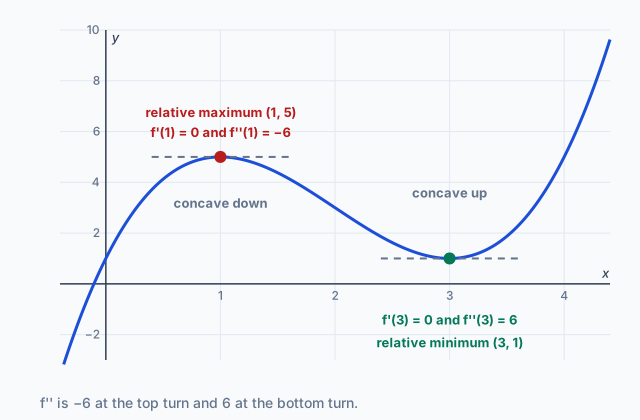
This is the second derivative test. The graph at the top shows both: is negative at the top of the hump and positive at the bottom of the dip.
Take . Then , so the critical points are and , and .
- , so has a relative minimum at , where .
- , so has a relative maximum at , where .
Only the sign of matters, not its size. A justification names the function and both facts: " has a relative minimum at because and ."
Quick check · Calculate
No calculator. Let , whose critical points are and . Use the second derivative test to find where has a relative maximum. What is the relative maximum value of ?
7b. When the test gives no conclusion
The test needs and a second derivative at that is positive or negative. When , it gives no conclusion. Three functions show why. Each has and :
- has a relative minimum at 0;
- has a relative maximum at 0;
- has neither.
The same evidence fits all three outcomes, so cannot decide. It does not mean "neither." It means "use another test": go back to the first derivative test and read the sign of on each side of .
The test also needs to exist. At a corner, such as at 0, does not exist, so cannot either, and again the sign of on each side is the tool.
Last, the test is only for critical points. If is a number other than 0, has no relative extremum at , whatever the sign of , because every relative extremum occurs at a critical point.
Quick check · Sort it
No calculator. Each card gives facts about a function at , where is defined on an open interval around . Tap a card, then what those facts let you conclude about at .
Relative maximum at
Relative minimum at
No relative extremum at
Cannot tell from these facts
7c. From relative to absolute: one critical point
A relative extremum compares with nearby values only. An absolute extremum compares it with every value on the interval. On a closed interval you can compare candidates, but an open or unbounded interval has no endpoints to check. This fact covers that case:
If is continuous on an interval and has only one critical point in it, and has a relative minimum at , then is the absolute minimum of on that interval. The same holds for a maximum.
The reason is the one from the medicine question. To go lower than somewhere else, the graph would have to turn around, and a turn needs a second critical point.
Take for all real . is 0 only at , and , so has a relative minimum there. It is the only critical point, so is the absolute minimum of .
Count the critical points first. For , the relative minimum at is , but is a second critical point, and is lower. There the relative minimum is not the absolute one.
Quick check · Decide and justify
No calculator. Let . Since and , has a relative minimum at , where . A classmate says is the absolute minimum value of on the interval . Is the classmate right?
Which reason supports your answer?
Part 3 Watch it done Two critical points, two different outcomes
Open the steps one at a time. The last one is yours.
Let . Find the critical points of and classify each one, using the second derivative test where it gives a conclusion.
Step 1 · Find the critical points
, which is 0 at and . exists for every , so these are the only critical points.
Step 2 · Find the second derivative
.
Step 3 · Test $x = 3$
. Since and , has a relative minimum at .
Step 4 · Test $x = 0$
, so the second derivative test gives no conclusion at .
Why this step?
Why can't settle what happens at ?
Functions such as , and all have a second derivative of 0 at a critical point, and they have a minimum, a maximum and neither. A zero is consistent with every outcome, so it cannot pick one.
Step 5 · Use the sign of $f'$ at $x = 0$
In , the factor is positive on both sides of 0 and is negative near 0, so on both sides. is decreasing through , so has neither a relative maximum nor a relative minimum there.
Your step · Calculate
No calculator. Finish it. For , the second derivative test showed a relative minimum at . What is the relative minimum value of ?
Part 4 Try it A trigonometric function and an unbounded interval
Try it · Multiple choice
No calculator. Let for . At which value of does have a relative minimum?
Try it · Calculate
No calculator. Let for . What is the absolute minimum value of on the interval ?
Part 5 Explain it Justify it in writing
Free response on the exam is written by hand, so work this on paper. Nothing you type here leaves this page. Then open the model answer and score yourself on each point.
Free response is 50% of the exam score. This one is shaped like Question 5, from free-response Part B (calculator not permitted).
Free-response practice · Question 5 style
No calculator. A delivery drone flies a 1-kilometer route at a constant speed of meters per second. The energy it uses on the route, in kilojoules, is modeled by for .
(a) Find . Determine the speed in the interval at which .
(b) Use the second derivative test to determine whether has a relative minimum or a relative maximum at the speed found in part (a). Justify your answer.
(c) What is the least energy the drone can use on the route, flying at a speed in the interval ? Justify that your value is the absolute minimum of on the interval, and give its units.
Model answer
(a) . Setting gives , so meters per second ( is not in the interval).
(b) , so . Since and , has a relative minimum at .
(c) . is continuous on , and exists on the whole interval and is 0 only at , so is the only critical point there. A relative minimum at the only critical point on an interval is the absolute minimum on that interval, so the least energy is 40 kilojoules, at 10 meters per second.
Score your own answer. This is a self-check, not a grade. Tick each point your answer makes.
Part 6 Check yourself A function known at its critical points
Both case questions use the sentence and the table below. Answer them from those.
The function is twice differentiable for all real numbers, and its only critical points are , and . The table gives the values of and its first two derivatives there.
| 4 | 0 | ||
| 1 | 0 | 0 | |
| 5 | 0 | 6 |
Case question 1 · Multiple choice
No calculator. At which value or values of does the second derivative test show that has a relative maximum?
Case question 2 · Calculate
No calculator. What is the absolute minimum value of on the interval ?
The rest stand on their own and do not use the case.
Check yourself · Spot the error
No calculator. A student classifies the critical points of . Tap the first line with a mistake.
Check yourself · Match
No calculator. Each function has a critical point at . Tap a function, then what is true of it at 0.
Part 7 Keep it Two earlier ideas this test stands on
The second derivative test leans on the first derivative test and on finding . Pull both back up.
Bring it back · Multiple choice
No calculator. The derivative of a function is . Which statement about is true?
Bring it back · Calculate
No calculator. Let . What is the value of at ?
In three lines
- At a critical point where , a negative gives a relative maximum and a positive one a relative minimum.
- If or does not exist, the second derivative test is silent; use the sign of on each side of .
- A relative extremum at the only critical point of a continuous function on an interval is the absolute extremum there.
Exam strategy for this topic
- Section I Part A, Multiple Choice (calculator not permitted): 29 questions in 62 minutes.
- Section I Part B, Multiple Choice (graphing calculator required): 13 questions in 38 minutes.
- Section II Part A, Free Response (graphing calculator required): 2 questions in 30 minutes.
- Section II Part B, Free Response (calculator not permitted): 4 questions in 60 minutes.
When you justify with the second derivative test, write both facts and the conclusion with the function's name: " has a relative maximum at because and ." Saying only "the graph is concave down" leaves out the critical point. For an absolute extremum on an interval with no endpoints to check, say that the point is the only critical point on the interval and that the function is continuous there.
Questions students ask
Do I have to use the second derivative test to find a relative extremum?
Only when a question asks for it. The first derivative test works at every critical point of a continuous function, and the second derivative test is often quicker when is easy to find. If a question says to use the second derivative test, use that one.
What do I write when ?
Say that the second derivative test gives no conclusion at , then switch to the first derivative test: find the sign of just left and just right of .
Does the size of matter?
No. Only its sign decides a maximum or a minimum. A value of 0.01 and a value of 100 both mean a relative minimum when .
Why does the one-critical-point fact need the function to be continuous?
A function with a break can jump to a lower or higher value without any critical point in between, so a relative extremum would not have to be absolute. Continuity rules out the jump.
Is a relative maximum always the largest value of the function?
No. It is the largest only among nearby values. On , the graph at the top of this lesson has a relative maximum of 5 at , and the curve rises above 5 near its right end.
Course alignment, for teachers
AP Calculus AB topic 5.7, Unit 5: Analytical Applications of Differentiation.
- Skill 3.D: Apply an appropriate mathematical definition, theorem, or test.
This lesson maps all 2 essential knowledge statements of the topic to the part that teaches each one: 2 are checked by a scored question. The map is in the lesson file.