Unit 6 · Topic 6.3 · about 30 minutes · 7 parts · 12 scored checks, 3 of them multiple choice
AP Calculus AB 6.3: Riemann Sums, Summation Notation, and Definite Integral Notation
Unit 6: 15 to 20% of the multiple-choice section
What you'll be able to do
- Interpret the limit of Riemann sums as a definite integral.
- Write the limit of a Riemann sum as a definite integral, and a definite integral as the limit of a Riemann sum.
Key vocabulary
| Term | What it means | The exam trap |
|---|---|---|
| Partition | A set of points that cuts into subintervals, not necessarily of equal width. | Find each width from the partition before you use it; a table of values often has uneven spacing. |
| Riemann sum | A sum of products, each the value of at a point in a subinterval times that subinterval's width. | Check that every term has a width as one of its factors before you add. |
| Summation notation | The symbol , which means add the terms for . | Read the bottom and the top of before you write terms; they say where starts and stops. |
| Definite integral, | For a continuous on , the limit of Riemann sums of as the widths of the subintervals approach 0. | The is part of the notation, coming from the widths in the sum; do not leave it off. |
 Tap to open the picture full size
Part 1 Think first Adding up a speed that keeps changing
Commit to a guess before you read on. Even a wrong guess makes the idea easier to hold on to.
Predict first
A car merging onto a highway speeds up, and seconds after it starts, its speed is meters per second, for . You estimate the distance it covers with left Riemann sums: first with 5 subintervals of 2 seconds each, then with 50, then with 500. What happens to the estimates as the subintervals get thinner?
In short. A definite integral is the number that the Riemann sums of a continuous function on approach as the widths of the subintervals approach 0.
- A Riemann sum is : a value of in each subinterval times that subinterval's width, all added.
- The definite integral is the limit of those sums: .
- With equal widths , a limit of sums and a definite integral can be translated in either direction.
Part 2 Learn it From one sum to the integral
3a. A Riemann sum, written with sigma
Cut the interval with points . That set of points is a partition, and it makes subintervals. The th one runs from to , and its width is . The widths do not have to be equal.
In each subinterval, pick one input . A Riemann sum is the sum of products, each a value of times a width:
The symbol , a capital sigma, means add. The under it and the over it say which terms: one for each from 1 to . This is summation notation.
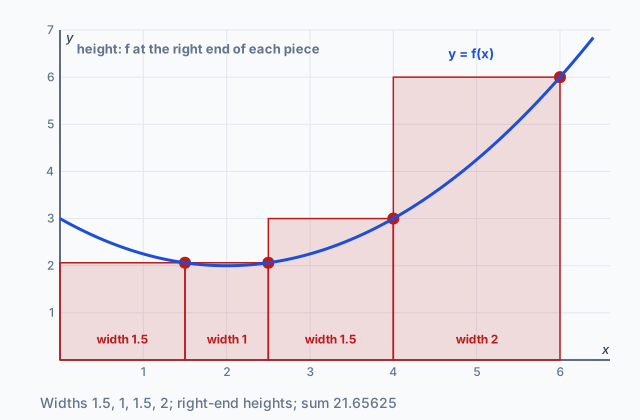
In the picture at the top, the partition is 0, 1.5, 2.5, 4, 6, so the widths are 1.5, 1, 1.5 and 2, and each is the right end of its subinterval. The Riemann sum is .
When the widths are equal, each one is .
Quick check · Calculate
No calculator. What is the value of the Riemann sum ?
3b. The limit of the sums is the definite integral
One Riemann sum is an approximation. Refine the partition so that every subinterval gets narrow, and the flat tops of the rectangles follow the curve more closely. For a continuous function, the sums then approach one number, whichever sample points you use. That number is the definite integral of from to :
Read the two sides piece by piece. The limit of the sum becomes the integral sign , a stretched S for sum. The heights become , and the widths become . The numbers and at the bottom and top of are the ends of the interval.
The condition is on the largest width, . Thinning only some of the subintervals is not enough, because one wide piece that is left keeps its error.
With equal widths , the largest width goes to 0 exactly when , so the limit can be written instead.
Quick check · Decide and justify
No calculator. Let be continuous and increasing on . For every , the left Riemann sum with equal subintervals is less than the right Riemann sum with equal subintervals. A classmate says that as , the two kinds of sum still approach the same number. Is the classmate right?
Which reason supports your answer?
3c. Translating between a limit and an integral
With equal widths and right endpoints, the sample points are , so
From an integral to a limit, fill in that pattern. For , and , so the integral is . Left endpoints, , give the same limit.
From a limit to an integral, read the pattern backward. In , the factor is , so the interval is 3 long. The input is 2 when , so , and . The function is cosine, and the limit is .
One limit can fit more than one integral. This one is also , which moves the interval and the function together. What has to agree is the value.
Quick check · Match
No calculator. Each limit equals one of the definite integrals. Tap a limit, then its integral.
Part 3 Watch it done An integral written as a limit of sums
Open the steps one at a time. The last piece is yours to write.
Write as the limit of a right Riemann sum with subintervals of equal width.
Step 1 · Name the parts
The function is and the interval is , so and .
Step 2 · Find the width
.
Step 3 · Find the right endpoints
The th right endpoint is . Check the ends: gives 2, and gives .
Why this step?
Why does each endpoint start from 2 instead of being just ?
The partition starts at . Without the 2, the points would run from 0 to 4, which is a partition of , the wrong interval for this integral.
Your step · Multiple choice
No calculator. Finish it. With and , which limit equals ?
Part 4 Try it Two more limits to read
Try it · Calculate
No calculator. Write as a definite integral, and use geometry to find its value.
Try it · Sort it
No calculator. Sort each limit by whether it equals .
Equals
Does not equal it
Part 5 Explain it Answer it as a free-response question
Free response on the exam is written by hand, so write your answer on paper first. Nothing you type here leaves this page. Then open the model answer and score yourself on each point.
Free response is 50% of the exam score. This one is shaped like Question 4, from free-response Part B (calculator not permitted).
Free-response practice · Question 4 style
No calculator. Water flows into a tank at the rate liters per minute, where is measured in minutes, for .
(a) Approximate using a left Riemann sum with four subintervals of equal length. Show the computation that leads to your answer, and include units.
(b) Write as the limit of a right Riemann sum with subintervals of equal length.
(c) Find the value of . Using correct units, interpret the meaning of this value in the context of the problem.
Model answer
(a) Each subinterval has length , and the left endpoints are 0, 2, 4 and 6. So liters.
(b) and the right endpoints are , so .
(c) The graph of is a line from to , so the region under it is a trapezoid, and . From to minutes, 40 liters of water flow into the tank.
Score your own answer. This is a self-check, not a grade. Tick each point your answer makes.
Part 6 Check yourself A runner, timed at uneven moments
The first two questions use the same table. A wrong answer links back to the part of the lesson that teaches it.
A runner's velocity is meters per second, where is seconds after the start and is continuous. A coach recorded the values in the table, at times that are not equally spaced.
| (seconds) | (meters per second) |
|---|---|
| 0 | 0 |
| 4 | 5.2 |
| 10 | 6.0 |
| 12 | 5.6 |
| 20 | 4.8 |
Case question 1 · Calculate
No calculator. Use a right Riemann sum with the four subintervals given by the table to approximate . Give the value in meters.
Case question 2 · Multiple choice
No calculator. Partition with times , let , and pick a time in each subinterval. Which expression equals ?
The rest stand on their own and do not use the case.
Check yourself · Spot the error
No calculator. A student writes as a definite integral. Tap the first line with a mistake.
Check yourself · Fill the statement
No calculator. Complete the statement: tap a blank, then a word or phrase.
For a continuous on , Riemann sums approach as the subinterval width approaches 0, and the limit does not depend on .
Part 7 Keep it Bring back earlier ideas
Each limit in this lesson stands on a Riemann sum from the last topic and on limits as grows without bound from Unit 1. Recalling them now keeps them ready.
Bring it back · Multiple choice
No calculator. The function is increasing and concave down on . A left Riemann sum and a trapezoidal sum , each with three subintervals of equal width, approximate . Which statement is true?
Bring it back · Calculate
No calculator. A right Riemann sum for on with equal subintervals simplifies to . Find . Give your answer as a decimal to three places.
In three lines
- A Riemann sum adds products: a value of at a point in each subinterval times that subinterval's width.
- The limit of Riemann sums as the largest width goes to 0 is the definite integral .
- With equal widths, , read in either direction.
Exam strategy for this topic
- Section I Part A, Multiple Choice (calculator not permitted): 29 questions in 62 minutes.
- Section I Part B, Multiple Choice (graphing calculator required): 13 questions in 38 minutes.
- Section II Part A, Free Response (graphing calculator required): 2 questions in 30 minutes.
- Section II Part B, Free Response (calculator not permitted): 4 questions in 60 minutes.
When you turn a limit of a sum into an integral, write , then (the input when ), then before you choose. When a table is unevenly spaced, write each width beside its height before you multiply, and in a free-response answer show the sum with its widths before the number.
Questions students ask
Do the subintervals of a Riemann sum have to be the same width?
No. A partition can have any widths, and tables of data often do. Equal widths make the algebra simpler, which is why the limit form usually uses .
Why is the limit taken as the largest width goes to 0, and not just as ?
More subintervals do not help if one of them stays wide. Making the largest width shrink makes every subinterval thin. With equal widths the two conditions say the same thing, so is used there.
Does it matter whether a limit uses left endpoints, right endpoints or midpoints?
Not for a continuous function. Every choice of sample points gives sums that approach the same definite integral. The choice matters only for one approximation with a fixed number of subintervals.
Can one limit of a Riemann sum be written as more than one integral?
Yes. is , and it is also , which shifts the interval and the function together. Both have the same value.
What does the in mean?
It comes from the widths in the Riemann sum, and it names the variable the function is integrated with respect to. The notation is incomplete without it.
Course alignment, for teachers
AP Calculus AB topic 6.3, Unit 6: Integration and Accumulation of Change.
- Skill 2.C: Identify a re-expression of mathematical information presented in a given representation.
This lesson maps all 4 essential knowledge statements of the topic to the part that teaches each one: 4 are checked by a scored question. The map is in the lesson file.