Unit 6 · Topic 6.4 · about 30 minutes · 7 parts · 12 scored checks, 3 of them multiple choice
AP Calculus AB 6.4: The Fundamental Theorem of Calculus and Accumulation Functions
Unit 6: 15 to 20% of the multiple-choice section
What you'll be able to do
- Write an accumulation function as a definite integral with a variable upper limit, find its values from areas, and find its derivative with the Fundamental Theorem of Calculus.
Key vocabulary
| Term | What it means | The exam trap |
|---|---|---|
| Definite integral | , the limit of Riemann sums of on , which gives the accumulated change, the signed area between the graph of and the axis. | When part of the graph dips below the axis, that piece of area enters with its sign. |
| Accumulation function | A function defined by a definite integral with a variable upper limit, such as . | When a question gives you a graph, decide first whether it is the graph of the integrand or of the accumulation function, then read a number off it. |
| Fundamental Theorem of Calculus | If is continuous on an interval containing , then for every in that interval. | State that the integrand is continuous before you use it, and look twice at the upper limit when it is not plain . |
 Tap to open the picture full size
Part 1 Think first How fast is the total growing?
Commit to a guess first. Even a wrong guess makes the idea easier to hold onto.
Predict first
Water runs into a tank through a pipe whose flow rate keeps changing. Let be the number of liters that have come in during the first minutes. At the instant the pipe is delivering 12 liters per minute, and by then 30 liters have come in. How fast is growing at ?
In short. A definite integral whose upper limit is a variable, , defines a new function, and when is continuous its derivative is .
- The input of is the upper limit , and the integrand uses a different letter, such as .
- The value is the signed area between the graph of and the -axis from to .
- If is continuous on an interval containing , then ; with an upper limit , the chain rule multiplies by .
Part 2 Learn it A function made from an integral, and its derivative
4a. An integral with a moving upper limit
Until now a definite integral had two fixed limits, and its value was one number: the accumulated change from to . Now hold the lower limit fixed and let the upper limit move. Each upper limit gives a different number, so the integral becomes a function of that limit:
A function built this way, by accumulating from a fixed starting input, is an accumulation function.
Read it piece by piece. The input of is , the right end of the interval. Inside the integral the variable is a different letter, , because is already in use as the endpoint; just runs from to . The value is the signed area between the graph of and the -axis from to , with area below the axis counted as negative.
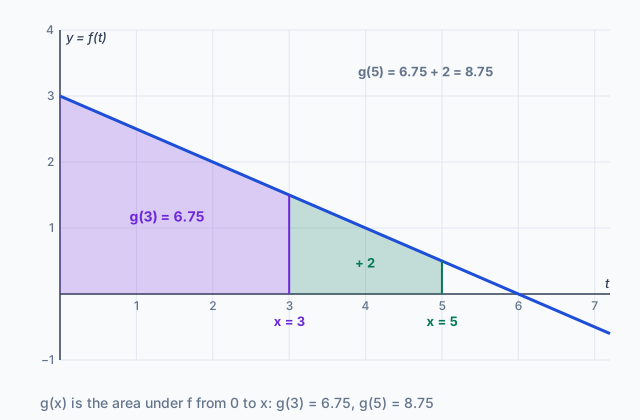
The graph at the top shows with . The shaded region from 0 to 3 has area 6.75, so . Sliding on to 5 adds the green strip, so .
When the interval has no width, so . For other inputs, when the graph of is made of lines or parts of circles, find the area with geometry.
Quick check · Calculate
No calculator. Let , and let . What is ?
4b. The derivative of an accumulation function
How fast does change as moves? Push a little further, to . The new area is the old area plus a thin strip from to . If is continuous, its height hardly changes across that strip, so the strip's area is close to . Then
and the approximation gets better as . The limit of that difference quotient is the derivative, so
This is the Fundamental Theorem of Calculus for accumulation functions. It has a hypothesis: is continuous on an interval containing , and is in that interval. Say so before you use it.
The derivative is the integrand with put in for . The lower limit does not appear in it, because moving only adds or removes a fixed piece of area, a constant. You also never need a formula for . For no area formula is in sight, yet is continuous for , so there, and .
Quick check · Calculate
No calculator. Let . What is ?
4c. When the upper limit is a function of x
Sometimes the upper limit is not but an expression in , such as or . Then the function is a composite. Let be the outer function; then
The chain rule from Unit 3 gives , and the theorem says . So, when is continuous on an interval containing and ,
In words: put the upper limit in for , then multiply by the derivative of the upper limit. Both moves are needed. Two slips are common. One leaves out the factor . The other puts plain into the integrand when the upper limit is .
For example, let . The integrand is continuous everywhere, the upper limit goes in for , and its derivative, 5, multiplies the result:
When the upper limit is plain , its derivative is 1, which is why no extra factor appeared in the last section.
Quick check · Multiple choice
No calculator. Let . Which of the following is ?
Part 3 Watch it done Values and a derivative from a semicircle
Watch each step, then do the last one yourself.
Let for . Find and , and find .
Step 1 · Read the integrand as a graph
is the upper half of the circle , which has radius 3 and center at the origin. It runs from to .
Step 2 · Find g(0) from the area
is the area of the quarter of that circle from to : .
Step 3 · Find g(3) from the area
is the area of the whole upper half: .
Step 4 · Check the hypothesis, then differentiate
is continuous on , an interval that contains the lower limit . By the Fundamental Theorem of Calculus, for in that interval.
Why this step?
Why state that is continuous on before writing ?
The theorem promises only when is continuous on an interval containing the lower limit and . Here the integrand is defined only for , so naming that interval also says where the result holds.
Your step · Calculate
No calculator. Finish it. For , where on , what is ?
Part 4 Try it A claim to judge and a derivation to check
Try it · Decide and justify
No calculator. Let and . A classmate notices that and says that too. Is the classmate right?
Which reason supports your answer?
Try it · Spot the error
No calculator. A student finds for . Tap the first line with a mistake.
Part 5 Explain it Write it the way the exam asks
Free response is handwritten on the exam, so work this on paper first. Nothing you type here leaves this page. Then open the model answer and score yourself on each point.
Free response is 50% of the exam score. This one is shaped like Question 5, from free-response Part B (calculator not permitted).
Free-response practice · Question 5 style
No calculator. A tank holds 40 liters of water at time . For , water flows into the tank at a rate of liters per hour, where is measured in hours, for , and for . No water leaves the tank.
(a) Write an expression involving an integral for , the number of liters of water in the tank at time hours.
(b) Find . Show the work that leads to your answer.
(c) Find , and justify your answer. Using correct units, interpret the meaning of in the context of the problem.
Model answer
(a) .
(b) . From to the graph of and the -axis bound a triangle of area . From to they bound a trapezoid of area . So liters.
(c) Both pieces of equal 6 at , so is continuous on . By the Fundamental Theorem of Calculus, , so . At time hours, the amount of water in the tank is increasing at a rate of 4 liters per hour.
Score your own answer. This is a self-check, not a grade. Tick each point your answer makes.
Part 6 Check yourself A function given by line segments
The two case questions use the same table. Answer them from it.
The function is continuous on , and its graph consists of line segments joining the points in the table. Let .
| 0 | 4 |
|---|---|
| 2 | 4 |
| 4 | 0 |
| 6 | |
| 8 |
Case question 1 · Calculate
No calculator. What is ?
Case question 2 · Multiple choice
No calculator. What is ?
The rest stand on their own and do not use the case.
Check yourself · Fill the statement
No calculator. The function is continuous everywhere. Tap a blank, then tap an answer.
For , the value is , and the derivative is .
Check yourself · Match
No calculator. Each function of is defined by an integral. Tap a function, then its derivative.
Part 7 Keep it Bring back earlier ideas
This lesson leans on the units of accumulated change from 6.1 and on the chain rule from Unit 3. Pulling them back up is what makes them last.
Bring it back · Multiple choice
No calculator. Water leaks from a barrel at a rate of gallons per minute, where is measured in minutes. In what units is the area of the region between the graph of and the -axis from to measured?
Bring it back · Calculate
No calculator. Let . What is ?
In three lines
- A definite integral with a variable upper limit, , defines a new function of .
- Its value at is the signed area from to , so it is 0 at .
- For continuous its derivative is ; with an upper limit , multiply by .
Exam strategy for this topic
- Section I Part A, Multiple Choice (calculator not permitted): 29 questions in 62 minutes.
- Section I Part B, Multiple Choice (graphing calculator required): 13 questions in 38 minutes.
- Section II Part A, Free Response (graphing calculator required): 2 questions in 30 minutes.
- Section II Part B, Free Response (calculator not permitted): 4 questions in 60 minutes.
To differentiate a function defined by an integral, first say the integrand is continuous, then write the integrand at the upper limit times the derivative of the upper limit. To find a value of an accumulation function, write the integral with both limits and its , then find the signed area, and give units when there is a context.
Questions students ask
Why is the variable inside the integral and not ?
Because is already the upper limit. Inside the integral the variable runs from to , so it needs its own letter. Writing uses one letter for two jobs and is not accepted notation.
Does the lower limit change the derivative?
No. Changing adds or removes a fixed piece of area, which is a constant, and a constant has derivative 0. The lower limit does change the values of the function, though, because it sets where equals 0.
Do I need a formula for before I can find ?
No. The theorem gives directly. That is what makes it useful for integrands such as , where no area formula is available.
Can an accumulation function be negative?
Yes. Area below the -axis counts as negative, so if more of the region from to lies below the axis than above it, is negative.
What if the upper limit is something like ?
Then the function is a composite, and the chain rule applies: put in for , then multiply by , the derivative of the upper limit.
Course alignment, for teachers
AP Calculus AB topic 6.4, Unit 6: Integration and Accumulation of Change.
- Skill 1.D: Identify an appropriate mathematical rule or procedure based on the relationship between concepts (e.g., rate of change and accumulation) or processes (e.g., differentiation and its inverse process, anti-differentiation) to solve problems.
This lesson maps all 2 essential knowledge statements of the topic to the part that teaches each one: 2 are checked by a scored question. The map is in the lesson file.