Unit 6 · Topic 6.6 · about 30 minutes · 7 parts · 13 scored checks, 3 of them multiple choice
AP Calculus AB 6.6: Applying Properties of Definite Integrals
Unit 6: 15 to 20% of the multiple-choice section
What you'll be able to do
- Calculate a definite integral from the signed areas of familiar shapes and from the properties of definite integrals.
Key vocabulary
| Term | What it means | The exam trap |
|---|---|---|
| Definite integral | The number , the limit of Riemann sums for on ; where it is the area between the graph and the -axis. | When part of the graph is below the axis, the integral and the total area are different numbers. Read which one the question asks for. |
| Limits of integration | The numbers and in : the lower limit , where the integral starts, and the upper limit , where it ends. | The lower limit does not have to be the smaller number. Check which limit is on the bottom before you use a value you were given. |
| Adjacent intervals | Two intervals that share an endpoint, such as and , so that together they make one interval. | Before you add two integrals, check that their intervals really meet at a shared endpoint. |
| Removable discontinuity | A point where exists but is not defined or not equal to the limit: a hole in the graph. | Being defined at does not settle whether is continuous at . Check the definition of continuity there. |
| Jump discontinuity | A point where both one-sided limits of exist but are not equal, so the graph jumps from one height to another. | Work out which formula applies on each side of the jump before you compute anything on either piece. |
 Tap to open the picture full size
Part 1 Think first How far did the scooter go?
Make a guess before the lesson starts. Even a wrong guess helps the answer stick.
Predict first
An electric scooter starts from rest and speeds up steadily, reaching 6 meters per second after 4 seconds. It then holds 6 meters per second for 3 more seconds. You have no formula for its velocity, only that description. How far does it travel in those 7 seconds?
In short. A definite integral can often be evaluated without an antiderivative, from the signed areas of shapes and from integrals whose values you already know.
- Area above the -axis counts as positive and area below counts as negative, so rectangles, triangles, trapezoids and circles give many integrals.
- Constants factor out, integrals of sums and differences split, reversing the limits changes the sign, and integrals over adjacent intervals add.
- A function with a removable or a jump discontinuity still has a definite integral: a single point adds no area, and a jump is handled by splitting the interval there.
Part 2 Learn it Shapes first, then the rules that combine them
6a. A definite integral from shapes you know
When the graph of is made of line segments and pieces of circles, you can evaluate with geometry. The definite integral measures the region between the graph and the -axis from to , with one adjustment: area above the axis counts as positive and area below the axis counts as negative.
Find each piece's area with a formula you know, give it its sign, and add.
- Rectangle: base times height.
- Triangle: times base times height.
- Trapezoid: the average of the two parallel sides times the width.
- Circle of radius : , so a semicircle is and a quarter circle is .
Example: . The graph of is the top half of the circle of radius 2 centered at the origin, so the region is a semicircle above the axis and the integral is .
With a sign change: . The line crosses the axis at . From 0 to 2 it bounds a triangle above the axis with area . From 2 to 5 it bounds a triangle below the axis with area , which counts as . So . The total area of the triangles, 6.5, is a different number.
Quick check · Calculate
No calculator. Use geometry to evaluate .
6b. Constant multiples and sums
Two properties let you take an integral apart and use values you already know.
Constant multiple: . Multiplying every height by multiplies every signed area by .
Sum: . Stacking one function's heights on top of another's adds their signed areas. Put the two together, with , and a difference splits the same way.
A constant on its own is a rectangle: , its height times the width of the interval, not just .
Example. Suppose and . Then
There is no such rule for a product. In general is not : with on , the integral of the product is 2, while the product of the integrals is .
Quick check · Multiple choice
No calculator. Suppose and . What is ?
6c. Reversing the limits and joining intervals
Reversal of limits: . In a Riemann sum each width is the change in across a piece. Running from back to makes every width negative, so the whole sum changes sign. An interval of no width gives nothing: .
Adjacent intervals: . The region from to and the region from to together make the region from to .
With reversal, the adjacent-interval property holds whatever order , and come in, as long as is integrable on an interval that contains all three. That makes it a tool for finding a missing piece. Suppose and . The pieces from 0 to 4 and from 4 to 10 make up 0 to 10, so
and reversing the limits, .
Before you combine values, write out the limits of every integral you know and of the one you want. The missing piece is usually easy to see once they are side by side.
Quick check · Match
No calculator. Suppose and . Tap an integral, then its value.
6d. Holes and jumps
The definite integral was defined for continuous functions, but the definition extends to a function with a removable discontinuity or a jump discontinuity. Two facts make that work.
A single point has no width. Changing a function's value at one input, or leaving it with no value there, changes no area. Take , which is not defined at . Everywhere else , so . That region is a trapezoid with parallel sides 1 and 4 and width 3, so the integral is .
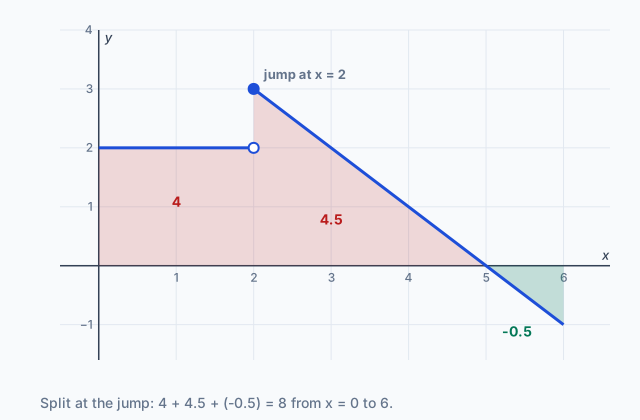
A jump splits the interval. Integrate each side of the jump as its own function, then add the pieces with the adjacent-interval property. The graph at the top of this lesson jumps at . The rectangle on the left, the triangle above the axis and the triangle below it give from 0 to 6.
Which side's formula holds at the jump itself makes no difference, for the same reason as before: it is one point, and one point adds no area.
Quick check · Decide and justify
No calculator. Let for and for . A classmate says , even though is not continuous at . Is the classmate right?
Which reason supports your answer?
Part 3 Watch it done Three properties and two shapes in one integral
Watch each step, then do the last one yourself.
Let for and for . Find .
Step 1 · Reverse the limits and factor out the 3
.
Step 2 · Split at the jump
As approaches 2 from the left, approaches 3, but . That is a jump, so integrate each side on its own: .
Why this step?
Why may the first piece use all the way to , when is 2 and not 3?
The value at a single input sits over no width, so it adds no area. That is why the definite integral extends to a function with a jump: each side is integrated as its own function, and which side owns the point makes no difference.
Step 3 · Left piece: a trapezoid
From 0 to 2, rises from 1 to 3 above the axis, so .
Step 4 · Right piece: two triangles
at . From 2 to 3 the region is a triangle above the axis with base 1 and height 2, area 1. From 3 to 5 it is a triangle below the axis with base 2 and height 4, area 4, which counts as . So .
Your step · Calculate
No calculator. Finish it. Let for and for , so that and . What is ?
Part 4 Try it A hole, and a set of claims
Try it · Spot the error
No calculator. Let for , and let . A student evaluates . Tap the first line with a mistake.
Try it · Sort it
No calculator. Here and are continuous on an interval that contains , and . Sort each statement: is it true for every such and , or not true in general? Tap a card, then a bin.
True for every and
Not true in general
Part 5 Explain it Answer it the way the exam asks
On the exam free response is handwritten, so work this on paper first. Nothing you type here leaves this page. Then open the model answer and score yourself on each point.
Free response is 50% of the exam score. This one is shaped like Question 3, from free-response Part B (calculator not permitted).
Free-response practice · Question 3 style
No calculator. Water flows into and out of a tank. For , the net rate at which water flows into the tank is liters per minute, where is measured in minutes, for , and for .
(a) The function is not continuous at . Explain why is still defined.
(b) Use geometry and the properties of definite integrals to find . Show the work that leads to your answer. Using correct units, interpret the meaning of this value in the context of the problem.
(c) A hose adds water at a constant 1.5 liters per minute for the whole 10 minutes, so the net rate becomes . Find , and identify the property of definite integrals that you use.
Model answer
(a) As approaches 4 from the left, approaches 8, but , so has a jump discontinuity at . On each side of the jump is a line. The definite integral extends to a function with a jump discontinuity: integrate each side and add, .
(b) is a triangle with base 4 and height 8, so it is 16. On , at : from 4 to 8 a triangle below the axis with base 4 and height 4 gives , and from 8 to 10 a triangle above with base 2 and height 2 gives 2. So liters. Over the 10 minutes, the amount of water in the tank increased by 10 liters.
(c) By the sum property, liters.
Score your own answer. This is a self-check, not a grade. Tick each point your answer makes.
Part 6 Check yourself Integrals from a table of known values
The two case questions use the same table. Answer them from it.
The functions and are continuous on . Their graphs are not given, but the values of three definite integrals are.
| Integral | Value |
|---|---|
| 4 | |
| 5 |
Case question 1 · Calculate
No calculator. What is ?
Case question 2 · Calculate
No calculator. What is ?
The rest stand on their own and do not use the case.
Check yourself · Fill the statement
No calculator. Tap a blank, then tap an answer.
For , the region between the graph of and the -axis is a of radius 4 that lies below the axis, so equals .
Check yourself · Multiple choice
No calculator. The function is continuous on . Which expression is equal to for every such ?
Part 7 Keep it Bring back earlier ideas
One question from earlier in this unit and one from Unit 1, whose kinds of discontinuity this lesson's last idea leans on.
Bring it back · Calculate
No calculator. Let . What is ?
Bring it back · Multiple choice
No calculator. Let for , and let . What kind of discontinuity does have at ?
In three lines
- A definite integral is a signed area: area above the axis counts as positive and area below counts as negative.
- Constants factor out, sums and differences split, reversed limits change the sign, and integrals over adjacent intervals add.
- A removable or jump discontinuity does not stop a definite integral: one point adds no area, and a jump splits the interval.
Exam strategy for this topic
- Section I Part A, Multiple Choice (calculator not permitted): 29 questions in 62 minutes.
- Section I Part B, Multiple Choice (graphing calculator required): 13 questions in 38 minutes.
- Section II Part A, Free Response (graphing calculator required): 2 questions in 30 minutes.
- Section II Part B, Free Response (calculator not permitted): 4 questions in 60 minutes.
When you build an integral from pieces, write each piece as an integral with its limits and its signed value, such as , before you add or multiply. The property you used is then visible in your work, and a sign slip is easy to find.
Questions students ask
Is a definite integral the same as the area under the curve?
Only where the graph is on or above the -axis. Below the axis the definite integral counts area as negative. For total area, add the areas of the pieces as positive numbers.
Why does reversing the limits change the sign?
In a Riemann sum each width is the change in from the start of a piece to its end. Going from down to makes every width negative, so every product in the sum, and the sum itself, changes sign.
Can I use these properties when I do not know a formula for the function?
Yes, and that is often the point. Given the values of a few integrals, the constant multiple, sum, reversal and adjacent-interval properties give the values of others without any formula for the function.
Does the value of a function at a jump change the integral?
No. A single input has no width, so its value adds no area. Integrate each side of the jump as its own function and add the two pieces.
Do I need to memorize area formulas for this?
You need the ones for rectangles, triangles, trapezoids and circles, including half and quarter circles. A graph such as is the top half of a circle of radius centered at the origin.
Course alignment, for teachers
AP Calculus AB topic 6.6, Unit 6: Integration and Accumulation of Change.
- Skill 3.D: Apply an appropriate mathematical definition, theorem, or test.
This lesson maps all 3 essential knowledge statements of the topic to the part that teaches each one: 3 are checked by a scored question. The map is in the lesson file.