Unit 6 · Topic 6.7 · about 30 minutes · 7 parts · 12 scored checks, 3 of them multiple choice
AP Calculus AB 6.7: The Fundamental Theorem of Calculus and Definite Integrals
Unit 6: 15 to 20% of the multiple-choice section
What you'll be able to do
- Evaluate a definite integral exactly by finding an antiderivative and applying the Fundamental Theorem of Calculus.
Key vocabulary
| Term | What it means | The exam trap |
|---|---|---|
| Antiderivative | A function whose derivative is , so that . | Differentiate your answer before you use it; that one step catches most sign and coefficient slips. |
| Definite integral | , the limit of Riemann sums of over , which gives the accumulated change over that interval. | Read which number is the upper limit and which is the lower before you compute anything. |
| Fundamental Theorem of Calculus | If is continuous on and is an antiderivative of , then . | It comes with a hypothesis about the integrand. State it in your work before you use the theorem. |
| Accumulation function | A function defined by a definite integral with a variable limit, such as . | The inside the integral is only a placeholder; the function's input is the limit , so write the answer in terms of . |
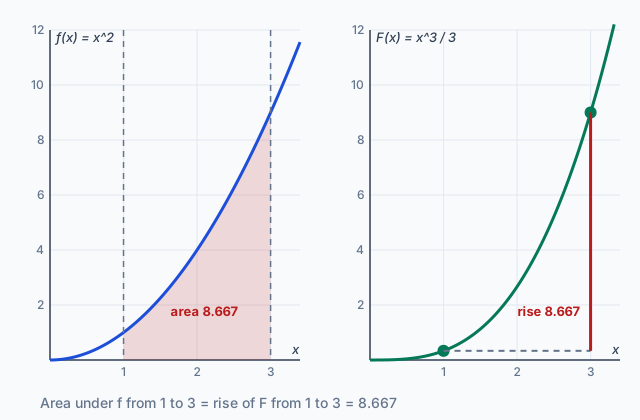 Tap to open the picture full size
Part 1 Think first How high does the drone climb?
Guess before you learn. A wrong guess still makes the answer stick.
Predict first
A drone lifts off and climbs with upward velocity meters per second, seconds after takeoff. How many meters does it rise between and ?
In short. The Fundamental Theorem of Calculus says that if is continuous on and is any antiderivative of , then .
- An antiderivative of is a function whose derivative is , and you can check one by differentiating it.
- When is continuous, the accumulation function is itself an antiderivative of , the one whose value at is 0.
- Check that is continuous on the whole interval before you use the theorem, and subtract in the order .
Part 2 Learn it Antiderivatives and the theorem that uses them
2a. An antiderivative runs a derivative backward
An antiderivative of a function is a function whose derivative is , so . Finding one means reading a derivative rule from right to left and asking what was differentiated to give .
Every rule from Unit 2 gives you one. Since , the function is an antiderivative of . Since , the function is an antiderivative of .
For a power with , raise the exponent by 1 and divide by the new exponent. An antiderivative of is , and differentiating gives back . The one exception is , where the new exponent would be 0; for , read an antiderivative off the derivative rule instead.
Always check by differentiating. A guess is an antiderivative exactly when its derivative is the function you started with. The check catches the usual slip with sine and cosine, where one of the two derivatives carries a minus sign: , while .
An antiderivative is never the only one. and also have derivative , because the derivative of a constant is 0. On an interval, any two antiderivatives of the same function differ by a constant.
Quick check · Match
No calculator. Tap a function, then an antiderivative of it.
2b. The accumulation function is an antiderivative
In topic 6.4 you met functions built from an integral, such as , and learned that when is continuous. Read that sentence again with this lesson's word in it: if is continuous on an interval containing , then is an antiderivative of on that interval.
So every continuous function has an antiderivative, even one no rule gives you. And this antiderivative has one feature the others lack:
That fixes which antiderivative it is. Suppose you want . Since , is plus some constant . Since , and . So
Check it: the derivative is , and the value at is 0.
Look at what that says about any other antiderivative of . and differ by a constant, , and at the constant is . So : the accumulation function is any antiderivative minus its own value at the lower limit.
Quick check · Multiple choice
No calculator. Let . Which expression is ?
2c. The Fundamental Theorem: F(b) minus F(a)
Put into the last line of the chunk before. The accumulation function at is the definite integral, so for any antiderivative :
Fundamental Theorem of Calculus. If is continuous on and is an antiderivative of , then
That turns an area or an accumulation into two function values and a subtraction. For : an antiderivative of is , so the integral is .
Three things to hold on to.
- Any antiderivative works. With you get . The constant appears in both values and cancels, so use the simplest one.
- Upper limit first. It is , the value at the top of the integral sign minus the value at the bottom. Reversed, you get the opposite sign.
- Check the hypothesis. The theorem needs continuous on all of . A function such as breaks at , so the theorem says nothing about an integral of it over an interval that contains 0.
Quick check · Calculate
No calculator. Evaluate .
Part 3 Watch it done Evaluating a definite integral with the theorem
Watch each step, then do the last one yourself.
Evaluate .
Step 1 · Check the hypothesis
The integrand is defined for every except 0, and 0 is not in . So it is continuous on , and the Fundamental Theorem of Calculus applies.
Why this step?
Why check continuity before you look for an antiderivative?
Continuity on is what the theorem needs. On the same integrand breaks at , and subtracting antiderivative values there would give a number the theorem does not back up.
Step 2 · Find an antiderivative
Write as . Raising the exponent to and dividing by gives . So , and the check works: .
Step 3 · Evaluate at both limits
and .
Your step · Calculate
No calculator. Finish it. With , and , what is ?
Part 4 Try it A leak and a claim
Try it · Calculate
No calculator. Water leaks from a barrel at a rate of liters per hour, hours after noon. How many liters leak out from to ?
Try it · Decide and justify
No calculator. A classmate writes , using the antiderivative . Is the classmate's work right?
Which reason supports your answer?
Part 5 Explain it Write it the way the exam asks
On the exam free response is written by hand, so do this one on paper first. Nothing you type here leaves this page. Then compare with the model answer and score yourself on each point.
Free response is 50% of the exam score. This one is shaped like Question 4, from free-response Part B (calculator not permitted).
Free-response practice · Question 4 style
No calculator. A tank holds 50 liters of water at time . For , water flows into the tank at the rate liters per minute and drains out at the rate liters per minute, where is in minutes.
(a) Use the Fundamental Theorem of Calculus to find . Show the antiderivative you use. Using correct units, interpret the meaning of the value in the context of the problem.
(b) Find the amount of water in the tank at time . Show the work that leads to your answer.
(c) Is the amount of water in the tank increasing or decreasing at time ? Justify your answer.
Model answer
(a) , and an antiderivative is , since . is continuous on , so . During the first 4 minutes, 32 liters of water flow into the tank.
(b) Let be the amount of water in the tank, in liters, at time . Then . An antiderivative of is , and is continuous on , so . So liters.
(c) The amount in the tank is , so . , so the amount of water is decreasing at .
Score your own answer. This is a self-check, not a grade. Tick each point your answer makes.
Part 6 Check yourself An antiderivative from a table
The two case questions use the same table. Answer them from it.
The function is continuous for all real numbers, and is an antiderivative of . Some values of are in the table.
| 0 | 4 |
|---|---|
| 1 | 1 |
| 2 | |
| 3 | 2 |
| 4 | 6 |
| 5 | 5 |
Case question 1 · Calculate
No calculator. What is the value of ?
Case question 2 · Multiple choice
No calculator. Let . What is ?
The rest stand on their own and do not use the case.
Check yourself · Spot the error
No calculator. A student evaluates . Tap the first line with a mistake.
Check yourself · Sort it
No calculator. Sort each function: is it an antiderivative of , or not?
An antiderivative of
Not an antiderivative of
Part 7 Keep it Bring back earlier ideas
The theorem leans on a property of integrals from 6.6 and on the derivative rules from Unit 2. Pulling them back up is what makes them last.
Bring it back · Calculate
No calculator. If and , what is ?
Bring it back · Multiple choice
No calculator. If , what is ?
In three lines
- An antiderivative of f is a function whose derivative is f, and differentiating it is the check.
- For continuous f, the integral of f from a to x is the antiderivative that is 0 at a.
- If f is continuous on [a, b] and F is any antiderivative, the integral from a to b is F(b) minus F(a).
Exam strategy for this topic
- Section I Part A, Multiple Choice (calculator not permitted): 29 questions in 62 minutes.
- Section I Part B, Multiple Choice (graphing calculator required): 13 questions in 38 minutes.
- Section II Part A, Free Response (graphing calculator required): 2 questions in 30 minutes.
- Section II Part B, Free Response (calculator not permitted): 4 questions in 60 minutes.
On a no-calculator integral, write the antiderivative you are using and then with both values before you simplify, so a reader can follow every step. On a calculator integral, write the integral itself, with its integrand, both limits and , before you give the number to three decimal places.
Questions students ask
Which antiderivative should I use?
Any one. A constant added to appears in both and and cancels in the subtraction, so the simplest antiderivative, with no constant, is the usual choice.
How is this different from what I did in 6.4?
In 6.4 you differentiated a function defined by an integral. Here the same fact is read the other way: that function is an antiderivative, and it leads to a way to evaluate any definite integral of a continuous function from an antiderivative.
Can the answer be negative?
Yes. A definite integral is a signed accumulation, so if is negative on most of the result can be negative. If is positive on the whole interval, though, a negative answer means something went wrong.
What if I cannot find an antiderivative?
Some continuous functions, such as , have an antiderivative that no formula you know writes down. The integral still exists. Where a question allows a calculator, write the integral with its integrand, both limits and , then give the calculator's value.
Do I really have to check continuity every time?
On paper, a short phrase is enough: "the integrand is continuous on ." It matters most when the integrand has a denominator or a logarithm, because those are where a break can sit inside the interval.
Course alignment, for teachers
AP Calculus AB topic 6.7, Unit 6: Integration and Accumulation of Change.
- Skill 3.D: Apply an appropriate mathematical definition, theorem, or test.
This lesson maps all 3 essential knowledge statements of the topic to the part that teaches each one: 3 are checked by a scored question. The map is in the lesson file.