Unit 6 · Topic 6.8 · about 30 minutes · 7 parts · 13 scored checks, 3 of them multiple choice
AP Calculus AB 6.8: Finding Antiderivatives and Indefinite Integrals: Basic Rules and Notation
Unit 6: 15 to 20% of the multiple-choice section
What you'll be able to do
- Find antiderivatives and indefinite integrals by running the derivative rules backward, and write them with integral notation and .
Key vocabulary
| Term | What it means | The exam trap |
|---|---|---|
| Antiderivative | A function is an antiderivative of when . | Check a proposed antiderivative by differentiating it and comparing with the original function, not by how it looks. |
| Indefinite integral, | The family of all antiderivatives of , written , where and is any constant. | An indefinite integral is a family of functions, not a number; read whether an integral sign has limits before you answer. |
| Constant of integration, | The arbitrary constant in ; each value of gives a different antiderivative of the same function. | Write on every indefinite integral, and keep it to the last line of the work. |
| Closed-form antiderivative | An antiderivative written with finitely many familiar functions, such as powers, roots, exponentials, logarithms and trigonometric functions. | A function can have an antiderivative that has no closed form; failing to find a formula does not mean it has no antiderivative. |
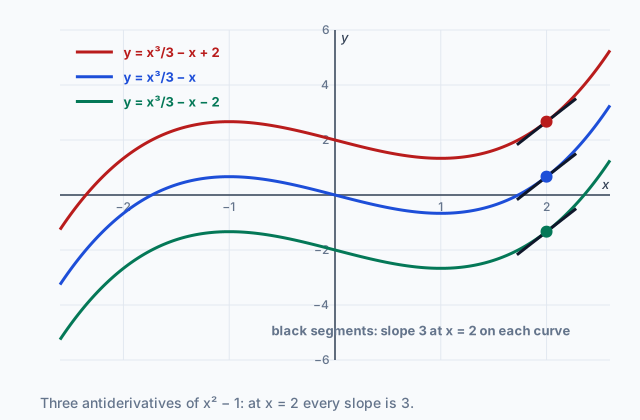 Tap to open the picture full size
Part 1 Think first How far after five seconds?
Commit to a guess first. Even a wrong guess makes the lesson stick better.
Predict first
A cyclist starts from rest and speeds up steadily, so that seconds later her speed is meters per second. How far has she ridden after 5 seconds?
In short. An antiderivative of is a function with , and the indefinite integral names every one of them at once.
- Two antiderivatives of the same function on an interval differ by a constant, which is why an indefinite integral ends in .
- Each derivative rule read backward is an antiderivative rule, so you check an antiderivative by differentiating it.
- Some functions have antiderivatives that cannot be written in closed form, and those are handled numerically or with an accumulation function.
Part 2 Learn it Antiderivatives, one idea at a time
2a. An antiderivative, and the + C
Up to now you have gone from a function to its derivative. Here you go the other way. A function is an antiderivative of when .
Take . Because , the function is an antiderivative of . So are and : a constant has derivative 0, so adding one does not change any slope. Their graphs are one curve shifted up or down, like the three curves in the picture at the top.
On an interval those shifts are the only antiderivatives there are, because two functions with the same derivative differ by a constant. The indefinite integral names the whole family at once:
where is any constant. In general , where . The function inside, , is the integrand, and says that is the variable.
An indefinite integral is a family of functions, not a number. The definite integral from earlier in this unit is the number. To check an antiderivative, differentiate it and compare with .
Quick check · Decide and justify
No calculator. Let . Is an antiderivative of ?
Which reason supports your answer?
2b. Run the derivative rules backward
Every derivative rule you know, read from right to left, is an antiderivative rule. Each row below starts from a derivative you already have.
| Because | the indefinite integral is |
|---|---|
| , for | |
The power rule has a gap at , where it would divide by 0. That gap is filled by the logarithm row: gets .
The derivative rules for sums and constant multiples run backward too: , and the integral of a sum is the sum of the integrals. So
Rewrite roots and fractions as powers before you start: and .
Quick check · Match
No calculator. Tap an integral, then the indefinite integral it equals.
2c. Some antiderivatives have no formula
A function that is continuous on an interval always has an antiderivative there. Whether you can write one down is a different question.
An antiderivative is in closed form when it is built from finitely many familiar functions (powers and roots, exponentials, logarithms, trigonometric and inverse trigonometric functions) by adding, subtracting, multiplying, dividing and composing them. Many functions have no closed-form antiderivative. Three you will meet are
This is not a matter of nobody being clever enough: mathematicians have proved that no such formula exists.
Looks can mislead. has no closed-form antiderivative, but has one, itself, because the chain rule gives . Before you decide that a function has none, ask whether it is the derivative of something you know.
A function with no closed-form antiderivative can still be worked with. A graphing calculator evaluates a definite integral of it numerically, and an accumulation function such as is an antiderivative of that needs no formula.
Quick check · Multiple choice
No calculator. Which of these functions has no closed-form antiderivative?
Part 3 Watch it done An indefinite integral, term by term
Open each step in turn, then finish the last one yourself.
Find .
Step 1 · Rewrite as powers
, so the integrand is .
Step 2 · Split the integral
By the sum and constant multiple rules, .
Step 3 · Reverse the power rule
and , each up to a constant.
Why this step?
Why is the second term when the integrand had ?
Raising the exponent from gives , and the rule divides by that new exponent. Dividing by gives . A quick check: .
Your step · Fill the statement
No calculator. Finish it. Tap a blank, then tap an answer.
The derivative of is , so an antiderivative of is .
Check the whole answer by differentiating: . That is the integrand, so the antiderivative is right. One at the end covers the constants from all three terms.
Part 4 Try it New integrands
Try it · Sort it
No calculator. How would you find an antiderivative of each function, if you can write one at all? Tap a card, then a bin.
Reverse the power rule
Reverse a trigonometric derivative
No closed-form antiderivative
Try it · Calculate
Graphing calculator required. The function has no closed-form antiderivative, so cannot be found from an antiderivative by hand. Use your calculator to evaluate it. Give your answer to three decimal places.
Part 5 Explain it Write it out, then score it
Free response on the exam is written by hand, so answer on paper first. Nothing you type on this page leaves it. Then open the model answer and give yourself each point you earned.
Free response is 50% of the exam score. This one is shaped like Question 4, from free-response Part B (calculator not permitted).
Free-response practice · Question 4 style
No calculator. Water is pumped into a storage tank at a rate modeled by gallons per hour, for , where is measured in hours.
(a) Find . Show the antiderivative of each term.
(b) Verify your answer to part (a) by differentiating it.
(c) Let be the number of gallons of water in the tank at time , so . Ana and Ben each model with your answer to part (a); Ana takes and Ben takes . Explain why both models agree with the rate . Using correct units, interpret the difference between the two models in the context of the problem.
Model answer
(a) Write as . Then .
(b) , which is .
(c) The two models differ only by the constant, and a constant has derivative 0, so both have . Ben's model puts 150 more gallons of water in the tank than Ana's at every time . The rate alone cannot tell the two apart; the amount of water at one time, such as , would.
Score your own answer. This is a self-check, not a grade. Tick each point your answer makes.
Part 6 Check yourself A table of derivatives, used backward
The first three questions use the table. The last two stand on their own.
A student made this table of derivatives while studying. Every row is correct. Use it to answer the questions.
Case question 1 · Multiple choice
No calculator. Use the table. Which of these is ?
Case question 2 · Calculate
No calculator. Let be any antiderivative of on the interval . Use the table to find .
Case question 3 · Decide and justify
No calculator. A classmate reads the table's second row and writes . Is the classmate right?
Which reason supports your answer?
The rest stand on their own and do not use the case.
Check yourself · Spot the error
No calculator. A student finds . Tap the first line with a mistake.
Check yourself · Sketch the graph
No calculator. is an antiderivative of . Sketch a possible graph of for from 0 to 4. The first point is fixed at 0.
One shape that fits
Drag a point up or down, or tap it and use the arrow keys. Only the shape is checked.
Part 7 Keep it Bring back earlier ideas
This lesson leans on an accumulation function from earlier in the unit and on the chain rule from Unit 3. Pulling each back up is what keeps it.
Bring it back · Calculate
No calculator. Let . Find .
Bring it back · Multiple choice
No calculator. If , what is ?
In three lines
- An antiderivative of is any function whose derivative is , and they differ from each other by constants.
- names them all, and the derivative rules read backward give .
- Some functions have no closed-form antiderivative, and then a calculator or an accumulation function does the work.
Exam strategy for this topic
- Section I Part A, Multiple Choice (calculator not permitted): 29 questions in 62 minutes.
- Section I Part B, Multiple Choice (graphing calculator required): 13 questions in 38 minutes.
- Section II Part A, Free Response (graphing calculator required): 2 questions in 30 minutes.
- Section II Part B, Free Response (calculator not permitted): 4 questions in 60 minutes.
In a written answer, show the antiderivative of each term, end every indefinite integral with , and differentiate your result to check it before you move on. When a definite integral's integrand has no closed-form antiderivative, write the integral with its limits and , then evaluate it with the calculator.
Questions students ask
Why does every indefinite integral need ?
Because a function has infinitely many antiderivatives, one for each constant. , and all have derivative , and names all of them.
What is the difference between and ?
The first, with no limits, is a family of functions, . The second, with limits, is a single number. Antiderivatives connect them: when is continuous on , the Fundamental Theorem of Calculus gives .
Why is it and not ?
is only defined for , but is also defined for . For the chain rule gives , so covers both sides.
Is there a product rule or a quotient rule for antiderivatives?
Not one you can apply term by term. Rewrite first when you can, by expanding a product or splitting a fraction into powers, and check the result by differentiating. Topic 6.9 adds a method that reverses the chain rule.
If I can't find an antiderivative, does that mean there isn't one?
No. Some integrands, such as , look hard and have a closed form. Others, such as , have antiderivatives with no closed form. Either way, a continuous function on an interval always has an antiderivative.
Course alignment, for teachers
AP Calculus AB topic 6.8, Unit 6: Integration and Accumulation of Change.
This lesson maps all 3 essential knowledge statements of the topic to the part that teaches each one: 3 are checked by a scored question. The map is in the lesson file.