Unit 7 · Topic 7.3 · about 30 minutes · 7 parts · 12 scored checks, 4 of them multiple choice
AP Calculus AB 7.3: Sketching Slope Fields
Unit 7: 5 to 10% of the multiple-choice section
What you'll be able to do
- Sketch a slope field for a differential equation at given points, and use the signs and patterns of its slopes to describe where solutions increase or decrease and to match a field to its equation.
Key vocabulary
| Term | What it means | The exam trap |
|---|---|---|
| Differential equation | An equation that gives a derivative, such as , in terms of the variables, such as and . | Before you use one, note which variables its right side actually contains. |
| Slope field | A picture of a differential equation made of short segments, one at each point of a finite grid, each tilted at the slope the equation gives at that point. | Ask what a segment's tilt stands for before you read anything else off the picture. |
| Grid point | One of the evenly spaced points where a slope field is drawn, such as every point with integer and from to 3. | Read each point as and keep the sign of a negative coordinate when you substitute. |
| Horizontal segment | A segment with slope 0, drawn at a point where . | Find every place the slope is 0 before deciding which way the other segments tilt. |
 Tap to open the picture full size
Part 1 Think first How fast is the coffee cooling now?
Make a guess before the lesson starts. Committing to an answer, even a wrong one, helps the right one stick.
Predict first
A cup of coffee sits in a kitchen kept at 70 degrees Fahrenheit. Its temperature , in degrees Fahrenheit, changes at the rate degrees per minute, where is in minutes. At 180 degrees its temperature is falling 11 degrees per minute. How fast is its temperature falling at the moment it reaches 125 degrees?
In short. A slope field is a picture of a differential equation : at each point of a grid, a short segment is drawn with slope , the slope a solution through that point has there.
- To sketch one, substitute each grid point's and into the differential equation and draw a short segment with that slope, centered on the point.
- Segments rise where , fall where and are horizontal where , so the signs of the equation's factors map out the field.
- If depends on only, the segments in each vertical column are parallel; if it depends on only, the segments in each horizontal row are.
Part 2 Learn it Three short ideas, each checked as you go
7a. A segment at every grid point
A differential equation such as gives the slope of a solution at any point , without telling you the solution itself. A slope field shows those slopes at a finite set of points, usually a grid.
At each grid point, substitute the point's and into the equation, then draw a short segment centered on the point with that slope. For :
| Point | Segment | |
|---|---|---|
| rises steeply | ||
| rises, less steeply | ||
| horizontal | ||
| falls steeply |
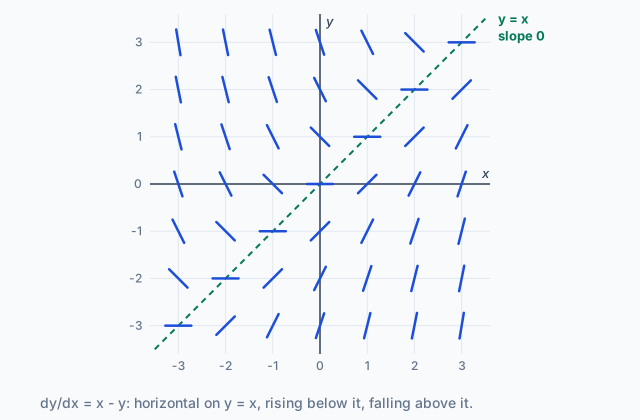
Keep every segment the same short length. Only the tilt carries information, and short segments keep neighbors from running into each other. The picture at the top of the page is this field at 49 points.
If the equation is not defined at a grid point, as is at , there is no slope there, so draw nothing at that point.
Quick check · Calculate
No calculator. In the slope field for , what is the slope of the segment drawn at the point ?
7b. Rising, falling and level
You rarely need every slope to see the shape of a field. The signs tell you most of it.
A segment rises from left to right where , falls where , and is horizontal where . So start by finding where . For that is the line , dashed in the picture at the top. Below it, and the segments rise. Above it, they fall.
When depends on alone, each zero is a whole horizontal line. The coffee's is 0 at every point with , so its field has a row of horizontal segments along . Above that row and the segments fall. Below it they rise.
When is a product, it is 0 wherever either factor is 0, and its sign can change when you cross one of those lines. Test one point in each region rather than guessing.
Each segment is a short piece of the tangent line to the solution through its point. Where the segments rise, a solution passing through is increasing; where they fall, it is decreasing.
Quick check · Sort it
No calculator. In the slope field for , sort each grid point by the slope of its segment. Tap a card, then tap a bin.
Positive slope (rises)
Zero slope (horizontal)
Negative slope (falls)
7c. Matching a field to its equation
To decide which equation a slope field shows, look for patterns before computing anything.
- Columns. If the segments in each vertical column are parallel, the slope does not change as changes, so depends on only, like .
- Rows. If the segments in each horizontal row are parallel, depends on only, like the coffee's .
- Neither. If the slopes change along both, the equation has both variables in it, like .
Next, use the horizontal segments: they mark where . Last, test a point or two for sign and steepness.
Say a field has horizontal segments along , parallel segments across each row, and falling segments above . That fits . It does not fit , which has the same horizontal row but rises above it, or , whose horizontal segments run down the column .
A common slip is to read a column of equal slopes as "depends on " because the column runs in the direction. Ask which variable changes along the line. Moving up a column, only changes, so equal slopes there mean does not matter.
Quick check · Match
No calculator. Tap a differential equation, then tap the description of its slope field.
Part 3 Watch it done Sketching a nine-point slope field
Watch each step, then finish the last one yourself.
Sketch the slope field for at the nine points with and .
Predict first
Before any arithmetic, guess: at which of the nine points will the segment be horizontal?
Step 1 · Set up
Work row by row. At each point write with that point's own and . Labeling them stops the most common slip, swapping the two.
Step 2 · Row y = 0
At : . At : . At : . Left to right, the row reads rising, horizontal, falling.
Why this step?
Why are the slopes in one row different from each other?
The equation has in it. Moving along a row changes , so it changes . Only an equation in alone makes every row parallel.
Step 3 · Row y = 1
At : . At : . At : . Draw each as a short segment centered on its point: slope 3 steep and rising, slope 1 rising less, slope falling.
Your step · Fill the statement
No calculator. Finish the top row, then say where the field is level. Tap a blank, then tap an answer.
For , the slopes in the row at , and are , and . Every horizontal segment of this slope field lies on the line .
Part 4 Try it The coffee's field, then a field from its description
Try it · Calculate
No calculator. The coffee's temperature satisfies , with in minutes and in degrees Fahrenheit. Its slope field has on the horizontal axis and on the vertical axis. What is the slope of every segment in the row ?
Try it · Multiple choice
No calculator. A slope field has three features. The segments in each horizontal row are parallel. The segments along and along are horizontal. Between those two lines, every segment rises from left to right. Which differential equation could the field show?
Part 5 Explain it Write it as a free-response answer
Free response on the exam is written by hand, so do this one on paper, including the slope field in part (a). Nothing you type here leaves the page. When you are done, open the model answer and score yourself against each point.
Free response is 50% of the exam score. This one is shaped like Question 4, from free-response Part B (calculator not permitted).
Free-response practice · Question 4 style
No calculator. Consider the differential equation .
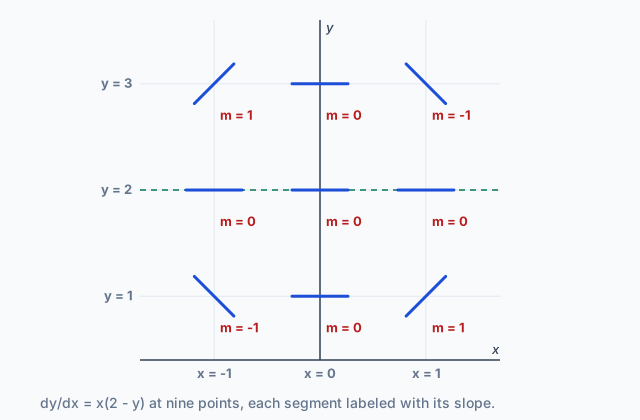
(a) On paper, draw axes and sketch the slope field for the given differential equation at the nine points with and .
(b) Find all points in the -plane for which . Justify your answer.
(c) Explain why every segment of the slope field along the line is horizontal.
Model answer
(a) Each slope is at its point. Row , left to right: , , . Row : , , . Row : , , . The sketch is below.
(b) is positive when its two factors have the same sign: and , or and . So the slopes are positive at every point with and , and at every point with and .
(c) On the line the factor is 0, so for every . A slope of 0 is a horizontal segment.
 Tap to open the picture full size
Score your own answer. This is a self-check, not a grade. Tick each point your answer makes.
Part 6 Check yourself Which equation made this field?
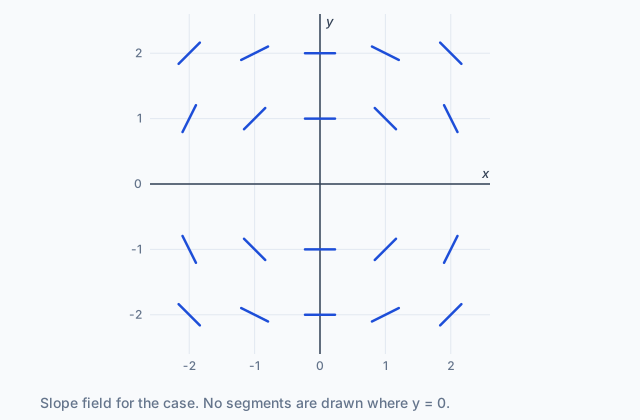
Both case questions use this slope field. Read every slope you need from it.
The slope field below is drawn at 20 grid points, for and . No segment is drawn where .
 Tap to open the picture full size
Case question 1 · Multiple choice
No calculator. Which differential equation could the slope field show?
Case question 2 · Decide and justify
No calculator. A classmate looks at the four grid points of the slope field with and and says, "A solution passing through any of these four points is decreasing at that point." Is the classmate right?
Which reason supports your answer?
The rest stand on their own and do not use the case.
Check yourself · Spot the error
No calculator. A student works out segments for the slope field of . Tap the first line with a mistake.
Check yourself · Calculate
No calculator. In the slope field for , the segment at the point is horizontal. What is ?
Part 7 Keep it Bring back earlier ideas
A slope field draws what a solution's derivative must be, and reading it uses the link between the sign of a derivative and a rising or falling graph. Pulling both back up is what keeps them.
Bring it back · Multiple choice
No calculator. Which function is a solution to the differential equation ?
Bring it back · Multiple choice
No calculator. The derivative of a function is . On which intervals is increasing?
In three lines
- A slope field draws a short segment with slope dy/dx = f(x, y) at each point of a grid, and leaves out points where f is not defined.
- Segments rise where dy/dx > 0, fall where dy/dx < 0 and are horizontal where dy/dx = 0; test a point on each side of every zero line.
- Parallel segments down each column mean dy/dx depends on x only; parallel segments across each row mean it depends on y only.
Exam strategy for this topic
- Section I Part A, Multiple Choice (calculator not permitted): 29 questions in 62 minutes.
- Section I Part B, Multiple Choice (graphing calculator required): 13 questions in 38 minutes.
- Section II Part A, Free Response (graphing calculator required): 2 questions in 30 minutes.
- Section II Part B, Free Response (calculator not permitted): 4 questions in 60 minutes.
When a free-response question asks you to sketch a slope field at given points, compute every slope first, then draw each segment short and centered on its point, with the zero slopes clearly flat. When asked where the slopes are positive or negative, name the regions with inequalities in and , and justify them with the sign of each factor of .
Questions students ask
How long should each segment be?
Short, and all the same length, a small fraction of the space between grid points. Only the tilt carries information, and a long segment can run into its neighbors.
Do I have to compute every slope exactly?
On a sketch at given points, yes. Each one takes seconds, and one segment with the wrong sign or steepness makes the whole sketch wrong. When you match a field to an equation, patterns and a couple of test points are faster.
What if the differential equation is not defined at a grid point?
Leave that point blank. There is no slope there, so there is nothing to draw.
Why do parallel segments across a row mean the equation depends on y only?
Moving along a row changes but not . If the slope never changes along the row, has no effect on it, so only can appear in the equation.
Can a slope field give me the formula for a solution?
No. It shows the direction of every solution at each grid point, which is enough to see how solutions behave and, in 7.4, to sketch one through a given point. A formula comes from solving the equation, later in this unit.
Course alignment, for teachers
AP Calculus AB topic 7.3, Unit 7: Differential Equations.
- Skill 2.C: Identify a re-expression of mathematical information presented in a given representation.
This lesson maps all 2 essential knowledge statements of the topic to the part that teaches each one: 2 are checked by a scored question. The map is in the lesson file.