Unit 7 · Topic 7.4 · about 30 minutes · 7 parts · 13 scored checks, 4 of them multiple choice
AP Calculus AB 7.4: Reasoning Using Slope Fields
Unit 7: 5 to 10% of the multiple-choice section
What you'll be able to do
- Estimate solutions to differential equations from a slope field and from the equation itself: trace the solution through a point, tell where it increases, decreases or stays constant, find its concavity, and approximate it with a tangent line.
Key vocabulary
| Term | What it means | The exam trap |
|---|---|---|
| Solution of a differential equation | A function whose derivative satisfies the equation at every in an interval. | Test a candidate by substituting it into both sides; a curve that looks right on a picture can still fail. |
| Particular solution | The one solution of a differential equation that also passes through a given point, such as . | An initial condition picks one member of a family; keep track of which point you were given. |
| Slope field | A picture of a differential equation: at each point of a grid, a short segment with the slope the equation gives there. | A solution curve runs along the segments it passes; it does not have to pass through the grid points. |
| Equilibrium solution | A constant function that solves a differential equation, so its slope field shows a full row of horizontal segments at height . | Write it as y = c, a function of x, and test it in the equation like any other candidate. |
| Tangent line approximation | An estimate of from the line through with slope : . | Use the slope at the given point, and keep the sign of the step h when you move to the left. |
 Tap to open the picture full size
Part 1 Think first Two cups of coffee, one room
Make a guess before the lesson starts. Committing to an answer, even a wrong one, helps the right one stick.
Predict first
Two cups of coffee sit in a room kept at 70 degrees Fahrenheit. One starts at 180 degrees and the other at 150 degrees. Each cup's temperature changes at the rate degrees per minute, so the hotter cup is cooling at 11 degrees per minute at the start and the cooler one at 8. Which describes the two temperature graphs over the next hour?
In short. A solution of a differential equation is a function, and the equation usually has a whole family of them; on a slope field each one is a curve that runs along the segments, and one point picks out one curve.
- The sign of at a point tells you whether the solution through it is increasing or decreasing, and a constant is a solution only when is 0 all along that row.
- Differentiate the equation with respect to , treating as a function of , to get and the concavity of a solution.
- The tangent line at a known point estimates a particular solution nearby, and concavity tells you whether that estimate is too high or too low.
Part 2 Learn it Four short ideas, each checked as you go
4a. A solution is a function, and there is a family of them
A differential equation such as gives a slope at every point. A solution is a function whose derivative obeys that rule at every . Test a candidate by substituting it.
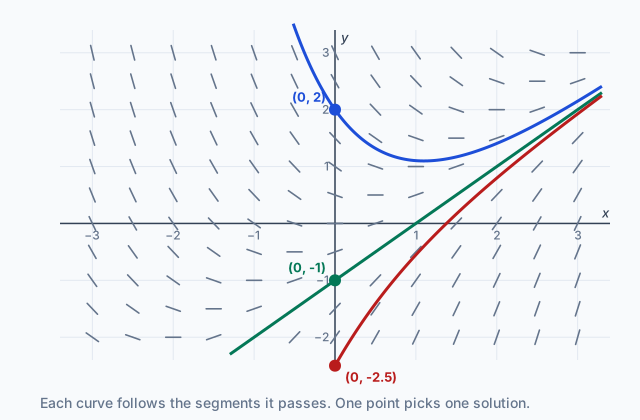
Try . Its derivative is 1, and . The two sides match for every , so is a solution. It is the green line in the picture at the top.
It is not the only one. The picture is the slope field of this equation: a short segment at each grid point with slope . Start anywhere and run along the segments you pass, and you trace a solution. Start at and you get the blue curve. Start at and you get the red one. Every point starts a curve, so the solutions form a family of functions. The one through a given point, such as , is a particular solution.
The members are not vertical shifts of one another. Moving up 3 gives , whose slope is 1 everywhere, but at the equation calls for slope . When the right side involves , the slope depends on the height, so a shifted curve gets the wrong slopes.
Quick check · Multiple choice
No calculator. Which of the following functions is a solution of the differential equation ?
4b. Rising, falling and constant solutions
You can describe a solution without any formula for it. Wherever , the solution through that point is increasing, and wherever , it is decreasing. So find the sign of the right side of the equation at the point.
Take . Below the line the right side is positive, so every solution there rises. Above it the right side is negative, so every solution there falls. On the row itself, for every .
That makes the constant function a solution: its derivative is 0, and the equation gives 0 at every point of it. A constant solution is called an equilibrium solution. On a slope field it is a whole row of horizontal segments.
A few horizontal segments are not enough. For , every segment along the line is horizontal, yet is not a solution: its slope is 1, and the equation gives 0 there. The blue curve only crosses that line, at its lowest point. Test a constant by asking whether the right side is 0 at every point of that row, whatever is.
Quick check · Sort it
No calculator. For the differential equation , tap each card, then tap what the solution through that point is doing there.
Increasing there
Decreasing there
Constant, an equilibrium solution
4c. Concavity straight from the equation
The second derivative of a solution comes from the differential equation itself. Differentiate both sides with respect to , remembering that is a function of , and then put the equation back in wherever appears.
For :
At this is , so the blue solution is concave up there, as the picture shows. Below the green line, where , the expression is negative, so solutions there are concave down. The red curve bends that way.
A term with in it needs the chain rule or the product rule:
Treating as a constant drops those factors, and the sign you get can be wrong.
The reading is the one from Unit 5: means the solution is concave up there, and means concave down.
Quick check · Calculate
No calculator. Let be the solution of with . What is the value of at the point ?
4d. A tangent line estimates a particular solution
A particular solution through the point has slope there, the value of at . Its tangent line is
Near the line stays close to the curve, so . The step can be negative.
For with , the slope is , the tangent line is , and .
Is 1.8 too high or too low? Concavity decides. A solution that is concave up near the point lies above its tangent line there, so the line gives an underestimate. Concave down gives an overestimate. Here , which is 3 at and stays positive for , where is near 2. So 1.8 is an underestimate.
The sign of the slope does not decide this. A falling curve can sit above its tangent line or below it, and so can a rising one.
Quick check · Calculate
No calculator. Let be the particular solution of with . Use the line tangent to the graph of at to approximate .
Part 3 Watch it done Estimate a solution, then judge the estimate
Watch each step, then finish the last one yourself.
Let be the particular solution of with . Use the line tangent to the graph of at to approximate , and decide whether the approximation is an overestimate or an underestimate.
Predict first
Before the steps open: will the tangent line come out too high or too low?
Step 1 · Find the slope at the point
At , .
Step 2 · Write the tangent line and use it
The tangent line is , so .
Step 3 · Find the second derivative from the equation
. At it is . For the solution stays near 3, so stays positive.
Why this step?
Why look at the second derivative instead of the slope, which is negative?
The slope says which way the solution moves, not how it bends. Whether a curve sits above or below its tangent line depends on its concavity, and the second derivative is what measures that.
Your step · Decide and justify
No calculator. Finish it. For the particular solution of with , the tangent line at gives , and . Is 2.4 an overestimate or an underestimate of ?
Which reason supports your answer?
Part 4 Try it Sketch a solution from the equation alone
Try it · Sketch the graph
No calculator. Let be the solution of with . Sketch a possible graph of for from 0 to 2. The first point is fixed at 8.
One shape that fits
Drag a point up or down, or tap it and use the arrow keys. Only the shape is checked.
Part 5 Explain it Write it as a free-response answer
Free response on the exam is written by hand, so work this on paper, including the sketch in part (a). Nothing you type here leaves the page. When you are done, open the model answer and score yourself on each point.
Free response is 50% of the exam score. This one is shaped like Question 6, from free-response Part B (calculator not permitted).
Free-response practice · Question 6 style
No calculator. Consider the differential equation .
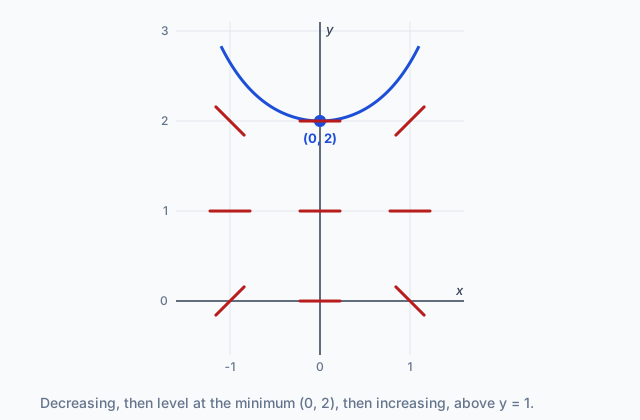
(a) On paper, draw axes and sketch the slope field for the given differential equation at the nine points with and . Then sketch the solution curve that passes through the point .
(b) Let be the particular solution to the differential equation with the initial condition . Write an equation for the line tangent to the graph of at , and use it to approximate .
(c) Find in terms of and . Is the approximation in part (b) an overestimate or an underestimate of ? Justify your answer.
Model answer
(a) The slopes are : 0 at all three points with and all three with ; 1 at and ; and at and . The solution through decreases to a minimum at , where it is level, then increases, staying above the row , as in the figure.
(b) At , . The tangent line is , so .
(c) . At it is . For , , so increases from 3 and , which keeps . The graph of is concave up there and lies above its tangent line, so 3.4 is an underestimate.
 Tap to open the picture full size
Score your own answer. This is a self-check, not a grade. Tick each point your answer makes.
Part 6 Check yourself Reason from a slope field
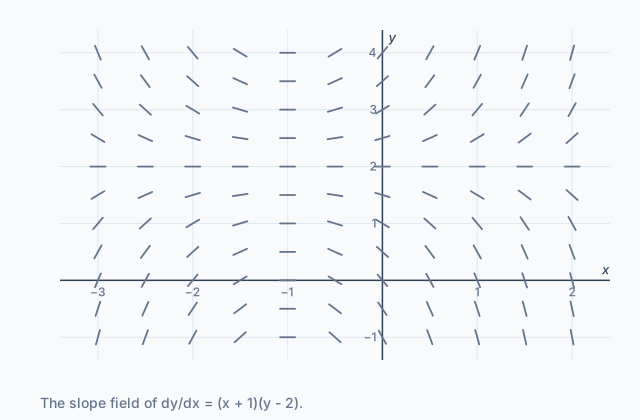
The first three questions use this slope field and its equation. Read each slope from the equation; the picture shows the pattern.
The figure shows the slope field for the differential equation .
 Tap to open the picture full size
Case question 1 · Multiple choice
No calculator. Which statement best describes the solution curve through the point at ?
Case question 2 · Calculate
No calculator. Let be the particular solution of with . Use the line tangent to the graph of at to approximate .
Case question 3 · Decide and justify
No calculator. For the same particular solution with , , which is . A classmate says the approximation from the tangent line is an overestimate. Is the classmate right?
Which reason supports your answer?
The rest stand on their own and do not use the case.
Check yourself · Spot the error
No calculator. A student finds the concavity of the solution of through the point . Tap the first line with a mistake.
Check yourself · Match
No calculator. Tap a differential equation, then its constant solutions.
Part 7 Keep it Bring back earlier ideas
Reasoning with a slope field leans on drawing one and on reading concavity from a second derivative. Pulling both back up is what keeps them.
Bring it back · Multiple choice
No calculator. In the slope field for , along which line are all of the segments horizontal?
Bring it back · Multiple choice
No calculator. A function is twice differentiable for all , and . At which values of does the graph of have a point of inflection?
In three lines
- A solution of a differential equation is a function, and a slope field shows the whole family; one point picks one curve.
- The sign of dy/dx says rising or falling, a level row is an equilibrium solution, and the second derivative found from the equation gives concavity.
- The tangent line at a known point estimates a particular solution, an underestimate where the solution is concave up and an overestimate where it is concave down.
Exam strategy for this topic
- Section I Part A, Multiple Choice (calculator not permitted): 29 questions in 62 minutes.
- Section I Part B, Multiple Choice (graphing calculator required): 13 questions in 38 minutes.
- Section II Part A, Free Response (graphing calculator required): 2 questions in 30 minutes.
- Section II Part B, Free Response (calculator not permitted): 4 questions in 60 minutes.
On a slope field question, draw each segment with the right sign and roughly the right steepness, and make zero slopes clearly flat. When you sketch a solution through a point, let it follow the segments and never cross an equilibrium row. For an overestimate or underestimate question, write from the equation, give its sign near the point, and say what that sign means for the curve and its tangent line.
Questions students ask
Can two solution curves of the same differential equation cross?
For the equations in this course, no. Where two solutions met they would share a point, and the equation gives one slope there and one path onward, so they would be the same curve. That is also why a solution starting above an equilibrium row stays above it.
Does a solution curve have to pass through the points where segments are drawn?
No. The segments are samples. A solution curve runs between them and follows the pattern the nearby segments show, the way a river follows the current.
How do I find the equilibrium solutions?
Set the right side of the equation equal to 0 and look for constant values of that make it 0 for every . For those are and . A zero that depends on alone, such as , is not one.
Why does the second derivative have dy/dx in it?
Because is a function of . Differentiating a term with respect to uses the chain rule, which brings out . You then replace with the right side of the differential equation, so the answer is in terms of and .
Is it enough to check the second derivative only at the starting point?
It tells you the concavity at that point. A full justification says the second derivative keeps its sign over the interval you step across, which usually follows from what the solution does there, as in the model answer above.
Course alignment, for teachers
AP Calculus AB topic 7.4, Unit 7: Differential Equations.
- Skill 4.D: Use appropriate graphing techniques.
This lesson maps the one essential knowledge statement of the topic to the part that teaches each one: 1 is checked by a scored question. The map is in the lesson file.