Unit 7 · Topic 7.6 · about 30 minutes · 7 parts · 12 scored checks, 4 of them multiple choice
AP Calculus AB 7.6: Finding General Solutions Using Separation of Variables
Unit 7: 5 to 10% of the multiple-choice section
What you'll be able to do
- Find general solutions to differential equations, by separating the variables when the equation is separable and by antidifferentiating when the rate depends on x alone.
Key vocabulary
| Term | What it means | The exam trap |
|---|---|---|
| Separable differential equation | A differential equation that can be written as , a function of alone times a function of alone. | Rewrite or factor the right side before you decide; some equations look mixed and are still a product, and some never become one. |
| Separation of variables | Rewriting a separable equation as and integrating each side with respect to its own variable. | Moving across means dividing by it, which assumes it is not 0; keep track of what that rules out. |
| General solution | An equation with an arbitrary constant that describes a whole family of solutions of a differential equation, one for each value of . | Where the constant sits matters. Differentiate your answer to make sure every member of the family satisfies the equation. |
| Constant of integration | The arbitrary constant that comes with an antiderivative; in a general solution it is what makes the answer a family. | After integrating both sides, count how many unknown numbers you really have before you write the next line. |
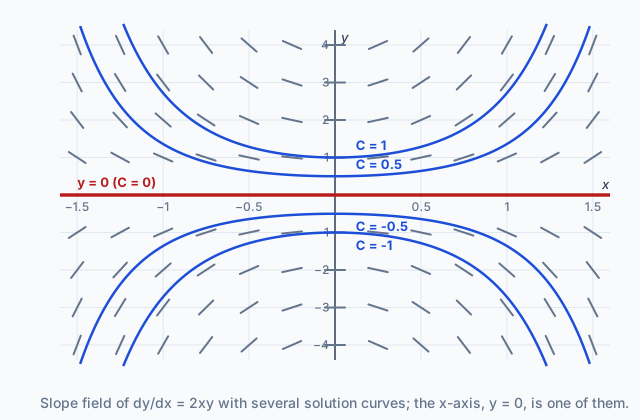 Tap to open the picture full size
Part 1 Think first Five times as many bacteria
Make a guess before the lesson starts. Committing to an answer, even a wrong one, helps the right one stick.
Predict first
A lab tech grows bacteria in a dish. The count , in thousands, changes at the rate , where is in hours, and she checks that fits this rule. Her partner's dish starts with 5 times as many bacteria and follows the same rule. Which function could give the partner's count?
In short. Separation of variables solves a differential equation of the form by putting every on the side with and every on the side with , integrating both sides, and adding one constant, which gives the general solution: the whole family of solutions.
- Separation works when the right side is a function of times a function of . When the right side has no at all, the general solution is .
- Integrating both sides brings in one constant of integration. It is what turns a single solution into a family.
- Solve for where you can, and keep the constant where the algebra puts it: inside an exponent, it becomes a factor. Dividing by an expression in can drop a constant solution.
Part 2 Learn it Three short ideas, each checked as you go
7a. Separable means an x part times a y part
A differential equation is separable when its right side can be written as a function of alone times a function of alone:
Then every can go to the left with , and every to the right with . For , divide both sides by and multiply by :
Sometimes the product is hidden. is , so it separates. factors as , so it separates too.
A sum of an part and a part is different. In , no algebra turns into a product : dividing by leaves , still a mix of both. Separation of variables does not solve that equation.
One case needs no separating at all. If the right side has no in it, as in , the solutions are the antiderivatives of : . For , that is .
Quick check · Sort it
No calculator. Each card is a differential equation. Tap a card, then tap whether separation of variables can solve it.
Separable
Not separable
7b. Integrate both sides, with one constant
Once the variables are apart, integrate each side with respect to its own variable. Take .
Multiply both sides by : .
Integrate: , so
The two constants are not the same number, so they do not cancel. Subtract to combine them: , where . A constant minus a constant is just some constant, so write one , on the side with , from the start.
Multiplying by 2 gives . Twice an unknown constant is still an unknown constant, so rename it: . This is a general solution: one equation for the whole family of solutions, one for each value of . Leave the out and you have only the one solution with .
Check it by differentiating implicitly: , so , the equation you started with.
Quick check · Multiple choice
No calculator. Which equation is the general solution of ?
7c. Solve for y, and watch for a lost solution
When you can, finish by solving for . Go back to , separated in the first chunk as . Integrating gives
Exponentiate both sides. The exponent is a sum, so , a product:
The number is just a nonzero constant, so call it : . The constant multiplies. Writing treats as , which is false, and the result fails the equation: its derivative is , not .
Now look back at the first step. Dividing by assumed . Yet is a solution, since both sides of are then 0. It is the flat line labeled in the graph at the top. It comes back as , so , for every constant , is the general solution. Whenever you divide by an expression in , ask whether that expression equal to 0 gives a solution.
Quick check · Spot the error
No calculator. A student solves for . Tap the first line with a mistake.
Part 3 Watch it done Separate, integrate, then solve for y
Watch each step, then finish the last one yourself.
Find the general solution of .
Step 1 · Separate
The right side is times , so the equation is separable. Multiply both sides by : . Nothing was divided by an expression that can be 0, so no solution is lost.
Step 2 · Integrate both sides
gives , with one constant, on the side with .
Why this step?
Why write only one constant?
Each side really has its own constant, . Moving across gives , which is just one unknown constant. They do not cancel, because they are different numbers.
Your step · Multiple choice
No calculator. Finish it. Starting from , which is the general solution of , solved for ?
Part 4 Try it New equations, same moves
Try it · Calculate
No calculator. Let be any solution of the differential equation . What is ?
Try it · Match
No calculator. Each differential equation is separable. Tap an equation, then its general solution.
Part 5 Explain it Write it as a free-response answer
Free response on the exam is written by hand, so do this one on paper. Nothing you type here leaves the page. When you are done, open the model answer and score yourself against each point.
Free response is 50% of the exam score. This one is shaped like Question 5, from free-response Part B (calculator not permitted).
Free-response practice · Question 5 style
No calculator. Consider the differential equation .
(a) Use separation of variables to find the general solution of the differential equation. Write your answer with as a function of .
(b) Verify that the constant function is a solution of the differential equation. Explain why the first step of your separation in part (a) leaves this solution out.
(c) A student writes the general solution as . For which value of , if any, is the student's function a solution of the differential equation? Justify your answer.
Model answer
(a) For , . Integrating both sides, . Then , so , and , where .
(b) If , then and , so the two sides agree for every . The separation divided both sides by , which is 0 when , so that step assumed . The solution comes back as with .
(c) If , then , while . These are equal for all only when . So the student's function is a solution only for , which gives , the member of the family in part (a) with constant 1.
Score your own answer. This is a self-check, not a grade. Tick each point your answer makes.
Part 6 Check yourself A mold culture's growth rule
Both case questions use this table. Read the rule you need from it.
A biologist models the mass of a mold culture growing on bread. While the mass is positive, it follows the rule in the table.
| Symbol | Meaning |
|---|---|
| Days since the biologist started timing | |
| Mass of the culture, in grams, with | |
| grams per day |
Case question 1 · Multiple choice
No calculator. Which equation correctly separates the variables of the model, so that each side can be integrated?
Case question 2 · Calculate
No calculator. Separating and integrating, the general solution of the model can be written , where is a constant. What is the value of ?
The rest stand on their own and do not use the case.
Check yourself · Put it in order
No calculator. Put the lines that solve for in order. Tap them in sequence.
Check yourself · Decide and justify
No calculator. To solve , a classmate writes , cancels the constants to get , and concludes that the only solutions are and . Is the classmate right?
Which reason supports your answer?
Part 7 Keep it Bring back earlier ideas
Separation of variables leans on what an antiderivative is and on reading a solution as a function in a family. Pulling both back up is what keeps them.
Bring it back · Multiple choice
No calculator. In the slope field for , the segments along one straight line all point along that line, so the line is a solution curve. Which line is it?
Bring it back · Calculate
No calculator. The function is continuous for all real numbers, and and are both antiderivatives of , with and . What is ?
In three lines
- A separable equation dy/dx = g(x)h(y) splits into a y side with dy and an x side with dx; when dy/dx = f(x), just antidifferentiate.
- Integrate both sides and write one constant; renaming 2C or ±e^C as C keeps it one constant.
- Solve for y where you can, put the constant where the algebra puts it, and check whether dividing by an expression in y lost a solution.
Exam strategy for this topic
- Section I Part A, Multiple Choice (calculator not permitted): 29 questions in 62 minutes.
- Section I Part B, Multiple Choice (graphing calculator required): 13 questions in 38 minutes.
- Section II Part A, Free Response (graphing calculator required): 2 questions in 30 minutes.
- Section II Part B, Free Response (calculator not permitted): 4 questions in 60 minutes.
On a free-response question, write the separated equation on its own line, then both antiderivatives with the constant, and only then solve for . If you divide by an expression in , say what you assumed. Check your final answer by differentiating it and substituting into the equation.
Questions students ask
How do I tell whether an equation is separable?
Try to write the right side as a function of times a function of . Factor out common factors and split exponents, since . If the part and the part are stuck together by a plus or minus that will not factor, as in , the equation is not separable.
Why is there only one constant when I integrate two sides?
Each side does get a constant, but they are two unknown numbers. Moving one across combines them into a single unknown constant, so writing one on the side with says the same thing in less ink.
Where did the absolute value go in ?
From , is either or . Both are a constant times , so one constant , positive or negative, covers both. Allowing adds the solution .
Do I have to solve for y?
When the algebra allows it, yes, and always when a question asks for as a function of . An implicit answer such as still describes the family when solving would need a choice of sign you cannot yet make.
What about a starting value like ?
A starting value picks one member of the family by fixing the constant. That is the next topic; here the goal is the whole family.
Course alignment, for teachers
AP Calculus AB topic 7.6, Unit 7: Differential Equations.
- Skill 1.E: Apply appropriate mathematical rules or procedures, with and without technology.
This lesson maps all 2 essential knowledge statements of the topic to the part that teaches each one: 2 are checked by a scored question. The map is in the lesson file.