Unit 7 · Topic 7.7 · about 30 minutes · 7 parts · 13 scored checks, 4 of them multiple choice
AP Calculus AB 7.7: Finding Particular Solutions Using Initial Conditions and Separation of Variables
Unit 7: 5 to 10% of the multiple-choice section
What you'll be able to do
- Find the particular solution of a differential equation through a given point, write it as a starting value plus an integral when that is the clearest form, and state the interval on which it is a solution.
Key vocabulary
| Term | What it means | The exam trap |
|---|---|---|
| General solution | The family of every function that satisfies a differential equation, usually written with a constant . | A family with in it is not yet an answer to a question that gives you a point. |
| Initial condition | A known point on the solution, written : at , equals . | Keep the two numbers straight: one is an value and the other is a value. |
| Particular solution | The one solution of a differential equation that also satisfies a given initial condition. | Check an answer by putting the initial into it: it must give back the initial exactly. |
| Domain of a solution | The open interval, containing the initial , on which the particular solution is defined and differentiable. | Find it after you have the particular solution, since it depends on the initial condition as well as on the equation. |
 Tap to open the picture full size
Part 1 Think first How tall at week 4?
Make a guess before the lesson starts. Committing to an answer, even a wrong one, helps the right one stick.
Predict first
Maya measures a bean plant every week. Its height , in centimeters, grows at the rate centimeters per week, where is the number of weeks since she started measuring. At the plant is 7 centimeters tall. How tall is it at ?
In short. A particular solution of a differential equation is the one member of the general solution that satisfies an initial condition , and it is a solution on an open interval that contains .
- Put the initial condition in right after you integrate, while still stands alone, and only then solve for .
- When , the particular solution with is : the starting value plus the change since .
- A formula can be defined in places where it is not the solution. Keep the interval around the initial , and choose any sign from the initial condition.
Part 2 Learn it Three short ideas, each checked as you go
7a. One point picks one curve
The general solution of a differential equation is a family of curves, one for each value of . For it is . Every curve in that family has the right slopes, but only one of them passes through a given point. That point, written as an initial condition such as , picks out the particular solution. Put it in and solve for : , so and .
In a separable equation, use the point right after you integrate, while still stands alone. Take with :
Now , gives , so . Then , and since is positive, .
If you solve for first, the constant changes shape: , a factor in front, not something added on. Writing there gives a curve that does not solve the equation at all.
Quick check · Multiple choice
No calculator. Which function is the solution of with the initial condition ?
7b. A particular solution written as an integral
When depends on alone, the Fundamental Theorem of Calculus writes the particular solution for you. If is continuous, the solution with is
Two quick checks show why. The derivative of is , so . And at the integral runs over no width, so .
Read it as the starting value plus the change since the start. That makes it useful in two cases. Some functions, such as , have no antiderivative you can write with the usual functions, yet with still has the solution . And sometimes you only know through a graph or a table. If and , then , with no formula for at all.
For an to the left of , the integral runs backward: .
Quick check · Fill the statement
No calculator. Tap a blank, then tap an answer.
The solution of with is the integral from to of .
7c. Where the solution lives
A solution has to be differentiable on an open interval that contains the initial , and it cannot jump across a place where it is not defined. So a particular solution can live on less than the whole line, even when its formula makes sense in more places.
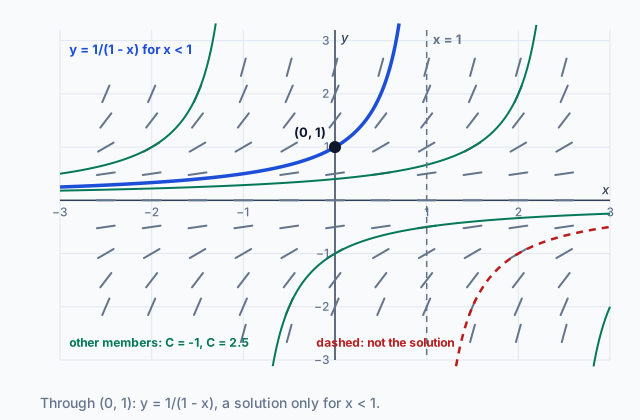
The graph at the top shows with . Separating gives , and the point gives , so and . The formula is defined for every except 1. But the solution starts at and cannot pass , where it blows up, so it is a solution only for . The dashed piece to the right of 1 is the same formula and a different curve.
The initial condition also chooses a sign. For with , separating gives , the point gives , and . Taking a square root allows . Only the negative root passes through , so .
Quick check · Multiple choice
No calculator. Let be the solution of with . On which interval is a solution?
Part 3 Watch it done A particular solution and its interval
Watch each step, then finish the last one yourself.
Find the solution of with the initial condition , and the interval on which it is a solution.
Step 1 · Separate
Multiply both sides by : .
Step 2 · Integrate
gives .
Step 3 · Find C now
Put in , : , so and .
Why this step?
Why put the point in before solving for ?
On this line stands alone, so the point gives it in one step. Solving first would put inside a logarithm, . That still works here, but in other equations solving first turns into a factor or puts it under a root, where it is easy to mishandle.
Step 4 · Solve for y
Take the natural log of both sides: . The logarithm needs .
Your step · Calculate
No calculator. Finish it. The solution is , and it is a solution on the open interval , which contains the initial . What is ?
Part 4 Try it A sign to choose, and a tank to fill
Try it · Multiple choice
No calculator. Which function is the solution of with the initial condition ?
Try it · Calculate
No calculator. A tank holds 40 gallons of water at . Water flows in so that gallons per hour, where is the amount in the tank after hours. How many gallons are in the tank at ?
Part 5 Explain it Write it as a free-response answer
Free response on the exam is written by hand, so do this one on paper. Nothing you type here leaves the page. When you are done, open the model answer and score yourself against each point.
Free response is 50% of the exam score. This one is shaped like Question 6, from free-response Part B (calculator not permitted).
Free-response practice · Question 6 style
No calculator. Consider the differential equation . Let be the particular solution to the differential equation with the initial condition .
(a) Write an equation for the line tangent to the graph of at . Use the tangent line to approximate .
(b) Find , the particular solution to the differential equation with the initial condition .
(c) Find the open interval on which the solution in part (b) is defined. Justify your answer.
Model answer
(a) At , . The tangent line is , so .
(b) , so and . At : , so and . Then , so .
(c) The interval is . The solution has to be differentiable on an interval that contains the initial , and is not defined at , so the interval cannot reach past 0.
Score your own answer. This is a self-check, not a grade. Tick each point your answer makes.
Part 6 Check yourself A solution read from a graph
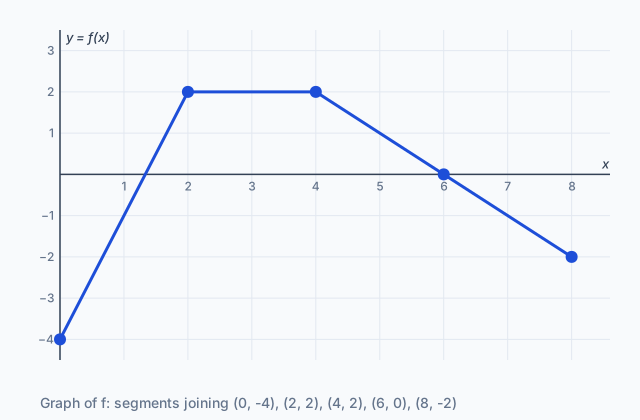
All three case questions use this graph. Read every value you need from it.
The function is continuous on , and its graph is made of four line segments. Let be the solution of the differential equation with the initial condition .
 Tap to open the picture full size
Case question 1 · Calculate
No calculator. What is ?
Case question 2 · Multiple choice
No calculator. Which expression gives for ?
Case question 3 · Decide and justify
No calculator. A classmate finds that and writes . Is the classmate right?
Which reason supports your answer?
The rest stand on their own and do not use the case.
Check yourself · Spot the error
No calculator. A student finds the solution of with . Tap the first line with a mistake.
Check yourself · Sort it
No calculator. Each card gives a differential equation, an initial condition and the formula that satisfies both. Sort each card by where that formula is the particular solution.
For every real
Only on part of the line
Part 7 Keep it Bring back earlier ideas
Every particular solution starts as a general solution from separation of variables, and the integral form rests on the Fundamental Theorem. Pulling both back up is what keeps them.
Bring it back · Match
No calculator. Tap a differential equation, then its general solution.
Bring it back · Calculate
No calculator. Evaluate .
In three lines
- A general solution is a family of curves; an initial condition picks the one particular solution through that point.
- Use the point right after integrating, while C stands alone; for dy/dx = f(x), the solution is y0 plus the integral of f from a to x.
- A solution lives on the open interval around the initial x where it stays defined, and the initial value picks any plus or minus sign.
Exam strategy for this topic
- Section I Part A, Multiple Choice (calculator not permitted): 29 questions in 62 minutes.
- Section I Part B, Multiple Choice (graphing calculator required): 13 questions in 38 minutes.
- Section II Part A, Free Response (graphing calculator required): 2 questions in 30 minutes.
- Section II Part B, Free Response (calculator not permitted): 4 questions in 60 minutes.
On the free-response question, show the separation with and on opposite sides, write both antiderivatives and one constant of integration, and use the initial condition on that same line before you solve for . Before you move on, put the initial into your answer and check that it gives back the initial .
Questions students ask
Do I have to use the initial condition before solving for y?
It is not a rule of algebra, but it is the safe habit. Right after integrating, stands alone and one substitution finds it. After you exponentiate or take a root, becomes a factor or sits under the root, where it is easy to mishandle.
Why is there only one particular solution through a point?
Putting the point into the general solution gives one equation for , and it has one answer. The slope field shows why: at each point the differential equation fixes one slope, so a curve through that point has only one way to go.
When should I write the solution as an integral?
When depends on alone and you either cannot find an antiderivative, as with , or only know from a graph or table. Then is the solution, and you evaluate it with areas or given values.
How do I find the interval where the solution is defined?
Find every where the formula, or along it, breaks down: a zero denominator, a negative under a square root, a logarithm of something not positive. Those points cut the line into intervals, and the solution is the one interval that contains the initial .
What do I do with the plus or minus from a square root?
Look at the initial . If is negative, keep the negative root; if it is positive, keep the positive one. Both roots satisfy the squared equation, but only one passes through the point.
Course alignment, for teachers
AP Calculus AB topic 7.7, Unit 7: Differential Equations.
- Skill 1.E: Apply appropriate mathematical rules or procedures, with and without technology.
This lesson maps all 3 essential knowledge statements of the topic to the part that teaches each one: 3 are checked by a scored question. The map is in the lesson file.