Unit 7 · Topic 7.8 · about 30 minutes · 7 parts · 13 scored checks, 4 of them multiple choice
AP Calculus AB 7.8: Exponential Models with Differential Equations
Unit 7: 5 to 10% of the multiple-choice section
What you'll be able to do
- Interpret a differential equation such as , its constant and its variables, with units, in the context of a growing or decaying quantity or a moving object.
- Find general and particular solutions in context: for exponential growth and decay, and position or velocity from a rate and an initial condition for motion along a line.
Key vocabulary
| Term | What it means | The exam trap |
|---|---|---|
| Exponential growth and decay model, | The differential equation for a quantity whose rate of change is proportional to the size of the quantity, with a constant. | Before you write it, find the words after "proportional to" and check that they name the changing quantity itself. |
| Constant of proportionality, | The fixed number that the amount is multiplied by to give its rate of change, measured in units of 1 per unit of time. | Its sign and its units both carry meaning in context; state them when you interpret it. |
| Particular solution | The one solution of a differential equation that also satisfies a given initial condition, such as at . | Look at which time the initial condition is given at before you use it to find the constant. |
| Half-life | For a decaying quantity, the time it takes for the amount to fall to half of what it was. | It is a time, not an amount; give it in units of time, and check that before you use it. |
| Doubling time | For a growing quantity, the time it takes for the amount to become twice what it was. | It is a time, not an amount; give it in units of time, and check that before you use it. |
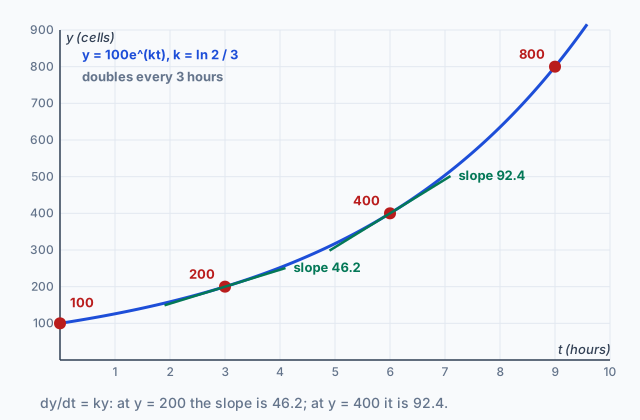 Tap to open the picture full size
Part 1 Think first How much caffeine is left tonight?
Make a guess before the lesson starts. Committing to an answer, even a wrong one, helps the right one stick.
Predict first
You drink a coffee with 160 milligrams of caffeine at 7 a.m. By noon, 5 hours later, your body has cleared half of it, so 80 milligrams are left. You have no more caffeine that day. About how much is left at 5 p.m.?
In short. An exponential model is the differential equation , which says a quantity changes at a rate proportional to its size; with at , its solution is .
- means growth and means decay, and is measured in units of 1 per unit of time.
- A second data point gives , and over equal stretches of time the amount is multiplied by the same factor.
- Motion along a line uses the same idea: antiderivatives of and are general solutions, and initial conditions pick the particular one.
Part 2 Learn it Four short ideas, each checked as you go
8a. Proportional to the size means dy/dt = ky
Many quantities change at a rate that depends on how much of them there is. A colony of 2,000 bacteria adds cells twice as fast as a colony of 1,000, because twice as many cells are dividing. Your body clears caffeine faster when there is more of it to clear.
The sentence "the rate of change of is proportional to " translates straight into an equation:
where is a constant, the constant of proportionality. Read each piece in context:
- is the amount (cells, milligrams, people), and is time.
- is how fast the amount changes, in units of per unit of time.
- has units of 1 per unit of time. If , the amount grows; if , it decays. With per hour and milligrams, milligrams per hour.
Read carefully what the rate is proportional to. "Tea cools at a rate proportional to the difference between its temperature and the 70°F room" is ; the difference plays the part of . A rate proportional to the time, , is a different equation with a different solution.
Quick check · Match
No calculator. In each, is the quantity named, is a constant and is time. Tap a statement, then the differential equation it describes.
8b. Solving it: y = y0 e^(kt)
Separate the variables, as with any separable equation. For :
Exponentiate both sides. The exponent is a sum, so the power splits into a product:
is a positive constant. Put in : . So that constant is the starting amount , and the particular solution is
Check it: , and at it gives .
The equation by itself has the general solution , one curve for every constant . The initial condition picks one. A colony with 500 cells at that grows by follows .
A model with a baseline works the same way once you rename. For , let . Then , so , where is the starting temperature.
Quick check · Fill the statement
No calculator. Tap a blank, then tap an answer.
To solve with at (and ), first separate the variables: . Integrate both sides: . Exponentiate and use the initial condition: .
8c. Finding k, half-life and doubling time
Usually is not given. A second measurement pins it down. If at and at , then , so
A town of 8,000 people that grows by this model to 10,000 in 5 years has per year. Leave exact; often you never need a decimal.
The ratio matters, not the difference. Over any two stretches of time of the same length, the amount is multiplied by the same factor. That gives two named times:
- Doubling time: , so when .
- Half-life: , so when .
A sample with per day has a half-life of 6 days: 80 grams becomes 40 after 6 days, 20 after 12 and 10 after 18. After half-lives, of the sample is left.
You never have to choose the sign of by hand. is negative exactly when , so a shrinking quantity gives a negative on its own.
Quick check · Calculate
No calculator. The mass of a radioactive sample satisfies , where is measured in years. After 30 years, of the original mass remains. What is the half-life of the sample, in years?
8d. Motion along a line: general, then particular
Motion along a line is the other everyday use of initial conditions. Velocity is the rate of change of position, and acceleration is the rate of change of velocity:
The right side of each depends only on , so you solve it by finding an antiderivative. Each antiderivative carries a : a general solution, one for every value of . An initial condition turns it into the particular one.
A cart has acceleration meters per second per second, with meters per second and meters.
- . At : , so .
- . At : , so .
Use each condition on the function it belongs to: the velocity condition fixes , and the position condition fixes .
When a condition is given at a time other than 0, put that time in. The constant is then not simply the given value. If the cart instead had , then , so and .
Quick check · Multiple choice
No calculator. A particle moves along the -axis with velocity for . At time , the particle's position is . Which gives the particle's position ?
Part 3 Watch it done A drug leaving the bloodstream
Watch each step, then finish the last one yourself.
A patient is given 80 milligrams of a drug. The amount in the bloodstream, in milligrams, decreases at a rate proportional to , and 4 hours later 20 milligrams remain. After how many hours, measured from the dose, will 10 milligrams remain?
Predict first
Before the steps, make a guess. When will 10 milligrams remain?
Step 1 · Write the model
"Decreases at a rate proportional to " is . With , the solution is , with in hours.
Step 2 · Use the second measurement
, so and . Then , so per hour. It is negative because the drug is leaving.
Why this step?
Why do you need the 4-hour measurement at all?
The equation and give for every value of . Only a second data point picks the one rate that fits this patient.
Step 3 · Set up the target
, so and .
Your step · Calculate
No calculator. Finish it. You have per hour and . After how many hours will 10 milligrams remain?
Part 4 Try it A cooling pie and a shrinking town
Try it · Calculate
No calculator. A pie comes out of the oven at 190°F into a 70°F kitchen. Its temperature , in degrees Fahrenheit, satisfies , where is measured in minutes. After 10 minutes the pie is at 130°F. What is its temperature after 20 minutes?
Try it · Decide and justify
No calculator. A town's population satisfies , where is in years. A council member says, "Each year the town will lose the same number of people." Is the council member right?
Which reason supports your answer?
Part 5 Explain it Write it as a free-response answer
Free response on the exam is written by hand, so do this one on paper. Nothing you type here leaves the page. When you are done, open the model answer and score yourself against each point.
Free response is 50% of the exam score. This one is shaped like Question 3, from free-response Part B (calculator not permitted).
Free-response practice · Question 3 style
No calculator. In a lab, the number of yeast cells in a culture, in millions, changes at a rate proportional to the number of cells present, where is measured in hours. At there are 4 million cells, and at there are 12 million cells.
(a) Write a differential equation for . Explain what the sign of the constant of proportionality tells you in the context of the problem.
(b) Find , the particular solution with , by separation of variables. Give the constant of proportionality exactly.
(c) At what time does the culture reach 36 million cells? Find the value of when . Using correct units, interpret this value in the context of the problem.
Model answer
(a) . The culture grew from 4 to 12 million cells, so : the rate of change is positive, and the number of cells is increasing.
(b) , so and (with ). Then , and gives , so . Using : , , . So .
(c) gives , so and hours. When , million cells per hour. At the moment the culture has 12 million cells (), the number of cells is increasing at a rate of million cells per hour.
Score your own answer. This is a self-check, not a grade. Tick each point your answer makes.
Part 6 Check yourself Fish in a pond
Both case questions use this table. Read every value you need from it.
A biologist stocks a pond with fish and counts them every 2 years. She models the number of fish, , years after stocking, with the differential equation , where is a constant. The model fits her counts exactly.
| (years) | (fish) |
|---|---|
| 0 | 400 |
| 2 | 600 |
| 4 | 900 |
Case question 1 · Calculate
No calculator. According to the model, how many fish will be in the pond at ?
Case question 2 · Multiple choice
No calculator. What is the value of in the model, in units of 1 per year?
The rest stand on their own and do not use the case.
Check yourself · Spot the error
No calculator. A student solves with , so . Tap the first line with a mistake.
Check yourself · Sort it
No calculator. Sort each situation by the form of its differential equation. Tap a card, then a bin.
: rate set by the amount
: rate set by the time
Part 7 Keep it Bring back earlier ideas
These come back from 7.7 and 6.9: a particular solution written as an integral, and a definite integral by substitution.
Bring it back · Multiple choice
No calculator. Which function is the particular solution to with ?
Bring it back · Multiple choice
No calculator. What is the value of ?
In three lines
- A rate proportional to the amount is dy/dt = ky; k > 0 means growth, k < 0 means decay, and k is per unit of time.
- Separating variables gives y = y0 e^(kt); a second data point gives k = (1/t1) ln(y1/y0), and half-life or doubling time is ln 2 / |k|.
- In motion problems, antiderivatives of a(t) and v(t) are general solutions; put the given time and value in to find each constant.
Exam strategy for this topic
- Section I Part A, Multiple Choice (calculator not permitted): 29 questions in 62 minutes.
- Section I Part B, Multiple Choice (graphing calculator required): 13 questions in 38 minutes.
- Section II Part A, Free Response (graphing calculator required): 2 questions in 30 minutes.
- Section II Part B, Free Response (calculator not permitted): 4 questions in 60 minutes.
When a free-response question says to use separation of variables, show the separated equation, both antiderivatives with a constant of integration, and the step where the initial condition finds the constant. Write the constant before you exponentiate and handle it as a factor, . When you interpret or , give the units and the time or amount it refers to.
Questions students ask
Why is the solution of dy/dt = ky an exponential and not a line?
A line has a constant rate of change. Here the rate is times the amount, so it changes as the amount changes. The function whose derivative is times itself is , which you can check by differentiating.
Do I have to use e, or can I write the answer with base 2 or base 3?
Both describe the same function: . The form is the one the differential equation produces, and it keeps visible, so start there. Any correct equivalent form is acceptable.
What if y could be negative?
Separation gives , so , and still holds with negative. In context the amount is almost always positive, so you can drop the absolute value once you say .
How do I find k when I am given a half-life instead of two amounts?
A half-life means , so . A doubling time works the same way with 2 in place of , which makes positive.
How is a motion problem a differential equation?
and are differential equations. Their right sides depend only on , so you solve each by finding an antiderivative, and the initial position or velocity picks the particular solution.
Course alignment, for teachers
AP Calculus AB topic 7.8, Unit 7: Differential Equations.
- Skill 3.G: Confirm that solutions are accurate and appropriate.
This lesson maps all 3 essential knowledge statements of the topic to the part that teaches each one: 3 are checked by a scored question. The map is in the lesson file.