Unit 8 · Topic 8.1 · about 30 minutes · 7 parts · 10 scored checks, 2 of them multiple choice, plus 2 from earlier lessons
AP Calculus AB 8.1: Finding the Average Value of a Function on an Interval
Unit 8: 10 to 15% of the multiple-choice section
What you'll be able to do
- Find the average value of a function on an interval by dividing its definite integral by the length of the interval.
Key vocabulary
| Term | What it means | The exam trap |
|---|---|---|
| Average value of a function | For continuous on , the number . | It is in the same units as the function, so check the units of your answer before you report it. |
| Definite integral | , the limit of Riemann sums of on ; for it is the area under the graph. | On its own it is a total, in units such as degree-hours, not an average. |
| Average rate of change | , the change in a function's output over the change in its input. | Its units are the function's units per unit of input, one quick way to tell it apart from an average value. |
 Tap to open the picture full size
Part 1 Think first What was the car's average speed?
Guess before you learn. A wrong guess still makes the answer stick.
Predict first
A car on a test track speeds up from rest. Its speed seconds later is meters per second for , so it goes from 0 to 36 meters per second. What was its average speed over those 6 seconds?
In short. The average value of a continuous function on is : the definite integral spread evenly over the length of the interval.
- The integral is a total, and dividing it by gives the height of a rectangle on with the same area.
- The average value uses every value of on the interval; the average rate of change, , uses only the two endpoints.
- With a table or a graph instead of a formula, find or approximate the integral first, then divide by the length of the interval the question names.
Part 2 Learn it Average value in three short ideas
8a. The integral, spread evenly over the interval
To average five test scores you add them and divide by 5. A continuous function has a value at every input in , far too many to add one at a time, so the definite integral does the adding. The average value of a continuous function on is
The integral plays the part of the total, and , the length of the interval, plays the part of the count.
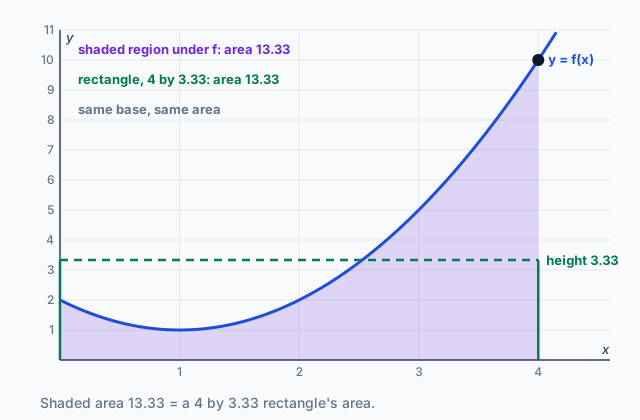
There is a picture for it. When , the integral is the area under the graph. Divide that area by the base, , and you get the height of a rectangle on the same base with the same area. That height is the average value. In the graph at the top, the shaded region and the rectangle with the dashed top have equal areas, so the parts of the region above the dashed line would exactly fill the gaps below it.
Example: on . The integral is , and the interval is long, so the average value is .
Quick check · Calculate
No calculator. What is the average value of on the interval ?
8b. Average value or average rate of change?
Both have "average" in the name and both divide by , so they are easy to mix up. They answer different questions.
- The average value of on is . It averages the outputs of , and it is in the units of .
- The average rate of change of on is . It uses only the two endpoints and says how fast changed, in units of per unit of input.
For on the average value is 10, from the integral, while the average rate of change is .
The two meet in one place. When is continuous, the Fundamental Theorem of Calculus gives , so
The average rate of change of is the average value of its derivative. For , the average value of on is . So before you start, ask which function you are averaging: itself, or its rate of change .
Quick check · Sort it
No calculator. The function has a continuous derivative, and is an antiderivative of . Sort each expression by what it equals for every such . Tap a card, then a bin.
The average value of on
The average rate of change of on
Neither, in general
8c. Tables, graphs and the size of the answer
Often comes as a graph or a table instead of a formula. The method does not change: find or approximate the integral, then divide by the length of the interval.
From a graph made of segments and arcs, find the integral from areas, counting area below the axis as negative. From a table, approximate the integral with a Riemann sum or a trapezoidal sum on the subintervals the table gives, even when their widths differ. Then divide by the length of the interval the question names. A table may run past it: if the readings go from 0 to 16 but the question asks about , use only the readings from 0 to 12 and divide by 12.
Then check the size of your answer. The average value is not automatically halfway between the least and greatest values of . It depends on how long stays at each height. A line spends as long below its middle height as above it, so its average value is halfway between its endpoint values. A function that stays low for most of the interval and climbs late, like the car in Think first, has an average value below that halfway mark. One that rises early and stays high has an average value above it.
Quick check · Decide and justify
No calculator. The function is increasing and its graph is concave up on , with and . A classmate says the average value of on is 7, halfway between 2 and 12. Is the classmate right?
Which reason supports your answer?
Part 3 Watch it done An average temperature from a formula
Watch each step, then do the last one yourself.
On a spring day the temperature in a greenhouse hours after 6 a.m. is degrees Fahrenheit, for . Find the average temperature in the greenhouse from 6 a.m. to 6 p.m.
Step 1 · Write the average value
The interval is , so the average temperature is .
Why this step?
Why is the integral divided by 12?
The integral adds up temperature times time over the whole day, in degree-hours. Dividing by the 12 hours gives the one steady temperature that would add up to the same total: the height of a rectangle 12 hours wide with the same area.
Step 2 · Find an antiderivative
An antiderivative of is . In a definite integral the constant cancels, so it can be left off here.
Your step · Calculate
No calculator. Finish it. Using the antiderivative , what is the average value of on , in degrees Fahrenheit?
Part 4 Try it A calculator integral and a cosine
Try it · Calculate
Graphing calculator required. Find the average value of on the interval . Give your answer to three decimal places.
Try it · Multiple choice
No calculator. What is the average value of on the interval ?
Part 5 Explain it Write it the way the exam asks
Free response is handwritten on the exam, so write your answer on paper first. Nothing you type here leaves this page. Then open the model answer and score yourself on each point.
Free response is 50% of the exam score. This one is shaped like Question 3, from free-response Part B (calculator not permitted).
Free-response practice · Question 3 style
No calculator. During a storm, rainwater flows into a drain at a rate of cubic feet per hour, where is measured in hours and .
(a) Find the average value of over the interval . Show the setup. Using correct units, explain the meaning of this value in the context of the problem.
(b) Find the average rate of change of over the interval . Indicate units of measure.
(c) The greatest value of on is 48 and the least is 0. A student says the average value of on must be 24, halfway between them. Explain why the student's reasoning is not correct.
Model answer
(a) cubic feet per hour. Over the 8 hours, rainwater flowed into the drain at an average rate of 32 cubic feet per hour: a steady 32 cubic feet per hour for 8 hours would bring in the same 256 cubic feet.
(b) cubic feet per hour per hour.
(c) The average value is the integral of divided by the length of the interval, which part (a) shows is 32, not 24. It depends on how long stays at each height, not only on its greatest and least values. Here stays near its peak for much of the storm, so the integral, 256, is more than .
Score your own answer. This is a self-check, not a grade. Tick each point your answer makes.
Part 6 Check yourself A tide pool
The two case questions use the same table. Answer them from it.
A scientist records the depth of the water in a tide pool, centimeters, hours after she arrives. The function is differentiable, and is continuous. She stays 10 hours, and the table gives her readings.
| (hours) | (centimeters) |
|---|---|
| 0 | 30 |
| 2 | 36 |
| 3 | 40 |
| 6 | 44 |
| 8 | 38 |
| 10 | 32 |
Case question 1 · Calculate
No calculator. Use a trapezoidal sum with the four subintervals the table gives from to to approximate the average depth of the water over , in centimeters.
Case question 2 · Multiple choice
No calculator. What is the average value of over ?
The rest stand on their own and do not use the case.
Check yourself · Spot the error
No calculator. A student finds the average value of on the interval . Tap the first line with a mistake.
Check yourself · Match
No calculator. Tap a function and its interval, then its average value on that interval.
Part 7 Keep it Bring back earlier ideas
An average value is a definite integral divided by a length, and it is easy to confuse with an average rate of change. Both come from earlier lessons.
From 6.7 The Fundamental Theorem of Calculus and Definite Integrals · Calculate
No calculator. Evaluate .
From 2.1 Defining Average and Instantaneous Rates of Change at a Point · Calculate
No calculator. Let . What is the average rate of change of over the interval ?
In three lines
- The average value of a continuous on is , the height of a rectangle with the same area.
- The average rate of change, , is a different quantity: it is the average value of , not of .
- From a table or a graph, find or approximate the integral, then divide by the length of the interval the question names.
Exam strategy for this topic
- Section I Part A, Multiple Choice (calculator not permitted): 29 questions in 62 minutes.
- Section I Part B, Multiple Choice (graphing calculator required): 13 questions in 38 minutes.
- Section II Part A, Free Response (graphing calculator required): 2 questions in 30 minutes.
- Section II Part B, Free Response (calculator not permitted): 4 questions in 60 minutes.
When a question asks for an average value, write with the actual limits before you integrate, and give units that match the function. When it asks for an average rate of change, write the difference quotient instead. Read which one the question names before you start.
Questions students ask
Is the average value the same as the average rate of change?
No. The average value averages the outputs of and uses the integral of . The average rate of change, , says how fast changed and uses only the endpoints. It equals the average value of .
Why divide by ?
The integral adds up the values of over the interval, so it grows with the interval. Dividing by the length turns that total into one typical height: the height of a rectangle on the same base with the same area.
Can an average value be negative?
Yes. Area below the axis counts as negative in a definite integral, so if is negative over enough of the interval, the integral and the average value are negative.
What if the function is given only by a table?
Approximate the integral with a Riemann sum or a trapezoidal sum on the subintervals the table gives, then divide by the length of the interval the question asks about, which may be shorter than the table.
Is the average value of a velocity the same as the average velocity?
Yes. The integral of velocity over is the displacement, so dividing it by gives displacement over elapsed time.
Course alignment, for teachers
AP Calculus AB topic 8.1, Unit 8: Applications of Integration.
- Skill 1.E: Apply appropriate mathematical rules or procedures, with and without technology.
This lesson maps the one essential knowledge statement of the topic to the part that teaches each one: 1 is checked by a scored question. The map is in the lesson file.