Unit 8 · Topic 8.2 · about 30 minutes · 7 parts · 13 scored checks, 3 of them multiple choice
AP Calculus AB 8.2: Connecting Position, Velocity, and Acceleration of Functions Using Integrals
Unit 8: 10 to 15% of the multiple-choice section
What you'll be able to do
- Use definite integrals to find a moving particle's displacement, total distance traveled, position and velocity.
Key vocabulary
| Term | What it means | The exam trap |
|---|---|---|
| Rectilinear motion | Motion along a straight line, where the position at each time is a single number such as . | Read which direction the problem calls positive before you interpret the sign of any answer. |
| Displacement | The change in a particle's position over an interval of time, given by the definite integral of its velocity over that interval. | Displacement and position are different quantities, so check which one a question asks for. |
| Speed | The absolute value of the velocity, . | Velocity carries a sign and speed does not, so read which of the two a question names. |
| Total distance traveled | The definite integral of speed over an interval of time, . | Read whether a question asks for total distance or for displacement before you set up the integral. |
 Tap to open the picture full size
Part 1 Think first Where did the robot end up?
Guess before you learn. A wrong guess still makes the answer stick.
Predict first
A delivery robot rolls along a straight hallway. For the first 40 seconds its velocity is 2 meters per second, toward the lobby. For the next 20 seconds its velocity is meters per second, so it rolls back the other way. After those 60 seconds, how far is the robot from where it started?
In short. For a particle moving along a line, the definite integral of its velocity over a time interval is its displacement, and the definite integral of its speed is the total distance it travels.
- A later position is a known position plus the integral of velocity: .
- Total distance is ; without a calculator, split the interval wherever changes sign.
- Velocity comes from acceleration the same way: .
Part 2 Learn it Position, distance and velocity from integrals
2a. The integral of velocity is displacement
A particle in rectilinear motion moves along a line, so its position at time is a single number, . Its velocity is : positive while it moves in the positive direction, negative while it moves back.
Because is an antiderivative of , the Fundamental Theorem of Calculus gives
That difference is the particle's displacement from to , its change in position. Motion in the positive direction adds to it and motion back subtracts from it. To say where the particle is, add the displacement to a position you already know:
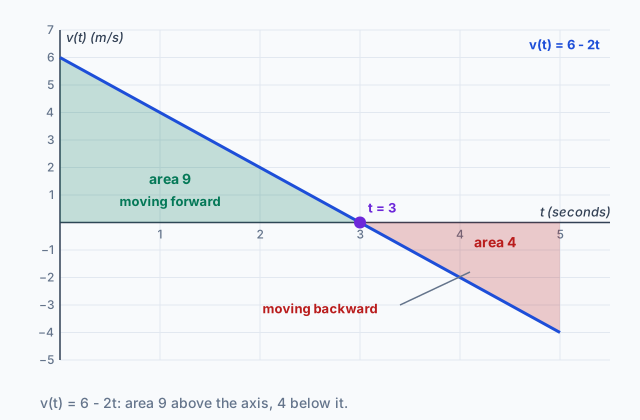
The graph at the top shows meters per second. From to the velocity is positive and the area above the axis is 9. From to it is negative and the area below the axis is 4. So meters. If the particle is at at , then at it is at .
The units multiply: meters per second times seconds gives meters.
Quick check · Calculate
No calculator. A particle moves along the x-axis with velocity for . At time the particle is at . What is its position at time ?
2b. The integral of speed is total distance
Displacement can hide motion. In the graph at the top the particle went 9 meters forward and 4 back, and the displacement, 5 meters, is what is left after the 4 cancel part of the 9.
Speed is the size of the velocity, , and it is never negative. The total distance traveled from to is the definite integral of speed:
Every stretch of motion now counts as positive, so for the graph at the top the total distance is meters.
Without a calculator, find where changes sign, split the interval at those times, and put a minus sign in front of each piece where :
With a graphing calculator, integrate directly from to .
Total distance is never less than the size of the displacement, and the two are equal only when the velocity never changes sign on the interval.
Quick check · Calculate
No calculator. A particle moves along a line with velocity for . What is the total distance the particle travels from to ?
2c. The integral of acceleration is change in velocity
The same idea works one level down. Acceleration is the rate of change of velocity, , so is an antiderivative of , and the integral of acceleration over a time interval is the change in velocity:
The value you start from has to be at the lower limit. If you know the velocity at , the integral starts at 2, not at 0.
Suppose a cyclist is riding at 2 meters per second at , and her acceleration is meters per second per second. Then
meters per second. The units work as before: meters per second per second times seconds gives meters per second.
Put the two levels together and a starting position, a starting velocity and the acceleration are enough to find where a particle is at any later time. Each step back is a definite integral added to a value you know.
Quick check · Multiple choice
No calculator. A cart moves along a straight track with acceleration meters per second per second. At second its velocity is meters per second. Which expression gives its velocity at seconds?
Part 3 Watch it done Total distance when the particle turns around twice
Watch each step, then do the last one yourself.
A particle moves along the x-axis with velocity for . Find the total distance the particle travels from to .
Step 1 · Find where the velocity changes sign
, so at and . on , on , and on .
Step 2 · Write the distance as an integral of speed, split at those times
Total distance .
Why this step?
Why does the middle integral get a minus sign?
On the velocity is negative, so there. The particle is moving back, and the minus sign turns that negative change in position into a positive distance.
Step 3 · Find an antiderivative
, so , , and .
Step 4 · Evaluate each piece
, , and .
Your step · Calculate
No calculator. Finish it. For , the integrals of over , and are , and . What is the total distance the particle travels from to ?
Part 4 Try it A calculator integral and a claim to judge
Try it · Calculate
Graphing calculator required. A slider moves along a straight rail with velocity centimeters per second for seconds. In radian mode, find the total distance the slider travels from to . Give your answer to three decimal places.
Try it · Decide and justify
No calculator. A particle moves along a line with a continuous velocity meters per second. Its velocity at is , and . A classmate says the particle traveled a total distance of 0 meters from to . Is the classmate right?
Which reason supports your answer?
Part 5 Explain it Write it the way the exam asks
On the exam free response is handwritten, so work on paper with your graphing calculator in radian mode. Nothing you type here leaves this page. Then compare with the model answer and score each point.
Free response is 50% of the exam score. This one is shaped like Question 1, from free-response Part A (graphing calculator required).
Free-response practice · Question 1 style
Graphing calculator required. A kayaker paddles along a straight canal. Her velocity is meters per minute for minutes, where a positive velocity means she is moving east. At time she is 40 meters east of a bridge. Your calculator is in radian mode. Give each decimal answer to three decimal places.
(a) Find the kayaker's position relative to the bridge at time . Show the setup that leads to your answer. Indicate units of measure.
(b) Find all times , for , at which the kayaker changes direction. Justify your answer.
(c) Find the total distance the kayaker paddles from to . Explain why this distance is greater than the distance between where she starts and where she ends. Indicate units of measure.
Model answer
(a) . At minutes the kayaker is 147.668 meters east of the bridge.
(b) Solving on the calculator for gives and minutes (truncated, 6.685 and 12.163). The velocity changes from positive to negative at and from negative to positive at , so she changes direction at both times.
(c) Total distance meters (truncated, 248.849). From to she paddles west. In the displacement, meters, that stretch is subtracted, but in the total distance it is added, so the total distance is greater than the 107.668 meters between her start and her end.
Score your own answer. This is a self-check, not a grade. Tick each point your answer makes.
Part 6 Check yourself A robot on a track
The three case questions use the same table. Answer them from it.
A small robot moves along a straight track. Its velocity , in centimeters per second, is made of straight line segments joining the points in the table, for seconds. A positive velocity means the robot moves to the right.
| (seconds) | (centimeters per second) |
|---|---|
| 0 | 0 |
| 3 | 6 |
| 5 | 6 |
| 7 | 0 |
| 10 |
Case question 1 · Calculate
No calculator. What is the total distance, in centimeters, that the robot travels from to ?
Case question 2 · Multiple choice
No calculator. At what time , for , is the robot farthest to the right?
Case question 3 · Calculate
No calculator. At the robot is at centimeters. What is its position , in centimeters?
The rest stand on their own and do not use the case.
Check yourself · Spot the error
No calculator. A particle moves along a line with velocity meters per second. A student finds the total distance it travels from to . Tap the first line with a mistake.
Check yourself · Match
No calculator. A particle moves along a line with position , velocity and acceleration . Tap an expression, then what it gives.
Part 7 Keep it From earlier lessons
This brings back the previous topic's average value, and from Unit 4 what the signs of velocity and acceleration mean. Bringing them back is what makes them last.
Bring it back · Calculate
No calculator. What is the average value of on the interval ?
Bring it back · Multiple choice
No calculator. A particle moves along a line. At time its velocity is and its acceleration is . Which statement is true at ?
In three lines
- The integral of velocity over a time interval is the displacement, and adding it to a known position gives a later position.
- The integral of speed, , is the total distance traveled; split the interval where the velocity changes sign.
- The integral of acceleration is the change in velocity, so .
Exam strategy for this topic
- Section I Part A, Multiple Choice (calculator not permitted): 29 questions in 62 minutes.
- Section I Part B, Multiple Choice (graphing calculator required): 13 questions in 38 minutes.
- Section II Part A, Free Response (graphing calculator required): 2 questions in 30 minutes.
- Section II Part B, Free Response (calculator not permitted): 4 questions in 60 minutes.
When a question asks where a particle is, write the known position plus the integral of velocity, with both limits and , before any number. When it asks how far the particle travels, write ; on a calculator part, evaluate that integral directly and give three decimal places with units.
Questions students ask
Is displacement the same as total distance traveled?
Only when the particle never turns around. Displacement subtracts the motion back from the motion forward, while total distance adds them. A runner who does one lap of a track has a displacement of 0 and a total distance of one lap.
Why is the integral of velocity a change in position?
Velocity is the derivative of position, so position is an antiderivative of velocity. The Fundamental Theorem of Calculus then says .
How do I find total distance without a calculator?
Find the times where changes sign, split the interval there, and integrate on each piece. Make every piece positive and add. On a graph, that is the total area between the velocity graph and the -axis.
Can displacement be negative?
Yes. A negative displacement means the particle ends up on the negative side of where it started. Total distance, an integral of speed, can never be negative.
What units does the integral of velocity have?
The units of velocity times the units of time. Meters per second times seconds gives meters, and for acceleration, meters per second per second times seconds gives meters per second.
Course alignment, for teachers
AP Calculus AB topic 8.2, Unit 8: Applications of Integration.
- Skill 1.D: Identify an appropriate mathematical rule or procedure based on the relationship between concepts (e.g., rate of change and accumulation) or processes (e.g., differentiation and its inverse process, anti-differentiation) to solve problems.
This lesson maps the one essential knowledge statement of the topic to the part that teaches each one: 1 is checked by a scored question. The map is in the lesson file.