Unit 8 · Topic 8.3 · about 30 minutes · 7 parts · 12 scored checks, 3 of them multiple choice
AP Calculus AB 8.3: Using Accumulation Functions and Definite Integrals in Applied Contexts
Unit 8: 10 to 15% of the multiple-choice section
What you'll be able to do
- Interpret a definite integral of a rate, or a function defined as an integral, in the context of an accumulation problem, with units.
- Find the net change in a quantity, and the amount at a later time, from a definite integral of its rate of change.
Key vocabulary
| Term | What it means | The exam trap |
|---|---|---|
| Rate of change | How fast a quantity is changing at one instant: the derivative of the quantity with respect to its input, such as . | A rate's units are the quantity's units per unit of the input, so a rate is never an amount. |
| Net change | The change in a quantity over an interval, its final value minus its initial value, which the definite integral of its rate of change over that interval gives. | Write it as final minus initial, , in that order, so a decrease comes out negative. |
| Accumulation function | A function defined as an integral, such as , which represents the accumulation of the rate of change from to . | Its input is the upper limit ; the inside the integral is only the variable of integration. |
| Definite integral | , the limit of Riemann sums of over , which for a rate of change is the accumulated change over that interval. | Write it with its integrand, both limits and the differential, or , especially when a calculator evaluates it. |
 Tap to open the picture full size
Part 1 Think first How many cars by ten o'clock?
Guess before you learn. A wrong guess still makes the answer stick.
Predict first
At 8 a.m. a parking garage holds 120 cars. From 8 to 10 a.m., cars drive in at a rate that climbs steadily from 60 cars per hour at 8 a.m. to 120 cars per hour at 10 a.m., and cars drive out at a steady 30 cars per hour. How many cars are in the garage at 10 a.m.?
In short. The definite integral of a quantity's rate of change over an interval is the net change in that quantity, and adding the amount at the start of the interval gives the amount at its end.
- , measured in the quantity's own units: rate units times time units.
- A function defined as an integral, such as , accumulates the rate from up to .
- With a rate in and a rate out, the rate of change is in minus out, and the integral of that difference is the net change.
Part 2 Learn it Three short ideas, each checked as you go
3a. The integral of a rate is a net change
If is an amount of something, its derivative is the rate at which that amount changes. Integrating the rate from to undoes the derivative and leaves the change in the amount:
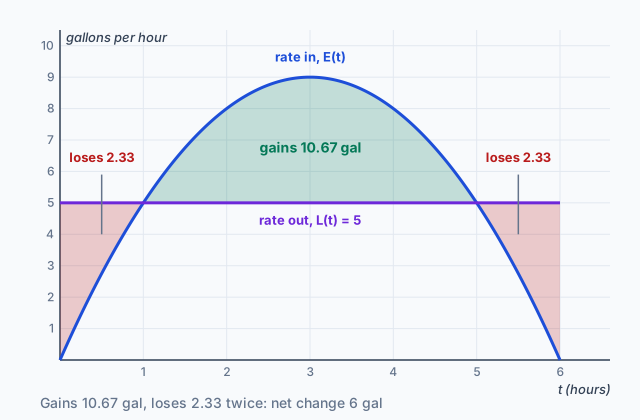
This is the net change in over the interval. Net is the important word. While the rate is positive the amount grows, while it is negative the amount shrinks, and the integral adds the gains and subtracts the losses. A tank that gains 30 gallons and then loses 10 has a net change of 20 gallons.
The units come from the area under the rate graph: the rate's units times the time's units. A rate in gallons per minute, integrated over minutes, gives gallons.
Keep two things apart from net change. The integral is not the amount itself, because it knows nothing about how much was there at . And it is not the total of every gain and loss counted as positive: the tank above had 40 gallons move in and out, but it changed by only 20.
Quick check · Calculate
No calculator. The amount of water in a tank is gallons, where is in minutes. For the amount changes at a rate of gallons per minute. By how many gallons does the amount of water change from to ?
3b. A function defined as an integral accumulates the rate
Now let the upper limit move. If is the rate of change of an amount, then
is the change in the amount from time 0 to time , for every . is a running total of the rate: it starts at and adds whatever the rate brings in as grows. A function defined as an integral like this represents an accumulation of a rate of change.
Add the starting amount and you have the amount itself. If a tank holds 40 gallons at , then at time it holds
gallons. The integral starts at the time you know the amount. If you know it at instead, write .
Because , the amount is increasing whenever the rate is positive and decreasing whenever the rate is negative.
Read any expression by what it is built from. A rate at one input is a rate. An integral of a rate is a change. A known amount plus an integral of the rate is an amount.
Quick check · Match
No calculator. A tank holds gallons of water at time hours. It holds 40 gallons at , and gallons per hour. Tap an expression, then what it means.
3c. Rate in, rate out, and which tool a question needs
Many situations give two rates: what comes in and what goes out. Say people join a line at people per minute and leave it, served, at people per minute. The line's length changes at people per minute, so over :
- the people who joined are ;
- the change in the line's length is ;
- the number in line at time is the number at time plus that change;
- how fast the line is growing at one instant is , with no integral at all.
The question's words point to the tool. "How many" or "how much" over an interval asks for an integral of a rate. "How fast" or "at what rate" at one moment asks for the rate itself. "How many are there at" a time asks for an amount, a starting value plus an integral.
The same structure fits water in a tank, cars in a garage, gravel on a pile or energy in a battery; only the units change. When the rates have no antiderivative you can find by hand, write the integral with its integrand, limits and , and evaluate it on a graphing calculator.
Quick check · Sort it
No calculator. Rain falls into a pond at a rate of gallons per hour, water drains out at gallons per hour, and the pond holds 9,000 gallons at . Tap a question, then the work it needs.
Evaluate a rate at one time
Integrate a rate over an interval
Add a starting amount to an integral
Part 3 Watch it done A gravel pile, on the calculator
Watch each step, then do the last one yourself.
A quarry keeps a pile of gravel. For hours, gravel is added to the pile at a rate of tons per hour and hauled away at a rate of tons per hour. At the pile holds 500 tons. How many tons of gravel are in the pile at ? Use a graphing calculator in radian mode, and give the answer to three decimal places.
Step 1 · Name what is asked, and set it up
It asks for an amount at a time, so start from the amount you know and add the net change. With the tons in the pile,
Why this step?
Why does the integral run from 0 to 6, and why is 500 added to it?
500 tons is the amount at . The integral of the pile's rate of change, , is the net change from that time to , so the integral starts where the amount is known and stops where it is wanted. The integral alone is only the change; 500 plus the change is the amount.
Step 2 · Look at the rates before you trust a number
At gravel arrives at and leaves at tons per hour, so the pile grows at first. At , and , so by then it is shrinking. The net change could have either sign, so let the integral decide. Enter as one function in radian mode so nothing is rounded before the end.
Your step · Calculate
Graphing calculator required. Finish it. Gravel is added to a pile at tons per hour and hauled away at tons per hour for , and the pile holds 500 tons at . In radian mode, evaluate to find the tons in the pile at . Give your answer to three decimal places.
Part 4 Try it Snow on a field, and a tank that turns around
Try it · Calculate
Graphing calculator required. The depth of snow on a field increases at a rate of inches per hour, where is in hours, and none of it melts. At there are 3 inches of snow on the ground. By how many inches does the depth of the snow increase from to ? Give your answer to three decimal places.
Try it · Decide and justify
No calculator. Water flows into and out of a tank. The amount of water changes at a rate of liters per minute, where is continuous, for , and for . A classmate says the tank holds more water at than at . Is the classmate right?
Which reason supports your answer?
Part 5 Explain it Answer it on paper, then score it
Free response is handwritten on the exam, so write your answer on paper first. Nothing you type here leaves this page. Then open the model answer and score yourself on each point.
Free response is 50% of the exam score. This one is shaped like Question 2, from free-response Part A (graphing calculator required).
Free-response practice · Question 2 style
Graphing calculator required. A home stores solar energy in a battery. For , where is measured in hours after 6 a.m., energy flows into the battery from solar panels at a rate of kilowatt-hours per hour, and flows out of the battery to the house at a rate of kilowatt-hours per hour. At time the battery holds 8 kilowatt-hours of energy.
(a) Find the value of . Using correct units, interpret the meaning of this value in the context of the problem.
(b) Find the amount of energy stored in the battery at time . Show the setup you use on your calculator, and give your answer to three decimal places. Indicate units of measure.
(c) Is the amount of energy stored in the battery increasing or decreasing at time ? Justify your answer.
Model answer
(a) . From 8 a.m. () to noon (), 10 kilowatt-hours of energy flowed out of the battery to the house.
(b) The energy stored at time is the 8 kilowatt-hours there at plus the net change since then:
(Truncated, 9.854.)
(c) Let be the energy stored. Then . Since , energy is leaving the battery faster than it arrives, so the amount stored is decreasing at .
Score your own answer. This is a self-check, not a grade. Tick each point your answer makes.
Part 6 Check yourself A cistern filling from a roof
The two case questions use the same table. Answer them from it.
Rainwater runs off a roof into a cistern at a rate of liters per hour, where is in hours and is continuous. Some values of are in the table. At the same time, water is drawn out of the cistern at a steady 10 liters per hour. At the cistern holds 150 liters.
| (hours) | (liters per hour) |
|---|---|
| 0 | 12 |
| 2 | 18 |
| 4 | 22 |
| 7 | 15 |
| 8 | 9 |
Case question 1 · Calculate
No calculator. Approximate the number of liters of water in the cistern at . Use a trapezoidal sum with the four subintervals shown in the table to approximate along the way.
Case question 2 · Multiple choice
No calculator. In the context of the cistern, what does represent?
The rest stand on their own and do not use the case.
Check yourself · Spot the error
No calculator. Water flows into a tank at gallons per minute and out at gallons per minute. The tank holds 50 gallons at . A student finds the amount in the tank at . Tap the first line with a mistake.
Check yourself · Fill the statement
No calculator. Tap a blank, then tap an answer.
A factory's stock of steel changes at a rate of tons per day, where is in days. The expression is measured in , and it gives the in the stock of steel from day 2 to day 5.
Part 7 Keep it Bring back earlier ideas
Net change grew out of displacement and out of reading a derivative in context. Pulling both back up is what makes them last.
Bring it back · Multiple choice
No calculator. A particle moves along the -axis with velocity meters per second for . What is the particle's displacement from to ?
Bring it back · Multiple choice
No calculator. The volume of water in a tank is liters, where is measured in minutes, and . Which statement is true?
In three lines
- The definite integral of a rate of change over an interval gives the net change in the quantity, gains minus losses, in the rate's units times the time's units.
- A function defined as an integral of a rate accumulates the rate, and a known amount plus that integral is the amount at a later time.
- With a rate in and a rate out, integrate their difference for the change, and evaluate the rates themselves only for how fast at one moment.
Exam strategy for this topic
- Section I Part A, Multiple Choice (calculator not permitted): 29 questions in 62 minutes.
- Section I Part B, Multiple Choice (graphing calculator required): 13 questions in 38 minutes.
- Section II Part A, Free Response (graphing calculator required): 2 questions in 30 minutes.
- Section II Part B, Free Response (calculator not permitted): 4 questions in 60 minutes.
On a calculator question, write the setup before the number: the starting amount, then the integral with its integrand, both limits and , then the value to three decimal places with units. Start the integral at the time the amount is known, and check whether the question asks for a change, an amount or a rate before you add or integrate anything.
Questions students ask
What is the difference between net change and total change?
Net change lets gains and losses cancel: it is the final value minus the initial value, . Counting every gain and every loss as positive gives the total that moved, , which for motion is the distance traveled. Read which one the question asks for.
Why does the integral have to start at the time the amount is known?
The integral adds up the change between its limits. If you know the amount at and want it at , the change you need is the change from 2 to 7, so the integral runs from 2 to 7. Starting it at 0 would add in a change that happened before the amount you know.
Do I need an antiderivative to answer these questions?
On a calculator question, no: write the integral with its limits and , then evaluate it numerically. On a question without a calculator the rate will be one you can integrate by hand, or given by a graph or table you can work from geometrically or with a Riemann sum.
How is this related to displacement in the last topic?
Displacement is the net change in position, the integral of velocity. This topic uses the same idea for any quantity whose rate of change you know: water, people, energy, gravel.
What units does the integral of a rate have?
The rate's units times the input's units. Liters per hour integrated over hours gives liters, and kilowatt-hours per hour over hours gives kilowatt-hours.
Course alignment, for teachers
AP Calculus AB topic 8.3, Unit 8: Applications of Integration.
- Skill 3.D: Apply an appropriate mathematical definition, theorem, or test.
This lesson maps all 3 essential knowledge statements of the topic to the part that teaches each one: 3 are checked by a scored question. The map is in the lesson file.