Unit 8 · Topic 8.5 · about 30 minutes · 7 parts · 12 scored checks, 3 of them multiple choice, plus 1 from earlier lessons
AP Calculus AB 8.5: Finding the Area Between Curves Expressed as Functions of y
Unit 8: 10 to 15% of the multiple-choice section
What you'll be able to do
- Calculate the area of a region in the plane with a definite integral, slicing with respect to or with respect to , whichever the region suits.
Key vocabulary
| Term | What it means | The exam trap |
|---|---|---|
| Area of a region in the plane | The size of a flat region enclosed by curves, found with a definite integral of the length of a slice across it. | An area is never negative, so a negative result points to a setup mistake, not a negative area. |
| Function of | A rule that gives one -value for each height ; its graph is read sideways. | An edge given as in terms of has to be rewritten before it can go inside a integral, and a curve can split into two halves when you do. |
| Definite integral with respect to | , the integral of a function whose input is , from to . | Write the every time. Without it, or with in its place, the integral says something else. |
 Tap to open the picture full size
Part 1 Think first How big is the pond?
Commit to a guess first. Checking it against the answer is what makes the method stick.
Predict first
A surveyor walks north from the south tip of a pond. Every few steps she measures straight across the pond, west to east. At meters north of the south tip the pond is meters wide, until it closes at its north tip, 4 meters north. About how large is the pond's surface?
In short. The area between two curves written as and , with , is the definite integral of right minus left, .
- Each horizontal slice has length right minus left, and its thickness is a small change in .
- The limits and are the heights where the region starts and stops.
- Slicing with respect to or gives the same area, so pick the one that needs fewer integrals.
Part 2 Learn it Slicing the other way
5a. Horizontal slices: right minus left
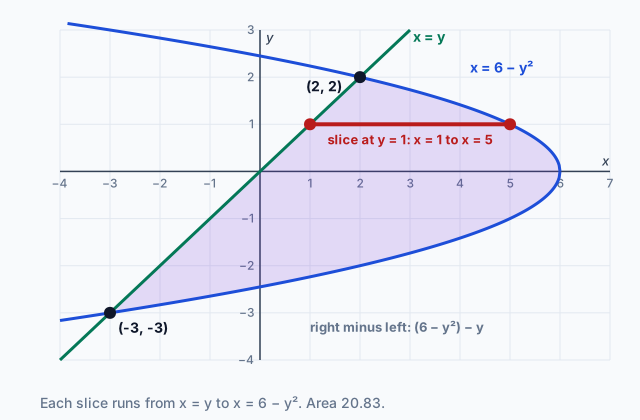
In Topic 8.4 each vertical slice was top minus bottom, added up with . Some regions are easier to cut the other way. A curve written as gives an -value at every height .
Cut the region into thin horizontal slices. A slice at height runs from the left curve to the right curve, so its length is right minus left, when , and its thickness is a small change in . Adding the slices from the lowest height to the highest height gives
The limits are heights: where the region starts and stops, often where the curves meet.
In the graph at the top, and meet where , which gives and . At the parabola is at and the line at , so the parabola is on the right, and
One height inside the region is enough to tell which curve is on the right, as long as the curves do not cross between and .
Quick check · Calculate
No calculator. Find the area of the region bounded by the curves and .
5b. Writing an edge as a function of y
Edges are often given as in terms of . To slice horizontally you need each edge as in terms of , so solve for :
- the line becomes ;
- the curve becomes , for only, because a square root is never negative;
- the curve becomes .
Two kinds of edge need a second look. A vertical line such as is already a function of : it is the same left or right edge at every height. A horizontal line such as the -axis, , is not an edge you subtract. It is where the slices stop, so it gives a limit of the integral.
A curve such as solves to , which is two functions of : the right half and the left half . Before you use one, check which half actually borders your region.
Quick check · Match
No calculator. Each curve is written with in terms of . Tap a curve, then the same curve written with in terms of .
5c. Same area, either variable
A region's area does not depend on how you slice it. Take the region between and the line . With horizontal slices,
With vertical slices, the top edge is and the bottom edge is , so
Since both give the same number, choose the slices that make the work shorter. Picture a slice sweeping across the region.
- If every vertical slice runs between the same two curves, one integral with respect to does it.
- If the top or the bottom edge changes partway across, a setup needs one integral for each piece. Try horizontal slices: if each one runs between the same left and right curves, one integral with respect to does it.
The same test works in reverse. A region whose left or right edge changes partway up is often simpler with .
Quick check · Multiple choice
No calculator. Let be the region bounded by , the horizontal line and the -axis. Which integral with respect to gives the area of ?
Part 3 Watch it done A region that wants horizontal slices
Watch each step, then do the last one yourself.
Find the area of the region bounded by , the line and the -axis.
Step 1 · Choose the slices
A vertical slice ends on the -axis for but on the line for , so needs two integrals. Every horizontal slice runs from the curve on the left to the line on the right, so use .
Step 2 · Write each edge as x in terms of y
becomes for , and becomes . The -axis, , is the bottom of the region.
Step 3 · Find the limits
The edges meet where , so and or . The region runs from up to , the height of the corner .
Why this step?
Why is the lower limit 0 and not ?
The bottom edge of this region is the -axis, where . At the line meets at , which is on the lower half of that parabola, , and not on . That point is not on this region at all.
Step 4 · Set up right minus left
At the line is at and the curve at , so the line is on the right. .
Your step · Calculate
No calculator. Finish it. The area of the region bounded by , and the -axis is . What is the area?
Part 4 Try it Two new regions
Try it · Calculate
Graphing calculator required. Let be the region bounded by the curves and . Find the area of . Give your answer to three decimal places.
Try it · Decide and justify
No calculator. Let be the region bounded by and . Its area is . A classmate says the same area is . Is the classmate right?
Which reason supports your answer?
Part 5 Explain it Write it the way the exam asks
Free response on the exam is written by hand, so work this on paper. Nothing you type here leaves this page. Then open the model answer and score yourself on each point.
Free response is 50% of the exam score. This one is shaped like Question 6, from free-response Part B (calculator not permitted).
Free-response practice · Question 6 style
No calculator. On a park map, with and measured in meters, the west shore of a pond follows the curve and a straight dam along its east side follows the line . The region enclosed by the shore and the dam is the surface of the pond.
(a) Find the area of the pond's surface. Show the integral you use and its antiderivative. Indicate units of measure.
(b) Write, but do not evaluate, an expression involving one or more integrals with respect to that gives the same area. Explain why a single integral with respect to is not enough.
(c) A rope along the horizontal line divides the pond's surface into two parts of equal area. Write an equation involving an integral with respect to that satisfies, and verify that satisfies it.
Model answer
(a) The shore and the dam meet where , so and or . At the dam is at and the shore at , so the dam is on the right.
The pond's surface is 36 square meters.
(b) Solved for , the shore is above and below, and the dam is . The corners are and .
One integral is not enough because the bottom edge changes at : to the left of a vertical slice ends on the lower half of the shore, , and to the right of it the slice ends on the dam.
(c) Half of the area is 18, so . With , , so satisfies the equation.
Score your own answer. This is a self-check, not a grade. Tick each point your answer makes.
Part 6 Check yourself A reservoir on a map
The two case questions use the same table. Answer them from it.
On a map of a reservoir, with and in meters, is the distance north of the dam. At height the east shore is at and the west shore is at , where and are continuous and for . The reservoir's surface is the region between the two shores from to .
| (meters) | (meters) | (meters) |
|---|---|---|
| 0 | 50 | 10 |
| 30 | 80 | 0 |
| 60 | 95 | 5 |
| 90 | 90 | 20 |
| 120 | 60 | 40 |
Case question 1 · Calculate
No calculator. Use a trapezoidal sum with the four subintervals shown in the table to approximate the area of the reservoir's surface, in square meters.
Case question 2 · Multiple choice
No calculator. Which expression gives the exact area of the reservoir's surface, in square meters?
The rest stand on their own and do not use the case.
Check yourself · Spot the error
No calculator. A student finds the area of the region bounded by and the line . Tap the first line with a mistake.
Check yourself · Sort it
No calculator. How many integrals does each region need? Tap a card, then a bin.
One integral in , two in
One integral in , two in
One integral either way
Check yourself · Fill the statement
No calculator. Tap a blank, then tap an answer.
To find an area with horizontal slices, solve each edge for in terms of , then integrate the curve minus the curve with respect to .
Part 7 Keep it Bring back earlier ideas
This lesson stands on vertical slices from Topic 8.4 and on reading a definite integral as signed area from Topic 6.6, where a piece below the axis counts as negative. Pulling them back up is what makes them last.
Bring it back · Multiple choice
No calculator. Which integral gives the area of the region bounded by and ?
From 6.6 Applying Properties of Definite Integrals · Calculate
No calculator. Use geometry to evaluate .
In three lines
- For curves written as and , a horizontal slice has length right minus left.
- The area is , with and the lowest and highest heights of the region.
- Slicing with or gives the same area; choose the one whose slices always end on the same two curves.
Exam strategy for this topic
- Section I Part A, Multiple Choice (calculator not permitted): 29 questions in 62 minutes.
- Section I Part B, Multiple Choice (graphing calculator required): 13 questions in 38 minutes.
- Section II Part A, Free Response (graphing calculator required): 2 questions in 30 minutes.
- Section II Part B, Free Response (calculator not permitted): 4 questions in 60 minutes.
When you set up a integral, write each edge as in terms of , say which one is on the right, and use heights as the limits. If a part asks you to write but not evaluate, the integral with its integrand, both limits and is the whole answer.
Questions students ask
How do I know whether to integrate with respect to or ?
Picture slices sweeping across the region. If every vertical slice ends on the same two curves, use . If the top or bottom edge changes partway across but every horizontal slice ends on the same left and right curves, use . Either way gives the same area.
Do I always have to rewrite as ?
Only when you slice horizontally. A integral needs each edge as in terms of . If solving for is hard, that is a sign to slice with instead.
Why right minus left, and not top minus bottom?
A horizontal slice lies along one height, so its two ends differ only in . Its length is the larger -value minus the smaller, which is the right edge minus the left edge.
Can the limits of a integral be negative?
Yes. They are heights, and a region can sit below the -axis. The region between and runs from to .
What if the curve on the right changes partway up?
Then one integral of right minus left is not enough. Split the region at the height where the curves cross and add an integral for each piece. Topic 8.6 does this.
Course alignment, for teachers
AP Calculus AB topic 8.5, Unit 8: Applications of Integration.
- Skill 1.E: Apply appropriate mathematical rules or procedures, with and without technology.
This lesson maps the one essential knowledge statement of the topic to the part that teaches each one: 1 is checked by a scored question. The map is in the lesson file.