Unit 8 · Topic 8.7 · about 30 minutes · 7 parts · 12 scored checks, 3 of them multiple choice
AP Calculus AB 8.7: Volumes with Cross Sections: Squares and Rectangles
Unit 8: 10 to 15% of the multiple-choice section
What you'll be able to do
- Calculate the volume of a solid whose cross sections are squares or rectangles with a definite integral of the cross-sectional area.
Key vocabulary
| Term | What it means | The exam trap |
|---|---|---|
| Cross section | The flat shape you get when you slice a solid with a plane, here a plane perpendicular to the -axis or to the -axis. | Read which axis the slices are perpendicular to before you measure anything; it decides the variable you integrate in. |
| Solid with known cross sections | A solid whose cross sections all have one shape, such as squares, sized by a base region, so the area of each can be written down. | The base region is where the solid stands, not a cross section of it. |
| Square cross section | A cross section that is a square; with side , its area is . | Find the side as one length across the base before you square anything. |
| Rectangular cross section | A cross section that is a rectangle; its area is its base times its height, . | The height comes from the problem's wording, so reread that sentence before you write the area. |
| Volume by cross sections | , the definite integral of the cross-sectional area over the interval the solid covers. | The limits are the ends of the base along the axis the slices are perpendicular to. |
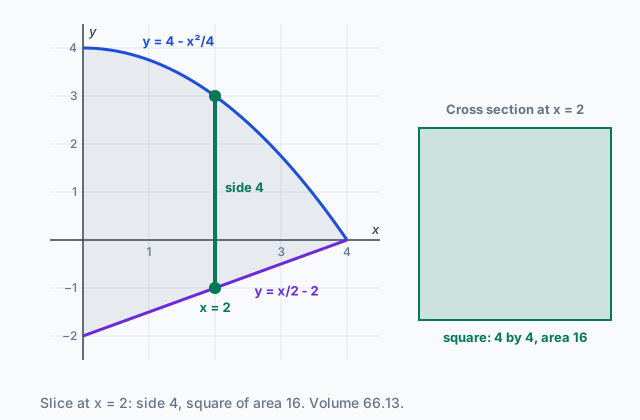 Tap to open the picture full size
Part 1 Think first How much glass is in the paperweight?
Make a guess first. Being wrong now still helps the right answer stick.
Predict first
A glass paperweight is a pyramid with a square base 6 centimeters on a side and a height of 9 centimeters. Every cross section parallel to the base is a square. How much glass is in it?
In short. A solid with known cross sections has volume , where is the area of the cross section at , found from the area formula for its shape.
- The side of a square, or the base of a rectangle, is the slice across the base region: top minus bottom, or right minus left when the slices are perpendicular to the -axis.
- A square of side has area , and a rectangle has area base times height, with the height read from the problem.
- Integrate the area, not the side, over the interval the base covers, in the variable of the axis the slices are perpendicular to.
Part 2 Learn it Slice, measure, integrate
7a. Volume is the integral of cross-sectional area
Think of a loaf of bread cut into thin slices. Each slice holds about the area of its face times its thickness, and the slices together are the loaf.
A solid with known cross sections works the same way. Lay it along the -axis from to , and let be the area of its cross section perpendicular to the -axis at . A slab of thickness there holds about , so the volume is about . That is a Riemann sum, and as the slabs get thinner its limit is a definite integral:
When each cross section is a square with side , its area is .
Back to the paperweight. Lay it on its side with the tip at and the base at . The side grows steadily from 0 to 6, so ; at the side is 2 and the area is 4. Then
cubic centimeters. Square the side first, then integrate. Integrating the side alone adds up lengths, not areas.
Quick check · Calculate
No calculator. A solid lies along the -axis from to . Its cross section perpendicular to the -axis at each is a square with side length . What is the volume of the solid?
7b. The side is the slice across the base
Most problems don't hand you the side. They give a base region in the -plane and say the cross sections perpendicular to the -axis are squares. The solid stands on that base, and each square stands on one slice across it.
The slice at runs from the bottom boundary up to the top one, so its length is , top minus bottom. That length is the side of the square, and
where and are the left and right ends of the base, often where the curves meet.
In the picture at the top, the top is and the bottom is . At , and , so the side is and the square's area is 16. A bottom boundary below the -axis makes the slice longer, not shorter.
Square the whole difference. is not .
If the cross sections are perpendicular to the -axis instead, each slice is horizontal. Its length is the right boundary minus the left one, written in terms of , and you integrate with respect to from the lowest in the base to the highest.
Quick check · Multiple choice
No calculator. The base of a solid is the region bounded by and for . Cross sections perpendicular to the -axis are squares. Which integral gives the volume of the solid?
7c. Rectangles: base times height
A rectangle needs two lengths. Its base lies in the base region: the slice across it, , just as for a square. The problem tells you the height, and the area is base times height:
The height can be given in a few ways, and each one changes :
- a fixed height, such as 3, gives ;
- a multiple of the base, such as half of it, gives ;
- a height that changes with comes with its own formula, and you multiply it by the base.
On the picture's base at the slice is 4 long. A rectangle of height 3 standing there has area , and one whose height is half its base is 4 by 2, with area 8. A square is the rectangle whose height equals its base.
Then integrate the area across the base, exactly as before: . Before you integrate, read the problem's sentence about the height once more. Writing a rectangle's area as if it were a square's is an easy slip to make.
Quick check · Calculate
No calculator. The base of a solid is the triangle bounded by , and . Cross sections perpendicular to the -axis are rectangles whose height is twice the length of their base. What is the volume of the solid?
Part 3 Watch it done Squares on the region between a line and a parabola
Each step opens in turn. The last one is yours.
The base of a solid is the region bounded by and . Cross sections perpendicular to the -axis are squares. Find the volume of the solid.
Step 1 · Find the ends of the base
gives , so and the curves meet at and .
Step 2 · Measure the side
At the line is at 2 and the parabola is at 0, so the line is on top on . The slice at has length .
Step 3 · Set up the integral
, so .
Why this step?
Why square instead of writing ?
Each cross section is one square, and its side is the whole slice, from the parabola up to the line. Its area is that one length squared. is a big square minus a small one, which is not the area of any cross section of this solid.
Step 4 · Expand and find an antiderivative
, which has antiderivative . So , with and .
Your step · Calculate
No calculator. Finish it. For the solid with square cross sections on the region between and , , where and . What is the volume? Give an exact decimal.
Part 4 Try it Turn the slices, then scale them
Try it · Calculate
No calculator. The base of a solid is the region in the first quadrant bounded by , the line and the -axis. Cross sections perpendicular to the -axis are squares. What is the volume of the solid?
Try it · Decide and justify
No calculator. Solid has square cross sections perpendicular to the -axis. Solid also has square cross sections perpendicular to the -axis over the same interval of , but at every its slice across the base is twice as long as the slice for . A classmate says the volume of is twice the volume of . Is the classmate right?
Which reason supports your answer?
Part 5 Explain it Write it the way the exam asks
Free response is handwritten on the exam, so work this one on paper first. Nothing you type here leaves this page. Then open the model answer and score yourself against each point.
Free response is 50% of the exam score. This one is shaped like Question 4, from free-response Part B (calculator not permitted).
Free-response practice · Question 4 style
No calculator. A sculptor casts a concrete piece whose base is the region bounded by the graph of , the -axis and the line , where and are measured in feet. Cross sections of the piece perpendicular to the -axis are squares.
(a) Write an integral expression for the volume of the piece, and find the volume. Show the work that leads to your answer, and use correct units.
(b) A second piece has the same base , but its cross sections perpendicular to the -axis are rectangles whose height is half the length of their base. Find the volume of the second piece. Indicate units of measure.
(c) A cut perpendicular to the -axis at divides the first piece into two parts, and the part between and holds one fourth of the volume. Write an equation involving an integral that satisfies, and find .
Model answer
(a) The slice at runs from to , so the side is feet and square feet. cubic feet.
(b) Each rectangle has base and height , so . The volume is cubic feet.
(c) , one fourth of 32. Then , so and feet.
Score your own answer. This is a self-check, not a grade. Tick each point your answer makes.
Part 6 Check yourself A tapered table leg
The two case questions use the same table. Answer them from it.
A woodworker shapes a square table leg 40 centimeters long. At a distance of centimeters from the top of the leg, its cross section perpendicular to the leg's length is a square with side centimeters, where is continuous. Some values are in the table.
| (centimeters) | (centimeters) |
|---|---|
| 0 | 6 |
| 10 | 5 |
| 20 | 4.5 |
| 30 | 4 |
| 40 | 5 |
Case question 1 · Multiple choice
No calculator. Which expression gives the volume of the leg, in cubic centimeters?
Case question 2 · Calculate
No calculator. Use a right Riemann sum with the four subintervals of the table to approximate the volume of the leg, in cubic centimeters.
The rest stand on their own and do not use the case.
Check yourself · Spot the error
No calculator. The base of a solid is the region bounded by and . Cross sections perpendicular to the -axis are squares. A student finds the volume. Tap the first line with a mistake.
Check yourself · Match
No calculator. The base of a solid runs from to , and its slice perpendicular to the -axis at has length . Tap a description of the cross sections, then the area of the cross section at .
Part 7 Keep it From earlier in the course
Two earlier ideas worth keeping: the area between two curves, which every base region here starts from, and changing the limits when you substitute. Pulling them back up is what makes them last.
Bring it back · Calculate
No calculator. Find the area of the region bounded by and . Give an exact decimal.
Bring it back · Multiple choice
No calculator. With the substitution , which integral is equal to ?
In three lines
- A solid's volume is the integral of its cross-sectional area, .
- For squares, is the side squared, and the side is the length of the slice across the base.
- For rectangles, is base times height, with the height taken from the problem.
Exam strategy for this topic
- Section I Part A, Multiple Choice (calculator not permitted): 29 questions in 62 minutes.
- Section I Part B, Multiple Choice (graphing calculator required): 13 questions in 38 minutes.
- Section II Part A, Free Response (graphing calculator required): 2 questions in 30 minutes.
- Section II Part B, Free Response (calculator not permitted): 4 questions in 60 minutes.
Write the area of one cross section, , before the integral, then write the integral with both limits and its differential. Without a calculator, show the antiderivative and its values at both limits before the number, and give a volume in context in cubic units.
Questions students ask
Do I need to draw the solid?
No. Draw the base region in the -plane and one slice across it. The slice gives you the side, and the shape's area formula does the rest.
What if the base dips below the -axis?
Nothing changes: the side is still top minus bottom. A bottom boundary below the axis makes larger, as at in the picture at the top, where the side is .
When do I integrate with respect to ?
When the cross sections are perpendicular to the -axis. Then each slice is horizontal, its length is right minus left written in terms of , and the limits are the lowest and highest in the base.
Is a square just a special rectangle here?
Yes. A square is the rectangle whose height equals its base, so .
Does the pyramid formula from geometry agree with the integral?
Yes. Slicing a pyramid with a square base into square cross sections and integrating their areas gives one third of the base area times the height, which is where that formula comes from.
Course alignment, for teachers
AP Calculus AB topic 8.7, Unit 8: Applications of Integration.
- Skill 3.D: Apply an appropriate mathematical definition, theorem, or test.
This lesson maps the one essential knowledge statement of the topic to the part that teaches each one: 1 is checked by a scored question. The map is in the lesson file.