Unit 1 · Topic 1.1 · about 30 minutes · 7 parts · 12 scored checks, 1 of them multiple choice
AP Chemistry 1.1: Moles and Molar Mass
Unit 1: 7 to 9% of the multiple-choice section
What you'll be able to do
- Calculate the amount of a substance in moles, its mass, or its number of particles, using dimensional analysis and the mole concept.
Key vocabulary
| Term | What it means | The exam trap |
|---|---|---|
| Mole (mol) | The amount of substance that contains 6.022 × 10²³ particles, whether atoms, molecules or formula units. | Its unit symbol is mol, so keep an amount in moles apart from a mass in grams when you label your work. |
| Avogadro's number | The number of particles in one mole, 6.022 × 10²³ mol⁻¹. | The power of ten is easy to drop or mistype, so write the whole number, with its unit, each time you use it. |
| Atomic mass unit (amu) | The unit for the mass of a single atom or molecule. | An amu value and a g/mol value can share the same number, so write the unit each time to show which one you mean. |
| Molar mass (M) | The mass of one mole of a substance, in grams per mole (g/mol). | Its unit is grams per mole, so keep that unit on the number through every step of a calculation. |
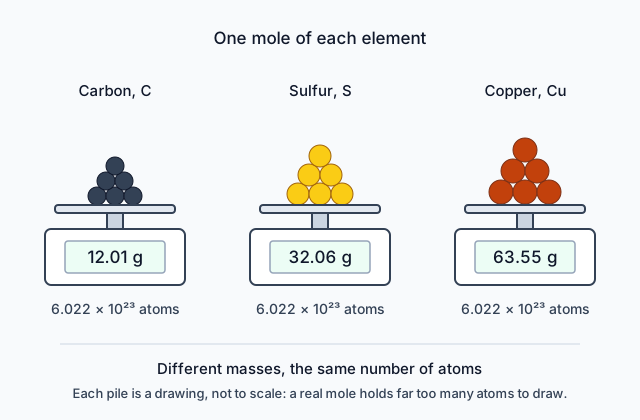 Tap to open the picture full size
Part 1 Think first Counting what you cannot see
Commit to a guess first. Being wrong now makes the right idea stick better.
Predict first
A hardware store sells nails by the pound. Rather than count out 500 nails, a clerk weighs them. A chemist has the same problem with atoms, only far worse: a single grain of salt holds more atoms than a person could count in a lifetime. How could a chemist find the number of atoms in a sample?
In short. A mole is 6.022 × 10²³ particles, and the molar mass of a substance, in grams per mole, lets a chemist count its particles by weighing it.
- Atoms are too small to count, so chemists connect the mass of a sample to the number of particles in it.
- The average mass of one particle in amu is numerically equal to the molar mass in g/mol, and n = m/M turns grams into moles.
- Avogadro's number, 6.022 × 10²³ mol⁻¹, turns moles into particles, and moles are always the middle step.
Part 2 Learn it From grams to atoms
2a. Counting by weighing
Atoms are far too small to count one by one in a lab. What a lab can measure is mass, on a balance. So chemistry needs a link between the mass of a substance and the number of particles in it, because it is particles, not grams, that take part in a chemical change.
The link is the same one the hardware clerk uses: if every nail has the same mass, the total mass divided by the mass of one nail is the number of nails. The atoms of an element have a known average mass, so the mass of a sample tells you how many atoms it holds.
The mass of one atom is tiny, so chemists give it in atomic mass units (amu). A carbon atom averages 12.01 amu and an aluminum atom 26.98 amu. These average masses are the numbers printed on the periodic table. One molecule's mass is the sum for its atoms.
Quick check · Decide and justify
A student cuts a piece of pure aluminum foil with a mass of 2.70 g. Her classmate says: "Atoms are far too small to count, so there is no way to know how many atoms are in this piece." Is the classmate right?
Which reason supports your decision?
2b. The mole and Avogadro's number
Counting by the single atom gives numbers too big to handle, so chemists count in a large, fixed batch called the mole (mol). One mole is 6.022 × 10²³ particles. That number is Avogadro's number, written with its unit as 6.022 × 10²³ mol⁻¹ and read as "particles per mole."
A mole works like a dozen: a dozen eggs is 12 eggs, and a mole of atoms is 6.022 × 10²³ atoms. The particle can be an atom, a molecule or a formula unit, so always say which one you are counting.
Avogadro's number links moles and particles:
- particles = moles × (6.022 × 10²³ mol⁻¹)
- moles = particles ÷ (6.022 × 10²³ mol⁻¹)
Example: 3.00 mol of helium atoms is (3.00 mol)(6.022 × 10²³ mol⁻¹) = 1.81 × 10²⁴ atoms.
To type a number like 6.022 × 10²³ into an answer box on this page, write it in e-notation, as 6.022e23.
Quick check · Calculate
How many silver atoms are in 0.350 mol of silver? Give your answer to three significant figures, typed in e-notation (6.022 × 10²³ is typed 6.022e23).
2c. Molar mass
Here is the link that makes weighing work. The average mass of one particle in amu is the same number as the mass of one mole of those particles in grams. A carbon atom averages 12.01 amu, so a mole of carbon atoms has a mass of 12.01 g. That mass per mole is the molar mass, M, in grams per mole (g/mol).
For a compound, add the atomic masses of every atom in the formula, counting each subscript. Water, H₂O, has two hydrogen atoms (1.008 amu each) and one oxygen atom (16.00 amu):
M(H₂O) = 2(1.008) + 16.00 = 18.02 g/mol
So one water molecule averages 18.02 amu, and one mole of water molecules, 6.022 × 10²³ of them, has a mass of 18.02 g. That mole of molecules holds twice as many hydrogen atoms as molecules, because each molecule has two.
Quick check · Fill the statement
Complete the description of nitrogen gas, N₂. The atomic mass of nitrogen is 14.01 amu.
One N₂ molecule has an average mass of 28.02 . One mole of N₂ has a mass of 28.02 . That mole contains 6.022 × 10²³ molecules, which together hold nitrogen atoms.
2d. Grams, moles and particles
Molar mass turns a mass into an amount in moles:
n = m/M
where n is the amount in moles, m is the mass in grams and M is the molar mass in g/mol. Rearranged, m = nM.
The safest way to use it is dimensional analysis: write each conversion as a fraction and check that the units cancel. For 3.60 g of water:
(3.60 g) × (1 mol / 18.02 g) = 0.200 mol
Grams cancel and leave moles. Had you multiplied by 18.02 g/mol instead, the units would come out as g²/mol, a sign the setup is upside down.
To go on to particles, add one more fraction: (0.200 mol) × (6.022 × 10²³ molecules / 1 mol) = 1.20 × 10²³ molecules. Mass to moles to particles is a chain, and moles are always the middle link.
Give an answer the number of significant figures the data carry. The mass 3.60 g has three, so the answers keep three.
Quick check · Calculate
How many moles of sodium chloride, NaCl, are in 10.0 g of it? The molar mass of NaCl is 58.44 g/mol. Give your answer to three significant figures.
Part 3 Watch it done Molecules in a drop of water
Predict first, then watch each step, then finish the calculation yourself.
A drop of water from an eyedropper has a mass of 0.0500 g. How many water molecules are in it? Atomic masses: H 1.008 amu, O 16.00 amu.
Predict first
Before you open the first step, guess: about how many water molecules are in that one drop?
Step 1 · Find the molar mass of water
M(H₂O) = 2(1.008 g/mol) + 16.00 g/mol = 18.02 g/mol.
Step 2 · Turn the mass into moles
n = m/M = (0.0500 g)/(18.02 g/mol) = 0.002775 mol. Grams cancel and leave moles. Keep the unrounded value, 0.0027747 mol, for the next step.
Why this step?
Why go through moles instead of straight from grams to molecules?
Molar mass links grams to moles, and Avogadro's number links moles to particles. Nothing links grams to particles in one step, so moles are the middle link.
Your step · Calculate
Finish it. With n = 0.0027747 mol of water, how many water molecules are in the drop? Give your answer to three significant figures, typed in e-notation (6.022 × 10²³ is typed 6.022e23).
molecules
One drop holds about 1.67 × 10²¹ molecules. Counting them at one per second, without a break, would take thousands of times longer than the age of the universe. Weighing the drop takes a few seconds.
Part 4 Try it A small gold bar
A jeweler sells a small bar of pure gold with a mass of 5.00 g. The molar mass of gold is 196.97 g/mol. These numbers are a teaching example.
Try it · Put it in order
Put the steps for finding the number of gold atoms in the bar in order.
Try it · Calculate
How many gold atoms are in the 5.00 g bar? The molar mass of gold is 196.97 g/mol. Give your answer to three significant figures, typed in e-notation (6.022 × 10²³ is typed 6.022e23).
Part 5 Explain it Count the atoms in a piece of foil
On the exam this is handwritten, so answer on paper first. Nothing you type here leaves this page. Then check your answer against the model and each scoring point.
Free response is 50% of the exam score. This one is shaped like a short-answer question, which is worth 4 points.
Free-response practice · Short-answer style
A student cuts a piece of aluminum foil with a mass of 13.5 g. The molar mass of aluminum is 26.98 g/mol, and the molar mass of copper is 63.55 g/mol. These numbers are a teaching example.
(a) Identify the mathematical relationship that turns the mass of the foil into an amount in moles.
(b) Calculate the amount of aluminum in the foil, in moles.
(c) Calculate the number of aluminum atoms in the foil.
(d) A piece of copper also has a mass of 13.5 g. Explain whether it contains more atoms than, fewer atoms than or the same number of atoms as the aluminum foil.
Model answer
(a) n = m/M: the amount in moles is the mass in grams divided by the molar mass in g/mol.
(b) n = (13.5 g)/(26.98 g/mol) = 0.50037 mol, which is 0.500 mol to three significant figures.
(c) Atoms = (0.50037 mol)(6.022 × 10²³ atoms/mol) = 3.01 × 10²³ atoms.
(d) Fewer. A copper atom has a larger average mass than an aluminum atom (63.55 amu against 26.98 amu), so the same 13.5 g holds fewer copper atoms: (13.5 g)/(63.55 g/mol) = 0.212 mol, less than the 0.500 mol of aluminum.
Score your own answer. This is a self-check, not a grade. Tick each point your answer makes.
Part 6 Check yourself Four samples on a balance
All three case questions use the table.
A student weighs out four samples of pure substances and looks up each molar mass. These numbers are a teaching example.
| Sample | Substance | Mass (g) | Molar mass (g/mol) |
|---|---|---|---|
| A | Carbon, C | 24.0 | 12.01 |
| B | Water, H₂O | 18.0 | 18.02 |
| C | Iron, Fe | 27.9 | 55.85 |
| D | Aluminum, Al | 40.5 | 26.98 |
Case question 1 · Rank it
Using the table: rank the four samples by the amount of substance each contains, in moles.
Most moles first
Give each one a place, 1 for first. Give two the same place if they are equal.
Your ranking: none yet
Case question 2 · Calculate
Using the table: how many aluminum atoms are in sample D? Give your answer to three significant figures, typed in e-notation (6.022 × 10²³ is typed 6.022e23).
Case question 3 · Multiple choice
Using the table: which sample contains the greatest total number of atoms?
The rest stand on their own and do not use the case.
Check yourself · Match
Match each conversion to the step that does it.
Check yourself · Spot the error
A student finds the mass of 0.150 mol of calcium carbonate, CaCO₃, the main ingredient of many antacid tablets. Atomic masses: Ca 40.08 amu, C 12.01 amu, O 16.00 amu. Tap the line with the mistake.
Part 7 Keep it Bring back earlier ideas
This is the course's first lesson, so there is nothing earlier to bring back yet. Later lessons will ask you about the mole and molar mass again.
In three lines
- Atoms are too small to count, so chemists count them by weighing, using the known average mass of each kind of particle.
- A mole is 6.022 × 10²³ particles, and the mass of one particle in amu is numerically equal to the molar mass in g/mol.
- n = m/M turns grams into moles, Avogadro's number turns moles into particles, and units that cancel show the setup is right.
Exam strategy for this topic
- Section I, Multiple Choice: 60 questions in 90 minutes.
- Section II, Free Response: 7 questions in 105 minutes.
- A scientific or graphing calculator is recommended for use on both sections of the exam.
In any conversion between grams, moles and particles, write each number with its unit and set up every factor as a fraction whose units cancel. If the units do not come out as what the question asks for, the setup is upside down. Round only at the end, to the significant figures in the data.
Questions students ask
What is a mole in chemistry?
A mole is 6.022 × 10²³ particles of a substance, the way a dozen is 12. It lets chemists count atoms and molecules by weighing them.
What is Avogadro's number?
It is 6.022 × 10²³ mol⁻¹, the number of particles in one mole. Multiply moles by it to get particles, and divide particles by it to get moles.
How do you find molar mass?
Add the atomic masses of every atom in the formula, multiplying each by its subscript. Water, H₂O, is 2(1.008) + 16.00 = 18.02 g/mol.
How do you convert grams to moles?
Divide the mass in grams by the molar mass in g/mol: n = m/M. The grams cancel and leave moles.
Why is the mass of one atom in amu the same number as the molar mass in grams?
Avogadro's number is the number of atomic mass units in one gram, so 6.022 × 10²³ particles of a given mass in amu weigh that same number of grams. A carbon atom averages 12.01 amu, and a mole of carbon atoms has a mass of 12.01 g.
Course alignment, for teachers
AP Chemistry topic 1.1, Unit 1: Atomic Structure and Properties.
- Skill 5.B: Identify an appropriate theory, definition, or mathematical relationship to solve a problem.
This lesson maps all 3 essential knowledge statements of the topic to the part that teaches each one: 3 are checked by a scored question. The map is in the lesson file.