Unit 1 · Topic 1.2 · about 30 minutes · 7 parts · 11 scored checks, 2 of them multiple choice, plus 2 from earlier lessons
AP Chemistry 1.2: Mass Spectra of Elements
Unit 1: 7 to 9% of the multiple-choice section
What you'll be able to do
- Explain how the mass spectrum of an element shows the masses of its isotopes and how common each one is, and how those give the element's average atomic mass.
Key vocabulary
| Term | What it means | The exam trap |
|---|---|---|
| Isotopes | Atoms of the same element that have different masses. | An isotope's name uses the whole number nearest its mass, so chlorine-35 names the isotope and is not its exact mass. |
| Mass spectrum | A graph from a mass spectrometer showing how many ions of each mass were detected in a sample. | The horizontal axis is mass, not time or energy, so read both axis labels before reading any peak. |
| Relative abundance | The share of an element's atoms that are one particular isotope. | Abundance counts atoms, not grams, so it is a share of how many atoms there are, not of how much they weigh. |
| Average atomic mass | The weighted average of the masses of an element's isotopes, the value printed on the periodic table. | The periodic table gives it to four or more significant figures, so keep that precision when you use it in a calculation. |
 Tap to open the picture full size
Part 1 Think first Two kinds of copper atoms
Commit to a guess first. Being wrong now makes the right idea stick better.
Predict first
A piece of pure copper wire holds two kinds of copper atoms: some with a mass of about 62.93 amu and some with a mass of about 64.93 amu. The periodic table lists copper's atomic mass as 63.55 amu. What does that number suggest about the two kinds of atoms?
In short. A mass spectrum of an element shows one peak for each of its isotopes, at that isotope's mass, with a height that gives how common the isotope is.
- The number of peaks is the number of isotopes, a peak's position is the isotope's mass, and its height is its relative abundance.
- The average atomic mass is a weighted average: multiply each isotope's mass by its abundance as a decimal, then add.
- With two isotopes, the average sits closer to the more abundant one, and no single atom needs to have it.
Part 2 Learn it Isotopes and the average atomic mass
2a. Reading a mass spectrum
Atoms of one element that differ in mass are isotopes of that element, named by the whole number nearest their mass: magnesium-24, copper-63. (Topic 1.5 shows what inside an atom makes isotopes differ.)
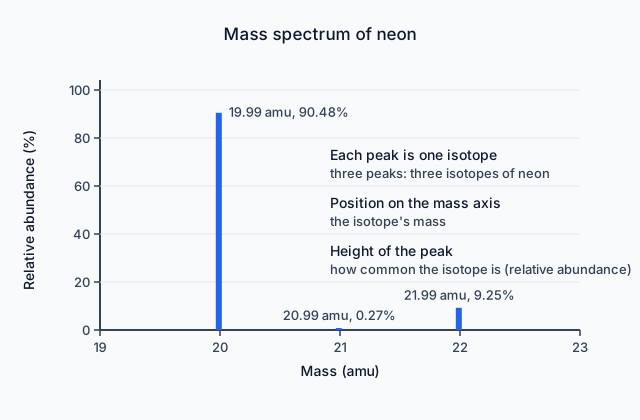
A mass spectrometer turns the atoms of a sample into ions, each with a charge of 1+, and sorts them by mass. Its output, the mass spectrum, is a graph with mass in amu along the horizontal axis and the number of ions detected up the vertical axis. For a sample of a single element:
- each peak is one isotope, so the number of peaks is the number of isotopes;
- a peak's position gives that isotope's mass;
- a peak's height gives its relative abundance, the share of the element's atoms that are that isotope.
Abundance may be shown as a percent, with the peaks adding to 100%, or as relative heights with the tallest peak set to 100. To turn heights into percents, divide each height by the sum of all the heights. For two peaks of heights 100 and 25.0, the sum is 125, so the shares are 100/125 = 80.0% and 25.0/125 = 20.0%.
Quick check · Multiple choice
The mass spectrum of a sample of pure rubidium has two peaks: one at 84.91 amu with a height of 100, and one at 86.91 amu with a height of 38.6. The tallest peak is set to 100. About what percent of rubidium atoms are rubidium-85?
2b. The weighted average
The atomic mass on the periodic table is the average atomic mass: the average mass of the element's atoms, weighted by how common each isotope is. Multiply each isotope's mass by its abundance written as a decimal, then add:
average atomic mass = (mass₁)(fraction₁) + (mass₂)(fraction₂) + ...
Example: an element has two isotopes, one of 40.00 amu with an abundance of 75.00% and one of 42.00 amu with 25.00%. These numbers are a teaching example.
(40.00 amu)(0.7500) + (42.00 amu)(0.2500) = 30.00 amu + 10.50 amu = 40.50 amu
A plain average of the two masses, 41.00 amu, would be wrong. Three of every four atoms are the lighter isotope, so each mass has to count in proportion to how many atoms have it.
Turn each percent into a decimal first. Multiplying by 75.00 instead of 0.7500 gives an answer 100 times too large.
Quick check · Calculate
Lithium, the metal in lithium-ion batteries, has two isotopes: lithium-6, of mass 6.015 amu and abundance 7.59%, and lithium-7, of mass 7.016 amu and abundance 92.41%. What is lithium's average atomic mass, in amu? Give your answer to four significant figures.
2c. Estimating and reading it backward
You can often judge an average atomic mass without working it out. The weighted average always lies between the lightest and the heaviest isotope masses, and for an element with two isotopes it sits closer to the one that is more abundant. If the two were equally common, it would sit halfway between them.
This works backward too. Chlorine's two isotopes have masses of 34.97 amu and 36.97 amu, and the periodic table lists chlorine as 35.45 amu. Halfway would be 35.97 amu. The listed value is much nearer 34.97 amu, so chlorine-35 must be the more common isotope.
For an element with two isotopes, the share of the heavier one is how far the average sits above the lighter mass, divided by the gap between the two masses:
(35.45 − 34.97)/(36.97 − 34.97) = 0.24, so about 24% of chlorine atoms are chlorine-37.
One more thing follows. No atom needs to have the average mass. Not one chlorine atom has a mass of 35.45 amu; that number describes the mixture, not any single atom.
Quick check · Decide and justify
Boron has two isotopes, boron-10 (10.01 amu) and boron-11 (11.01 amu). The periodic table lists boron's average atomic mass as 10.81 amu. Which isotope is more abundant?
Which reason supports your decision?
Part 3 Watch it done The average atomic mass of silicon
Predict first, then watch each step, then finish the calculation yourself.
Silicon, the element in computer chips, gives a mass spectrum with three peaks: 27.98 amu with a relative abundance of 92.22%, 28.98 amu with 4.69%, and 29.97 amu with 3.09%. What is the average atomic mass of silicon?
Predict first
Before you open the first step, predict: where will silicon's average atomic mass fall?
Step 1 · Turn each percent into a decimal
92.22% = 0.9222, 4.69% = 0.0469 and 3.09% = 0.0309. The three add to 1.0000, as the shares of all the atoms must.
Step 2 · Weight the first two isotopes
(27.98 amu)(0.9222) = 25.8032 amu and (28.98 amu)(0.0469) = 1.3592 amu. Keep these unrounded for the last step.
Why this step?
Why multiply each mass by its abundance instead of averaging the three masses?
Most silicon atoms are silicon-28. A plain average would count each rare isotope as much as the common one; weighting by abundance counts each isotope in proportion to how many atoms it is.
Your step · Calculate
Finish it. Weight the third isotope, 29.97 amu at 0.0309, and add it to 25.8032 amu and 1.3592 amu. What is the average atomic mass of silicon, in amu? Give your answer to four significant figures.
amu
The answer, 28.09 amu, sits almost on top of the silicon-28 peak, because more than nine in ten silicon atoms are silicon-28. It is the value printed on the periodic table.
Part 4 Try it A spectrum of gallium
A lab runs a sample of pure gallium, a metal that melts in your hand, through a mass spectrometer. The spectrum shows two peaks: one at 68.93 amu with a relative abundance of 60.11%, and one at 70.92 amu with a relative abundance of 39.89%.
Try it · Calculate
What is the average atomic mass of gallium, in amu, from this spectrum? Give your answer to four significant figures.
Try it · Decide and justify
A student notices that the periodic table's value for gallium matches neither peak in this spectrum, and concludes that the sample cannot be pure gallium. Is the student right?
Which reason supports your decision?
Part 5 Explain it From a spectrum to an atomic mass
On the exam this is handwritten, so answer on paper first. Nothing you type here leaves this page. Then check your answer against the model and each scoring point.
Free response is 50% of the exam score. This one is shaped like a short-answer question, which is worth 4 points.
Free-response practice · Short-answer style
The mass spectrum of a sample of pure rhenium shows two peaks: one at 184.95 amu with a relative abundance of 37.40%, and one at 186.96 amu with a relative abundance of 62.60%.
(a) Identify the number of isotopes of rhenium the spectrum shows.
(b) Calculate the average atomic mass of rhenium.
(c) Without calculating, explain why the average atomic mass is closer to 186.96 amu than to 184.95 amu.
(d) A student says that some rhenium atoms must have a mass equal to the average atomic mass from part (b). Explain whether the spectrum supports this claim.
Model answer
(a) Two isotopes, one for each peak.
(b) (184.95 amu)(0.3740) + (186.96 amu)(0.6260) = 69.17 amu + 117.04 amu = 186.2 amu.
(c) More of the atoms, 62.60% of them, are the 186.96 amu isotope, so in the weighted average that mass counts for more and pulls the average toward it.
(d) No. The spectrum shows atoms only at 184.95 amu and 186.96 amu, with no peak at 186.2 amu. The average describes the mixture of the two isotopes; no single atom has that mass.
Score your own answer. This is a self-check, not a grade. Tick each point your answer makes.
Part 6 Check yourself The mass spectrum of magnesium
All three case questions use the spectrum.
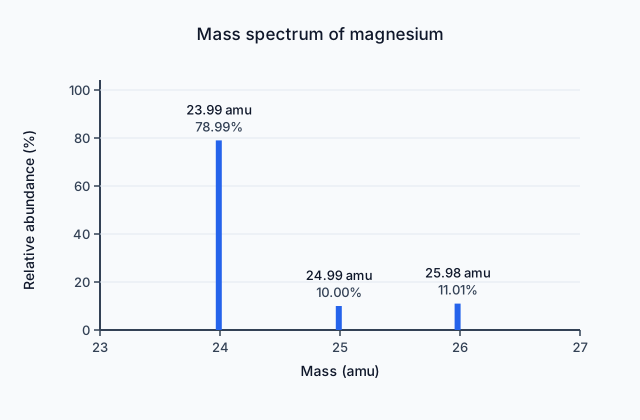
The mass spectrum below is of a sample of pure magnesium. Each peak comes from magnesium ions with a charge of 1+.
 Tap to open the picture full size
Case question 1 · Calculate
Using the spectrum: what is the average atomic mass of magnesium, in amu? Give your answer to four significant figures.
Case question 2 · Calculate
Using the spectrum: what percent of the magnesium atoms in the sample have a mass greater than 24.50 amu? Give your answer to four significant figures.
Case question 3 · Multiple choice
Using the spectrum: a second sample of magnesium gives peaks at the same three masses, but its 25.98 amu peak is taller and its 23.99 amu peak is shorter than in this spectrum. How does its average atomic mass compare with this sample's?
The rest stand on their own and do not use the case.
Check yourself · Spot the error
A student finds the average atomic mass of europium from its mass spectrum. Tap the line where the work first goes wrong.
Check yourself · Rank it
Each element below has two isotopes. Antimony: isotopes of 120.90 and 122.90 amu, average atomic mass 121.76 amu. Iridium: isotopes of 190.96 and 192.96 amu, average atomic mass 192.22 amu. Vanadium: isotopes of 49.9472 and 50.9440 amu, average atomic mass 50.9415 amu. Rank the elements by the share of their atoms that are the heavier isotope.
Largest share of the heavier isotope first
Give each one a place, 1 for first. Give two the same place if they are equal.
Your ranking: none yet
Part 7 Keep it Bring back earlier ideas
This lesson leans on two ideas from Moles and Molar Mass: that the mass of one particle in amu is the same number as its molar mass in g/mol, and how to turn grams into moles. Pulling them back up is what makes them last.
From 1.1 Moles and Molar Mass · Calculate
How many moles of sodium chloride, NaCl, are in 10.0 g of it? The molar mass of NaCl is 58.44 g/mol. Give your answer to three significant figures.
From 1.1 Moles and Molar Mass · Fill the statement
Complete the description of nitrogen gas, N₂. The atomic mass of nitrogen is 14.01 amu.
One N₂ molecule has an average mass of 28.02 . One mole of N₂ has a mass of 28.02 . That mole contains 6.022 × 10²³ molecules, which together hold nitrogen atoms.
In three lines
- A mass spectrum of an element has one peak per isotope: the position is the isotope's mass and the height is its relative abundance.
- The average atomic mass is the weighted average of the isotope masses: multiply each by its abundance as a decimal, then add.
- The average lies between the isotope masses, sits nearer the more abundant of two isotopes, and need not be the mass of any single atom.
Exam strategy for this topic
- Section I, Multiple Choice: 60 questions in 90 minutes.
- Section II, Free Response: 7 questions in 105 minutes.
- A scientific or graphing calculator is recommended for use on both sections of the exam.
When a question gives a mass spectrum, first read both axes and check whether the heights are percents or are scaled so the tallest peak is 100. Then write each isotope's mass beside its abundance as a decimal before you multiply. Check that your average lies between the lightest and heaviest isotope masses.
Questions students ask
What does a mass spectrum show?
For a sample of one element, it shows one peak for each isotope. A peak's position is the isotope's mass, and its height is the isotope's relative abundance.
How do you calculate average atomic mass?
Multiply each isotope's mass by its abundance as a decimal and add the products. For isotopes of 40.00 amu (75.00%) and 42.00 amu (25.00%), it is 30.00 + 10.50 = 40.50 amu.
Why is the atomic mass on the periodic table not a whole number?
It is a weighted average of the masses of the element's isotopes, so it usually falls between them and need not be a whole number.
How can you tell which isotope is most abundant?
On a mass spectrum, it is the tallest peak. For an element with two isotopes, it is also the one whose mass the average atomic mass sits closer to.
What if the peaks are scaled so the tallest is 100?
Divide each height by the sum of all the heights to turn the heights into percents, then find the weighted average as usual.
Beyond the AP Exam
College Board sets this limit on what the AP Exam asks about this topic. Anything past it is not on the exam.
Interpreting mass spectra of samples containing multiple elements or peaks arising from species other than singly charged monatomic ions will not be assessed on the AP Exam.
Course alignment, for teachers
AP Chemistry topic 1.2, Unit 1: Atomic Structure and Properties.
- Skill 5.D: Identify information presented graphically to solve a problem.
This lesson maps all 2 essential knowledge statements of the topic to the part that teaches each one: 2 are checked by a scored question. The map is in the lesson file.