Unit 5 · Topic 5.10 · about 30 minutes · 7 parts · 13 scored checks, 2 of them multiple choice, plus 2 from earlier lessons
AP Chemistry 5.10: Multistep Reaction Energy Profile
Unit 5: 7 to 9% of the multiple-choice section
What you'll be able to do
- Draw and read a reaction energy profile for a multistep reaction, showing the activation energy of each step and the overall energy change.
Key vocabulary
| Term | What it means | The exam trap |
|---|---|---|
| Reaction coordinate | The axis along which a reaction's progress from reactants to products is plotted on an energy profile. | The horizontal axis is progress, not time, so do not read the width of a hill as how long a step takes. |
| Transition state | The highest-energy arrangement of the particles in one elementary step, the top of that step's hill on the profile. | Peaks and valleys on a profile mean different things, so name each one before you use it. |
| Reaction intermediate | A species that one elementary step produces and a later step uses up, so it is present only while the reaction is going on. | An intermediate does not appear in the overall equation, so look for it in the steps instead. |
| Activation energy of a step | The energy difference between a step's transition state and the level of the particles that step starts with. | Each step starts from its own level, so decide where a step begins before you measure it. |
| Rate-determining step | The slowest elementary step of a mechanism, the one with the largest activation energy, which sets how fast the whole reaction can go. | Slowest is a comparison between steps, so find every step's value before you name one. |
| Overall energy change | The energy of the products minus the energy of the reactants, which is negative for an exothermic reaction and positive for an endothermic one. | It compares only the two ends of the profile, so ask what is being compared before you choose a pair of levels. |
 Tap to open the picture full size
Part 1 Think first A road with two passes
Commit to a guess first. Being wrong now makes the right idea stick better.
Predict first
A road for cyclists starts at a trailhead and climbs 60 m to a first pass. It drops 40 m into a village, climbs 25 m to a second pass, and then drops 90 m to a harbor, which is 45 m lower than the trailhead. Hundreds of riders make the trip each day. Which part of the road limits how many can get across?
In short. A multistep reaction has one hill on its energy profile for each elementary step, and the profile shows every step's activation energy, the intermediates between the steps, and the overall energy change.
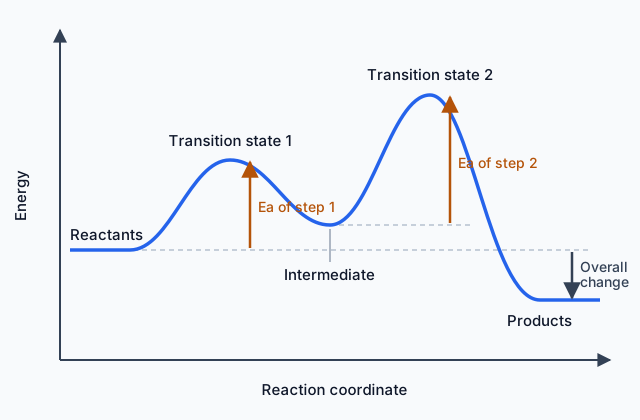
- Each peak is the transition state of one step, and each valley between peaks is a reaction intermediate.
- A step's activation energy is measured up from the level where that step starts, and the step with the largest one is the slowest.
- The overall energy change is the products' level minus the reactants' level, however many steps and peaks lie between them.
Part 2 Learn it Reading a multistep energy profile
2a. One hill for each step
A reaction that happens in one elementary step has one hill on its energy profile. Most reactions happen through a mechanism of several elementary steps, and the profile of a multistep reaction has one hill for each step. Energy is up the vertical axis, and the reaction coordinate, the progress from reactants to products, runs along the bottom.
- Each peak is the transition state of one step, the highest-energy arrangement of the particles in that step. It is not a substance you could collect.
- Each valley between two peaks is a reaction intermediate, a real species that one step produces and the next step uses up.
- The left end is the reactants and the right end is the products.
A mechanism with n steps has n peaks and n − 1 valleys. The table gives the energies for a mechanism of NO₂ + CO → NO + CO₂ in two steps. These numbers are a teaching example.
| Point on the profile | Particles | Energy (kJ/mol) |
|---|---|---|
| Reactants | 2 NO₂ + CO | 0.0 |
| Transition state 1 | top of the first hill | 120. |
| Intermediate | NO₃ + NO + CO | 20.0 |
| Transition state 2 | top of the second hill | 45.0 |
| Products | NO₂ + NO + CO₂ | −226 |
Quick check · Multiple choice
A reaction energy profile has three peaks between the reactants and the products, with one valley between each pair of neighboring peaks. How many elementary steps and how many reaction intermediates does the mechanism have?
2b. Each step has its own barrier
Every elementary step has its own barrier. The activation energy of a step is the climb from the level of the particles that step starts with, up to the top of that step's own peak.
- Step 1 starts at the reactants, so its activation energy is the first peak minus the reactants: 120. − 0.0 = 120. kJ/mol.
- Step 2 starts at the intermediate, not at the reactants, so its activation energy is the second peak minus the intermediate: 45.0 − 20.0 = 25.0 kJ/mol.
The second peak, at 45.0 kJ/mol, sits above the reactants. But the particles in step 2 are already at 20.0 kJ/mol when it begins, so their climb is only 25.0 kJ/mol. Measuring from the reactants, or reading the height of the peak, gives the wrong barrier. Always find the level a step starts from first.
Quick check · Calculate
A two-step reaction has these energies in kJ/mol: reactants 15.0, first transition state 85.0, intermediate 40.0, second transition state 70.0, products 5.0. These numbers are a teaching example. What is the activation energy of step 2, in kJ/mol? Give your answer to three significant figures.
2c. The slowest step
A mechanism cannot go faster than its hardest hill allows. A step with a large activation energy is one that few collisions get over, so it is slow, and the step with the largest activation energy is the slowest. It is the rate-determining step, and the rate law of the reaction follows from it.
In the NO₂ + CO example, step 1 has an activation energy of 120. kJ/mol and step 2 has 25.0 kJ/mol. Step 1 is the rate-determining step.
To find it from a profile, compare each step's own climb, not where the step comes in the order and not how far it drops afterward. The first step is not always the slowest, and a step that releases a great deal of energy is not necessarily fast.
Quick check · Decide and justify
A three-step mechanism has these energies in kJ/mol: reactants 50.0, transition state 1 at 80.0, first intermediate 20.0, transition state 2 at 95.0, second intermediate 45.0, transition state 3 at 70.0, products 0.0. These numbers are a teaching example. Which step is the rate-determining step?
Which reason supports your decision?
2d. Energy change of a step and of the whole reaction
Each step is exothermic if the particles end it at a lower level than they started it, and endothermic if they end it at a higher level. The height of the peak in between has no say in this: it sets the barrier, not the direction.
In the NO₂ + CO example, step 1 goes from 0.0 to 20.0 kJ/mol, so it is endothermic by 20.0 kJ/mol. Step 2 goes from 20.0 to −226 kJ/mol, so it is exothermic by 246 kJ/mol.
The overall energy change compares only the two ends: the products' level minus the reactants' level, here −226 − 0.0 = −226 kJ/mol. It is the sum of the steps' changes (+20.0 and −246), and it does not depend on the number of steps or the height of any peak. A negative value means the reaction is exothermic overall, even when an early step is endothermic.
Quick check · Sort it
Each card describes one step of a mechanism, with energies in kJ/mol. Tap a card, then the bin for what kind of step it is.
Exothermic step
Endothermic step
Part 3 Watch it done Which step is slowest?
Predict first, then watch each step, then finish the calculation yourself.
A mechanism has three elementary steps. Its energies, in kJ/mol, are: reactants 0.0, transition state 1 at 35.0, first intermediate 10.0, transition state 2 at 70.0, second intermediate 25.0, transition state 3 at 55.0, products −20.0. These numbers are a teaching example. Which step is the rate-determining step, and what is the overall energy change?
Predict first
Before you open the first step, predict: which of the three steps is the slowest?
Step 1 · Find the level each step starts from
Step 1 starts at the reactants, 0.0 kJ/mol. Step 2 starts at the first intermediate, 10.0 kJ/mol. Step 3 starts at the second intermediate, 25.0 kJ/mol.
Step 2 · Find the climb of steps 1 and 2
Step 1: 35.0 − 0.0 = 35.0 kJ/mol. Step 2: 70.0 − 10.0 = 60.0 kJ/mol. Keep both for the comparison.
Why this step?
Why is the climb of step 2 measured from 10.0 kJ/mol and not from 0.0 kJ/mol?
Step 2 begins with the first intermediate, which sits at 10.0 kJ/mol. Those particles do not have to climb from the reactants' level again, so their barrier is the climb from 10.0 to the peak at 70.0.
Your step · Calculate
Finish it. Step 3 starts at the second intermediate, 25.0 kJ/mol, and its transition state is at 55.0 kJ/mol. What is the activation energy of step 3, in kJ/mol? Give your answer to three significant figures.
kJ/mol
The climbs are 35.0, 60.0 and 30.0 kJ/mol, so step 2 has the largest activation energy and is the rate-determining step. For the overall change, only the ends matter: −20.0 − 0.0 = −20.0 kJ/mol, so the reaction is exothermic overall, even though step 1 on its own climbs to an intermediate that is above the reactants.
Part 4 Try it Draw it, then read it
First, draw a profile from a table. A two-step reaction has these energies in kJ/mol: reactants 20, transition state 1 at 70, intermediate 40, transition state 2 at 60, products 10. These numbers are a teaching example.
Try it · Sketch the graph
Draw the profile of the two-step reaction. The five points, from left to right, are the reactants, transition state 1, the intermediate, transition state 2 and the products. Energies are in kJ/mol: reactants 20, transition state 1 at 70, intermediate 40, transition state 2 at 60, products 10. The first point is fixed.
One shape that fits
Drag a point up or down, or tap it and use the arrow keys. The shape is checked, and so are the values the question lets you work out.
Now read a profile. A three-step mechanism has these energies in kJ/mol: reactants 0.0, transition state 1 at 50.0, first intermediate −10.0, transition state 2 at 90.0, second intermediate 20.0, transition state 3 at 60.0, products −40.0. These numbers are a teaching example.
Try it · Rank it
Rank the three steps by activation energy.
Largest activation energy first
Give each one a place, 1 for first. Give two the same place if they are equal.
Your ranking: none yet
Try it · Spot the error
A student reads the three-step profile above. Tap the line with the mistake.
Part 5 Explain it Read a two-step profile
On the exam this is handwritten, so answer on paper first. Nothing you type here leaves this page. Then check your answer against the model and each scoring point.
Free response is 50% of the exam score. This one is shaped like a short-answer question, which is worth 4 points.
Free-response practice · Short-answer style
A reaction has a two-step mechanism. The energies along its profile, in kJ/mol, are: reactants 40.0, transition state 1 at 100., intermediate 60.0, transition state 2 at 75.0, products 10.0. These numbers are a teaching example.
(a) Calculate the activation energy of each step.
(b) Identify the rate-determining step, and justify your answer with your values from part (a).
(c) Calculate the overall energy change, and indicate whether the reaction is exothermic or endothermic overall.
(d) On paper, represent the reaction with an energy profile. Label the reactants, the products, the intermediate and the two transition states, and show each step's activation energy. Then compare your drawing with the description in the model answer.
Model answer
(a) Step 1 starts at the reactants: 100. − 40.0 = 60. kJ/mol. Step 2 starts at the intermediate: 75.0 − 60.0 = 15.0 kJ/mol.
(b) Step 1 is the rate-determining step, because its activation energy, 60. kJ/mol, is larger than step 2's, 15.0 kJ/mol, so it is the slowest step.
(c) The overall energy change is the products minus the reactants: 10.0 − 40.0 = −30.0 kJ/mol. The reaction is exothermic overall.
(d) The drawing starts at 40.0 kJ/mol for the reactants, rises to a first peak at 100., falls to a valley at 60.0 for the intermediate, rises to a second, lower peak at 75.0, and falls to the products at 10.0, below the reactants. An arrow from 40.0 up to 100. is the activation energy of step 1, and an arrow from 60.0 up to 75.0 is the activation energy of step 2.
Score your own answer. This is a self-check, not a grade. Tick each point your answer makes.
Part 6 Check yourself A three-step reaction
All three case questions use the table.
A student is given the energies along the profile of a three-step reaction. These numbers are a teaching example.
| Point on the profile | Energy (kJ/mol) |
|---|---|
| Reactants | 20.0 |
| Transition state 1 | 75.0 |
| First intermediate | 40.0 |
| Transition state 2 | 60.0 |
| Second intermediate | −5.0 |
| Transition state 3 | 110. |
| Products | −30.0 |
Case question 1 · Calculate
Using the table: what is the activation energy of step 3, in kJ/mol? Give your answer to three significant figures.
Case question 2 · Multiple choice
Using the table: which steps are endothermic?
Case question 3 · Calculate
Using the table: what is the overall energy change of the reaction, in kJ/mol? Include its sign, and give your answer to three significant figures.
The rest stand on their own and do not use the case.
Check yourself · Put it in order
A student has a table of the energies along a multistep profile and wants to find the rate-determining step. Put the steps in order.
Check yourself · Match
Match each feature of an energy profile to what it shows.
Part 7 Keep it Bring back earlier ideas
This lesson builds on what an activation energy is and on what an elementary step is. Pulling those back up is what makes them last.
Use the collision model on situations the lesson has not shown.
From 5.5 Collision Model · Rank it
Four gas-phase reactions are run at the same temperature. They differ only in activation energy. Rank them by the fraction of collisions that have at least the activation energy.
Largest fraction first
Give each one a place, 1 for first. Give two the same place if they are equal.
Your ranking: none yet
From 5.4 Elementary Reactions · Fill the statement
Complete the description of an elementary reaction.
An elementary reaction happens in a single . Its coefficients count the that take part, and the exponents in its rate law match those . A step in which or more particles must collide at once is rare.
In three lines
- Each elementary step of a mechanism is one hill on the profile: its peak is a transition state, and each valley between peaks is a reaction intermediate.
- A step's activation energy is its peak minus the level it starts from, and the step with the largest one is the slowest, the rate-determining step.
- The overall energy change is the products' level minus the reactants' level, so a reaction can be exothermic overall even when an early step is endothermic.
Exam strategy for this topic
- Section I, Multiple Choice: 60 questions in 90 minutes.
- Section II, Free Response: 7 questions in 105 minutes.
- A scientific or graphing calculator is recommended for use on both sections of the exam.
Write the energy of every point and the level each step starts from before you subtract. Label every activation energy as a climb with units, and when you sketch a profile on paper, put the reactants, products, intermediates and transition states on the right levels relative to each other.
Questions students ask
What does the energy profile of a multistep reaction show?
It shows the energy along the reaction coordinate from the reactants to the products, with one hill for each elementary step, a valley for each reaction intermediate, and the activation energy of each step.
How many peaks and valleys does a mechanism have?
A mechanism with n elementary steps has n peaks, one transition state per step, and n − 1 valleys, one reaction intermediate between each pair of neighboring steps.
How do I find the activation energy of a step on a profile?
Subtract the level the step starts from, the reactants or the intermediate before it, from the energy of that step's own transition state.
How do I find the rate-determining step on a profile?
Find each step's activation energy as a climb from its own starting level. The step with the largest one is the slowest, so it is the rate-determining step.
Can a reaction be exothermic overall if one step is endothermic?
Yes. The overall energy change is the products' level minus the reactants' level, so a later exothermic step can outweigh an earlier endothermic one.
Course alignment, for teachers
AP Chemistry topic 5.10, Unit 5: Kinetics.
- Skill 3.B: Represent chemical substances or phenomena with appropriate diagrams or models (e.g., electron configuration).
This lesson maps the one essential knowledge statement of the topic to the part that teaches each one: 1 is checked by a scored question. The map is in the lesson file.