Unit 5 · Topic 5.11 · about 30 minutes · 7 parts · 12 scored checks, 2 of them multiple choice, plus 2 from earlier lessons
AP Chemistry 5.11: Catalysis
Unit 5: 7 to 9% of the multiple-choice section
What you'll be able to do
- Explain how a catalyst speeds up a reaction by changing its mechanism, including which parts of the energy profile change and which stay the same.
Key vocabulary
| Term | What it means | The exam trap |
|---|---|---|
| Catalyst | A substance that increases the rate of a reaction by providing a path with a lower activation energy or more effective collisions, and is regenerated, so its net concentration is constant. | Being regenerated is not the same as taking no part, so decide where in the mechanism a catalyst is used before you say what it does. |
| Alternative mechanism | A different series of elementary steps from the reactants to the products, which a catalyst provides, usually with a new intermediate. | A new route changes what happens between the ends of a profile, so check which levels a question says have changed. |
| Enzyme | A biological catalyst that binds its reactant at an active site, so the reactant is oriented favorably or reacts with a lower activation energy. | Enzymes follow the same rules as other catalysts, so test an enzyme claim against the general rules. |
| Acid-base catalysis | Catalysis in which a reactant or an intermediate gains or loses a proton, creating a new intermediate and new elementary steps. | A proton moves in more than one step, so follow where it goes before you decide what is consumed. |
| Surface catalysis | Catalysis in which a reactant or an intermediate binds to, or forms a covalent bond with, a surface, creating bound intermediates and new elementary steps. | The surface is part of the mechanism, so ask what it is doing at each step before you call it a bystander. |
| Homogeneous and heterogeneous catalyst | A homogeneous catalyst is in the same phase as the reactants, and a heterogeneous catalyst is in a different phase, such as a solid in contact with a gas. | Phase describes where the catalyst is, not how it works, so classify by phase and explain by mechanism. |
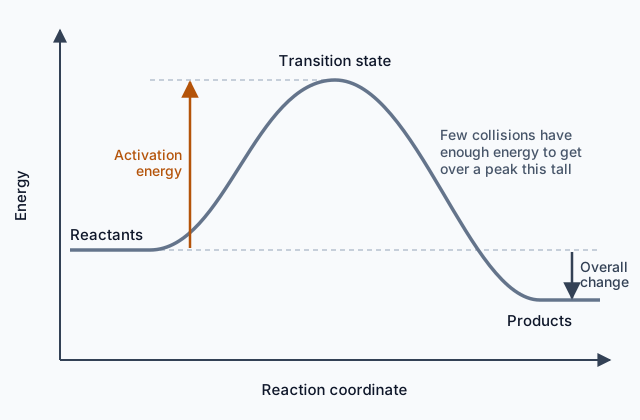 Tap to open the picture full size
Part 1 Think first Fizzing on a potato
Commit to a guess first. Being wrong now makes the right idea stick better.
Predict first
A bottle of hydrogen peroxide from the pharmacy keeps for months on a shelf. A student drops a piece of raw potato into a glass of it, and it fizzes at once with oxygen. When the fizzing dies down, the potato looks unchanged, and a fresh splash of peroxide makes the same piece fizz again. How can the potato speed the reaction up and still be there afterward?
In short. A catalyst speeds up a reaction by giving it a new mechanism with a lower activation energy for its slowest step, and it is regenerated, so its net amount does not change.
- A catalyst changes the route, not the reactants' or products' energies, so the overall energy change stays the same.
- A catalyst is consumed in one step of the new mechanism and regenerated in a later one, so it does not appear in the overall equation.
- Enzymes, acid-base catalysts and surfaces each bind or bond to reactants, creating new intermediates and new steps.
Part 2 Learn it How a catalyst changes the path
2a. A different route with a lower barrier
A catalyst is a substance that speeds up a reaction without being used up overall. It does this by providing a different route from the reactants to the products, an alternative mechanism. For the rate to go up, the catalyst must do one or both of two things:
- give the reaction a path whose slowest step has a lower activation energy than the original, so a larger share of collisions has enough energy to get over it;
- make more of the collisions effective, for example by holding the reactants in an orientation that suits the reaction.
Drawn on the same axes, the two routes look different in the middle and the same at the ends. The catalyzed route usually has more steps, a new intermediate and a lower highest hill. Both routes start at the reactants' level and end at the products' level, so the overall energy change is the same. The catalyst changes the path between the two levels, not where the levels are.
To compare routes, find the barrier of the slowest step on each, as you did for a multistep profile.
Quick check · Rank it
One reaction can follow four routes at the same temperature and concentrations. The activation energy of each elementary step, in kJ/mol, is: Route A (no catalyst), one step, 90.0; Route B (catalyst X), two steps, 35.0 and 70.0; Route C (catalyst Y), two steps, 50.0 and 20.0; Route D (catalyst Z), two steps, 25.0 and 40.0. These numbers are a teaching example. Rank the routes by rate, assuming the slowest step of each route sets its rate.
Fastest first
Give each one a place, 1 for first. Give two the same place if they are equal.
Your ranking: none yet
2b. Used in one step, regenerated in another
A catalyst is part of the mechanism, so it does react. What makes it a catalyst is that it is consumed in one step and regenerated in a later one, so its net concentration stays constant. It is often consumed in the rate-determining step.
Iodide ions, I⁻, catalyze the breakdown of hydrogen peroxide:
- Step 1 (slow): H₂O₂ + I⁻ → H₂O + IO⁻
- Step 2 (fast): H₂O₂ + IO⁻ → H₂O + O₂ + I⁻
Add the steps and cancel what appears on both sides. The IO⁻ cancels, and so does the I⁻, leaving 2 H₂O₂ → 2 H₂O + O₂.
The two species that cancel are easy to confuse. The catalyst, I⁻, is a reactant in an early step and a product of a later one. The intermediate, IO⁻, is a product of an early step and a reactant of a later one. A catalyst is there at the start and still there at the end, and an intermediate is there only in between. Neither appears in the overall equation.
Quick check · Sort it
A simplified mechanism for the destruction of ozone high in the atmosphere has two steps: Cl + O₃ → ClO + O₂, then ClO + O → Cl + O₂. Tap a card, then the bin for the role of that species.
Reactant
Catalyst
Intermediate
Product
2c. Catalysts that bind or bond to reactants
Many catalysts work by attaching to a reactant, and a new intermediate appears in which the catalyst and the reactant are joined. The new steps that make and use this intermediate are the new route.
Binding catalysts. Some catalysts bind the reactants. The reactants are held in an orientation that suits the reaction, or react with a lower activation energy, or both. Many enzymes work this way. An enzyme binds its reactant at an active site, the reactant reacts while bound, and the products leave, so the enzyme is free to bind another.
Acid-base catalysis. Some catalysts form a covalent bond to a reactant. In acid-base catalysis, a reactant or an intermediate either gains a proton or loses one. For example, H⁺ can attach to a reactant, which then reacts more easily, and a later step gives the H⁺ back. The protonated reactant is a new intermediate, and the steps that form and use it are new elementary reactions.
In both kinds, the catalyst is consumed in one step and regenerated in a later one.
Quick check · Fill the statement
Complete the description of how two kinds of catalyst work.
An enzyme speeds up a reaction by the reactant at its active site, which holds it in a more favorable . In acid-base catalysis, a reactant or an intermediate gains or loses a . In both, the catalyst creates a new , and new elementary steps involve it.
2d. Surface catalysis
In surface catalysis, a reactant or an intermediate binds to the surface of a solid, or forms a covalent bond with it. The reactants stick to the surface, and the particles bound there react in new elementary steps. The bound species are new reaction intermediates, and the steps that form and use them are the new route, with a lower barrier than the original. The surface is regenerated when the products leave.
A car's catalytic converter works this way. Exhaust flows over a honeycomb coated with platinum and rhodium, and carbon monoxide and nitrogen oxides react on the metal surface to form carbon dioxide and nitrogen.
A catalyst can be in the same phase as the reactants, like I⁻ dissolved with hydrogen peroxide, or in a different phase, like a solid metal in contact with a gas. These are called homogeneous and heterogeneous catalysts. Surface catalysts are heterogeneous, so only the atoms at the surface can bind reactants.
Quick check · Multiple choice
In a car's catalytic converter, exhaust gases flow over a honeycomb coated with platinum and rhodium, and carbon monoxide and nitrogen oxides are converted to carbon dioxide and nitrogen far faster than they would be without the metal. Which statement explains how the metal speeds up the reaction?
Part 3 Watch it done How much does iodide help?
Predict first, then watch each step, then finish the calculation yourself.
Hydrogen peroxide breaks down slowly: 2 H₂O₂ → 2 H₂O + O₂. With iodide ions it follows a two-step mechanism: step 1 (slow) is H₂O₂ + I⁻ → H₂O + IO⁻, and step 2 (fast) is H₂O₂ + IO⁻ → H₂O + O₂ + I⁻. The energies, in kJ/mol, are: without iodide, reactants 0.0, transition state 75.0, products −196. With iodide, reactants 0.0, transition state 1 at 55.0, intermediate 10.0, transition state 2 at 35.0, products −196. These numbers are a teaching example. By how much does iodide lower the activation energy of the rate-determining step?
Predict first
Before you open the first step, predict: how will the overall energy change of the reaction with iodide compare with the one without?
Step 1 · Find the barrier without iodide
The uncatalyzed reaction is one step from 0.0 to a transition state at 75.0 kJ/mol, so its activation energy is 75.0 − 0.0 = 75.0 kJ/mol.
Step 2 · Find the barrier of each step with iodide
Step 1 starts at the reactants: 55.0 − 0.0 = 55.0 kJ/mol. Step 2 starts at the intermediate: 35.0 − 10.0 = 25.0 kJ/mol. Step 1 has the larger barrier, which agrees with the mechanism calling it slow, so step 1 is the rate-determining step of the catalyzed route.
Why this step?
Why compare 75.0 with the 55.0 of step 1, and not with the 25.0 of step 2?
A route can go no faster than its slowest step. Step 2's barrier, 25.0, is not the bottleneck, so the slowest step on each route, 55.0 with iodide and 75.0 without, is what the catalyst changes.
Your step · Calculate
Finish it. The slowest step has an activation energy of 75.0 kJ/mol without iodide and 55.0 kJ/mol with iodide. By how many kJ/mol does iodide lower the activation energy of the rate-determining step? Give your answer to three significant figures.
kJ/mol
Iodide lowers the barrier of the slowest step from 75.0 to 55.0 kJ/mol. Both routes start at 0.0 and end at −196 kJ/mol, so the catalyst changed the path and left the overall energy change alone. The iodide that step 1 used up is returned in step 2, so the amount of iodide at the end equals the amount at the start.
Part 4 Try it Draw it, then judge it
First, draw a catalyzed route. Without a catalyst, a reaction goes from reactants at 30 kJ/mol over one transition state at 90 to products at 10. A catalyst gives it a two-step route through an intermediate bound to the catalyst. These numbers are a teaching example.
Try it · Sketch the graph
Draw the catalyzed route. The five points, from left to right, are the reactants, transition state 1, the intermediate bound to the catalyst, transition state 2 and the products. Energies are in kJ/mol: reactants 30, transition state 1 at 60, bound intermediate 40, transition state 2 at 50, products 10. The first point is fixed.
One shape that fits
Drag a point up or down, or tap it and use the arrow keys. The shape is checked, and so are the values the question lets you work out.
Now judge two claims about catalysts.
Try it · Decide and justify
A student adds 1.00 g of manganese dioxide powder to hydrogen peroxide solution, and oxygen bubbles off about 40 times as fast as without the powder. After the fizzing stops, the student filters, dries and weighs the powder and finds 1.00 g. These numbers are a teaching example. Is manganese dioxide acting as a catalyst or as a reactant?
Which reason supports your decision?
Try it · Spot the error
A student explains how an enzyme speeds up a reaction. Tap the line with the mistake.
Part 5 Explain it Iodide and hydrogen peroxide
On the exam this is handwritten, so answer on paper first. Nothing you type here leaves this page. Then check your answer against the model and each scoring point.
Free response is 50% of the exam score. This one is shaped like a short-answer question, which is worth 4 points.
Free-response practice · Short-answer style
Iodide ions speed up the decomposition of hydrogen peroxide, 2 H₂O₂ → 2 H₂O + O₂. The mechanism has two steps. Step 1 (slow): H₂O₂ + I⁻ → H₂O + IO⁻. Step 2 (fast): H₂O₂ + IO⁻ → H₂O + O₂ + I⁻.
(a) Identify the catalyst and the reaction intermediate in the mechanism.
(b) Explain, in terms of activation energy, why adding iodide ions makes the reaction faster.
(c) Justify the statement that the amount of iodide ion is the same after the reaction as before it.
(d) On paper, represent both routes on one energy profile, with and without iodide. Then compare your drawing with the description in the model answer.
Model answer
(a) The catalyst is I⁻ and the intermediate is IO⁻.
(b) Iodide gives the reaction a different mechanism, in which the slowest step has a lower activation energy than the one-step uncatalyzed reaction. A larger share of collisions has enough energy to get over the lower barrier, so the reaction is faster.
(c) I⁻ is consumed in step 1 and regenerated in step 2, so its net amount does not change, and it does not appear in the overall equation.
(d) Both routes start at the same reactants level and end at the same lower products level. The uncatalyzed route has one tall peak. The catalyzed route has two lower peaks with a valley between them for the intermediate IO⁻, and its first peak, the slowest step, is lower than the uncatalyzed peak.
Score your own answer. This is a self-check, not a grade. Tick each point your answer makes.
Part 6 Check yourself A catalyzed and an uncatalyzed route
Both case questions use the table.
A reaction can follow two routes: one with no catalyst and one in which a solid metal surface acts as a catalyst. The table gives the energy at each point of each route. These numbers are a teaching example.
| Point on the profile | Uncatalyzed (kJ/mol) | Catalyzed (kJ/mol) |
|---|---|---|
| Reactants | 15.0 | 15.0 |
| Transition state of the one step | 100. | none |
| Transition state 1 | none | 50.0 |
| Intermediate bound to the surface | none | 20.0 |
| Transition state 2 | none | 45.0 |
| Products | −25.0 | −25.0 |
Case question 1 · Calculate
Using the table: what is the activation energy of the rate-determining step on the catalyzed route, in kJ/mol? Give your answer to three significant figures.
Case question 2 · Multiple choice
Using the table: how does the catalyzed route compare with the uncatalyzed route?
The rest stand on their own and do not use the case.
Check yourself · Put it in order
A gas reacts on the surface of a solid catalyst. Put the events in the order they happen.
Check yourself · Match
Match each kind of catalyst to how it speeds up a reaction.
Part 7 Keep it Bring back earlier ideas
This lesson compares routes by their slowest step and reads each step's barrier from a profile. Pulling those back up is what makes them last.
From 5.10 Multistep Reaction Energy Profile · Decide and justify
A three-step mechanism has these energies in kJ/mol: reactants 50.0, transition state 1 at 80.0, first intermediate 20.0, transition state 2 at 95.0, second intermediate 45.0, transition state 3 at 70.0, products 0.0. These numbers are a teaching example. Which step is the rate-determining step?
Which reason supports your decision?
First, draw a profile from a table. A two-step reaction has these energies in kJ/mol: reactants 20, transition state 1 at 70, intermediate 40, transition state 2 at 60, products 10. These numbers are a teaching example.
Now read a profile. A three-step mechanism has these energies in kJ/mol: reactants 0.0, transition state 1 at 50.0, first intermediate −10.0, transition state 2 at 90.0, second intermediate 20.0, transition state 3 at 60.0, products −40.0. These numbers are a teaching example.
From 5.10 Multistep Reaction Energy Profile · Rank it
Rank the three steps by activation energy.
Largest activation energy first
Give each one a place, 1 for first. Give two the same place if they are equal.
Your ranking: none yet
In three lines
- A catalyst speeds up a reaction by providing a different mechanism whose slowest step has a lower activation energy, or by making collisions more effective.
- A catalyst is consumed in one step and regenerated in a later one, so its net concentration is constant and the overall energy change stays the same.
- Enzymes, acid-base catalysts and surfaces bind or bond to reactants, creating new intermediates and new elementary steps.
Exam strategy for this topic
- Section I, Multiple Choice: 60 questions in 90 minutes.
- Section II, Free Response: 7 questions in 105 minutes.
- A scientific or graphing calculator is recommended for use on both sections of the exam.
When you explain a catalyst, say that it provides a new mechanism, name the step whose activation energy is lower, and say that the catalyst is regenerated in a later step. Keep the reactants' and products' levels unchanged on any profile you draw, and show the new intermediate as a valley.
Questions students ask
How does a catalyst speed up a reaction?
It provides an alternative mechanism with a lower activation energy for the slowest step, or one that makes more collisions effective, so more particles react per second at the same temperature.
Is a catalyst used up?
It is consumed in one step of the mechanism, often the rate-determining step, and regenerated in a later one, so its net concentration is constant and it is not in the overall equation.
Does a catalyst change the energy of the reactants or the products?
No. On a profile, the catalyzed and uncatalyzed routes start and end at the same levels, so the overall energy change is the same. Only the path between them changes.
How do enzymes work as catalysts?
Many enzymes bind the reactant at an active site, which holds it in a more favorable orientation or lets it react with a lower activation energy. The bound reactant is a new intermediate.
What is the difference between acid-base catalysis and surface catalysis?
In acid-base catalysis a reactant or an intermediate gains or loses a proton. In surface catalysis a reactant or an intermediate binds to, or forms a covalent bond with, a surface.
Course alignment, for teachers
AP Chemistry topic 5.11, Unit 5: Kinetics.
- Skill 6.E: Provide reasoning to justify a claim using connections between particulate and macroscopic scales or levels.
This lesson maps all 5 essential knowledge statements of the topic to the part that teaches each one: 5 are checked by a scored question. The map is in the lesson file.