Unit 5 · Topic 5.8 · about 30 minutes · 7 parts · 11 scored checks, 2 of them multiple choice, plus 2 from earlier lessons
AP Chemistry 5.8: Reaction Mechanism and Rate Law
Unit 5: 7 to 9% of the multiple-choice section
What you'll be able to do
- Identify the rate law for a reaction from a mechanism in which the first step is rate limiting, and test a proposed mechanism against a measured rate law.
Key vocabulary
| Term | What it means | The exam trap |
|---|---|---|
| Rate-limiting step | The slowest elementary step in a mechanism, which sets the rate of the overall reaction. | A step is not slow because of where it sits in the mechanism, so find it from the information given. |
| Rate law | An equation that gives the rate of a reaction as a rate constant times reactant concentrations raised to powers. | The powers belong to the overall reaction only when they are measured or derived, so check where they came from. |
| Molecularity | The number of reactant particles that collide in one elementary step. | Count particles, not kinds of particle, and count only the reactants of the step. |
| Consistent mechanism | A mechanism whose steps add up to the overall equation and whose predicted rate law matches the measured one. | A mechanism can look right on one test, so ask which tests have actually been applied. |
 Tap to open the picture full size
Part 1 Think first A bakery with one oven
Commit to a guess first. Being wrong now makes the right idea stick better.
Predict first
A small bakery makes bread in three stages. Mixing can handle 60 loaves an hour. The one oven can bake only 20 loaves an hour. Packing can handle 60 loaves an hour. The owner buys a second mixer, so mixing can now handle 120 loaves an hour. These numbers are a teaching example. About how many loaves an hour does the bakery turn out now?
In short. When the first step of a mechanism is the slowest, the rate law of the reaction is the rate law of that step, with each exponent equal to the reactant's coefficient in the step.
- The slowest elementary step sets the overall rate, so speeding up a faster step does not change it.
- Only the species in the slow step appear in the rate law, so a reactant that enters only after it is left out.
- A proposed mechanism fits the evidence only if its steps add up to the overall equation and its slow step gives the measured rate law.
Part 2 Learn it The slow step sets the rate law
2a. The slowest step sets the rate
In the bakery, the oven set the pace. In a mechanism, the rate-limiting step (also called the rate-determining step) is the slowest elementary step, and it sets the pace for the whole reaction. The overall rate cannot be faster than it, and making any other step faster does not change it.
The rate of one elementary step comes straight from its equation: each exponent is the coefficient of that reactant. So when the first step is the rate-limiting one, the rate law of the overall reaction is the rate law of that step. Each particle that step makes is used up by a fast step as soon as it forms, so the slow step controls how quickly products appear.
For NO₂ + CO → NO + CO₂, a mechanism is:
- Step 1 (slow): NO₂ + NO₂ → NO₃ + NO
- Step 2 (fast): NO₃ + CO → NO₂ + CO₂
Step 1 has two NO₂, so rate = k[NO₂]². CO does not appear. It is a reactant, but it does not take part until step 2, after the slow step, so the rate does not depend on it. The overall equation has one NO₂ and one CO, yet the rate law is second order in NO₂ and zero order in CO. The rate law comes from the slow step, not from the overall equation.
Quick check · Multiple choice
A reaction has a two-step mechanism. Step 1 is slow and step 2 is fast. Which change would increase the overall rate the most?
2b. From mechanism to rate law
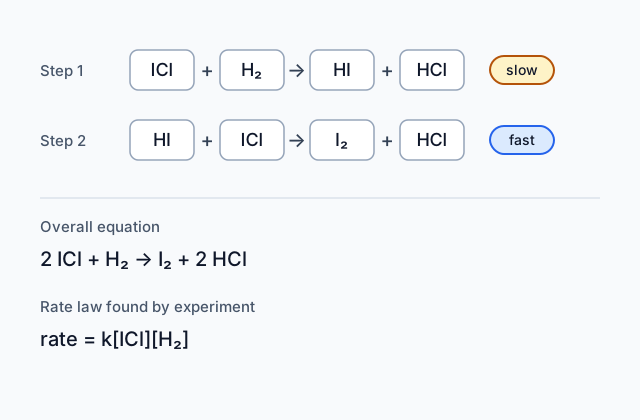
Here is the whole method, applied to 2 ICl + H₂ → I₂ + 2 HCl, which has the mechanism:
- Step 1 (slow): ICl + H₂ → HI + HCl
- Step 2 (fast): HI + ICl → I₂ + HCl
- Check that the steps add up. Adding them and canceling HI gives 2 ICl + H₂ → I₂ + 2 HCl, the overall equation.
- Find the slow step. Here it is step 1.
- Write its rate law from its coefficients. One ICl and one H₂ collide, so rate = k[ICl][H₂].
- Check that only reactants appear. An intermediate, here HI, cannot be set or measured at the start, so a rate law should contain none. When the first step is slow it holds none, because nothing has made an intermediate yet.
Notice what is left out. The 2 in 2 ICl never becomes a square, because only one ICl is in the slow step. A species is in the rate law only if it is in the slow step, so a reactant that enters later is left out, and a catalyst that is used in the slow step goes in.
Quick check · Calculate
Nitryl chloride decomposes: 2 NO₂Cl → 2 NO₂ + Cl₂. A proposed mechanism has two steps. Step 1 (slow): NO₂Cl → NO₂ + Cl. Step 2 (fast): NO₂Cl + Cl → NO₂ + Cl₂. At one temperature the rate constant of the rate law this mechanism gives is k = 0.50 s⁻¹. This is a teaching example. What is the rate of the reaction (the rate of the slow step), in M/s, when [NO₂Cl] = 0.60 M? Give your answer to two significant figures.
2c. Testing a proposed mechanism
Experiments give a rate law, and a mechanism has to match it. For a mechanism with a slow first step, two things must be true: its steps add up to the overall equation, and the rate law of its slow step is the one measured.
Take 2 NO₂ + O₃ → N₂O₅ + O₂, whose measured rate law is rate = k[NO₂][O₃]. Compare two proposals.
- Mechanism P: Step 1 (slow) NO₂ + O₃ → NO₃ + O₂, then Step 2 (fast) NO₃ + NO₂ → N₂O₅. The slow step gives rate = k[NO₂][O₃], which matches.
- Mechanism Q: Step 1 (slow) NO₂ + NO₂ → N₂O₄, then Step 2 (fast) N₂O₄ + O₃ → N₂O₅ + O₂. The slow step gives rate = k[NO₂]², which does not match.
Both mechanisms add up to the overall equation, so adding the steps cannot tell them apart. The rate law can, and it rules Q out. A match does not prove P, because another mechanism might give the same rate law, but a mismatch does rule a mechanism out. Notice too that neither mechanism follows the coefficients of the overall equation, which would predict k[NO₂]²[O₃].
Quick check · Decide and justify
The reaction 2 NO₂ → 2 NO + O₂ has the measured rate law rate = k[NO₂]². Mechanism R: Step 1 (slow) NO₂ + NO₂ → NO₃ + NO, then Step 2 (fast) NO₃ → NO + O₂. Mechanism S: Step 1 (slow) NO₂ → NO + O, then Step 2 (fast) NO₂ + O → NO + O₂. Which mechanisms are consistent with both the overall equation and the measured rate law?
Which reason supports your decision?
Part 3 Watch it done A reactant that is not in the rate law
Predict first, then watch each step, then finish the calculation yourself.
Tert-butyl bromide reacts with hydroxide ions: (CH₃)₃CBr + OH⁻ → (CH₃)₃COH + Br⁻. Experiments show that doubling [(CH₃)₃CBr] doubles the rate, and doubling [OH⁻] does not change it. A proposed mechanism has two steps. Step 1 (slow): (CH₃)₃CBr → (CH₃)₃C⁺ + Br⁻. Step 2 (fast): (CH₃)₃C⁺ + OH⁻ → (CH₃)₃COH. Is the mechanism consistent with the experiments?
Predict first
Before you open the first step, predict: will the rate law contain OH⁻, even though OH⁻ is a reactant?
Step 1 · Check that the steps add up
Adding the steps gives (CH₃)₃CBr + (CH₃)₃C⁺ + OH⁻ → (CH₃)₃C⁺ + Br⁻ + (CH₃)₃COH. The (CH₃)₃C⁺ cancels, leaving (CH₃)₃CBr + OH⁻ → (CH₃)₃COH + Br⁻, the overall equation.
Step 2 · Write the rate law of the slow step
Step 1 is slow and has one particle, so it is unimolecular: rate = k[(CH₃)₃CBr].
Why this step?
Why does OH⁻ not appear in the rate law?
OH⁻ takes part only in step 2, which is fast and comes after the slow step. The overall rate is set by step 1, which OH⁻ is not in, so changing [OH⁻] does not change the rate.
Step 3 · Compare with the experiments
The rate law is first order in (CH₃)₃CBr and zero order in OH⁻. Doubling [(CH₃)₃CBr] doubles the rate and doubling [OH⁻] changes nothing, which is what was measured, so the mechanism is consistent.
Your step · Calculate
Finish it. With rate = k[(CH₃)₃CBr], by what factor does the rate change when [(CH₃)₃CBr] is tripled and [OH⁻] is doubled? Give a whole number.
The mechanism passes both tests. OH⁻ is a reactant but it is not in the rate law, because the slow step is over before it comes in. That is why a rate law has to be measured, or derived from a mechanism, and never read from the overall equation.
Part 4 Try it The iodide mechanism again
You met this mechanism for the breakdown of hydrogen peroxide in the last lesson. Now it comes with a rate: step 1 is slow and step 2 is fast.
- Step 1 (slow): H₂O₂ + I⁻ → H₂O + IO⁻
- Step 2 (fast): H₂O₂ + IO⁻ → H₂O + O₂ + I⁻
The overall reaction is 2 H₂O₂ → 2 H₂O + O₂.
Try it · Spot the error
A student derives the rate law of the iodide mechanism. Tap the line with the mistake.
Try it · Rank it
Four mixtures of hydrogen peroxide and iodide ion react by the iodide mechanism above, at the same temperature. Mixture A has [H₂O₂] = 0.20 M and [I⁻] = 0.10 M. Mixture B has 0.10 M and 0.30 M. Mixture C has 0.20 M and 0.30 M. Mixture D has 0.10 M and 0.10 M. Rank the mixtures by their initial rates.
Fastest first
Give each one a place, 1 for first. Give two the same place if they are equal.
Your ranking: none yet
Part 5 Explain it Hydrogen bromide and oxygen
On the exam this is handwritten, so answer on paper first. Nothing you type here leaves this page. Then check your answer against the model and each scoring point.
Free response is 50% of the exam score. This one is shaped like a short-answer question, which is worth 4 points.
Free-response practice · Short-answer style
The reaction 4 HBr + O₂ → 2 H₂O + 2 Br₂ is found by experiment to be first order in HBr and first order in O₂. A proposed mechanism has three steps.
Step 1 (slow): HBr + O₂ → HOOBr
Step 2 (fast): HOOBr + HBr → 2 HOBr
Step 3 (fast, happens twice): HOBr + HBr → H₂O + Br₂
(a) Identify the rate-limiting step and determine the rate law the mechanism predicts.
(b) Identify the two intermediates in the mechanism.
(c) Explain why the rate law is not rate = k[HBr]⁴[O₂], even though the overall equation has 4 HBr.
(d) Calculate the factor by which the rate changes when [HBr] is tripled and [O₂] is doubled.
Model answer
(a) Step 1 is the rate-limiting step. It has one HBr and one O₂, so the rate law is rate = k[HBr][O₂], which matches the experiment.
(b) HOOBr is an intermediate, made in step 1 and used in step 2. HOBr is an intermediate, made in step 2 and used in step 3.
(c) The coefficients of an overall equation show the amounts that react, not the particles in the slow step. Only one HBr takes part in the slow step. The other HBr react in the fast steps after it, so they do not affect the rate.
(d) The rate is proportional to [HBr][O₂], so the factor is 3 × 2 = 6.
Score your own answer. This is a self-check, not a grade. Tick each point your answer makes.
Part 6 Check yourself Nitrogen dioxide and fluorine
Both case questions use the table.
The reaction 2 NO₂ + F₂ → 2 NO₂F is studied at one temperature, and the table gives the initial rate for three experiments. These numbers are a teaching example. Two mechanisms are proposed. Mechanism A: Step 1 (slow) NO₂ + F₂ → NO₂F + F, then Step 2 (fast) NO₂ + F → NO₂F. Mechanism B: Step 1 (slow) NO₂ + NO₂ → N₂O₄, then Step 2 (fast) N₂O₄ + F₂ → 2 NO₂F.
| Experiment | [NO₂] (M) | [F₂] (M) | Initial rate (M/s) |
|---|---|---|---|
| 1 | 0.100 | 0.100 | 2.40 × 10⁻² |
| 2 | 0.200 | 0.100 | 4.80 × 10⁻² |
| 3 | 0.100 | 0.200 | 4.80 × 10⁻² |
Case question 1 · Multiple choice
Using the table: which mechanism is consistent with the rate data?
Case question 2 · Calculate
Using the table: a new experiment at the same temperature has [NO₂] = 0.500 M and [F₂] = 0.800 M. What initial rate does the rate law from mechanism A predict, in M/s? Give your answer to three significant figures.
The rest stand on their own and do not use the case.
Check yourself · Put it in order
Put the steps for testing a mechanism that has a slow first step against measured data in order.
Check yourself · Fill the statement
Complete the statement about a mechanism whose first step is slow.
The rate law of the reaction is the rate law of the step. Each exponent equals the of that reactant in that step. A reactant that first enters in a later, fast step is the rate law.
Check yourself · Select all
A mechanism has a slow first step, 2 A → X, then a fast second step, X + B → products. Select the two true statements.
Select 2 answers, then check.
Part 7 Keep it Bring back earlier ideas
This lesson leans on two earlier ideas: how to tell an intermediate from a reactant in a mechanism, and how an elementary step's rate law comes from its coefficients. Pulling them back up is what makes them last.
From 5.7 Introduction to Reaction Mechanisms · Decide and justify
A mechanism for 2 NO₂ + F₂ → 2 NO₂F has two steps. Step 1: NO₂ + F₂ → NO₂F + F. Step 2: NO₂ + F → NO₂F. Is the fluorine atom, F, an intermediate or a product of the overall reaction?
Which reason supports your decision?
Now use the same rule on steps you have not seen. In each, the equation is one elementary reaction.
From 5.4 Elementary Reactions · Match
Match each elementary reaction to its rate law.
In three lines
- The slowest elementary step sets the overall rate, so speeding up a faster step does not change it.
- When the first step is slow, the rate law is that step's rate law, with each exponent equal to the reactant's coefficient in the step, and a reactant that enters later is left out.
- A mechanism is consistent with the evidence only if its steps add up to the overall equation and its slow step gives the measured rate law.
Exam strategy for this topic
- Section I, Multiple Choice: 60 questions in 90 minutes.
- Section II, Free Response: 7 questions in 105 minutes.
- A scientific or graphing calculator is recommended for use on both sections of the exam.
Mark the slow step, write its rate law from its own coefficients, and check that only reactants appear. When asked whether a mechanism is consistent, check both that the steps add up to the overall equation and that the slow step's rate law matches the measured one.
Questions students ask
What is the rate-limiting step?
It is the slowest elementary step in a mechanism. It sets the rate of the overall reaction, and making any faster step faster does not change that rate.
How do you find the rate law from a mechanism whose first step is slow?
Write the rate law of the slow step from its coefficients: each exponent equals the reactant's coefficient in that step. That is the rate law of the overall reaction.
Why can a reactant be missing from the rate law?
A reactant that takes part only in a fast step after the slow one cannot change how fast the slow step goes, so the reaction is zero order in it.
Why is the rate law not read from the overall equation?
The coefficients of an overall equation show the amounts that react. Only an elementary step's coefficients are the numbers of particles that collide.
How can a rate law test a mechanism?
If the rate law of a mechanism's slow step does not match the measured rate law, the mechanism is ruled out. A match supports it but does not prove it.
Beyond the AP Exam
College Board sets this limit on what the AP Exam asks about this topic. Anything past it is not on the exam.
Collection of data pertaining to detection of a reaction intermediate will not be assessed on the AP Exam.
Course alignment, for teachers
AP Chemistry topic 5.8, Unit 5: Kinetics.
- Skill 5.B: Identify an appropriate theory, definition, or mathematical relationship to solve a problem.
This lesson maps the one essential knowledge statement of the topic to the part that teaches each one: 1 is checked by a scored question. The map is in the lesson file.