Unit 5 · Topic 5.7 · about 30 minutes · 7 parts · 12 scored checks, 2 of them multiple choice, plus 2 from earlier lessons
AP Chemistry 5.7: Introduction to Reaction Mechanisms
Unit 5: 7 to 9% of the multiple-choice section
What you'll be able to do
- Identify the components of a reaction mechanism, including its steps, intermediates and catalysts, and check that the steps combine to give the overall balanced equation.
Key vocabulary
| Term | What it means | The exam trap |
|---|---|---|
| Reaction mechanism | The ordered series of elementary steps by which reactants become products, whose steps add up to the overall balanced equation. | The overall equation alone cannot tell you the mechanism, so treat a mechanism as a model that evidence supports. |
| Elementary step | A single collision or break-up in a mechanism, written as an equation that shows the particles that take part. | An overall equation is not an elementary step unless it is told to be one, because it can be the sum of several steps. |
| Reaction intermediate | A species produced by some elementary steps and consumed by others, so it is present only while the reaction is occurring. | Look at every step, not just the one that makes the species, before you name its role. |
| Catalyst | A species used in one elementary step and regenerated in a later one, so it is not consumed overall. | The order of use and regeneration matters, because reversing it describes a different role. |
 Tap to open the picture full size
Part 1 Think first One chlorine atom, thousands of ozone molecules
Commit to a guess first. Being wrong now makes the right idea stick better.
Predict first
High in the atmosphere, the ozone layer shields the ground from ultraviolet light. Chlorine atoms from old refrigerants and sprays destroy it, and one chlorine atom can help destroy thousands of ozone molecules, yet at the end it is still a chlorine atom, ready to go again. What best explains how one atom can do so much?
In short. A reaction mechanism is the series of elementary steps, in order, by which reactants become products, and its steps add up to the overall balanced equation.
- An intermediate is made by one step and used up by a later one, so it exists only while the reaction runs and never appears in the overall equation.
- A catalyst is used in one step and made again in a later one, so it does not appear in the overall equation either.
- Several mechanisms can add up to the same overall equation, and detecting an intermediate is evidence for the mechanism that predicts it.
Part 2 Learn it Reading a mechanism
2a. Steps that add up
A balanced equation tells you what goes in and what comes out. It does not tell you how the change happens, and most changes do not happen in one collision. They happen as a series of simple events called elementary steps, each a single collision or break-up. The ordered list of steps is the reaction's mechanism.
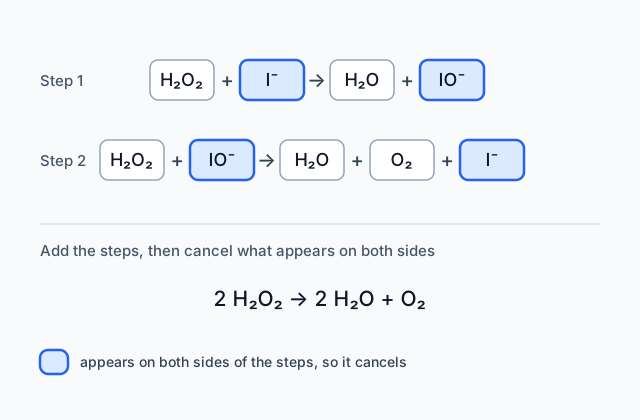
Iodide ions speed up the breakdown of hydrogen peroxide, 2 H₂O₂ → 2 H₂O + O₂. One proposed mechanism has two steps:
- Step 1: H₂O₂ + I⁻ → H₂O + IO⁻
- Step 2: H₂O₂ + IO⁻ → H₂O + O₂ + I⁻
To add the steps, write every reactant of both steps on the left and every product on the right, then cancel any species that appears on both sides. Here IO⁻ and I⁻ cancel, and what is left is 2 H₂O₂ → 2 H₂O + O₂, the overall equation. A mechanism is acceptable only if its steps combine to give exactly the overall balanced equation.
If one step has to happen twice for every time another happens once, double its equation before adding.
Quick check · Calculate
A two-step mechanism for NO₂ + CO → NO + CO₂ is: Step 1: NO₂ + NO₂ → NO₃ + NO. Step 2: NO₃ + CO → NO₂ + CO₂. Add the two steps and cancel what appears on both sides. How many NO₂ molecules are on the reactant side of the overall equation? Give a whole number.
2b. Intermediates
Look at IO⁻ in the mechanism. Step 1 makes it, and step 2 uses it up. A species that is produced by some elementary steps and consumed by others is a reaction intermediate. Two things follow.
- It cancels when you add the steps, so it never appears in the overall equation. It is neither a reactant nor a product of the reaction.
- It exists only while the reaction is going on. None is there before the first step has run, and none is left once every step has finished.
Do not confuse an intermediate with a product. A product is made and stays, because no later step uses it. An intermediate is made and then consumed.
The overall equation leaves intermediates out, so only the mechanism shows them. That is part of what a mechanism is for.
Quick check · Decide and justify
A mechanism for 2 NO₂ + F₂ → 2 NO₂F has two steps. Step 1: NO₂ + F₂ → NO₂F + F. Step 2: NO₂ + F → NO₂F. Is the fluorine atom, F, an intermediate or a product of the overall reaction?
Which reason supports your decision?
2c. Catalysts and the four roles
Now look at I⁻ in the same mechanism. Step 1 uses it up, and step 2 makes it again, so there is as much at the end as at the start. A species that is used in one step and regenerated, in the same amount, in a later one is a catalyst. Like an intermediate, it cancels when the steps are added, so it is not in the overall equation.
The difference between the two is the order. An intermediate is made first, then used. A catalyst is used first, then made again.
You can name all four roles by asking where a species first appears, whether it shows up again on the other side of a later step, and, for a species that is used first, whether as much is made again as was used.
The amounts matter. In the mechanism NO₂ + NO₂ → NO₃ + NO, then NO₃ + CO → NO₂ + CO₂, NO₂ is used first, two molecules, and made again later, but only one molecule. The net change is one NO₂ used up, so NO₂ is a reactant, not a catalyst. A catalyst has a net change of zero.
| First appears | Appears again on the other side of a later step? | Role |
|---|---|---|
| On the left of a step | No | Reactant |
| On the left of a step | Yes, and as much is made again as was used (net change zero) | Catalyst |
| On the left of a step | Yes, but less is made again than was used | Reactant |
| On the right of a step | Yes | Intermediate |
| On the right of a step | No | Product |
Quick check · Sort it
Nitric oxide takes part in the loss of ozone in the atmosphere. Step 1: NO + O₃ → NO₂ + O₂. Step 2: NO₂ + O → NO + O₂. The overall reaction is O₃ + O → 2 O₂. Tap a species, then the bin for its role.
Reactant
Intermediate
Catalyst
Product
2d. Evidence for a mechanism
Different mechanisms can add up to the same overall equation, so the equation alone cannot tell you which one is real. Nobody watches single steps happen. A mechanism is a model, and evidence supports it or does not.
One kind of evidence is an intermediate. If a mechanism says a species is made and used up along the way, a chemist can look for that species while the reaction runs. Finding it supports a mechanism that predicts it over one that does not. It does not prove the mechanism, because a different mechanism might involve the same species. Failing to find it proves little, since an intermediate is used as it forms and may be too scarce to see.
This lesson asks you to interpret such a finding, not to design the experiment that makes it.
Quick check · Multiple choice
Two mechanisms have been proposed for NO₂ + CO → NO + CO₂. Mechanism 1 is one step, NO₂ + CO → NO + CO₂. Mechanism 2 has two steps: NO₂ + NO₂ → NO₃ + NO, then NO₃ + CO → NO₂ + CO₂. A chemist reports finding NO₃ in the mixture while the reaction is running. Which claim does this report best support?
Part 3 Watch it done Back to the chlorine atom
Predict first, then watch each step, then finish the work yourself.
In the stratosphere, oxygen atoms react with ozone: O₃ + O → 2 O₂. A proposed mechanism with a chlorine atom from a refrigerant has two steps. Step 1: Cl + O₃ → ClO + O₂. Step 2: ClO + O → Cl + O₂. Do the steps add up to the overall equation, and what role does each species play?
Predict first
Before you open the first step, predict: when you add the two steps, which species will still be in the overall equation?
Step 1 · Add the steps
Write every reactant on the left and every product on the right: Cl + O₃ + ClO + O → ClO + O₂ + Cl + O₂.
Step 2 · Cancel what appears on both sides
Cl and ClO each appear on both sides, so they cancel. What is left is O₃ + O → 2 O₂, the overall equation, so the mechanism fits it.
Why this step?
Why can Cl and ClO be crossed out of the overall equation?
Each is made in one step and used in the other, in equal amounts, so neither changes overall. A species that cancels is neither a reactant nor a product of the whole reaction.
Step 3 · Find where each species first appears
Cl is on the left of step 1 and on the right of step 2. ClO is on the right of step 1 and on the left of step 2. O₂ is on the right of both steps.
Your step · Fill the statement
Finish it. Name the role of each species in the chlorine mechanism.
Cl is used in step 1 and made again in step 2, so it is a . ClO is made in step 1 and used in step 2, so it is an . O₂ is made and never used again, so it is a .
The chlorine atom is not on the sideline and it is not used up. It is a catalyst, which is why one atom can destroy thousands of ozone molecules. The overall equation shows none of this, which is why you need the mechanism.
Part 4 Try it Two intermediates
A mechanism can have more than one intermediate. One proposed mechanism for 2 NO + 2 H₂ → N₂ + 2 H₂O has three steps:
- Step 1: NO + NO → N₂O₂
- Step 2: N₂O₂ + H₂ → N₂O + H₂O
- Step 3: N₂O + H₂ → N₂ + H₂O
Try it · Select all
Select the two species that are intermediates in this mechanism.
Select 2 answers, then check.
Try it · Spot the error
A student reasons about the three-step mechanism above. Tap the line with the mistake.
Part 5 Explain it Manganese ions as a helper
On the exam this is handwritten, so answer on paper first. Nothing you type here leaves this page. Then check your answer against the model and each scoring point.
Free response is 50% of the exam score. This one is shaped like a short-answer question, which is worth 4 points.
Free-response practice · Short-answer style
Manganese(II) ions speed up the reaction of cerium(IV) ions with thallium(I) ions. One proposed mechanism has three steps.
Step 1: Ce⁴⁺ + Mn²⁺ → Ce³⁺ + Mn³⁺
Step 2: Ce⁴⁺ + Mn³⁺ → Ce³⁺ + Mn⁴⁺
Step 3: Mn⁴⁺ + Tl⁺ → Mn²⁺ + Tl³⁺
(a) Identify the catalyst in the mechanism.
(b) Identify the two intermediates in the mechanism.
(c) Determine the overall balanced equation, and explain how the steps combine to give it.
(d) A chemist detects Mn³⁺ in the mixture while the reaction is running. Explain whether this proves that the mechanism is correct.
Model answer
(a) Mn²⁺ is the catalyst. Step 1 uses it and step 3 makes it again.
(b) Mn³⁺ and Mn⁴⁺ are the intermediates. Step 1 makes Mn³⁺ and step 2 uses it up. Step 2 makes Mn⁴⁺ and step 3 uses it up.
(c) Adding the steps puts 2 Ce⁴⁺, Tl⁺, Mn²⁺, Mn³⁺ and Mn⁴⁺ on the left, and 2 Ce³⁺, Tl³⁺, Mn³⁺, Mn⁴⁺ and Mn²⁺ on the right. The three manganese ions appear on both sides and cancel, leaving 2 Ce⁴⁺ + Tl⁺ → 2 Ce³⁺ + Tl³⁺.
(d) No. Finding Mn³⁺ is evidence that supports this mechanism, because the mechanism predicts it. It does not prove the mechanism, because a different mechanism could also involve Mn³⁺.
Score your own answer. This is a self-check, not a grade. Tick each point your answer makes.
Part 6 Check yourself Making sulfur trioxide
All three case questions use the table.
Nitrogen oxides help turn sulfur dioxide into sulfur trioxide, a step toward sulfuric acid. The table gives a simplified mechanism. Step 1 happens twice for every time step 2 happens once. These steps are a teaching example.
| Step | Equation |
|---|---|
| 1 | NO₂ + SO₂ → NO + SO₃ |
| 2 | 2 NO + O₂ → 2 NO₂ |
Case question 1 · Multiple choice
Using the table: which is the overall equation for this mechanism?
Case question 2 · Calculate
Using the table: when the mechanism runs as described, how many molecules of SO₃ form for each molecule of O₂ used? Give a whole number.
Case question 3 · Decide and justify
Using the table: what role does NO play in this mechanism?
Which reason supports your decision?
The rest stand on their own and do not use the case.
Check yourself · Put it in order
Put the steps for finding the overall equation from a mechanism in order.
Check yourself · Match
Match each term to its meaning.
Part 7 Keep it Bring back earlier ideas
This lesson leans on two earlier ideas: an elementary step is a single collision, and a reaction that seems to need three particles at once probably happens in several steps. Pulling them back up is what makes them last.
From 5.4 Elementary Reactions · Sort it
Each card shows an elementary reaction. Tap a card, then the bin that gives its molecularity.
Unimolecular
Bimolecular
Termolecular
From 5.4 Elementary Reactions · Multiple choice
Which statement best explains why elementary steps with three or more colliding particles are rare?
In three lines
- A mechanism is the ordered series of elementary steps for a reaction, and its steps must add up, after canceling, to the overall balanced equation.
- An intermediate is made by one step and used up by a later one; a catalyst is used by one step and made again by a later one; neither is in the overall equation.
- Detecting an intermediate is evidence for the mechanism that predicts it, but it does not prove that mechanism.
Exam strategy for this topic
- Section I, Multiple Choice: 60 questions in 90 minutes.
- Section II, Free Response: 7 questions in 105 minutes.
- A scientific or graphing calculator is recommended for use on both sections of the exam.
When a question gives a mechanism, add the steps and cancel before you name any roles, and write where each species first appears. Name each role by its order of use, since an intermediate and a catalyst both cancel. If a step must happen twice, double it before you add.
Questions students ask
What is a reaction mechanism?
It is the ordered series of elementary steps by which reactants become products. When the steps are added and the species on both sides are canceled, they give the overall balanced equation.
What is the difference between an intermediate and a catalyst?
An intermediate is made in one step and used up in a later one. A catalyst is used in one step and made again in a later one. Neither appears in the overall equation.
Why is an intermediate not in the overall equation?
It is made by one step and used up by another, in equal amounts, so it cancels when the steps are added.
How do you check that a mechanism fits an overall equation?
Double any step that happens twice, write all the reactants on one side and all the products on the other, cancel what appears on both sides, and compare what is left with the overall equation.
Does finding an intermediate prove a mechanism?
No. It is evidence that supports a mechanism that predicts it, but a different mechanism might involve the same species.
Beyond the AP Exam
College Board sets this limit on what the AP Exam asks about this topic. Anything past it is not on the exam.
Collection of data pertaining to detection of a reaction intermediate will not be assessed on the AP Exam.
Course alignment, for teachers
AP Chemistry topic 5.7, Unit 5: Kinetics.
- Skill 1.B: Describe the components of and quantitative information from models and representations that illustrate both particulate-level and macroscopic-level properties.
This lesson maps all 4 essential knowledge statements of the topic to the part that teaches each one: 4 are checked by a scored question. The map is in the lesson file.