Unit 6 · Topic 6.9 · about 30 minutes · 7 parts · 11 scored checks, 0 of them multiple choice, plus 2 from earlier lessons
AP Chemistry 6.9: Hess’s Law
Unit 6: 7 to 9% of the multiple-choice section
What you'll be able to do
- Represent a chemical or physical process as a sequence of steps.
- Explain the relationship between the enthalpy of a chemical or physical process and the sum of the enthalpies of the individual steps.
Key vocabulary
| Term | What it means | The exam trap |
|---|---|---|
| Hess's law | The enthalpy change of an overall process equals the sum of the enthalpy changes of its steps. Reversing a reaction changes the sign of ΔH, multiplying it multiplies ΔH, and adding reactions adds their ΔH values. | Every change to an equation has a matching change to its ΔH, so make both changes together. |
| Intermediate | A species made in one step of a sequence and used up in a later step, so it cancels when the steps are added. | Only a species that appears on both sides of the added equations cancels, so look at the side each one is on. |
| Overall reaction | The single reaction left when the steps of a sequence are added and everything that appears on both sides is canceled. | Check what is left against the target before you trust a sum of ΔH values. |
 Tap to open the picture full size
Part 1 Think first Graphite into diamond
Commit to a guess first. Being wrong now makes the right idea stick better.
Predict first
Graphite and diamond are both pure carbon. A calorimeter can measure each one burning to CO₂(g) at 298 K: burning 1 mole of graphite releases 393.5 kJ, and burning 1 mole of diamond releases 395.4 kJ. Turning graphite into diamond directly needs enormous pressure and is too slow to measure in a calorimeter. What would you predict for the enthalpy change of C(graphite) → C(diamond), per mole?
In short. Hess's law says that when reactions are added to give an overall reaction, their enthalpy changes add too, so a ΔH that is hard to measure can be built from ones that are known.
- Reversing a reaction changes the sign of ΔH, and multiplying a reaction by a factor multiplies ΔH by the same factor.
- Adding reactions adds their ΔH values, and any species that appears on both sides cancels.
- It works because energy is conserved: the thermal energy transferred over a sequence of steps adds up to the net transfer.
Part 2 Learn it Hess's law
2a. A reaction as a sequence of steps
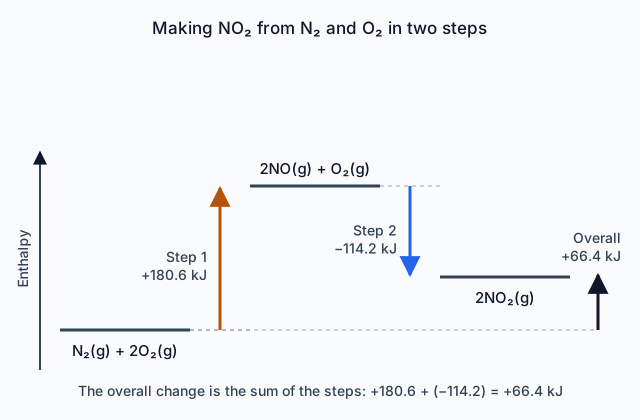
Many processes can be broken into a series of steps, and each step has its own enthalpy change. Nitrogen and oxygen can make nitrogen dioxide in two steps:
(1) N₂(g) + O₂(g) → 2NO(g) ΔH₁ = +180.6 kJ
(2) 2NO(g) + O₂(g) → 2NO₂(g) ΔH₂ = −114.2 kJ
Add the equations, with all the reactants on the left and all the products on the right: N₂ + O₂ + 2NO + O₂ → 2NO + 2NO₂. The 2NO appears on both sides, so it cancels. It is an intermediate, made in step 1 and used up in step 2. What remains is the overall reaction, N₂(g) + 2O₂(g) → 2NO₂(g).
Its enthalpy change is the sum of the steps: +180.6 + (−114.2) = +66.4 kJ. This is Hess's law, and it follows from conservation of energy. Each step moves thermal energy to or from the surroundings, so the net energy moved over the whole sequence is the sum of the amounts moved in the steps. At constant pressure, that makes ΔH of the overall process the sum of the ΔH values of the steps.
Quick check · Calculate
Carbon burns to carbon dioxide in two steps. Step 1: C(s) + ½O₂(g) → CO(g), ΔH₁ = −110.5 kJ. Step 2: CO(g) + ½O₂(g) → CO₂(g), ΔH₂ is not known. The overall reaction, C(s) + O₂(g) → CO₂(g), has ΔH = −393.5 kJ. What is ΔH₂, in kJ? Give the sign, and round to the tenths place.
2b. Reversing and multiplying
The equation you are given is often not quite the one you need. Two changes fix that, and each changes ΔH in a matching way.
Reverse a reaction, and ΔH keeps its size but changes sign. If making water releases energy, splitting it up takes in the same amount.
Multiply a reaction by a factor c, and ΔH is multiplied by the same factor. Twice the matter reacts, so twice the energy moves.
Start from 2H₂(g) + O₂(g) → 2H₂O(l), ΔH = −571.6 kJ.
- Reversed: 2H₂O(l) → 2H₂(g) + O₂(g), ΔH = +571.6 kJ.
- Halved: H₂(g) + ½O₂(g) → H₂O(l), ΔH = −285.8 kJ.
- Tripled: 6H₂(g) + 3O₂(g) → 6H₂O(l), ΔH = −1714.8 kJ.
When you do both, do both to ΔH. Reversing and tripling gives +1714.8 kJ. A ΔH always belongs to the equation with its coefficients as written, so change the number whenever you change the equation.
Quick check · Calculate
The reaction 2SO₂(g) + O₂(g) → 2SO₃(g) has ΔH = −197.8 kJ. What is ΔH for 4SO₃(g) → 4SO₂(g) + 2O₂(g), in kJ? Give the sign, and round to the tenths place.
2c. Adding equations
To build a target reaction from given equations, work in three moves.
- Find each target species in one of the given equations, and note which side of the target it is on.
- Reverse a given equation if its species is on the wrong side, and multiply it if its coefficient is wrong. Make the same change to its ΔH at the same time.
- Add the adjusted equations and cancel every species that appears on both sides. What is left must be the target exactly. Only then add the adjusted ΔH values.
Do the check in move 3 before you add the ΔH values. If the equations do not add up to the target, the sum of their ΔH values belongs to some other reaction.
In the nitrogen dioxide example, neither equation needed a change, so only the adding and the canceling were used. Most problems need at least one reversal or one multiplier too.
Quick check · Select all
Which two equations add up, exactly as written, to the overall reaction 2S(s) + 3O₂(g) → 2SO₃(g)? Select two.
Select 2 answers, then check.
Part 3 Watch it done Acetylene from its elements
Predict first, then watch each step, then finish the calculation yourself.
Acetylene, C₂H₂, is the fuel in a welding torch. Forming it from carbon and hydrogen is not practical to measure directly, but burning is easy to measure. Find ΔH for 2C(s) + H₂(g) → C₂H₂(g) from these equations. These numbers are a teaching example.
(1) C(s) + O₂(g) → CO₂(g) ΔH = −393.5 kJ
(2) H₂(g) + ½O₂(g) → H₂O(l) ΔH = −285.8 kJ
(3) 2C₂H₂(g) + 5O₂(g) → 4CO₂(g) + 2H₂O(l) ΔH = −2598.8 kJ
Predict first
Before you open the first step, predict: which of the three given equations will have to be reversed?
Step 1 · Place each target species
The target has 2C(s) and H₂(g) on the left and C₂H₂(g) on the right. Equation (1) has C(s) on the left, but only 1 mol where the target needs 2 mol, so multiply it by 2. Equation (2) has H₂(g) on the left, 1 mol, so keep it as written. Equation (3) has C₂H₂(g) on the left, where the target needs it on the right, so reverse it.
Step 2 · Change the ΔH values to match
Doubling (1) gives 2C(s) + 2O₂(g) → 2CO₂(g), ΔH = 2(−393.5) = −787.0 kJ. Equation (2) stays at −285.8 kJ. Equation (3) has 2 mol of C₂H₂ and the target needs 1 mol, so after reversing it, multiply it by ½.
Why this step?
Why is equation (3) reversed and also halved?
The target has C₂H₂ on the right, where (3) has it on the left, so it is reversed, which changes the sign of ΔH. The target makes 1 mol of C₂H₂ and (3) uses 2 mol, so it is halved, which halves ΔH.
Step 3 · Check that the equations add to the target
Add the three adjusted equations. The 2CO₂ and the H₂O(l) appear on both sides and cancel, and so does the oxygen: 2O₂ + ½O₂ on the left against 5/2 O₂ on the right. What is left is 2C(s) + H₂(g) → C₂H₂(g), the target.
Your step · Calculate
Finish it. For 2C(s) + H₂(g) → C₂H₂(g), doubling equation (1) gives −787.0 kJ and equation (2) stays at −285.8 kJ. Equation (3) has ΔH = −2598.8 kJ. What is ΔH for the target, in kJ? Give the sign, and round to the tenths place.
kJ
The target reaction absorbs energy even though all three given reactions release it. The sign comes out of the arithmetic, not from the signs of the given values, so do not guess it.
Part 4 Try it Carbon disulfide
Carbon disulfide, CS₂, is a solvent. Making it from carbon and sulfur is hard to run cleanly in a calorimeter, but burning each of the three substances is easy. These values come from standard tables.
Try it · Match
The target is C(s) + 2S(s) → CS₂(l). It is built from three equations: (1) C(s) + O₂(g) → CO₂(g), ΔH = −393.5 kJ; (2) S(s) + O₂(g) → SO₂(g), ΔH = −296.8 kJ; (3) CS₂(l) + 3O₂(g) → CO₂(g) + 2SO₂(g), ΔH = −1076.1 kJ. Match each equation to what is done to it.
Try it · Calculate
Find ΔH for C(s) + 2S(s) → CS₂(l) from these equations: (1) C(s) + O₂(g) → CO₂(g), ΔH = −393.5 kJ; (2) S(s) + O₂(g) → SO₂(g), ΔH = −296.8 kJ; (3) CS₂(l) + 3O₂(g) → CO₂(g) + 2SO₂(g), ΔH = −1076.1 kJ. Give your answer in kJ with its sign, rounded to the tenths place.
Part 5 Explain it Hydrogenating ethene
On the exam this is handwritten, so answer on paper first. Nothing you type here leaves this page. Then check your answer against the model and each scoring point.
Free response is 50% of the exam score. This one is shaped like a short-answer question, which is worth 4 points.
Free-response practice · Short-answer style
Ethene, C₂H₄, adds hydrogen to make ethane: C₂H₄(g) + H₂(g) → C₂H₆(g). A student has three measured reactions, all at constant pressure. These numbers are a teaching example.
(1) C₂H₄(g) + 3O₂(g) → 2CO₂(g) + 2H₂O(l) ΔH = −1411.1 kJ
(2) 2C₂H₆(g) + 7O₂(g) → 4CO₂(g) + 6H₂O(l) ΔH = −3120.8 kJ
(3) H₂(g) + ½O₂(g) → H₂O(l) ΔH = −285.8 kJ
(a) Identify what must be done to equation (2), and why.
(b) Calculate ΔH for C₂H₄(g) + H₂(g) → C₂H₆(g).
(c) Explain why CO₂, H₂O and O₂ do not appear in the target reaction.
(d) Justify, using conservation of energy, why the ΔH of the target is the sum of the adjusted ΔH values.
Model answer
(a) Reverse equation (2), because C₂H₆ is a reactant in (2) but a product in the target. Multiply it by ½, because (2) uses 2 mol of C₂H₆ and the target makes 1 mol.
(b) Equation (1) and equation (3) are used as written. Reversed and halved, (2) gives ½ × (+3120.8) = +1560.4 kJ. ΔH = (−1411.1) + (−285.8) + 1560.4 = −136.5 kJ.
(c) After the three adjusted equations are added, 2CO₂, 3H₂O and 7/2 O₂ appear on both sides, so they cancel and only the target remains.
(d) Energy is conserved, and each step transfers thermal energy to or from the surroundings. The net thermal energy transferred over the sequence is therefore the sum of the transfers in the steps, so at constant pressure the overall ΔH is the sum of the ΔH values of the steps.
Score your own answer. This is a self-check, not a grade. Tick each point your answer makes.
Part 6 Check yourself Hydrazine, a rocket fuel
All three case questions use the table.
Hydrazine, N₂H₄, is used as a rocket fuel. A student wants ΔH for making it from its elements, N₂(g) + 2H₂(g) → N₂H₄(l), and has two measured reactions. The values are a teaching example.
| Equation | ΔH (kJ) |
|---|---|
| A: N₂H₄(l) + O₂(g) → N₂(g) + 2H₂O(l) | −622.3 |
| B: H₂(g) + ½O₂(g) → H₂O(l) | −285.8 |
Case question 1 · Calculate
Using the table: what is ΔH for N₂(g) + 2H₂(g) → N₂H₄(l), in kJ? Give the sign, and round to the tenths place.
Case question 2 · Rank it
Using the table: rank these four changes by the energy they release, from the one that releases the most energy to the one that absorbs the most.
Releases the most energy first
Give each one a place, 1 for first. Give two the same place if they are equal.
Your ranking: none yet
Case question 3 · Decide and justify
Using the table: is making hydrazine from its elements, N₂(g) + 2H₂(g) → N₂H₄(l), exothermic or endothermic?
Which reason supports your decision?
The rest stand on their own and do not use the case.
Check yourself · Spot the error
The reaction 2NO(g) + O₂(g) → 2NO₂(g) has ΔH = −114.2 kJ. A student finds ΔH for 4NO₂(g) → 4NO(g) + 2O₂(g). Tap the line with the first mistake.
Check yourself · Put it in order
Put the steps for finding the ΔH of a target reaction from given reactions in order.
Part 7 Keep it Bring back earlier ideas
This lesson leans on two earlier ideas: how to calculate an enthalpy change from a table of formation values, and how the energy one body loses is the energy another gains. Pulling them back up is what makes them last.
From 6.8 Enthalpy of Formation · Calculate
Calcium carbonate breaks down when heated: CaCO₃(s) → CaO(s) + CO₂(g). The standard enthalpies of formation, in kJ/mol, are CaCO₃(s) −1206.9, CaO(s) −635.1 and CO₂(g) −393.5. What is ΔH° for the reaction as written, in kJ? Give the sign, and round to the tenths place.
From 6.4 Heat Capacity and Calorimetry · Spot the error
A hot metal is placed in cool water in a calorimeter, and the water warms by 3.0 °C. A student explains the result. Tap the line with the mistake.
In three lines
- Many processes are a sequence of steps, each with its own ΔH, and the overall ΔH is the sum of the steps because energy is conserved.
- Reversing a reaction changes the sign of ΔH, and multiplying a reaction by a factor multiplies ΔH by the same factor.
- Add the adjusted equations, cancel what appears on both sides, check that the target remains, and then add the adjusted ΔH values.
Exam strategy for this topic
- Section I, Multiple Choice: 60 questions in 90 minutes.
- Section II, Free Response: 7 questions in 105 minutes.
- A scientific or graphing calculator is recommended for use on both sections of the exam.
Write each given equation with the change you make to it (reverse, multiply, or both) and the matching ΔH beside it, then add the equations to show the target remains. Keep the sign and the units on every number.
Questions students ask
What is Hess's law?
It says the enthalpy change of an overall process is the sum of the enthalpy changes of its steps. It follows from conservation of energy.
What happens to ΔH when you reverse a reaction?
It keeps its size and changes sign. If the forward reaction releases 100 kJ, the reverse absorbs 100 kJ.
What happens to ΔH when you multiply a reaction?
It is multiplied by the same factor. Doubling the coefficients doubles ΔH, and halving them halves it.
How do you combine equations to get a target reaction?
Reverse or multiply each given equation so the target species are on the right sides with the right coefficients, add the equations, cancel what appears on both sides, and add the adjusted ΔH values.
Why can enthalpy changes be added?
Energy is conserved, and each step moves thermal energy to or from the surroundings. The net thermal energy moved over the sequence is the sum of what moved in the steps.
Beyond the AP Exam
College Board sets this limit on what the AP Exam asks about this topic. Anything past it is not on the exam.
The concept of state functions will not be assessed on the AP Exam.
Course alignment, for teachers
AP Chemistry topic 6.9, Unit 6: Thermochemistry.
- Skill 5.A: Identify quantities needed to solve a problem from given information (e.g., text, mathematical expressions, graphs, or tables).
This lesson maps all 3 essential knowledge statements of the topic to the part that teaches each one: 3 are checked by a scored question. The map is in the lesson file.