Unit 6 · Topic 6.8 · about 30 minutes · 7 parts · 12 scored checks, 1 of them multiple choice, plus 2 from earlier lessons
AP Chemistry 6.8: Enthalpy of Formation
Unit 6: 7 to 9% of the multiple-choice section
What you'll be able to do
- Calculate the enthalpy change for a chemical or physical process based on the standard enthalpies of formation.
Key vocabulary
| Term | What it means | The exam trap |
|---|---|---|
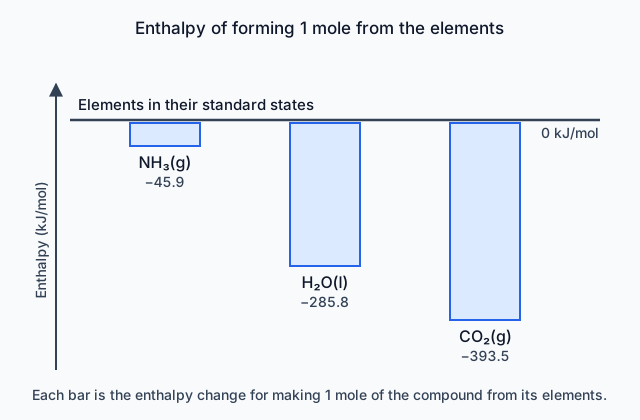
| Standard enthalpy of formation (ΔH°f) | The enthalpy change when 1 mole of a substance forms from its elements, each in its standard state, in kJ per mole. | A table value belongs to 1 mole of one particular substance in one particular state, so read the coefficient and the state before you use it. |
| Standard state | The pure substance in a stated phase at 1 atm and a stated temperature, usually 298 K. For an element, the reference is its most stable form. | Many elements exist in more than one form or phase, so check which one an equation or a table names. |
| Formation reaction | A balanced equation that makes exactly 1 mole of one compound from its elements, each in its standard state. | An equation can look like a formation reaction and still fail on one count, so check the reactants and the number of moles made. |
| Standard enthalpy of reaction (ΔH°rxn) | The enthalpy change of a reaction with every substance in its standard state, found from the formation values of the products and the reactants. | A difference depends on its order, so decide which sum comes first before you subtract. |
 Tap to open the picture full size
Part 1 Think first Nitrogen and oxygen in the air
Commit to a guess first. Being wrong now makes the right idea stick better.
Predict first
Air is about 78 percent nitrogen and 21 percent oxygen, and the two sit side by side without reacting. In a hot engine, or in a lightning bolt, they do combine to make nitric oxide, NO. Chemists keep a table that gives, for each compound, the enthalpy change for making 1 mole of it from its elements. What would you expect that number to be for NO?
In short. The standard enthalpy of formation, ΔH°f, is the enthalpy change when 1 mole of a substance forms from its elements in their standard states, and a table of these values gives the ΔH° of a reaction.
- ΔH°rxn = ΣΔH°f(products) − ΣΔH°f(reactants), with each ΔH°f multiplied by its coefficient in the balanced equation.
- Every substance in the equation needs a value, and the form and state of each one has to match the table.
- The same method works for a physical process, such as a liquid becoming a gas, and it can be rearranged to find an unknown ΔH°f.
Part 2 Learn it Enthalpy of formation
2a. One mole from its elements
A table of standard enthalpies of formation lets you find the enthalpy change of a reaction without running it. The standard enthalpy of formation, ΔH°f, of a substance is the enthalpy change when 1 mole of it forms from its elements, each element in its standard state. An element's standard state is its most stable form at 1 atm and 298 K: graphite for carbon, H₂(g) for hydrogen.
The ° means standard conditions, and the unit is kJ per mole of the substance formed. For liquid water:
H₂(g) + ½O₂(g) → H₂O(l) ΔH°f = −285.8 kJ/mol
Three things make an equation a formation reaction:
- The reactants are elements only, each in its standard state.
- Exactly 1 mole of one compound is made. A fraction such as ½O₂ is fine.
- The equation is balanced.
Double the equation and you make 2 moles, so its enthalpy change is 2 × ΔH°f, not ΔH°f.
Quick check · Sort it
Each card shows a reaction at 298 K and 1 atm. Tap a card, then the bin: is its enthalpy change a standard enthalpy of formation, ΔH°f, as the equation is written?
A standard enthalpy of formation
Not a standard enthalpy of formation
2b. The zero of the table
Formation values measure every compound against its own elements, so the elements are the reference point. Making an element from itself changes nothing:
ΔH°f = 0 for an element in its standard state.
The reaction O₂(g) → O₂(g) does nothing, so ΔH°f of O₂(g) is 0 kJ/mol. The same is true of H₂(g), N₂(g), Cl₂(g), Fe(s), graphite and Br₂(l).
The rule comes with a condition. It holds only for the standard state, the most stable form at 1 atm and 298 K. Another form of the same element, or the same element in another phase, is not the reference, and its value is not zero. Diamond is not zero, and bromine gas, Br₂(g), is +30.9 kJ/mol, because bromine is a liquid at 298 K.
A printed table lists compounds and leaves out the elements, since their zeros are understood. If a substance in your equation is an element in its standard state, use 0. Do not go looking for an entry.
Quick check · Select all
Which two of these have a standard enthalpy of formation of exactly 0 kJ/mol at 298 K and 1 atm? Select two.
Select 2 answers, then check.
2c. Products minus reactants
For any reaction, picture two routes: take every reactant apart into its elements, then build every product from those elements. The enthalpy change is the formation values of the products minus those of the reactants:
ΔH°rxn = ΣΔH°f(products) − ΣΔH°f(reactants)
Σ means "the sum of". A table value is per mole, so multiply each ΔH°f by its coefficient in the balanced equation before you add. Always subtract in this order. Reactants minus products gives the right size with the wrong sign.
For N₂(g) + 3H₂(g) → 2NH₃(g), the products sum to 2(−45.9) = −91.8 kJ. N₂ and H₂ are elements in their standard states, so the reactants sum to 0. ΔH° = −91.8 − 0 = −91.8 kJ.
The table values below stop at the tenths place, so give ΔH° to the tenths place too.
| Substance | ΔH°f (kJ/mol) |
|---|---|
| CO₂(g) | −393.5 |
| CO(g) | −110.5 |
| H₂O(l) | −285.8 |
| H₂O(g) | −241.8 |
| CH₄(g) | −74.8 |
| NH₃(g) | −45.9 |
| CaO(s) | −635.1 |
| CaCO₃(s) | −1206.9 |
Quick check · Calculate
Calcium carbonate breaks down when heated: CaCO₃(s) → CaO(s) + CO₂(g). The standard enthalpies of formation, in kJ/mol, are CaCO₃(s) −1206.9, CaO(s) −635.1 and CO₂(g) −393.5. What is ΔH° for the reaction as written, in kJ? Give the sign, and round to the tenths place.
2d. A physical process, too
A physical process has an enthalpy change that comes from the same table, because its start and its end are substances with formation values. Take liquid water turning into water vapor, H₂O(l) → H₂O(g):
ΔH° = ΔH°f of H₂O(g) − ΔH°f of H₂O(l) = (−241.8) − (−285.8) = +44.0 kJ
The positive sign says the change takes in energy.
The state of every substance is part of its identity. H₂O(l) and H₂O(g) have different formation values, so a number taken from the wrong row belongs to a different change. Write the state after every formula before you look anything up.
Quick check · Calculate
Methanol evaporates: CH₃OH(l) → CH₃OH(g). The standard enthalpies of formation, in kJ/mol, are CH₃OH(l) −238.7 and CH₃OH(g) −201.0. What is ΔH° for this process, in kJ? Give the sign, and round to the tenths place.
Part 3 Watch it done Burning natural gas
Predict first, then watch each step, then finish the calculation yourself.
Natural gas is mostly methane, CH₄. Find ΔH° for burning methane to carbon dioxide and liquid water: CH₄(g) + 2O₂(g) → CO₂(g) + 2H₂O(l). The standard enthalpies of formation, in kJ/mol, are CH₄(g) −74.8, CO₂(g) −393.5 and H₂O(l) −285.8.
Predict first
Before you open the first step, predict: will the sum of the formation values for the products be more negative or less negative than the sum for the reactants?
Step 1 · Add up the products
Multiply each value by its coefficient. CO₂(g): 1 × (−393.5) = −393.5 kJ. H₂O(l): 2 × (−285.8) = −571.6 kJ. The products sum to −965.1 kJ.
Step 2 · Add up the reactants
CH₄(g): 1 × (−74.8) = −74.8 kJ. O₂(g) is an element in its standard state, so its term is 2 × 0 = 0. The reactants sum to −74.8 kJ.
Why this step?
Why does O₂ add nothing to the reactant sum?
ΔH°f of O₂(g) is 0, because O₂ is the reference form of oxygen. Forming O₂ from itself changes nothing, so the term is 2 × 0 = 0 and no table entry is needed.
Your step · Calculate
Finish it. The products sum to −965.1 kJ and the reactants sum to −74.8 kJ. What is ΔH° for the reaction, in kJ? Give the sign, and round to the tenths place.
kJ
The energy is released because the products sit far below the reactants on the table's scale. About 890 kJ leaves the system for every mole of methane burned, which is why natural gas heats homes.
Part 4 Try it States and unknowns
Try it · Decide and justify
Two students use the same table of standard enthalpies of formation to find ΔH° for burning hydrogen, a rocket fuel. Student A writes 2H₂(g) + O₂(g) → 2H₂O(l) and gets ΔH° = −571.6 kJ. Student B writes 2H₂(g) + O₂(g) → 2H₂O(g) and gets ΔH° = −483.6 kJ. Can both be right?
Which reason supports your decision?
Try it · Calculate
A table works backward too. A calorimeter measures ΔH° = −1366.8 kJ for C₂H₅OH(l) + 3O₂(g) → 2CO₂(g) + 3H₂O(l), and every formation value but one is known: CO₂(g) −393.5 and H₂O(l) −285.8 kJ/mol. What is ΔH°f of C₂H₅OH(l), in kJ/mol? Give the sign, and round to the tenths place.
Part 5 Explain it Burning ethane
On the exam this is handwritten, so answer on paper first. Nothing you type here leaves this page. Then check your answer against the model and each scoring point.
Free response is 50% of the exam score. This one is shaped like a short-answer question, which is worth 4 points.
Free-response practice · Short-answer style
Ethane, C₂H₆, is a component of natural gas. The standard enthalpies of formation, in kJ/mol, are C₂H₆(g) −84.0, CO₂(g) −393.5 and H₂O(l) −285.8. Ethane burns by 2C₂H₆(g) + 7O₂(g) → 4CO₂(g) + 6H₂O(l).
(a) Represent the reaction whose enthalpy change is ΔH°f of C₂H₆(g), with a balanced equation that shows the state of every substance.
(b) Calculate ΔH° for the combustion as written, in kJ.
(c) Determine the enthalpy change per mole of ethane burned.
(d) Explain why the O₂(g) in the combustion adds nothing to the calculation.
Model answer
(a) 2C(s, graphite) + 3H₂(g) → C₂H₆(g)
(b) Products: 4(−393.5) + 6(−285.8) = −1574.0 + (−1714.8) = −3288.8 kJ. Reactants: 2(−84.0) + 7(0) = −168.0 kJ. ΔH° = −3288.8 − (−168.0) = −3120.8 kJ.
(c) The equation burns 2 mol of ethane, so −3120.8 kJ ÷ 2 mol = −1560.4 kJ per mole of ethane.
(d) O₂(g) is an element in its standard state, so its ΔH°f is 0. Making an element from itself involves no change, so 7(0) adds nothing to the reactant sum.
Score your own answer. This is a self-check, not a grade. Tick each point your answer makes.
Part 6 Check yourself Nitrogen oxides
All three case questions use the table.
Nitrogen oxides form in hot engines and in industry, where burning ammonia is the first step in making nitric acid. A student looks up standard enthalpies of formation at 298 K and 1 atm for four compounds.
| Substance | ΔH°f (kJ/mol) |
|---|---|
| NH₃(g) | −45.9 |
| NO(g) | +90.3 |
| NO₂(g) | +33.2 |
| H₂O(g) | −241.8 |
Case question 1 · Calculate
Using the table: what is ΔH° for 4NH₃(g) + 5O₂(g) → 4NO(g) + 6H₂O(g), in kJ? Give the sign, and round to the tenths place.
Case question 2 · Rank it
Using the table: rank these three reactions by the energy released, from the reaction that releases the most energy to the one that releases the least or absorbs energy.
Releases the most energy first
Give each one a place, 1 for first. Give two the same place if they are equal.
Your ranking: none yet
Case question 3 · Multiple choice
Using the table: N₂(g) and O₂(g) have no row in it. A student says ΔH° for N₂(g) + O₂(g) → 2NO(g) cannot be found until those two are looked up. Which response is correct?
The rest stand on their own and do not use the case.
Check yourself · Spot the error
A student uses standard enthalpies of formation, in kJ/mol, of H₂O₂(l) −187.8 and H₂O(l) −285.8 to find ΔH° for 2H₂O₂(l) → 2H₂O(l) + O₂(g). Tap the line with the first mistake.
Check yourself · Put it in order
Put the steps for finding ΔH° of a reaction from a table of formation values in order.
Part 7 Keep it Bring back earlier ideas
This lesson leans on two earlier ideas: the sign of an energy change tells you which way energy moved, and breaking bonds takes in energy while forming them releases it. Pulling them back up is what makes them last.
Back to the cold pack, now in a lab. A student dissolves 20.0 g of ammonium nitrate, NH₄NO₃, in 100.0 g of water in a coffee-cup calorimeter. The temperature falls from 23.0 °C to 10.2 °C. Treat the solution as 120.0 g with a specific heat capacity of 4.18 J/(g·°C). These numbers are a teaching example.
From 6.4 Heat Capacity and Calorimetry · Decide and justify
Is dissolving ammonium nitrate in water exothermic or endothermic?
Which piece of evidence supports your decision?
From 6.7 Bond Enthalpies · Sort it
Each card describes a change in bonding. Tap a card, then the bin for what happens to the energy of the system.
Takes in energy
Releases energy
In three lines
- The standard enthalpy of formation, ΔH°f, is the enthalpy change for making 1 mole of a substance from its elements in their standard states, in kJ/mol.
- ΔH°rxn = ΣΔH°f(products) − ΣΔH°f(reactants), with each value multiplied by its coefficient, and an element in its standard state counts as 0.
- Use the row that matches each substance and its state. The method works for a physical process, and it can be rearranged to find an unknown ΔH°f.
Exam strategy for this topic
- Section I, Multiple Choice: 60 questions in 90 minutes.
- Section II, Free Response: 7 questions in 105 minutes.
- A scientific or graphing calculator is recommended for use on both sections of the exam.
Write the equation with the state of every substance, then write products minus reactants with each ΔH°f times its coefficient, so a grader can follow every term. Give the answer with its sign and units, to the decimal place of the table values.
Questions students ask
What is the standard enthalpy of formation?
It is the enthalpy change when 1 mole of a substance forms from its elements, each in its standard state, at standard conditions. The unit is kJ/mol.
Why is the enthalpy of formation of an element zero?
An element in its standard state is the reference point of the table, and making it from itself changes nothing. Only the standard state counts: graphite is zero, diamond is not, and Br₂(l) is zero, Br₂(g) is not.
How do you calculate ΔH° from enthalpies of formation?
Multiply each ΔH°f by its coefficient, add the products, add the reactants, and subtract: ΔH°rxn = ΣΔH°f(products) − ΣΔH°f(reactants).
Do you multiply by the coefficients?
Yes. A table value is the enthalpy change for 1 mole, so a coefficient of 3 means 3 times the value.
Can enthalpies of formation be used for a physical change?
Yes. For a change such as H₂O(l) → H₂O(g), subtract the value of the starting state from the value of the ending state, using the row that matches each state.
Course alignment, for teachers
AP Chemistry topic 6.8, Unit 6: Thermochemistry.
- Skill 5.F: Calculate, estimate, or predict an unknown quantity from known quantities by selecting and following a logical computational pathway and attending to precision (e.g., performing dimensional analysis and attending to significant figures).
This lesson maps the one essential knowledge statement of the topic to the part that teaches each one: 1 is checked by a scored question. The map is in the lesson file.