Unit 8 · Topic 8.3 · about 30 minutes · 7 parts · 12 scored checks, 1 of them multiple choice, plus 2 from earlier lessons
AP Chemistry 8.3: Weak Acid and Base Equilibria
Unit 8: 11 to 15% of the multiple-choice section
What you'll be able to do
- Explain how pH, pOH and the concentrations of all species are related in a solution of a weak monoprotic acid or a weak base.
Key vocabulary
| Term | What it means | The exam trap |
|---|---|---|
| Weak acid | An acid of which only a small percentage of molecules ionize in water, so most remain as un-ionized HA. | Strength is about how much of the acid ionizes, not about how concentrated the solution is. |
| Weak base | A base of which only a small percentage of molecules react with water to make OH⁻, so most remain as un-ionized B. | A weak base still makes hydroxide ions, so look at which direction the reaction with water goes. |
| Acid ionization constant (Ka) | The equilibrium constant for a weak acid reacting with water, Ka = [H₃O⁺][A⁻] / [HA], often reported as pKa = −log Ka. | Remember that a smaller pKa means a larger Ka, so check the direction before you compare acids. |
| Base ionization constant (Kb) | The equilibrium constant for a weak base reacting with water, Kb = [HB⁺][OH⁻] / [B], often reported as pKb = −log Kb. | Water does not appear in Ka or Kb, so leave it out of the expression. |
| Percent ionization | The concentration of acid or base that ionized, divided by its starting concentration, times 100. | Divide by the starting concentration, not by the equilibrium concentration of the un-ionized form. |
| Conjugate acid-base pair | Two species that differ by one H⁺, such as HA and A⁻; their constants obey Kw = Ka × Kb. | Use Ka and Kb of the same pair at the same temperature, and multiply them rather than adding them. |
 Tap to open the picture full size
Part 1 Think first Two acids, one concentration
Commit to a guess first. Being wrong now makes the right idea stick better.
Predict first
A chemist has two solutions with the same volume, temperature and concentration, 0.10 M. One is hydrochloric acid and the other is acetic acid, the acid in vinegar. She tests both with a calibrated pH meter. What does she most likely find?
In short. A weak acid or weak base ionizes only a small percentage in water, so [H₃O⁺] or [OH⁻] is far below the starting concentration and is found from Ka or Kb.
- For a weak acid, Ka = [H₃O⁺][A⁻] / [HA]; for a weak base, Kb = [HB⁺][OH⁻] / [B]; pKa and pKb are their negative logarithms.
- Percent ionization is the concentration ionized divided by the starting concentration, times 100.
- A conjugate acid-base pair obeys Ka × Kb = Kw, so pKa + pKb = pKw, which is 14.00 at 25 °C.
Part 2 Learn it Equilibria that stay mostly un-ionized
2a. Weak acids and Ka
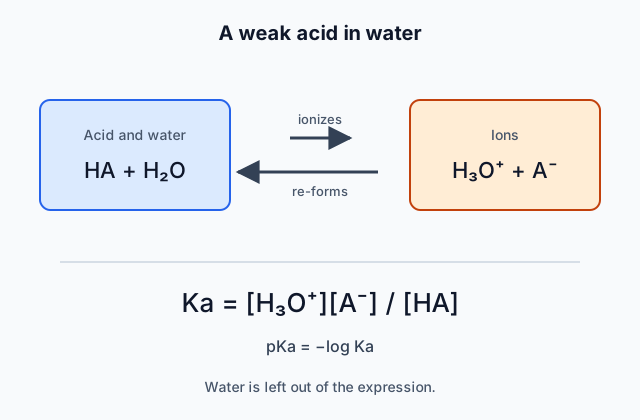
A weak acid reacts with water only a little. For an acid HA:
HA(aq) + H₂O(l) ⇌ H₃O⁺(aq) + A⁻(aq)
The equilibrium sits far to the left. Only a small percentage of the HA molecules ionize, so [H₃O⁺] is much less than the starting concentration and most of the acid stays as HA.
The equilibrium constant is the acid ionization constant, often reported as a pKa:
Ka = [H₃O⁺][A⁻] / [HA] and pKa = −log Ka
A smaller Ka means less ionization, so a weaker acid.
To find the pH, let x be the [H₃O⁺] that forms. Each ionization also makes one A⁻, so [H₃O⁺] = [A⁻] = x, and [HA] = C − x, where C is the starting concentration. Because x is small next to C, use [HA] ≈ C. Then Ka = x² / C, so x = √(Ka × C), and pH = −log x.
Example: for 0.400 M acetic acid, Ka = 1.8 × 10⁻⁵, so x = 2.7 × 10⁻³ M and pH = 2.57. If you are given a pKa, turn it into Ka first: Ka = 10^(−pKa).
Quick check · Calculate
A weak acid HA has pKa = 4.40. What is the pH of a 0.200 M solution of HA at 25 °C? Treat [HA] at equilibrium as 0.200 M. Give two decimal places.
2b. Weak bases and Kb
A weak base takes an H⁺ from water, but ordinarily just a small percentage of its molecules do. For a base B, such as ammonia:
B(aq) + H₂O(l) ⇌ HB⁺(aq) + OH⁻(aq)
NH₃(aq) + H₂O(l) ⇌ NH₄⁺(aq) + OH⁻(aq)
So [OH⁻] is much less than the starting concentration of the base, and most of the base stays as B.
The constant is the base ionization constant, often reported as a pKb:
Kb = [HB⁺][OH⁻] / [B] and pKb = −log Kb
The method matches the acid's, with x now the [OH⁻]. Then [HB⁺] = [OH⁻] = x and [B] ≈ C, so x = √(Kb × C). Taking −log x gives the pOH, not the pH. Find the pH last: pH = 14.00 − pOH at 25 °C.
Quick check · Fill the statement
Complete the description of aqueous ammonia, NH₃, as a weak base.
When NH₃ reacts with water, it forms its conjugate acid, , and the ion , which makes the solution basic. Its base ionization constant is Kb = .
2c. Percent ionization
Percent ionization says how much of a weak acid or base actually reacted:
percent ionization = (concentration ionized / starting concentration) × 100
The concentration ionized is x: [H₃O⁺] for an acid, or [OH⁻] for a base. You can get x from Ka or Kb and the starting concentration, as in the last two chunks. You can also get it from a measurement. Each ionization makes one H₃O⁺ and one A⁻, so the concentration of either one, or the pH, gives the amount that ionized.
Example: a 0.250 M solution of a weak acid has pH 2.60. Then [H₃O⁺] = 10^(−2.60) = 2.5 × 10⁻³ M, and the percent ionization is (2.5 × 10⁻³ / 0.250) × 100 = 1.0%.
For a weak acid or base this is a small percent. That is what makes the approximation [HA] ≈ C reasonable.
Quick check · Calculate
A 0.100 M solution of a weak acid has a pH of 2.85. What is the percent ionization of the acid? Give two significant figures.
2d. Conjugate pairs
When an acid HA gives up an H⁺, what is left, A⁻, is its conjugate base, and A⁻ can take an H⁺ back to become HA. The two form a conjugate acid-base pair, and their constants are tied together through water:
Kw = Ka × Kb and pKw = pKa + pKb
Both constants must be for the same pair at the same temperature. At 25 °C, Kw = 1.0 × 10⁻¹⁴, so pKa + pKb = 14.00.
The product is fixed, so a stronger acid (larger Ka) has a weaker conjugate base (smaller Kb), and the reverse.
Example: acetic acid has Ka = 1.8 × 10⁻⁵, so the acetate ion, CH₃COO⁻, has Kb = (1.0 × 10⁻¹⁴) / (1.8 × 10⁻⁵) = 5.6 × 10⁻¹⁰. In p-values, pKa = 4.74, so pKb = 14.00 − 4.74 = 9.26.
Quick check · Calculate
Hydrofluoric acid, HF, has Ka = 6.8 × 10⁻⁴ at 25 °C. What is Kb for its conjugate base, F⁻? Give two significant figures, typed in e-notation (1.0 × 10⁻⁷ is typed 1.0e-7).
Part 3 Watch it done The pH of aqueous ammonia
Predict first, then watch each step, then finish the calculation yourself.
Ammonia, NH₃, is a weak base with Kb = 1.8 × 10⁻⁵ at 25 °C. What is the pH of a 0.200 M solution of NH₃? Give two decimal places.
Predict first
Before you open the first step, predict: will [OH⁻] be about 0.200 M, somewhat less than 0.200 M, or far less than 0.200 M?
Step 1 · Write the reaction and Kb
NH₃ + H₂O ⇌ NH₄⁺ + OH⁻, so Kb = [NH₄⁺][OH⁻] / [NH₃] = 1.8 × 10⁻⁵.
Step 2 · Let x be the hydroxide ion concentration
Each ionization makes one NH₄⁺ and one OH⁻, so [NH₄⁺] = [OH⁻] = x. Then [NH₃] = 0.200 − x.
Why this step?
Why can [NH₃] be taken as 0.200 M, with no −x?
Ammonia is a weak base, so only a small percentage ionizes. Here x is about 1% of 0.200 M, so subtracting it changes [NH₃] too little to matter.
Step 3 · Solve for x
x² = Kb × C = (1.8 × 10⁻⁵)(0.200) = 3.6 × 10⁻⁶, so x = [OH⁻] = 1.8974 × 10⁻³ M. Keep the unrounded value for the next step.
Your step · Calculate
Finish it. With [OH⁻] = 1.8974 × 10⁻³ M, what is the pH of the solution at 25 °C? Give two decimal places.
The pOH is 2.72, so the pH is 11.28. As a check, x is 0.95% of 0.200 M, a small percent, so using [NH₃] ≈ 0.200 M was justified. About 99% of the ammonia is still NH₃.
Part 4 Try it Ranking and measuring
These numbers are a teaching example.
Try it · Rank it
Five solutions, each 0.10 M, are at 25 °C: A, hydrochloric acid, HCl; B, acetic acid, CH₃COOH, Ka = 1.8 × 10⁻⁵; C, hypochlorous acid, HOCl, Ka = 3.0 × 10⁻⁸; D, ammonia, NH₃, Kb = 1.8 × 10⁻⁵; E, sodium hydroxide, NaOH. Rank the solutions by pH.
Highest pH first
Give each one a place, 1 for first. Give two the same place if they are equal.
Your ranking: none yet
Try it · Calculate
A 0.0500 M solution of an acid has Ka = 1.8 × 10⁻⁵. What is the percent ionization of the acid? Use [HA] ≈ 0.0500 M and give two significant figures.
Part 5 Explain it The pH of a weak acid
On the exam this is handwritten, so answer on paper first. Nothing you type here leaves this page. Then check your answer against the model and each scoring point.
Free response is 50% of the exam score. This one is shaped like a short-answer question, which is worth 4 points.
Free-response practice · Short-answer style
A student prepares a 0.400 M solution of a weak monoprotic acid, HA, at 25 °C. For HA, Ka = 2.0 × 10⁻⁵.
(a) Represent the reaction of HA with water, and write the expression for Ka.
(b) Calculate [H₃O⁺] in the solution. Assume [HA] is about 0.400 M.
(c) Calculate the pH of the solution.
(d) A 0.400 M solution of hydrochloric acid has a pH of 0.398. Explain why the pH of the HA solution is higher.
Model answer
(a) HA(aq) + H₂O(l) ⇌ H₃O⁺(aq) + A⁻(aq), and Ka = [H₃O⁺][A⁻] / [HA].
(b) With [H₃O⁺] = [A⁻] = x and [HA] ≈ 0.400 M, Ka = x² / 0.400, so x = √((2.0 × 10⁻⁵)(0.400)) = 2.8 × 10⁻³ M.
(c) pH = −log(2.8 × 10⁻³) = 2.55.
(d) HCl is a strong acid and ionizes completely, so its [H₃O⁺] is the full 0.400 M. HA is a weak acid: only about 0.71% of its molecules ionize, so its [H₃O⁺] is far below 0.400 M, and a smaller [H₃O⁺] means a higher pH.
Score your own answer. This is a self-check, not a grade. Tick each point your answer makes.
Part 6 Check yourself Three weak acids
All three case questions use the table.
A student prepares three solutions of weak monoprotic acids at 25 °C, each at the same starting concentration. These numbers are a teaching example.
| Solution | Ka | Starting concentration (M) |
|---|---|---|
| X | 1.8 × 10⁻⁵ | 0.500 |
| Y | 3.0 × 10⁻⁸ | 0.500 |
| Z | 2.0 × 10⁻⁴ | 0.500 |
Case question 1 · Calculate
Using the table: what is the pH of solution X? Use [HA] ≈ the starting concentration, and give two decimal places.
Case question 2 · Multiple choice
Using the table: which solution has the highest pH?
Case question 3 · Select all
Using the table: which two statements about solution Z are true? Select two.
Select 2 answers, then check.
The rest stand on their own and do not use the case.
Check yourself · Spot the error
A student finds the pH of 0.400 M ammonia, NH₃, which has Kb = 1.8 × 10⁻⁵. Tap the line with the mistake.
Check yourself · Match
Match each weak acid, with its pKa, to the pKb of its conjugate base at 25 °C.
Part 7 Keep it Bring back earlier ideas
This lesson leans on two earlier ideas: the pH of a solution that ionizes completely, and the rule for turning a concentration into a pH. Pulling them back up is what makes them last.
From 8.2 pH and pOH of Strong Acids and Bases · Calculate
A student makes a 0.0150 M solution of barium hydroxide, Ba(OH)₂, a strong base, at 25 °C. What is the pH? Give three decimal places.
From 8.1 Introduction to Acids and Bases · Calculate
At 50 °C, Kw for water is 5.5 × 10⁻¹⁴. What is the pH of pure water at 50 °C? Give two decimal places.
In three lines
- A weak acid or base ionizes only a little, so x = √(Ka × C) or √(Kb × C) gives [H₃O⁺] or [OH⁻], far below the starting concentration.
- Percent ionization is (concentration ionized / starting concentration) × 100, and it is small for a weak acid or base.
- A conjugate acid-base pair obeys Ka × Kb = Kw, so pKa + pKb = pKw, which is 14.00 at 25 °C.
Exam strategy for this topic
- Section I, Multiple Choice: 60 questions in 90 minutes.
- Section II, Free Response: 7 questions in 105 minutes.
- A scientific or graphing calculator is recommended for use on both sections of the exam.
For a weak acid or base, write the reaction with a double arrow and the Ka or Kb expression, let x be the ion concentration, and state that you take [HA] ≈ C. Remember that −log x is the pOH for a base, and give the pH with the decimal places the data allow.
Questions students ask
How do you find the pH of a weak acid solution?
Write Ka = [H₃O⁺][A⁻] / [HA], let x = [H₃O⁺] = [A⁻], solve for x (x = √(Ka × C) when x is small next to C), and take pH = −log x.
What is the difference between a strong acid and a weak acid?
A strong acid ionizes completely, so [H₃O⁺] equals its starting concentration. A weak acid ionizes only a small percentage, so [H₃O⁺] is much less than its starting concentration.
How do you calculate percent ionization?
Divide the concentration that ionized, [H₃O⁺] for an acid or [OH⁻] for a base, by the starting concentration, and multiply by 100.
How are Ka and Kb of a conjugate pair related?
Their product is Kw: Ka × Kb = Kw, which is 1.0 × 10⁻¹⁴ at 25 °C. Equivalently, pKa + pKb = pKw.
How do you find the pH of a weak base solution?
Use Kb = [HB⁺][OH⁻] / [B] with x = [OH⁻], solve for x, take pOH = −log x, and then pH = 14.00 − pOH at 25 °C.
Course alignment, for teachers
AP Chemistry topic 8.3, Unit 8: Acids and Bases.
- Skill 5.C: Explain the relationship between variables within an equation when one variable changes.
This lesson maps all 6 essential knowledge statements of the topic to the part that teaches each one: 6 are checked by a scored question. The map is in the lesson file.