Unit 8 · Topic 8.2 · about 30 minutes · 7 parts · 11 scored checks, 1 of them multiple choice, plus 2 from earlier lessons
AP Chemistry 8.2: pH and pOH of Strong Acids and Bases
Unit 8: 11 to 15% of the multiple-choice section
What you'll be able to do
- Calculate the pH and pOH of a solution of a strong acid or a strong base from the concentrations of the species present.
Key vocabulary
| Term | What it means | The exam trap |
|---|---|---|
| Strong acid | An acid whose molecules all ionize in water, giving hydronium ions and the acid's conjugate base. | Strength describes how much of the acid ionizes, and has nothing to do with how concentrated the solution is. |
| Strong base | A base that dissociates completely in water to release hydroxide ions, such as the group I and group II hydroxides. | Check how many hydroxide ions one formula unit releases before you use the concentration on the label. |
| Ionization | A reaction with water that forms ions from molecules, as HCl does when it forms H₃O⁺ and Cl⁻. | Use ionization for molecules that react with water, and dissociation for compounds that are already ionic. |
| Dissociation | The separation of an ionic compound into its ions in water, as NaOH separates into Na⁺ and OH⁻. | Write the dissociation equation, with coefficients, before you read a concentration from it. |
| Conjugate base | What is left of an acid after it gives up an H⁺, such as Cl⁻ from HCl. | Build the conjugate base from the acid's formula by removing one H⁺ and keeping the rest of the charge. |
 Tap to open the picture full size
Part 1 Think first A bottle of hydrochloric acid
Commit to a guess first. Being wrong now makes the right idea stick better.
Predict first
A lab bottle is labeled 0.010 M HCl, hydrochloric acid. A chemist reads the label and says, without opening the bottle or using a pH meter, that its pH is 2.00. How can she know?
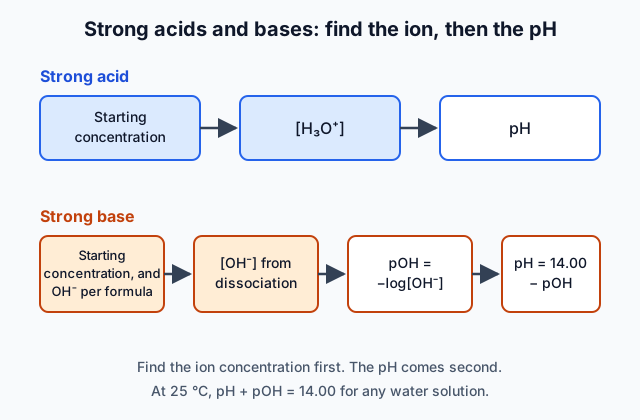
In short. A strong acid ionizes completely, so [H₃O⁺] equals its starting concentration, and a strong base dissociates completely, so [OH⁻] equals its starting concentration times the hydroxide ions in its formula.
- For a strong acid, pH = −log of the acid concentration, and no un-ionized acid molecules remain.
- A group I hydroxide such as NaOH gives [OH⁻] equal to its concentration, and a group II hydroxide such as Ba(OH)₂ gives twice its concentration.
- A base gives the pOH first; at 25 °C, pH = 14.00 − pOH, and Kw gives the concentration of the other ion.
Part 2 Learn it Completely ionized
2a. Strong acids
A strong acid reacts completely with water. All of its molecules transfer an H⁺ to water, so each one makes a hydronium ion and the acid's conjugate base:
HCl(aq) + H₂O(l) → H₃O⁺(aq) + Cl⁻(aq)
The single arrow means the reaction goes to completion. The strong acids on the list are HCl, HBr, HI, HClO₄, H₂SO₄ and HNO₃, and the examples here are acids that give one hydronium ion per molecule.
Two things follow. First, no HCl molecules are left, so the solution holds H₃O⁺ and Cl⁻ and almost nothing else but water. Second, the concentration of H₃O⁺ equals the starting concentration of the acid, so the pH is found from the label:
[H₃O⁺] = starting concentration of the acid
pH = −log[H₃O⁺]
Example: for 0.0040 M HI, [H₃O⁺] = 0.0040 M, so pH = 2.40. The number of decimal places follows the significant figures in the concentration, just as in the last topic.
Quick check · Calculate
A student makes a 0.0250 M solution of nitric acid, HNO₃, a strong acid. What is the pH of the solution? Give three decimal places, the number that three significant figures in the concentration allow.
2b. Strong bases
A strong base dissociates completely in water. The group I hydroxides (LiOH, NaOH, KOH) and the group II hydroxides, such as Ba(OH)₂, are already made of ions, so water simply separates them:
NaOH(s) → Na⁺(aq) + OH⁻(aq)
Ba(OH)₂(s) → Ba²⁺(aq) + 2 OH⁻(aq)
Count the hydroxide ions in the formula. One NaOH gives one OH⁻, so [OH⁻] equals the starting concentration. One Ba(OH)₂ gives two, so [OH⁻] is double the starting concentration.
The base gives you [OH⁻], so find the pOH first, and then the pH:
pOH = −log[OH⁻]
pH = 14.00 − pOH at 25 °C
Example: for 0.0020 M NaOH, [OH⁻] = 0.0020 M, so pOH = 2.70 and pH = 14.00 − 2.70 = 11.30.
Quick check · Calculate
A student makes a 0.0150 M solution of barium hydroxide, Ba(OH)₂, a strong base, at 25 °C. What is the pH? Give three decimal places.
2c. Every species in the solution
The solution of a strong acid or base holds only a few species, and you can find the concentration of every one.
Take 0.0250 M HNO₃ at 25 °C:
- [H₃O⁺] = 0.0250 M, the starting concentration.
- [NO₃⁻] = 0.0250 M, one for each H₃O⁺.
- [HNO₃] is essentially zero, because the acid is all ionized.
- [OH⁻] comes from Kw: (1.0 × 10⁻¹⁴) / 0.0250 = 4.0 × 10⁻¹³ M.
A base works the same way in reverse. The base sets [OH⁻], and Kw gives the small concentration of H₃O⁺.
Because pH + pOH = 14.00 at 25 °C, whichever of the two you found first gives you the other. For 0.0250 M HNO₃, pH = 1.602, so pOH = 14.000 − 1.602 = 12.398.
Quick check · Sort it
A 0.0250 M solution of HNO₃ is made at 25 °C. Tap each species, then the bin that describes its concentration in the solution.
About 0.0250 M
Far below 0.0250 M
Part 3 Watch it done The pH of a KOH solution
Predict first, then watch each step, then finish the calculation yourself.
A student dissolves 1.85 g of potassium hydroxide, KOH (molar mass 56.11 g/mol), in water and adds water to make 250.0 mL of solution at 25 °C. What is the pH of the solution? Give three decimal places.
Predict first
Before you open the first step, predict: will [OH⁻] in the solution be greater than, equal to, or less than the molarity of the KOH?
Step 1 · Find the moles of KOH
n = 1.85 g / 56.11 g/mol = 0.032971 mol. Keep the extra digits for the next step.
Step 2 · Find the molarity
M = 0.032971 mol / 0.2500 L = 0.13188 M.
Step 3 · Find the hydroxide ion concentration
KOH dissociates completely, KOH → K⁺ + OH⁻, with one hydroxide ion per formula unit. So [OH⁻] = 0.13188 M.
Why this step?
Why is [OH⁻] equal to the KOH concentration, with no equilibrium calculation?
KOH is a strong base, so it dissociates completely and no KOH is left over. Every formula unit releases exactly one OH⁻, so [OH⁻] equals the starting concentration.
Your step · Calculate
Finish it. With [OH⁻] = 0.13188 M, what is the pH of the potassium hydroxide solution at 25 °C? Give three decimal places.
The pOH, 0.880, is small because the solution is concentrated in OH⁻, and its pH, 13.120, is close to the top of the scale. The same steps work for any strong base; the one thing that changes is how many OH⁻ one formula unit releases.
Part 4 Try it Comparing strong solutions
Every solution here is at 25 °C. These numbers are a teaching example.
Try it · Rank it
Five solutions at 25 °C are made from strong acids and strong bases: A, 0.10 M HCl; B, 0.10 M NaOH; C, 0.050 M Ba(OH)₂; D, 0.010 M HNO₃; E, 0.0010 M KOH. Rank the solutions by pH.
Highest pH first; equal pH shares a place
Give each one a place, 1 for first. Give two the same place if they are equal.
Your ranking: none yet
Try it · Decide and justify
Solution P is 0.010 M Ba(OH)₂ and solution Q is 0.015 M KOH, both at 25 °C. Which solution has the higher pH?
Which reason supports your decision?
Part 5 Explain it Barium hydroxide solution
On the exam this is handwritten, so answer on paper first. Nothing you type here leaves this page. Then check your answer against the model and each scoring point.
Free response is 50% of the exam score. This one is shaped like a short-answer question, which is worth 4 points.
Free-response practice · Short-answer style
A student prepares a 0.0360 M solution of the strong base barium hydroxide, Ba(OH)₂, at 25 °C.
(a) Represent the dissolving of Ba(OH)₂ in water with an equation.
(b) Calculate the hydroxide ion concentration of the solution.
(c) Calculate the pH of the solution.
(d) A second student prepares 0.0360 M KOH. Explain whether its pH is higher than, lower than, or equal to the pH of the Ba(OH)₂ solution.
Model answer
(a) Ba(OH)₂(s) → Ba²⁺(aq) + 2 OH⁻(aq).
(b) Each formula unit gives two hydroxide ions, so [OH⁻] = 2 × 0.0360 M = 0.0720 M.
(c) pOH = −log(0.0720) = 1.143, so pH = 14.00 − 1.143 = 12.857.
(d) The KOH solution has a lower pH. KOH releases only one OH⁻ per formula unit, so [OH⁻] is 0.0360 M, half of the Ba(OH)₂ value. Its pOH is 1.444 and its pH is 12.556. Less OH⁻ means a lower pH.
Score your own answer. This is a self-check, not a grade. Tick each point your answer makes.
Part 6 Check yourself Four strong solutions
All three case questions use the table.
A student prepares four solutions at 25 °C, each with the same starting concentration, 0.0200 M. Each solute is a strong acid or a strong base. These numbers are a teaching example.
| Solution | Solute | Starting concentration (M) |
|---|---|---|
| A | HClO₄ | 0.0200 |
| B | NaOH | 0.0200 |
| C | Ba(OH)₂ | 0.0200 |
| D | HI | 0.0200 |
Case question 1 · Calculate
Using the table: what is the pH of solution C? Give three decimal places.
Case question 2 · Multiple choice
Using the table: which two solutions have the same pH?
Case question 3 · Select all
Using the table: which two statements about solution A, 0.0200 M HClO₄ at 25 °C, are true? Select two.
Select 2 answers, then check.
The rest stand on their own and do not use the case.
Check yourself · Spot the error
A student finds the pH of 0.0050 M Ba(OH)₂ at 25 °C. Tap the line with the mistake.
Check yourself · Match
Match each solution at 25 °C to its pH.
Part 7 Keep it Bring back earlier ideas
This lesson leans on two earlier ideas: turning a concentration into a pH, and counting the ions that one formula unit gives. Pulling them back up is what makes them last.
From 8.1 Introduction to Acids and Bases · Calculate
The hydronium ion concentration of a sample of rainwater is 3.2 × 10⁻⁵ M. What is its pH? Give the number of decimal places that two significant figures in the concentration allow.
Two drawings of solutions the lesson has not shown: a molecular solute that hydrogen bonds with water, and two solutes drawn side by side.
From 3.8 Representations of Solutions · Decide and justify
At one scale, a student draws a 0.20 M glucose solution as 4 glucose molecules in a box. At the same scale, in a box of the same size, she draws a 0.10 M sodium chloride solution as 2 Na⁺ ions and 2 Cl⁻ ions. Is the sodium chloride drawing consistent with its concentration?
Which reason supports your decision?
In three lines
- A strong acid ionizes completely, so [H₃O⁺] equals its starting concentration and pH = −log[H₃O⁺].
- A strong base dissociates completely: [OH⁻] equals the concentration for a group I hydroxide and double it for a group II hydroxide.
- A base gives the pOH first, and pH = 14.00 − pOH at 25 °C; Kw gives the concentration of the other ion.
Exam strategy for this topic
- Section I, Multiple Choice: 60 questions in 90 minutes.
- Section II, Free Response: 7 questions in 105 minutes.
- A scientific or graphing calculator is recommended for use on both sections of the exam.
Write the dissociation or ionization equation for a strong acid or base, and read the concentration of H₃O⁺ or OH⁻ from its coefficients. For a base, find the pOH first and subtract it from 14.00, and give the pH with the decimal places the concentration allows.
Questions students ask
How do you find the pH of a strong acid?
A strong acid ionizes completely, so [H₃O⁺] equals the starting concentration of the acid, and pH = −log[H₃O⁺].
How do you find the pH of a strong base?
Find [OH⁻] from the starting concentration and the formula, take pOH = −log[OH⁻], and then pH = 14.00 − pOH at 25 °C.
Why is [OH⁻] twice the concentration for Ba(OH)₂?
Each formula unit of Ba(OH)₂ contains two hydroxide ions, and a strong base dissociates completely, so every formula unit releases both.
Which acids and bases are strong?
The strong acids on the list are HCl, HBr, HI, HClO₄, H₂SO₄ and HNO₃. The strong bases are the hydroxides of group I and group II metals.
Is there any un-ionized strong acid left in the solution?
Essentially none. A strong acid ionizes completely, so the solution holds H₃O⁺ and the conjugate base, with a very small concentration of OH⁻ from water.
Course alignment, for teachers
AP Chemistry topic 8.2, Unit 8: Acids and Bases.
- Skill 5.B: Identify an appropriate theory, definition, or mathematical relationship to solve a problem.
This lesson maps all 2 essential knowledge statements of the topic to the part that teaches each one: 2 are checked by a scored question. The map is in the lesson file.