Unit 8 · Topic 8.5 · about 30 minutes · 7 parts · 12 scored checks, 1 of them multiple choice, plus 2 from earlier lessons
AP Chemistry 8.5: Acid-Base Titrations
Unit 8: 11 to 15% of the multiple-choice section
What you'll be able to do
- Explain what a titration curve shows about a mono- or polyprotic acid or base: its concentration, its pKa and the pH at the equivalence point.
Key vocabulary
| Term | What it means | The exam trap |
|---|---|---|
| Titration | A controlled acid-base reaction in which a solution of known concentration is added slowly to a measured volume of a solution of unknown concentration. | The solution in the buret and the solution in the flask play different roles, so name which is which before you use any number. |
| Equivalence point | The point where the moles of titrant added equal the moles of analyte originally present. | Equal moles describes the amounts, so check what species those moles made before you say anything about the pH. |
| Half-equivalence point | The point halfway to the equivalence point, where a weak acid and its conjugate base (or a weak base and its conjugate acid) are present in equal concentrations. | Work out the volume first, and only then read the curve. |
| Titration curve | A graph of pH against the volume of titrant added. | Different parts of the curve are controlled by different species, so ask what is in the flask at the point you are reading. |
| Polyprotic acid | An acid with more than one acidic proton, each with its own Ka and pKa. | Count the steep rises, not the formulas on the page, when the question gives you a curve. |
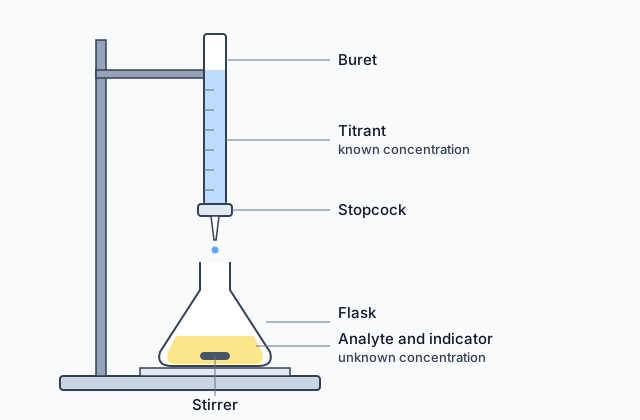 Tap to open the picture full size
Part 1 Think first One drop turns it pink
Commit to a guess first. Being wrong now makes the right idea stick better.
Predict first
A student adds sodium hydroxide solution, drop by drop, to a flask of hydrochloric acid that holds a few drops of indicator. The indicator turns pink above about pH 8. She swirls after every drop. For a long time the liquid stays colorless, and then a single drop turns the whole flask pink. Why is the change so sudden?
In short. A titration adds a solution of known concentration to one of unknown concentration, and the curve of pH against volume added shows the equivalence point, where moles of titrant equal moles of analyte.
- At the equivalence point the moles of titrant equal the moles of analyte, which gives the analyte's concentration for strong and weak acids and bases alike.
- Halfway to the equivalence point of a weak acid or base, the pH equals the pKa, so the curve gives the pKa.
- The pH at the equivalence point depends on what is left: 7 for a strong acid and strong base, above 7 for a weak acid, below 7 for a weak base.
Part 2 Learn it Reading a titration
2a. The curve and the equivalence point
In a titration, a solution of known concentration, the titrant, is added slowly from a buret to a measured volume of a solution of unknown concentration, the analyte. An acid-base reaction is run under control, so you can follow it. A titration curve plots pH against the volume of titrant added.
The curve has a steep rise. Its middle is the equivalence point, where the moles of titrant added equal the moles of analyte originally present:
n(titrant) = n(analyte)
That holds for monoprotic acids and bases, strong or weak. It turns a volume into a concentration, because moles = M × V:
M(analyte) × V(analyte) = M(titrant) × V(titrant at equivalence)
Use the volume of analyte you started with, not the total volume in the flask.
Example (a teaching example): 20.00 mL of HCl needs 16.00 mL of 0.1000 M NaOH to reach the equivalence point. n(NaOH) = 1.600 × 10⁻³ mol, which equals n(HCl), so [HCl] = (1.600 × 10⁻³ mol)/(0.02000 L) = 0.08000 M.
This is the mixing of the last topic done in small steps: before the steep rise the analyte is in excess, and after it the titrant is.
Quick check · Calculate
A 25.00 mL sample of acetic acid, a weak acid, is titrated with 0.5000 M NaOH. The equivalence point is reached after 21.40 mL of NaOH is added. What is the molarity of the acetic acid? Give your answer to four significant figures.
2b. The pH at the equivalence point
At the equivalence point, the pH is set by the major species in the solution. The titration has used up the acid and the base in equal moles, so look at what they made.
- Strong acid with strong base. Only the spectator ions are left, and neither reacts with water. The pH is 7.
- Weak acid with strong base. All of the weak acid has become its conjugate base, A⁻, which reacts with water: A⁻ + H₂O ⇌ HA + OH⁻. The pH is above 7.
- Weak base with strong acid. All of the weak base has become its conjugate acid, HB⁺, which reacts with water: HB⁺ + H₂O ⇌ B + H₃O⁺. The pH is below 7.
So the equivalence point, where the moles match, is not always where the pH is 7. It is where the pH curve rises most steeply, and for a weak acid that happens above 7.
The conjugate is also diluted: its moles are spread over the volume of acid and base together.
Quick check · Sort it
Each card names a titration carried to its equivalence point. Tap a card, then the bin for the pH of the solution at that point, at 25 °C.
Above 7
Equal to 7
Below 7
2c. The half-equivalence point and the pKa
For a weak acid, a point halfway to the equivalence point is special. At half the equivalence volume, half of the HA has been converted to A⁻, so [HA] = [A⁻]. Put that into the Henderson-Hasselbalch equation:
pH = pKa + log([A⁻] / [HA]) = pKa + log(1) = pKa
This is the half-equivalence point. The pH there equals the pKa of the acid, so a titration curve gives you the pKa: find the equivalence volume, halve it, and read the pH at that volume. Then Ka = 10^(−pKa).
A weak base works the same way: at its half-equivalence point, [B] = [HB⁺], and the pH equals the pKa of the conjugate acid HB⁺.
Example (a teaching example): a weak acid reaches the equivalence point at 24.0 mL. The pH at 12.0 mL is 4.40, so pKa = 4.40 and Ka = 10^(−4.40) = 4.0 × 10⁻⁵.
The half-equivalence point is also a buffer, because both HA and A⁻ are present in equal amounts.
Quick check · Calculate
A student titrates 25.0 mL of a weak acid with 0.100 M NaOH. The pH is 2.39 before any base is added, 3.85 after 15.0 mL, 8.29 after 30.0 mL and 11.92 after 35.0 mL. The pH rises most steeply at 30.0 mL. What is Ka of the weak acid? Type your answer in e-notation, to two significant figures (1.4 × 10⁻⁴ is typed 1.4e-4).
2d. Polyprotic acids
A polyprotic acid has more than one acidic proton. A diprotic acid, H₂A, loses them one at a time, each with its own Ka and pKa: H₂A ⇌ H⁺ + HA⁻ first, and HA⁻ ⇌ H⁺ + A²⁻ second.
Titrated with NaOH, each proton gives its own steep rise, so the number of steep rises tells you the number of acidic protons. Each proton needs the same moles of base, so the second rise comes at twice the volume of the first. The curve also shows what is present:
- At the start, the major species is H₂A, and it stays the larger of the two until halfway to the first rise. Past halfway, HA⁻ is larger.
- At the first equivalence point, the middle of the first rise, it is HA⁻.
- At the second equivalence point, it is A²⁻.
- Halfway to the first rise, [H₂A] = [HA⁻] and the pH is pKa₁. Halfway between the first and second rises, [HA⁻] = [A²⁻] and the pH is pKa₂.
Reading a polyprotic curve is about which species is large and which is small at each point.
Quick check · Fill the statement
A student titrates 20.0 mL of a weak diprotic acid, H₂A, with 0.100 M NaOH. The pH rises steeply at 20.0 mL and again at 40.0 mL. Complete the description.
The curve has two steep rises because each molecule of H₂A has acidic protons. At 20.0 mL, the middle of the first steep rise, the major species is . At 40.0 mL the major species is . The pH at 10.0 mL equals .
Part 3 Watch it done A weak acid, start to finish
Watch each step, then finish the calculation yourself.
A student titrates 25.00 mL of a weak acid, HX, with 0.1000 M NaOH. The equivalence point is reached after 18.60 mL, and the pH after 9.30 mL is 4.15. Find the concentration of HX, its Ka, and the pH at the equivalence point.
Step 1 · Find the concentration
At the equivalence point n(HX) = n(NaOH) = (0.1000 M)(0.01860 L) = 1.860 × 10⁻³ mol. So [HX] = (1.860 × 10⁻³ mol)/(0.02500 L) = 0.07440 M.
Step 2 · Find Ka at the half-equivalence point
Half of 18.60 mL is 9.30 mL, so the pH there, 4.15, is the pKa. Ka = 10^(−4.15) = 7.1 × 10⁻⁵.
Why this step?
Why does the pH equal the pKa at 9.30 mL?
Half of the HX has been converted to X⁻ by then, so [HX] = [X⁻]. The ratio in the Henderson-Hasselbalch equation is 1, its log is zero, and the pH equals the pKa.
Step 3 · Find what is in the flask at the equivalence point
All of the HX is now X⁻, in a total volume of 25.00 + 18.60 = 43.60 mL. [X⁻] = (1.860 × 10⁻³ mol)/(0.04360 L) = 0.04266 M. X⁻ is a weak base with Kb = Kw/Ka = (1.0 × 10⁻¹⁴)/(7.1 × 10⁻⁵) = 1.4 × 10⁻¹⁰. Next is [OH⁻], and then the pH.
Your step · Calculate
Finish it. At the equivalence point the solution holds 0.04266 M X⁻, and Kb of X⁻ is 1.4 × 10⁻¹⁰. What is the pH of the solution? Give your answer with two decimal places.
One curve gave three results: the concentration from the equivalence volume, the Ka from half of it, and the pH at the equivalence point from the species that is left. The pH came out above 7 because the major species at the equivalence point is the conjugate base of a weak acid.
Part 4 Try it Two acids, two curves
The equivalence point does not sit at pH 7 for every titration. Decide which sample is the weak acid, then rank four titrations by the pH at their equivalence points. These numbers are a teaching example.
Try it · Decide and justify
Two 25.00 mL samples, each 0.1000 M, are titrated with 0.1000 M NaOH. One sample is a strong acid and the other is a weak acid. Acid X has a pH of 7.00 at 25.00 mL of base. Acid Y has a pH of 8.62 at 25.00 mL of base, where its curve is steepest. Which acid is the weak acid?
Which reason supports your decision?
Try it · Rank it
Four titrations each use 25.0 mL of a 0.100 M solution and are carried to the equivalence point with 0.100 M of the other reagent. Rank the pH at the equivalence point, highest first. Ka values: acetic acid 1.8 × 10⁻⁵, HF 6.8 × 10⁻⁴, NH₄⁺ 5.6 × 10⁻¹⁰.
Highest pH first
Give each one a place, 1 for first. Give two the same place if they are equal.
Your ranking: none yet
Part 5 Explain it Ammonia titrated with hydrochloric acid
On the exam this is handwritten, so answer on paper first. Nothing you type here leaves this page. Then check your answer against the model and each scoring point.
Free response is 50% of the exam score. This one is shaped like a long-answer question, which is worth 10 points.
Free-response practice · Long-answer style
A student titrates 25.00 mL of aqueous ammonia, NH₃(aq), with 0.1000 M HCl(aq). The equivalence point is reached after 22.50 mL of HCl is added. After 11.25 mL of HCl has been added, the pH of the solution is 9.25.
(a) Calculate the molarity of the ammonia solution.
(b) Determine the value of Ka for NH₄⁺, using the pH after 11.25 mL.
(c) Identify the nitrogen-containing species that is present in the largest amount at the equivalence point, and represent with an equation the reaction that determines the pH there.
(d) Calculate the pH at the equivalence point.
(e) The student repeats the titration with 25.00 mL of 0.09000 M NaOH in place of the ammonia. Explain how the pH at the equivalence point compares with the pH in the ammonia titration.
Model answer
(a) n(HCl) = (0.1000 M)(0.02250 L) = 2.250 × 10⁻³ mol = n(NH₃). [NH₃] = (2.250 × 10⁻³ mol)/(0.02500 L) = 0.09000 M.
(b) 11.25 mL is half of 22.50 mL, the half-equivalence point, where [NH₃] = [NH₄⁺] and pH = pKa = 9.25. Ka = 10^(−9.25) = 5.6 × 10⁻¹⁰.
(c) NH₄⁺ is present in the largest amount, because all the NH₃ has been converted. NH₄⁺(aq) + H₂O(l) ⇌ NH₃(aq) + H₃O⁺(aq).
(d) [NH₄⁺] = (2.250 × 10⁻³ mol)/(0.04750 L) = 0.04737 M. [H₃O⁺] = √(Ka × [NH₄⁺]) = √((5.6 × 10⁻¹⁰)(0.04737)) = 5.2 × 10⁻⁶ M, so pH = 5.29.
(e) The NaOH titration ends at pH 7, which is higher than 5.29. At its equivalence point only Na⁺ and Cl⁻ are present, and neither reacts with water. In the ammonia titration, NH₄⁺ is a weak acid and reacts with water to make H₃O⁺.
Score your own answer. This is a self-check, not a grade. Tick each point your answer makes.
Part 6 Check yourself Titrating a weak acid
All three case questions use the table.
A student titrates 25.00 mL of a weak monoprotic acid, HA, with 0.1000 M NaOH and records the pH after each volume of base. These numbers are a teaching example.
| Volume of NaOH added (mL) | pH |
|---|---|
| 0.00 | 2.85 |
| 5.00 | 4.13 |
| 10.00 | 4.60 |
| 15.00 | 5.08 |
| 19.00 | 5.88 |
| 19.90 | 6.90 |
| 20.00 | 8.62 |
| 20.10 | 10.35 |
| 21.00 | 11.34 |
| 25.00 | 12.00 |
Case question 1 · Calculate
Using the table: what is the pKa of HA? Give your answer with two decimal places.
Case question 2 · Multiple choice
Using the table: why is the pH at 20.00 mL, 8.62, above 7?
Case question 3 · Calculate
Using the table: what is the molarity of the HA solution? Give your answer to three significant figures.
The rest stand on their own and do not use the case.
Check yourself · Spot the error
A student titrates 25.00 mL of 0.1000 M HF, a weak acid, with 0.1000 M KOH. Tap the line where the reasoning first goes wrong.
Check yourself · Match
Using the table: match each region of the curve to what is true there.
Part 7 Keep it Bring back earlier ideas
Titrations are repeated mixing of an acid and a base, and every volume turns into moles first. Pulling those ideas back up is what makes them last.
From 8.4 Acid-Base Reactions and Buffers · Sort it
Each card describes a weak acid mixed with a strong base. Tap a card, then the bin for what is in the solution once the reaction is complete.
Weak acid and its conjugate base
Only the conjugate base
Excess hydroxide ion
Two lab situations.
From 3.7 Solutions and Mixtures · Calculate
A student uses a pipet to put 25.00 mL of 2.00 M glucose into a 100.0 mL volumetric flask, then adds water up to the mark and mixes. What is the molarity of the new solution? Give your answer to three significant figures.
In three lines
- At the equivalence point the moles of titrant equal the moles of analyte, which gives the analyte's concentration for strong and weak acids and bases.
- Halfway to the equivalence point of a weak acid or base, the pH equals the pKa; the equivalence point is above 7 for a weak acid, 7 for strong with strong, and below 7 for a weak base.
- A polyprotic acid gives one steep rise for each acidic proton, and each rise has its own species and its own pKa.
Exam strategy for this topic
- Section I, Multiple Choice: 60 questions in 90 minutes.
- Section II, Free Response: 7 questions in 105 minutes.
- A scientific or graphing calculator is recommended for use on both sections of the exam.
Mark the equivalence point as the middle of the steepest rise, and halve its volume to find the half-equivalence point. Write the species that is left before you say anything about the pH, and give a concentration from the original volume of the analyte. Show the equation with its arrows when you explain why a pH is above or below 7.
Questions students ask
What is the equivalence point of a titration?
The point where the moles of titrant added equal the moles of analyte originally present. It is in the middle of the steepest rise of the titration curve.
How do you find the concentration of the analyte from a titration?
Find the moles of titrant used at the equivalence point, equal to the moles of analyte for a monoprotic acid or base, and divide by the original volume of the analyte.
How do you find the pKa of a weak acid from a titration curve?
Read the pH at half the equivalence volume. There [HA] = [A⁻], so the pH equals the pKa.
Why is the equivalence point above pH 7 for a weak acid titrated with a strong base?
All of the acid has become its conjugate base, which is a weak base and reacts with water to make hydroxide ion.
How does a polyprotic acid show up on a titration curve?
Each acidic proton gives its own steep rise, so the number of rises equals the number of acidic protons, and each half-equivalence point gives one pKa.
Beyond the AP Exam
College Board sets this limit on what the AP Exam asks about this topic. Anything past it is not on the exam.
Computation of the concentration of each species present in the titration curve for polyprotic acids will not be assessed on the AP Exam. Such computations for titration of monoprotic acids are within the scope of the course (see topic 8.4 and topic 8.4), as is qualitative reasoning regarding what species are present in large versus small concentrations at any point in a titration of a polyprotic acid.
Course alignment, for teachers
AP Chemistry topic 8.5, Unit 8: Acids and Bases.
- Skill 5.D: Identify information presented graphically to solve a problem.
This lesson maps all 5 essential knowledge statements of the topic to the part that teaches each one: 5 are checked by a scored question. The map is in the lesson file.