Unit 8 · Topic 8.6 · about 30 minutes · 7 parts · 11 scored checks, 2 of them multiple choice, plus 2 from earlier lessons
AP Chemistry 8.6: Molecular Structure of Acids and Bases
Unit 8: 11 to 15% of the multiple-choice section
What you'll be able to do
- Explain how the strength of an acid or base depends on the structure of its molecule or ion, by looking at how stable its conjugate partner is.
Key vocabulary
| Term | What it means | The exam trap |
|---|---|---|
| Conjugate base | The species left after an acid has given up H⁺. | The conjugate base is part of the same structure as the acid, so draw it before you compare strength. |
| Carboxylic acid | A weak acid that contains the -COOH group. | Look at where each hydrogen is bonded before you decide which ones count. |
| Inductive effect | The pulling of electron density through bonds by a nearby electronegative atom. | The effect weakens with distance, so look at which atoms are close to the group that carries the charge. |
| Resonance | The sharing of a charge among several atoms in an ion, which makes the ion more stable. | Count the atoms that actually share the charge, not just the atoms in the ion. |
| Strong base | A base that is essentially completely dissociated in water, such as a group 1 or group 2 hydroxide. | Strength is about how completely a base dissociates, not about how concentrated its solution is. |
 Tap to open the picture full size
Part 1 Think first One hydrogen out of four
Commit to a guess first. Being wrong now makes the right idea stick better.
Predict first
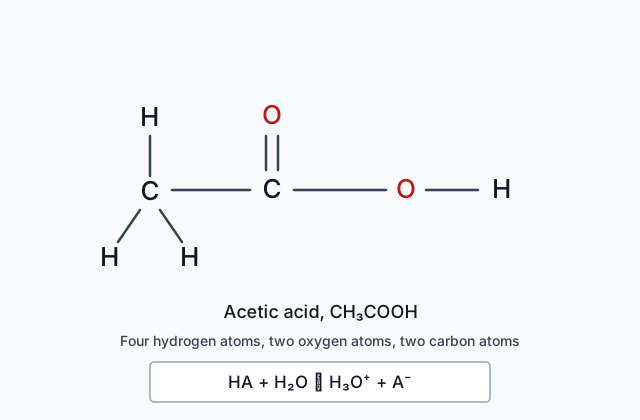
Acetic acid, CH₃COOH, the acid in vinegar, has four hydrogen atoms: three on a carbon atom and one on an oxygen atom. In water, only one kind of hydrogen ever leaves the molecule as H⁺. Which one is it?
In short. The structure of a molecule shows which proton leaves and how readily: the more stable the conjugate base is, the stronger the acid.
- A strong acid has a very weak conjugate base, stabilized by electronegativity, inductive effects, resonance, or some combination.
- Carboxylic acids are a common class of weak acid, and ammonia and carboxylate ions are common weak bases.
- Electronegative atoms stabilize the conjugate base relative to the conjugate acid, and so increase acid strength.
Part 2 Learn it Reading strength from structure
2a. Which proton leaves
A molecule can have many hydrogen atoms, but usually only some of them take part in acid-base reactions. A proton leaves when the atom it was bonded to can hold the negative charge that remains. That is a job for an electronegative atom such as oxygen or nitrogen, not for carbon.
A carboxylic acid has a carboxyl group, -COOH. Its acidic proton is the one on the oxygen:
R-COOH + H₂O ⇌ R-COO⁻ + H₃O⁺
The other hydrogen atoms in the molecule, on carbon, do not leave in water. Carboxylic acids are one common class of weak acid, because the proton leaves only partly.
A base needs a way to take a proton, and the usual way is a lone pair on an electronegative atom. In ammonia, NH₃, the lone pair on nitrogen binds H⁺ to make NH₄⁺. In a carboxylate ion, R-COO⁻, the lone pairs on oxygen do the same. Nitrogenous bases such as ammonia and carboxylate ions are common weak bases.
So from a structure you can read where the acidic proton is, and where a proton can attach.
Quick check · Multiple choice
Propanoic acid, CH₃CH₂COOH, has six hydrogen atoms: three on the CH₃ carbon, two on the CH₂ carbon and one on the oxygen of the carboxyl group, -COOH. Which hydrogen atom can leave as H⁺ in water?
2b. Strong acids and strong bases
A strong acid gives up its proton essentially completely, so the particles in solution are H₃O⁺ and the conjugate base. The strong acids named in the course are HCl, HBr, HI, HClO₄, H₂SO₄ and HNO₃.
What makes them strong is the conjugate base: it is very weak, because it is so stable that it holds on to H⁺ hardly at all. Cl⁻, Br⁻, I⁻, ClO₄⁻ and NO₃⁻ are stabilized by electronegativity, inductive effects, resonance, or some combination of them (the next chunks look at how).
The same pairing runs the other way for bases. The strong bases are the group 1 and group 2 hydroxides, such as NaOH, KOH and Ca(OH)₂. They dissociate completely to give hydroxide ion, whose conjugate acid, water, is a very weak acid. That is why OH⁻ takes up H⁺ so completely.
A strong acid and its conjugate base are opposite in strength: the stronger the acid, the weaker its conjugate base. The same is true of a strong base and its conjugate acid.
Quick check · Decide and justify
Hydrobromic acid, HBr, is a strong acid. What does that say about its conjugate base, Br⁻?
Which reason supports your decision?
2c. Weak acids and weak bases
Most acids and bases are weak, which means the proton moves only partly. Their structures fall into families.
- Weak acids. Carboxylic acids, such as acetic acid CH₃COOH and formic acid HCOOH, are the common class.
- Weak bases. Nitrogenous bases, such as ammonia NH₃, and carboxylate ions, such as CH₃COO⁻, are the common weak bases. A carboxylate ion is the conjugate base of a weak acid, so it is a weak base.
These pair up in a pattern. The conjugate base of a weak acid is a weak base, and the conjugate acid of a weak base is a weak acid. NH₄⁺ is a weak acid for that reason.
A strong acid has a very weak conjugate base, so Cl⁻ hardly acts as a base in water. But a weak acid's conjugate base does act, a little. That small amount is enough to change a pH, as in acetate in water.
So a substance's family tells you its strength: strong acid, weak acid, strong base or weak base, and what its conjugate partner is like.
Quick check · Sort it
Each card names a substance in water. Tap a card, then the bin that describes it.
Strong acid
Weak acid
Strong base
Weak base
2d. Why structure sets strength
Strength comes down to one question: how stable is the conjugate base, compared with the acid it came from? The more stable it is, the more readily the acid gives up H⁺. Three structural features stabilize a conjugate base:
- Electronegativity. If the negative charge sits on an electronegative atom, it is held more comfortably. Electronegative elements tend to stabilize the conjugate base relative to the conjugate acid, and so increase acid strength.
- Inductive effects. Electronegative atoms nearby pull electron density toward themselves through the bonds, which spreads the charge. The closer such atoms are, and the more of them there are, the larger the effect.
- Resonance. If the charge can be shared among two or more atoms by resonance, it is spread out and more stable. In a carboxylate ion, the charge is shared by two oxygen atoms.
So to compare acids, find the acidic hydrogen, write the conjugate base, and ask which base spreads or holds its charge better. Acid strength follows.
Quick check · Rank it
Each acid below has a -COOH group, and each has the same number of carbon atoms. Rank the acids by strength, using the structure of the conjugate base.
Strongest acid first
Give each one a place, 1 for first. Give two the same place if they are equal.
Your ranking: none yet
Part 3 Watch it done Nitric acid and nitrous acid
Predict first, then watch each step, then finish the argument yourself.
Nitric acid, HNO₃, is a strong acid. Nitrous acid, HNO₂, is a weak acid. Explain the difference from the structures of their conjugate bases.
Predict first
Before you open the first step, predict: which acid has the more stable conjugate base?
Step 1 · Find the acidic hydrogen
In both acids the hydrogen that leaves is bonded to an oxygen atom, the electronegative atom that will hold the charge: HO-NO₂ and HO-NO.
Step 2 · Write the conjugate bases
Losing H⁺ gives NO₃⁻ and NO₂⁻. Each ion has its negative charge on the oxygen atoms bonded to the nitrogen.
Why this step?
Why does the number of oxygen atoms matter?
Resonance spreads the negative charge over every oxygen that can share it, and the more atoms share it, the lower the charge on each and the more stable the ion. The extra oxygen atoms also pull electron density toward themselves.
Step 3 · Count the sharing
Draw the resonance structures of each ion. The charge is shared over every oxygen atom that can carry it, so count those atoms for NO₃⁻ and for NO₂⁻, and compare the two ions.
Your step · Fill the statement
Finish it. Complete the argument for why nitric acid is stronger than nitrous acid.
The negative charge of NO₃⁻ is spread over oxygen atoms and the negative charge of NO₂⁻ over . NO₃⁻ is therefore stable, and HNO₃ is the acid.
The same pattern shows up across a family: more oxygen atoms around the central atom stabilize the conjugate base more and make the acid stronger. In both of these acids the argument is the same, a more stable conjugate base means a stronger acid.
Part 4 Try it Predict from the structure
Use the same argument on molecules the lesson did not show. Each answer comes from the structure of a conjugate base.
Try it · Decide and justify
Trifluoroacetic acid, CF₃COOH, has three fluorine atoms on the carbon next to the -COOH group. Acetic acid, CH₃COOH, has three hydrogen atoms there. Which acid is stronger?
Which reason supports your decision?
Try it · Select all
Which two of these are weak bases in water? Select two.
Select 2 answers, then check.
Part 5 Explain it Acetic acid and trichloroacetic acid
On the exam this is handwritten, so answer on paper first. Nothing you type here leaves this page. Then check your answer against the model and each scoring point.
Free response is 50% of the exam score. This one is shaped like a short-answer question, which is worth 4 points.
Free-response practice · Short-answer style
Acetic acid, CH₃COOH, and trichloroacetic acid, Cl₃CCOOH, are both carboxylic acids. A 0.10 M solution of trichloroacetic acid has a much lower pH than a 0.10 M solution of acetic acid.
(a) Identify the hydrogen atom in CH₃COOH that acts as the acid.
(b) Represent the reaction of CH₃COOH with water with an equation that shows its conjugate base.
(c) Explain, in terms of the structures of the conjugate bases, why trichloroacetic acid is the stronger acid.
(d) Make a claim about whether the trichloroacetate ion is a stronger or a weaker base than the acetate ion, and justify it.
Model answer
(a) The hydrogen atom bonded to the oxygen atom of the -COOH group.
(b) CH₃COOH(aq) + H₂O(l) ⇌ CH₃COO⁻(aq) + H₃O⁺(aq).
(c) The three chlorine atoms are electronegative and pull electron density toward themselves through the bonds (an inductive effect), which helps to carry the negative charge of the carboxylate group. Trichloroacetate is therefore more stable than acetate, so it forms more readily, and the acid is stronger.
(d) Weaker. The more stable a conjugate base is, the less it attracts H⁺. Trichloroacetate is the conjugate base of the stronger acid, so it holds H⁺ less tightly than acetate does.
Score your own answer. This is a self-check, not a grade. Tick each point your answer makes.
Part 6 Check yourself Four carboxylic acids
Both case questions use the table.
Four carboxylic acids are compared at 25 °C. Each Ka is the acid ionization constant of the -COOH group. These numbers are a teaching example, rounded from standard tables.
| Acid | Formula | Ka |
|---|---|---|
| Acetic acid | CH₃COOH | 1.8 × 10⁻⁵ |
| Formic acid | HCOOH | 1.8 × 10⁻⁴ |
| Chloroacetic acid | ClCH₂COOH | 1.4 × 10⁻³ |
| Fluoroacetic acid | FCH₂COOH | 2.6 × 10⁻³ |
Case question 1 · Multiple choice
Using the table: which acid has the weakest conjugate base?
Case question 2 · Decide and justify
Using the table: a student claims that an electronegative atom near the -COOH group makes a carboxylic acid stronger. Does the table support the claim?
Which evidence supports your decision?
The rest stand on their own and do not use the case.
Check yourself · Spot the error
A student explains why HBr is a strong acid. Tap the line where the reasoning first goes wrong.
Check yourself · Put it in order
Put the steps in order for comparing the strengths of two acids from their structures.
Part 7 Keep it Bring back earlier ideas
Structure explains strength through two earlier ideas: electronegativity and resonance. Pulling them back up is what makes them last.
From 2.1 Types of Chemical Bonds · Fill the statement
Complete the description of two bonds to hydrogen. The electronegativities are N 3.04, H 2.20 and P 2.19.
An N-H bond is , and the atom in it carries a partial negative charge. A P-H bond is .
From 2.6 Resonance and Formal Charge · Spot the error
A student describes the carbonate ion, CO₃²⁻, in which the carbon atom is bonded to all three oxygen atoms. Tap the line where the reasoning first goes wrong.
In three lines
- Only a proton on an electronegative atom, such as the oxygen of a carboxyl group, leaves as H⁺; carboxylic acids are weak acids, and ammonia and carboxylate ions are weak bases.
- A strong acid has a very weak conjugate base, and a strong base has a very weak conjugate acid.
- The more stable the conjugate base, through electronegativity, inductive effects or resonance, the stronger the acid.
Exam strategy for this topic
- Section I, Multiple Choice: 60 questions in 90 minutes.
- Section II, Free Response: 7 questions in 105 minutes.
- A scientific or graphing calculator is recommended for use on both sections of the exam.
To explain a difference in strength, name the acidic hydrogen, write the conjugate base, and then say which structural feature stabilizes it: electronegativity, an inductive effect or resonance. A strong answer links the stability of the conjugate base to how readily the acid gives up H⁺.
Questions students ask
Which hydrogen in a carboxylic acid is acidic?
The hydrogen bonded to the oxygen of the -COOH group. After it leaves, the negative charge sits on an electronegative oxygen and is shared with the second oxygen by resonance.
Why is a strong acid's conjugate base so weak?
A strong acid gives up H⁺ completely because its conjugate base is very stable. A very stable base has almost no attraction for H⁺.
Which acids and bases does the course call strong?
The strong acids are HCl, HBr, HI, HClO₄, H₂SO₄ and HNO₃. The strong bases are the group 1 and group 2 hydroxides.
What are common weak acids and weak bases?
Carboxylic acids are a common class of weak acid. Nitrogenous bases such as ammonia and carboxylate ions are common weak bases.
How does electronegativity change acid strength?
Electronegative atoms stabilize the conjugate base relative to the conjugate acid, so they make an acid stronger.
Course alignment, for teachers
AP Chemistry topic 8.6, Unit 8: Acids and Bases.
- Skill 6.C: Support a claim with evidence from representations or models at the particulate level, such as the structure of atoms and/or molecules.
This lesson maps the one essential knowledge statement of the topic to the part that teaches each one: 1 is checked by a scored question. The map is in the lesson file.