Unit 7 · Topic 7.8 · about 30 minutes · 7 parts · 14 scored checks, 3 of them multiple choice
AP Human Geography 7.8: Sustainable Development
Unit 7: 12 to 17% of the multiple-choice section
What you'll be able to do
- Explain how sustainable development policies, ecotourism and the UN Sustainable Development Goals relate to and affect industrialization and spatial development.
Key vocabulary
| Term | What it means | The exam trap |
|---|---|---|
| Sustainable development | Development planned so that a place can keep developing over the long term; Learn it gives the full meaning. | It is a goal for policies, not one industry or one kind of place, so name the policy you mean. |
| Natural-resource depletion | Using up a resource such as forests, fish or minerals, so less of it is left for later. | It is about running out of a resource, which is a different problem from making it dirty. |
| Mass consumption | Buying, using up and throwing away goods in large amounts across a society, which grows as incomes rise. | It describes how a whole society buys and discards, not the waste from one factory. |
| Pollution | Wastes released into the air, water or soil that harm people and other living things. | Pollution and depletion can come from the same activity, so read what a policy is aimed at before you name the problem. |
| Climate change | The long-term warming of the planet and the changes in weather patterns that come with it, driven by greenhouse gases. | It is change over decades, so one heat wave or one unusually cold winter is weather, not climate change. |
| Ecotourism | Tourism based in natural environments, often ones threatened by industrialization or development, that frequently helps protect the environment while providing jobs for the local population. | It has two separate benefits, so an answer about how it works should name both the protection and the jobs. |
| UN Sustainable Development Goals | A set of goals agreed by the United Nations' member countries, each with targets and measured indicators, used to measure progress in development. | Know that the goals measure progress through indicators; you do not need to memorize the list. |
| Small-scale finance | Small loans, savings accounts and other financial services for people that banks do not serve, also called microfinance. | It is lending, not a gift of aid: borrowers repay what they borrow. |
| Public transportation | Buses, trains and other transit that anyone can ride for a fare, run by a government or a company. | A private shuttle that carries only one company's workers is not public transportation, even if it uses buses. |
 Tap to open the picture full size
Part 1 Think first Save the lake, keep the farms
Commit to a guess first. Being wrong now makes the right idea stick better.
Predict first
A hypothetical lakeside region gets its water from one lake. Each year its farms and its growing city take more water out than rain and rivers put back, and the lake is shrinking. The region's leaders want a plan that keeps the farms and jobs going and still leaves a full lake for the people who will live there 50 years from now. Which plan fits that goal best?
In short. Sustainable development meets people's needs today without using up the resources and environment that people will need later; its policies target the problems industrialization brings, ecotourism is one such policy, and the UN Sustainable Development Goals measure whether development is making progress.
- Sustainable development policies attempt to remedy natural-resource depletion, mass consumption, pollution and climate change, and they change where and how industry grows.
- Ecotourism is tourism in natural places, often ones threatened by development, that frequently helps protect them while providing jobs for local people. It works best when the money and jobs stay local and visitor numbers are limited.
- The UN Sustainable Development Goals measure progress through indicators, so projects such as small-scale finance and public transportation are judged by the change they make, such as greenhouse gases emitted per rider.
Part 2 Learn it Development that lasts
2a. What sustainable development tries to fix
Sustainable development is development that meets people's needs today without using up the resources, or damaging the environment, that people later will need. It still means jobs, income, housing and services. What changes is how they are produced.
Sustainable development policies attempt to remedy four problems that come with industrialization:
- Natural-resource depletion: using up forests, fish, groundwater or minerals faster than they can be replaced, or for good.
- Mass consumption: people buying, using up and throwing away goods in large amounts as incomes rise.
- Pollution: wastes that dirty the air, water and soil, usually most heavily near where they are released, such as soot or sewage.
- Climate change: the warming of the whole planet caused by greenhouse gases from burning fuel and clearing forests. Their harm is worldwide, not local, so a policy aimed at them is a climate policy.
These policies change where and how industry grows. A rule that factories treat their wastewater adds a cost to building beside a river, so new plants gather where treatment works already exist. Money for wind and solar farms to replace coal plants sends new power plants to places where the wind and sun are strong, often rural areas that gain the jobs. A yearly limit on logging keeps a sawmill town working for decades instead of a few good years.
Quick check · Sort it
Each card is a policy in a hypothetical country. Tap a card, then the problem it is mainly meant to remedy.
Natural-resource depletion
Mass consumption
Pollution
Climate change
2b. Ecotourism
Ecotourism is tourism based in natural environments, often places threatened by looming industrialization or development: a forest a logging road is creeping toward, a reef beside a planned port, wetlands marked out for farms. Visitors pay to walk, watch wildlife or dive. That frequently helps protect the place, and it provides jobs for the local population as guides, cooks, drivers, boat crews and lodge staff.
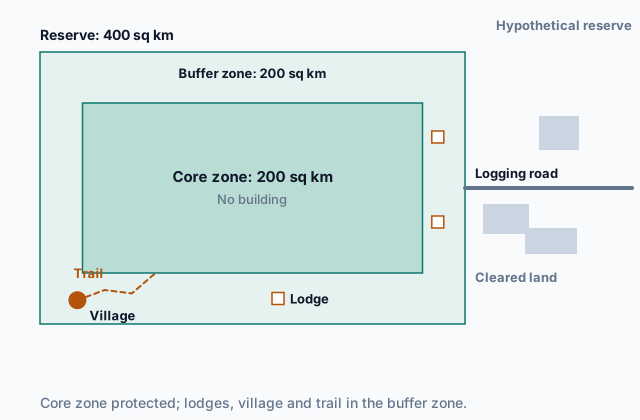
The protection comes from the money. While the forest stands, it keeps earning; cut down, it earns once. The picture at the top of the page shows one common layout: a core zone left untouched, and a buffer zone where a village, lodges and a trail take the visitors, with logging stopped at the boundary. (Core here is a zoning word for the protected middle of a reserve; it has nothing to do with core countries.)
Ecotourism does not always work. If the lodges are owned far away, most of what visitors pay leaves the area, and local people gain little reason to protect it. Too many visitors can wear away trails and drive off wildlife. So ask two things of any plan: does it protect the environment, and how much of the money and how many of the jobs stay with local people?
Quick check · Calculate
A hypothetical rainforest lodge takes in $1,500,000 a year from visitors. It pays $420,000 in wages to guides and staff from nearby villages and buys $180,000 of food and supplies from local farms and shops. The rest goes to owners and suppliers outside the area. What percentage of the lodge's revenue stays in the local community?
2c. The UN Sustainable Development Goals
How do you know whether development is moving forward? The United Nations' member countries agreed on a set of Sustainable Development Goals to measure progress in development. Each goal is named in plain words, such as No Poverty, Quality Education, Gender Equality, Clean Water and Sanitation, Sustainable Cities and Communities, and Climate Action. Under each goal sit targets, and under each target sit indicators: figures a country can measure again and again to see whether it is moving toward the goal.
The goals look past income alone. A country can grow richer while its rivers get dirtier or its girls leave school early, and the indicators would show both.
They also give single projects a yardstick. Before a project starts, planners measure the indicators it is meant to move. After it runs, they measure again, and the change is the project's progress. A well-digging program is judged by the share of homes with safe water nearby, not by the number of wells dug.
Quick check · Match
Planners in a hypothetical country measure each indicator below before and after a project. Match each UN Sustainable Development Goal to the indicator that measures progress toward it.
2d. Small loans and public transit
The goals help measure progress in two kinds of project the course names.
Small-scale finance, also called microfinance, offers small loans, savings accounts and insurance to people that banks turn away because they have no collateral or credit record, many of them women in rural villages. A small loan can buy a sewing machine, a cow or stock for a market stall. Progress is measured in the borrowers' lives: businesses started, household income, children kept in school. Where it works, people can earn a living in their own village instead of migrating to a city for work.
Public transportation projects, such as a new rail line or a bus route with its own lanes, move more people with less fuel than private cars do. They are measured by riders, travel times and greenhouse gases emitted per rider, since a full bus spreads its fuel across many trips. They also shape where a city grows. Homes, shops and offices cluster near the stations, so the city builds up around the line instead of spreading outward into farmland.
Quick check · Fill the statement
Complete the description of two projects measured against the UN Sustainable Development Goals.
A small-scale finance program lends amounts to people that banks turn away, and its progress is measured by changes in the lives of its . A new bus line is measured by the greenhouse gases it emits per . It also changes where the city grows: new homes and shops cluster its stations.
Part 3 Watch it done Is the new bus line cleaner?
Watch each step, then do the last one yourself.
Hypothetical City V replaced a diesel bus route with an electric bus line that has its own lanes. The old route emitted 3,000 kg of carbon dioxide a day and carried 6,000 riders a day. The new line, counting the power plants that charge its buses, emits 1,200 kg a day and carries 12,000 riders a day. City V reports its progress toward the Climate Action goal with emissions per rider. By what percentage did emissions per rider fall?
Predict first
Total daily emissions fell from 3,000 kg to 1,200 kg, a drop of 60%. Before the steps, how do you expect emissions per rider to change?
Step 1 · Choose the measure
Emissions per rider = daily emissions ÷ daily riders. It lets a route that carries few people be compared fairly with one that carries many.
Step 2 · Work out the old route
3,000 kg ÷ 6,000 riders = 0.5 kg of carbon dioxide per rider.
Why this step?
Why measure per rider instead of comparing the two daily totals?
The new line carries twice as many people. The totals show only part of the change; per rider shows how much cleaner each trip is, and it lets projects of different sizes be compared on the same indicator.
Your step · Calculate
Finish it. Work out the new line's emissions per rider, then the percentage by which emissions per rider fell from the old route's 0.5 kg.
percent
Part 4 Try it Choose a plan for a reef coast
Try it · Match
Hypothetical Province R has a mangrove forest along its coast and a coral reef just offshore. A company wants to clear mangroves for shrimp ponds, and village groups want to run reef and mangrove tours. Match each term to the observation that shows it.
Try it · Decide and justify
Province R's government will approve one tourism plan for the coast. Plan 1 is a 600-room resort owned by an overseas hotel chain, built on cleared mangrove land beside a new cruise pier. Plan 2 is a set of small lodges owned by village groups, with local guides and a daily limit on reef visitors. Which plan better fits ecotourism as a sustainable development policy?
Which reason supports your answer?
Part 5 Explain it Explain sustainable development in a country
Nothing you type leaves this page. Check your answer against the model and each scoring point.
Free response is 50% of the exam score. This one is shaped like Question 1, from free-response II.
Free-response practice · Question 1 style
A hypothetical country is industrializing quickly. Its forests are being cleared, its rivers carry factory waste, and its capital city is spreading outward into farmland. The government now judges new projects against the UN Sustainable Development Goals.
(A) Identify one problem that sustainable development policies attempt to remedy.
(B) Describe one way ecotourism provides jobs for a local population.
(C) Explain how ecotourism can protect a natural environment threatened by industrialization.
(D) Explain how the UN Sustainable Development Goals can be used to measure the progress of a public transportation project in the capital.
(E) Explain how a small-scale finance program can contribute to development in the country's rural villages.
(F) Describe one challenge to urban sustainability, other than climate change, that a new public transit line in the capital could reduce.
(G) Explain one limitation of ecotourism as a way to protect the environment across the whole country.
Model answer
(A) Pollution: the country's rivers carry factory waste. (Natural-resource depletion, mass consumption or climate change also answer.)
(B) Visitors to a forest need guides, cooks, drivers and lodge staff, and an ecotourism business hires people from nearby villages for that work.
(C) Ecotourism earns money only while the forest stays standing. The jobs and income it brings give local people and the government a reason to keep the forest instead of letting it be logged or cleared, and visitor fees can pay for rangers who guard it.
(D) The goals set indicators, such as greenhouse gases emitted per rider, travel times, or the share of residents near a stop. Planners measure them before the project and again after it opens, or track them each year against the goal's target, and the change shows the project's progress toward goals such as Climate Action and Sustainable Cities and Communities.
(E) Small loans let villagers whom banks turn away, many of them women, start or grow a small business such as a shop or a few animals. Household income rises, families can keep children in school, and people can earn a living in the village instead of migrating to the city.
(F) Suburban sprawl. If homes and shops cluster near the stations, the city grows up around the line instead of spreading into farmland. Poor air quality from traffic is another answer.
(G) Ecotourism works only where there is nature visitors will pay to see and a way to reach it, so it cannot protect every forest and wetland in the country. And where lodges are owned outside the country, most of the money leaves, so local people gain little reason to protect the land.
Score your own answer. This is a self-check, not a grade. Tick each point your answer makes.
Part 6 Check yourself Three ways to use a forest
The case questions use the table. The others mix the ideas from the whole lesson.
Hypothetical District F is mostly forest. A logging company holds a concession on part of it, locally owned ecotourism lodges run in another part, and ranchers have cleared some land for cattle. The district council compares the three uses with one year of figures.
| Use | Revenue | Local jobs | Share of revenue kept in the district | Forest cleared (hectares) |
|---|---|---|---|---|
| Logging | $6,000,000 | 120 | 15% | 800 |
| Ecotourism lodges | $2,500,000 | 300 | 60% | 5 |
| Cattle ranching | $3,000,000 | 90 | 40% | 400 |
Case question 1 · Multiple choice
Which statement about District F is supported by the table?
Case question 2 · Calculate
How many more dollars a year stay in District F from ecotourism than from logging?
Case question 3 · Multiple choice
District F's council ends the logging concession and lets new locally owned ecotourism lodges open on that land. If the new lodges match the table's ecotourism row in revenue, jobs, share kept and forest cleared, which outcome is expected?
The rest stand on their own and do not use the case.
Check yourself · Spot the error
A student uses one hypothetical district's results to judge ecotourism for its whole country. Which line is the first to go wrong?
Check yourself · Select all
Which two statements describe how the UN Sustainable Development Goals are used? Select two.
Select 2 answers, then check.
Part 7 Keep it Bring back earlier ideas
This lesson stands on the world economy from Topic 7.7 and the theories of development from Topic 7.5.
Bring it back · Multiple choice
A company based in a core country closes its factory there and outsources the work to a factory in a newly industrialized country. What happens to manufacturing jobs in each country?
Bring it back · Match
Match each theory of development to the idea at its center.
In three lines
- Sustainable development meets today's needs without using up what later generations need; its policies target resource depletion, mass consumption, pollution and climate change.
- Ecotourism earns from natural places while they stay protected and provides local jobs, when the money and jobs stay local and visitors are limited.
- The UN Sustainable Development Goals measure progress with indicators, so a small-loan program or a transit line is judged by the change it makes, such as emissions per rider.
Exam strategy for this topic
- Section I, Multiple Choice: 60 questions in 60 minutes.
- Section II, Free Response: 3 questions in 75 minutes.
When a question asks how a policy is sustainable, say what it does for people now (jobs, income, services) and what it protects for later. For ecotourism, give both parts: protecting the environment and providing local jobs.
Questions students ask
Is ecotourism always good for the environment?
No. It frequently helps, but too many visitors, new roads and lodges, or owners who take the earnings elsewhere can undo the protection. Judge a plan by what it protects and who gets the jobs and money.
Do I need to memorize the numbers of the UN Sustainable Development Goals?
No. Know that the goals measure progress in development through indicators, and be ready to explain how a project such as a small-loan program or a transit line is judged by the change it makes in them. You do not need to memorize the list.
Does sustainable development mean less industry?
No. It means industry and cities that keep providing jobs and services without using up resources or harming the environment people will need later. Sustainability rules often change where and how industry grows rather than stopping it.
Is small-scale finance the same as foreign aid?
No. It lends small amounts that borrowers repay, to people banks will not serve, so they can start or grow a business. Its progress is measured in the borrowers' lives, such as income and businesses started.
Are the places and numbers in this lesson real?
No. Every country, province, district, city and figure here is hypothetical, with numbers chosen to show each idea clearly. The UN Sustainable Development Goals are real, and the lesson names them without any real statistics.
Course alignment, for teachers
AP Human Geography topic 7.8, Unit 7: Industrial and Economic Development Patterns and Processes.
- Skill 5.D: Explain the degree to which a geographic concept, process, model, or theory effectively explains geographic effects across various geographic scales.
This lesson maps all 3 essential knowledge statements of the topic to the part that teaches each one: 3 are checked by a scored question. The map is in the lesson file.