Unit 7 · Topic 7.7 · about 30 minutes · 7 parts · 14 scored checks, 3 of them multiple choice
AP Human Geography 7.7: Changes as a Result of the World Economy
Unit 7: 12 to 17% of the multiple-choice section
What you'll be able to do
- Explain how growing international trade, deindustrialization and interdependence in the world economy moved factory jobs between core regions and newly industrialized countries, and what that change did to each place.
Key vocabulary
| Term | What it means | The exam trap |
|---|---|---|
| Outsourcing | A company handing part of its work to another firm, often one in another country with lower costs. | Say which work leaves and which stays. |
| Deindustrialization | A decline in a region's manufacturing jobs and factories. | It names a change in one sector, so say which sector you mean. |
| Economic restructuring | A shift in the base of a region's economy, such as from manufacturing to services. | Name what the economy shifted from and what it shifted to. |
| Newly industrialized country | A country whose economy has recently shifted from farming and raw materials to manufacturing, with fast-growing factory exports. | Say what changed in the country's economy, not only what it gained. |
| Special economic zone | A district where the government sets looser economic rules than elsewhere in the country, such as lower taxes, to draw foreign investment. | Say what its rules change for a firm that moves there. |
| Free-trade zone | An area where goods can be brought in, stored, handled and shipped out again without paying the country's import duties. | Name what happens to goods inside it, not only that they are traded. |
| Export-processing zone | An area of factories that bring in parts and materials free of duties and turn them into goods sold abroad. | Its name says what its factories do, so describe that, not only its tax rules. |
| International division of labor | The split of one product's work among countries by skill and pay, with lower-paying work in developing countries and higher-paying work in the core. | It describes how work is split, so name the tasks when you use it. |
| Post-Fordism | Flexible production in smaller batches of many models, with multiskilled workers and work contracted to specialist firms. | Fordism is the older system it replaced, so read which one a description fits. |
| Just-in-time delivery | Supplying parts so they arrive shortly before they are used, keeping stored stock low. | It is about when parts arrive, which is narrower than the whole post-Fordist system. |
| Economies of scale | The fall in the cost of each unit as a firm produces more, as fixed costs are spread over more units. | It is about a firm's size, not about where it sits next to other firms. |
| Agglomeration | The clustering of firms in one place, where they share workers, suppliers, infrastructure and ideas. | It is about firms being near each other, not about one firm growing larger. |
| Multiplier effect | The way a change in one economic activity spreads through the rest of a region's economy. | Before you calculate, check how the question counts the jobs it asks about. |
| Growth pole | A place where government or firms concentrate investment in a fast-growing industry so that growth spreads to the region around it. | Say where the growth has to show up before you judge one. |
 Tap to open the picture full size
Part 1 Think first When the factory leaves town
Commit to a guess first. Being wrong now makes the right idea stick better.
Predict first
A hypothetical river town has about 20,000 jobs. Its largest employer, a tire factory with 2,000 workers, closes and moves its work to another country. Over the next few years, about how many jobs will the town lose in all?
In short. As trade and communication tied the world economy together, companies moved factory work from core regions to newly industrialized countries, governments there built special zones to draw it, and new ways of producing goods changed where jobs of every kind cluster.
- Outsourcing and economic restructuring cut manufacturing jobs in core regions and add them in newly industrialized countries, while the core's jobs shift toward services.
- Special economic zones, free-trade zones and export-processing zones draw factories to countries outside the core, under an international division of labor that leaves the lower-paying work in developing countries.
- Post-Fordist production, just-in-time delivery, economies of scale and agglomeration shape where firms locate, and the multiplier effect spreads each gain or loss of jobs, which is what a growth pole is built to use.
Part 2 Learn it How the world economy moved jobs
2a. Outsourcing and restructuring
Outsourcing is a company handing part of its work to another firm. Since cheaper shipping and faster communication let a company run a supply chain across oceans, much of that work has gone to firms in other countries.
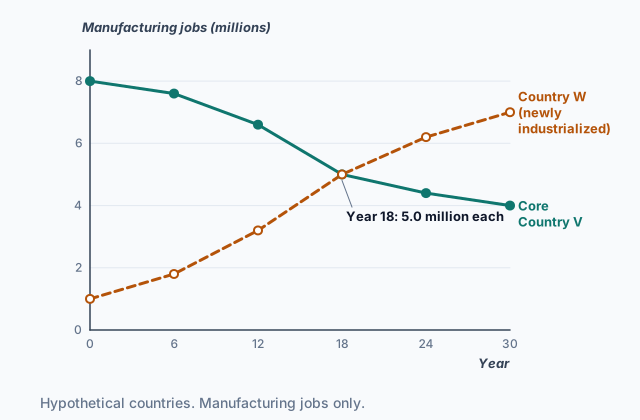
Factory work moved first. A clothing or electronics company in a core country pays high wages, and assembly needs many workers, so it contracts the work to factories where wages are far lower. The countries that gained those factories quickly, shifting from farming and raw materials to manufacturing, are newly industrialized countries.
The chart at the top of the page shows the pattern in two hypothetical countries: manufacturing jobs fall in core Country V and rise in Country W.
For the core, this is economic restructuring: a region's economy shifts from one base to another. Factory jobs decline, which is deindustrialization, while the company keeps its headquarters, design, research and finance at home. So a core region's jobs shift toward services. Restructuring does not mean the economy shrinks; total jobs can hold steady or grow. The workers hit hardest are those whose factory skills no longer have a local buyer.
The two places now depend on each other: the core company's sales depend on factories abroad, and those factory jobs depend on the company's orders. That is the growing interdependence of the world economy.
Quick check · Fill the statement
Complete the description of two hypothetical countries.
A company in core Country J hands its sewing work to a contractor in Country L, where wages are much lower. The company's move is an example of . As its mills close, Country J's textile region goes through , and its jobs shift toward services. Country L, which gained many factory jobs within a generation, is a .
2b. New zones and a division of labor
Countries outside the core compete for these factories, and many build new manufacturing zones with their own rules:
- A special economic zone is a district where the government sets looser economic rules than in the rest of the country, such as lower taxes and fewer limits on foreign ownership, to draw foreign investment.
- A free-trade zone is an area where goods can be brought in, stored, handled and shipped out again without paying the country's import duties.
- An export-processing zone is an area of factories that bring in parts and materials free of duties and turn them into goods sold abroad.
A free-trade zone is not a free trade agreement, which is a deal between whole countries to cut tariffs. The zone labels overlap, and one zone can be more than one kind. All three cut a company's costs of making and shipping goods.
The work on one product is now split among countries. Research, design, marketing and finance stay mostly in core countries, where the skilled, well-paid workers and the headquarters are. Routine assembly goes to factories in developing countries, often in these zones, where wages are low. This is the international division of labor: the lower-paying jobs on a product sit in developing countries, and the higher-paying jobs on the same product stay in the core.
Quick check · Sort it
A hypothetical phone company is headquartered in core Country H and has a factory in an export-processing zone in Country N. Under the international division of labor, where is each task most likely done? Tap a card, then a place.
Core Country H
Country N's export-processing zone
2c. New ways of making things
For much of the twentieth century, big factories followed Fordism: one standard product made in huge runs on a fixed assembly line, each worker repeating one narrow task, with warehouses holding months of parts.
Post-Fordist production is flexible. Factories make smaller batches of many models and switch as demand changes, workers handle several tasks, and companies contract pieces of the work to specialist firms, nearby or abroad. A key post-Fordist method is just-in-time delivery: suppliers send parts so they arrive shortly before they are used, so little money sits in stored stock. Just-in-time delivery needs reliable suppliers, and many settle close to the plants they serve.
Two older ideas still shape where firms go. Economies of scale are the savings a firm gets as it grows: a bigger plant spreads the cost of its machines and buildings over more units, so each unit costs less. Agglomeration is the clustering of firms in one place, where they share skilled workers, suppliers, roads and ideas, and each firm's costs fall.
Quick check · Sort it
Each card describes how a hypothetical factory works. Tap a card, then the kind of production it shows.
Fordist
Post-Fordist
2d. Multipliers, services, high technology and growth poles
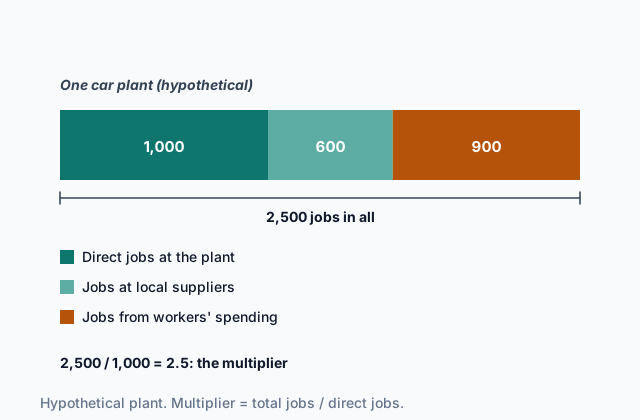
Jobs create other jobs. A new plant buys parts and services from local suppliers, and its workers spend their pay in local shops. That spread of jobs and spending from one new activity is the multiplier effect. It runs in reverse too: a closed plant takes supplier and shop jobs with it.
In this lesson, a multiplier of 2.5 means each direct job supports 2.5 jobs in all, the direct job included. So total jobs = direct jobs × multiplier.
 Tap to open the picture full size
In core regions, the service sector (finance, health care, education, retail, tourism, business services) has grown as factory jobs fell. High technology industries such as software, chips and biotechnology have grown too. They cluster near universities and research labs, where skilled workers, research and other tech firms are close by, an agglomeration that is hard to move abroad.
Governments use these ideas on purpose. A growth pole is a place where government or firms concentrate investment in a fast-growing industry, such as a new plant or a research park, so that its growth spreads through multiplier effects to the region around it.
Quick check · Calculate
A hypothetical chip company opens a plant in City D with 1,400 direct jobs. The region's employment multiplier is 3: each direct job supports 3 jobs in all, the direct job included. How many jobs in all does the plant support in the region?
Part 3 Watch it done How many jobs leave with the factory?
Watch each step, then do the last one yourself.
Hypothetical Millford, a town in core Country H, loses its appliance factory and its 1,500 jobs when the company moves assembly to an export-processing zone abroad. Planners use an employment multiplier of 2.4 for the town: each factory job supports 2.4 jobs in all, the factory job included. How many jobs does Millford lose outside the factory?
Predict first
Before the steps, where do you expect Millford to lose more jobs?
Step 1 · Write the multiplier rule
Total jobs = direct jobs × multiplier. The direct jobs are the 1,500 at the factory.
Step 2 · Work out the total
1,500 × 2.4 = 3,600 jobs lost in all, inside the factory and around it.
Why this step?
Why does a diner across town lose jobs when only the factory moved?
The factory bought parts and services from local firms, and its workers spent their pay in town. When the orders and paychecks stop, those businesses lose sales and cut staff. That is the multiplier effect running in reverse.
Your step · Calculate
Finish it. Of the 3,600 jobs Millford loses in all, how many are outside the factory?
jobs
Part 4 Try it Build a phone, around the world
Try it · Match
A hypothetical phone company, headquartered in core Country H, compares what Country N offers before it builds there. Match each term to the arrangement it describes.
Try it · Decide and justify
The same company will build a new plant to assemble phones that it sells around the world. Under the international division of labor, where is the plant most likely to go?
Which reason supports your answer?
Part 5 Explain it Explain a factory's move
Nothing you type leaves this page. Check your answer against the model and each scoring point.
Free response is 50% of the exam score. This one is shaped like Question 1, from free-response II.
Free-response practice · Question 1 style
A company headquartered in a city in a hypothetical core country closes its appliance factory there and moves its assembly to an export-processing zone in a hypothetical newly industrialized country. The company's design, marketing and finance offices stay in the core city. The core city's region also has a cluster of software and chip-design firms near a research university.
(A) Identify one reason the company moved its assembly to the newly industrialized country.
(B) Describe the effect of the move on manufacturing jobs in the core city.
(C) Explain how the multiplier effect spreads job losses beyond the factory in the core city.
(D) Describe one feature of an export-processing zone.
(E) Explain how the company's choice of where to put each kind of work shows the international division of labor.
(F) Explain how the growth of the service sector can change the core city's economy after the factory closes.
(G) Explain one reason the region's software and chip-design firms stay clustered there instead of moving abroad.
Model answer
(A) Assembly needs many workers, and wages in the newly industrialized country are much lower.
(B) Manufacturing jobs in the core city fall. The factory's assembly jobs leave the city, part of the deindustrialization of the core.
(C) The factory bought parts and services from local suppliers, and its workers spent their pay at local stores and restaurants. When the factory closes, those businesses lose sales and cut jobs, so the city loses more jobs than the factory employed.
(D) An export-processing zone lets factories bring in parts and materials without paying import duties, as long as the finished goods are sold abroad.
(E) The routine, lower-paying assembly work goes to the developing country, while the higher-paying design, marketing and finance work stays in the core. Splitting one product's work among countries by skill and pay is the international division of labor.
(F) As factory jobs fall, jobs in finance, health care, education and business services grow, so the city's economy restructures toward services. Total jobs can hold steady, but many former factory workers need new training to get them.
(G) High technology firms gain from agglomeration: they share skilled workers, universities, research labs and suppliers in one region, and moving abroad would cut them off from those advantages.
Score your own answer. This is a self-check, not a grade. Tick each point your answer makes.
Part 6 Check yourself Harbor City and Port Lin
The case questions use the table. The others mix the ideas from the whole lesson.
Hypothetical Harbor City, in core Country H, and hypothetical Port Lin, a port city in Country N with an export-processing zone, report their jobs in two sectors twenty years apart.
| Place | Sector | Year 1 | Year 21 |
|---|---|---|---|
| Harbor City | Manufacturing | 160 | 40 |
| Harbor City | Services | 240 | 360 |
| Port Lin | Manufacturing | 20 | 140 |
| Port Lin | Services | 30 | 90 |
Case question 1 · Multiple choice
Which statement best describes what the table shows about the two places?
Case question 2 · Calculate
In Year 21, what percentage of Harbor City's jobs in the two sectors shown were in manufacturing?
Case question 3 · Multiple choice
A news story notices that Harbor City lost 120 thousand factory jobs while Port Lin gained 120 thousand, and says the table proves Harbor City's factory jobs moved to Port Lin. Which is a limitation of the table for supporting that claim?
The rest stand on their own and do not use the case.
Check yourself · Spot the error
A student explains why a hypothetical phone company moved its assembly to Country N. Which line is the first to go wrong?
Check yourself · Select all
Hypothetical Country R's government builds a chip plant and a research university in City G, a slow-growing city, hoping to make it a growth pole. Which two outcomes would show the plan is working? Select two.
Select 2 answers, then check.
Part 7 Keep it Bring back earlier ideas
This lesson stands on trade from Topic 7.6, and its zone factories bring back women's work from Topic 7.4.
Bring it back · Multiple choice
Hypothetical Country A can make both cloth and wine at lower cost than hypothetical Country B, but its cost advantage is much larger in cloth. What does the principle of comparative advantage predict?
Bring it back · Fill the statement
Complete the description of women's work in a hypothetical country.
In hypothetical Country M, many more women work for wages than a generation ago, many of them on assembly lines in its export-processing zones. That shift shows that women's roles as a country develops economically. Yet the women still earn less than men in similar jobs and are seldom promoted, so their larger place in the workforce has not brought in wages or opportunities.
In three lines
- Deindustrialization is a fall in one sector, so check the other sectors and the total before you call a place declining.
- An export-processing zone's goods are sold abroad, and the international division of labor sends routine, lower-paying work there.
- Total jobs = direct jobs × multiplier, and for the jobs beyond the direct ones, subtract the direct jobs.
Exam strategy for this topic
- Section I, Multiple Choice: 60 questions in 60 minutes.
- Section II, Free Response: 3 questions in 75 minutes.
When a question asks about the effects of outsourcing, name a place and a direction for each effect: jobs fall in the core region, jobs grow in the newly industrialized country. When it gives job data, add up every sector before you call a change a decline.
Questions students ask
Is outsourcing the same as offshoring?
Not quite. Outsourcing is handing work to another firm, at home or abroad. Offshoring is moving work to another country, whether to another firm or to the company's own factory there. Much of the work that left core regions was both.
What is the difference between the three kinds of zones?
A special economic zone is defined by its looser rules for investment. A free-trade zone is defined by goods moving in and out free of import duties. An export-processing zone is defined by factories turning duty-free parts into goods sold abroad. The labels overlap, and one zone can be more than one kind.
Does deindustrialization mean a city is declining?
Not always. Factory jobs fall, but service and high technology jobs can grow enough to keep the total steady or raise it. Workers whose skills fit the old factories are often the ones left behind.
How do I use a multiplier in a calculation?
In this lesson, total jobs = direct jobs × multiplier, and the total includes the direct jobs. For the jobs beyond the direct ones, subtract the direct jobs from the total.
Are the countries, cities and companies in this lesson real?
No. Every country, city, plant and company here is hypothetical, with numbers chosen to show each idea clearly.
Course alignment, for teachers
AP Human Geography topic 7.7, Unit 7: Industrial and Economic Development Patterns and Processes.
- Skill 4.F: Explain possible limitations of visual sources provided.
This lesson maps all 3 essential knowledge statements of the topic to the part that teaches each one: 3 are checked by a scored question. The map is in the lesson file.