Unit 1 · Topic 1.3 · about 30 minutes · 7 parts · 12 scored checks, 2 of them multiple choice, plus 2 from earlier lessons
AP Macroeconomics 1.3: Comparative Advantage and Gains from Trade
Unit 1: 5 to 10% of the multiple-choice section
What you'll be able to do
- Define absolute advantage and comparative advantage, and determine who has each using data from PPCs or tables.
- Explain how specializing by comparative advantage and trading at suitable terms of trade lead to gains from trade, and calculate terms of trade that benefit both sides, using data from PPCs or tables.
Key vocabulary
| Term | What it means | The exam trap |
|---|---|---|
| Absolute advantage | Being able to produce more of a good or service than any other producer with the same quantity of resources. | In an input table of hours per unit the smaller number has the absolute advantage, so reading the hours like output gives the answer backwards. |
| Comparative advantage | Being able to produce a good or service at a lower opportunity cost than another producer. | Comparative advantage goes to the producer that gives up less per unit, not the one that makes more, so a producer that is faster at both goods still has it in only one. |
| Specialization | Concentrating production on the good a producer makes at the lower opportunity cost and trading for the rest. | Specializing means each producer makes the good it has the comparative advantage in, even when the other producer has the absolute advantage in that good. |
| Terms of trade | The rate at which one good is exchanged for another, such as 2 units of clothing for 1 unit of food. | Terms that help both sides must lie strictly between the two producers' opportunity costs of the same good, so convert an offer like 10 food for 25 clothing into 2.5 clothing per food before comparing. |
| Gains from trade | The extra goods each side can consume after specializing and trading, beyond what its own PPC allows. | Gains show up in consumption, not production: each side still produces on its own PPC, and trade lets it consume at a point beyond that curve. |
 Tap to open the picture full size
Part 1 Think first Two roommates, two chores
Guess before you learn. A wrong guess still makes the answer stick.
Predict first
Maya and Jon share an apartment and split two chores, cooking and cleaning. In one hour, Maya can cook 4 meals or clean 4 rooms. In one hour, Jon can cook 1 meal or clean 2 rooms. Maya is faster at both. This weekend each has 4 hours, and 6 rooms must be cleaned. Who should clean the 6 rooms so that the two of them cook the most meals in the time left?
In short. Comparative advantage is the ability to produce a good at a lower opportunity cost than another producer, and specializing by it, then trading, lets both producers end up with more than they could make alone.
- Absolute advantage means producing more of a good than another producer with the same quantity of resources.
- Comparative advantage means producing a good at a lower opportunity cost than another producer.
- Trade helps both sides only at terms of trade that lie between their two opportunity costs.
Part 2 Learn it Four short ideas, each checked as you go
2a. Who makes more: absolute advantage
A producer has an absolute advantage in a good when it can make more of that good than another producer with the same quantity of resources. It compares raw output and nothing else.
Production data comes in two kinds of table, and they read in opposite directions.
- An output table lists how much each producer can make with its resources, say in a day. Greta's Bakery can bake 300 loaves or 100 cakes. Tim's, with the same ovens and staff, can bake 200 loaves or 80 cakes. Here bigger is better, so Greta has the absolute advantage in both goods.
- An input table lists what it takes to make one unit, often in hours. If Ana needs 2 hours to knit a sweater and Ben needs 3, Ana has the absolute advantage in sweaters. Here smaller is better, because fewer hours per sweater means more sweaters from the same hours.
Before you compare anything, read the units, in a table's head or in a description, and decide which kind of data it is.
Quick check · Multiple choice
A worker in Ardel needs 6 hours to make a bicycle and 2 hours to make a tablet. A worker in Bosk needs 9 hours to make a bicycle and 6 hours to make a tablet. The two countries have the same number of workers. Which statement about absolute advantage is correct?
2b. Who gives up less: comparative advantage
A producer has a comparative advantage in a good when it can make that good at a lower opportunity cost than another producer. The question is no longer how much, but what each unit costs in the other good.
With an output table, the opportunity cost of one unit of a good is what you give up divided by what you get. Greta can bake 300 loaves or 100 cakes, so each cake costs her 300 ÷ 100 = 3 loaves. Tim can bake 200 loaves or 80 cakes, so each cake costs him 200 ÷ 80 = 2.5 loaves. Tim gives up less per cake, so Tim has the comparative advantage in cakes, even though Greta bakes more of both.
For loaves, a loaf costs Greta 100 ÷ 300 = 1/3 cake and Tim 80 ÷ 200 = 0.4 cake, so Greta has the comparative advantage in loaves. When two producers' opportunity costs differ, each has the comparative advantage in one good, never both.
With an input table of hours, the opportunity cost of one unit of a good is its own hours divided by the hours for one unit of the other good. Either way, say the cost per unit of which good, measured in the other.
Quick check · Calculate
With the same tools and the same number of workers, Lena's workshop can make either 40 chairs or 10 tables in a week, and Omar's can make either 30 chairs or 15 tables. Each faces a constant opportunity cost. What is Lena's opportunity cost of making one table, measured in chairs?
2c. Specialize, trade, and land beyond the PPC
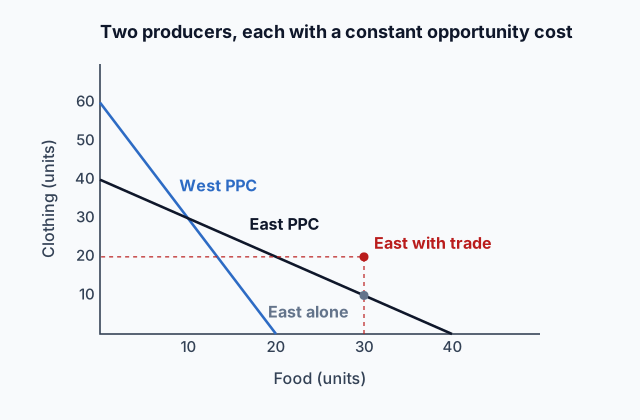
The graph at the top of the page shows two countries with the same resources. East can make 40 units of food or 40 of clothing, so a unit of food costs it 1 unit of clothing. West can make 20 units of food or 60 of clothing, so a unit of food costs it 3. East has the comparative advantage in food and West in clothing.
On its own, a country can only consume what it produces: a point on or inside its own PPC. Now let East make only food (40 units) and West only clothing (60 units), each the good it makes at the lower opportunity cost. East then trades 10 food to West for 20 clothing.
East ends with 30 food and 20 clothing. Alone, 30 food would have left room for only 10 clothing, so East now consumes at a point beyond its own PPC. West ends with 10 food and 40 clothing, where alone it could have had only 30 clothing. Both countries have a combination neither could produce by itself. Specializing by comparative advantage makes more in total, and trade shares the extra out. That extra is the gains from trade.
Quick check · Decide and justify
Pell, a country, can produce 20 tons of fish or 40 tons of rice in a year, at a constant opportunity cost. On its own it chose 10 tons of fish and 20 tons of rice. Then it produced only rice, 40 tons, and traded 16 tons of rice to another country for 10 tons of fish. Pell now has 10 tons of fish and 24 tons of rice. Could Pell have produced this combination on its own?
Which reason supports your choice?
2d. Terms of trade that help both
The terms of trade are the rate at which the two goods swap, such as 2 units of clothing for 1 unit of food. Both sides gain only if that rate lies between their two opportunity costs, written per unit of the same good.
A unit of food costs East 1 unit of clothing and costs West 3. At 2 clothing per food, East gets 2 for a unit that cost it 1 to make, and West pays 2 for a unit that would cost it 3 to make. Both come out ahead.
Move the rate outside that range and one side refuses. At 0.8 clothing per food, East would be paid less than the food cost it to make. At 3.5, West would pay more than making the food itself would cost. At exactly 1 or exactly 3, one side only breaks even.
Offers are not always written per one unit. An offer of 10 food for 25 clothing is 25 ÷ 10 = 2.5 clothing per food, inside the range. Turn every offer into the same unit before you compare it. The procedure never changes: find each side's opportunity cost of the same good, then any rate between the two helps both.
Quick check · Sort it
Kiri gives up 0.5 bushel of pears to grow one bushel of apples. Tova gives up 2.5 bushels of pears to grow one bushel of apples. Kiri specializes in apples, Tova in pears, and Kiri trades apples to Tova for pears. Tap an offer, then tap whether it leaves both of them better off than growing both fruits themselves.
Both are better off
At least one is not better off
Part 3 Watch it done Shoes and jackets, from hours of work
Watch each step, then do the last one yourself.
A worker in Corin needs 2 hours to make a pair of shoes and 4 hours to make a jacket. A worker in Delo needs 3 hours to make a pair of shoes and 9 hours to make a jacket. Each country has the same number of workers. Decide who has each kind of advantage, and find terms of trade for jackets that help both countries.
Step 1 · Read the table the right way
These are hours per unit, so fewer hours means more output from the same workers. Corin needs fewer hours for both goods (2 against 3 for shoes, 4 against 9 for a jacket), so Corin has the absolute advantage in both.
Step 2 · Find the opportunity cost of a pair of shoes
The 2 hours a Corin worker spends on a pair of shoes could have made 2 ÷ 4 = 1/2 of a jacket. The 3 hours a Delo worker spends on shoes could have made 3 ÷ 9 = 1/3 of a jacket.
Why this step?
Why divide the shoe hours by the jacket hours, when an output table divides the other way?
In an input table the hours are what each good costs. The time spent on one pair of shoes, counted in jackets, is the shoe hours divided by the hours one jacket takes. An output table lists quantities instead, so there you divide what is given up by what is gained.
Step 3 · Name the comparative advantages
Delo gives up less to make a pair of shoes (1/3 of a jacket against 1/2), so Delo has the comparative advantage in shoes. That leaves Corin with the comparative advantage in jackets, even though it is faster at both goods. Corin should make jackets and Delo shoes.
Your step · Fill the statement
Finish it. Corin sells jackets to Delo for shoes. Tap a blank, then tap a number.
For both countries to gain, one jacket must trade for more than pairs of shoes and fewer than pairs of shoes.
Part 4 Try it New graphs and numbers, your turn
Alba's production possibilities curve
The most wool Alba can produce in a year for each amount of wheat.
Brin's production possibilities curve
The most wool Brin can produce in a year for each amount of wheat.
Try it · Fill the statement
The two graphs show the production possibilities curves of Alba and Brin, countries with the same quantity of resources, for one year. Each curve is a straight line, so each country faces a constant opportunity cost. Read where each curve meets the axes. Tap a blank, then tap a number or a country.
One ton of wheat costs Alba tons of wool and costs Brin tons of wool, so has the comparative advantage in wool.
Try it · Calculate
Islandia can produce 60 crates of mangoes or 30 crates of coconuts in a month, at a constant opportunity cost. It produces only mangoes, 60 crates, and trades 24 crates of mangoes to another country for 16 crates of coconuts. How many more crates of mangoes does Islandia have after the trade than it could have had on its own while also having 16 crates of coconuts?
Try it · Calculate
Two bakers work the same hours. Mateo needs 2 hours to bake a loaf of bread and 5 hours to bake a cake. Teo needs 1 hour for a loaf and 4 hours for a cake. These are hours per unit, not units per day. How many loaves of bread does one cake cost Mateo?
Part 5 Explain it Answer a short free-response question
Nothing you type leaves this page.
Free response is 33.35% of the exam score. This one is shaped like Question 3, Short.
Free-response practice · Question 3 style
Varn and Zell are countries with the same quantity of resources and constant opportunity costs. In a year, Varn can produce 90 tons of steel or 30 tons of grain, and Zell can produce 40 tons of steel or 40 tons of grain. (a) Calculate Varn's opportunity cost of producing one ton of grain. Show your work. (b) Which country has a comparative advantage in producing steel? Explain. (c) Suppose each country specializes according to comparative advantage. Would terms of trade of 1 ton of grain for 2 tons of steel be mutually beneficial? Explain.
Model answer
(a) Varn gives up 90 tons of steel to produce 30 tons of grain, so one ton of grain costs 90 ÷ 30 = 3 tons of steel. (b) Varn. One ton of steel costs Varn 30 ÷ 90 = 1/3 ton of grain and costs Zell 40 ÷ 40 = 1 ton of grain, so Varn has the lower opportunity cost of steel. (c) Yes. Zell specializes in grain, and one ton of grain costs Zell 1 ton of steel and Varn 3 tons. A price of 2 tons of steel lies between those, so Zell gets more steel for its grain than the grain cost it, and Varn pays less than producing the grain itself would cost.
Score your own answer. This is a self-check, not a grade. Tick each point your answer makes.
Part 6 Check yourself Read the advantage from a table
Every answer here comes from the table, so read it first.
Norra and Sudo are fictional countries with the same quantity of resources. The table shows the most of each good a country can produce in a year if all of its resources go into that good. Each country faces a constant opportunity cost.
| Country | Phones | Laptops |
|---|---|---|
| Norra | 120 | 40 |
| Sudo | 60 | 30 |
Case question 1 · Calculate
What is Sudo's opportunity cost of producing one phone, measured in laptops?
Case question 2 · Multiple choice
Which statement about Norra and Sudo is correct?
The rest stand on their own and do not use the case.
Check yourself · Match
Ivo and Uma make kites with the same tools and materials. Each line describes a different week. Tap a description, then tap who has the absolute advantage in kites that week.
Check yourself · Spot the error
With the same resources, Jada can bake 15 pies or 5 cakes in a day, and Rui can bake 8 pies or 2 cakes, each at a constant opportunity cost. A student worked out terms of trade that help both. Tap the first line that goes wrong.
Part 7 Keep it Keep it
Marlow, a fictional country, makes only laptops and rice. With all of its resources fully and efficiently employed, it can produce any of these combinations:
| Point | Laptops (thousands) | Rice (thousand tons) |
|---|---|---|
| V | 0 | 60 |
| W | 5 | 56 |
| X | 10 | 48 |
| Y | 15 | 33 |
| Z | 20 | 0 |
From 1.2 Opportunity Cost and the Production Possibilities Curve (PPC) · Calculate
Using Marlow's production possibilities, what is the opportunity cost of each additional thousand laptops when Marlow moves from point X to point Y, in thousand tons of rice?
Dana opened Juniper Bikes, a bike repair shop, with her own savings and a $12,000 bank loan, which bought the repair stands. In March, every repair stand was in use during every hour the shop was open. The shop kept these records:
| Item | March |
|---|---|
| Hours worked by the shop's two mechanics | 320 hours |
| Repair stands with tool sets | 4 |
| Shop space rented on Main Street | 900 square feet |
| Bank loan Dana used to buy the stands | $12,000 |
| Repairs customers asked for | 260 |
| Repairs the shop finished | 200 |
From 1.1 Scarcity · Fill the statement
Tap a blank, then tap a word or number.
In March, customers asked Juniper Bikes for more repairs than the shop finished. The mechanics' hours and the repair stands were , so Dana had to which repairs the shop took on.
In three lines
- Absolute advantage compares how much each producer makes with the same resources.
- Comparative advantage goes to the lower opportunity cost, per unit of the same good.
- Specialize by comparative advantage and trade at a price between the two costs, and both gain.
Exam strategy for this topic
- Section I, Multiple Choice: 60 questions in 70 minutes.
- Section II, Free Response: 3 questions in 60 minutes.
- This lesson's Explain it is shaped like free-response question 3, Short.
- A four-function calculator is allowed on both sections of the exam.
Write every opportunity cost with its units and the division that produced it, such as 90 divided by 30 = 3 tons of steel per ton of grain. For terms of trade, put both producers' costs in terms of the same good first, then say whether the offered rate lies between them.
Questions students ask
Can one country have the comparative advantage in both goods?
No, not when the two producers' opportunity costs differ. If a good costs one producer less, the other good costs it more, so each has the comparative advantage in one good. Absolute advantage in both goods is possible.
How do I find opportunity cost from a table of hours?
Divide the good's own hours by the hours for one unit of the other good. If a worker needs 2 hours for a pair of shoes and 4 hours for a jacket, a pair of shoes costs 2 divided by 4, which is 1/2 of a jacket.
Why would the faster producer ever leave a job to the slower one?
Because time spent on one good is time not spent on the other. Maya can cook 4 meals or clean 4 rooms in an hour, and Jon can cook 1 meal or clean 2 rooms, so each room costs Maya a whole meal but costs Jon only half a meal. Letting Jon clean leaves more meals for both of them.
How do I tell whether terms of trade help both sides?
Find each side's opportunity cost of the same good. Any rate strictly between those two costs helps both, and at exactly one of them that side only breaks even. If food costs one country 1 unit of clothing and the other 3, a rate of 2 clothing per food works.
What does it mean to consume beyond the PPC?
Each country still produces on its own curve, but after trading it holds a combination it could not make alone. East specializes in food, trades 10 food for 20 clothing, and ends with 30 food and 20 clothing; on its own, 30 food left room for only 10 clothing.
Course alignment, for teachers
AP Macroeconomics topic 1.3, Unit 1: Basic Economic Concepts.
- Skill 1.C: Identify an economic concept, principle, or model using quantitative data or calculations.
This lesson maps all 4 essential knowledge statements of the topic to the part that teaches each one: 4 are checked by a scored question. The map is in the lesson file.