Unit 2 · Topic 2.1 · about 30 minutes · 7 parts · 10 scored checks, 1 of them multiple choice, plus 2 from earlier lessons
AP Macroeconomics 2.1: The Circular Flow and GDP
Unit 2: 12 to 17% of the multiple-choice section
What you'll be able to do
- Describe how GDP is measured and what its components are, using the circular flow diagram where it helps, and calculate nominal GDP.
Key vocabulary
| Term | What it means | The exam trap |
|---|---|---|
| Gross domestic product (GDP) | The market value of all final goods and services produced in a country in a given period, usually a year. | Shares of stock, a used car and a Social Security check all change hands for dollars, but none of them adds to this year's GDP, because none pays for a good or service produced this year. |
| Final output | Goods and services bought by the users who keep them, rather than used up in making something else for sale. | Business purchases can still be final: a bakery's new delivery van counts as investment, while the steel a carmaker turns into cars is intermediate and already inside the price of the cars. |
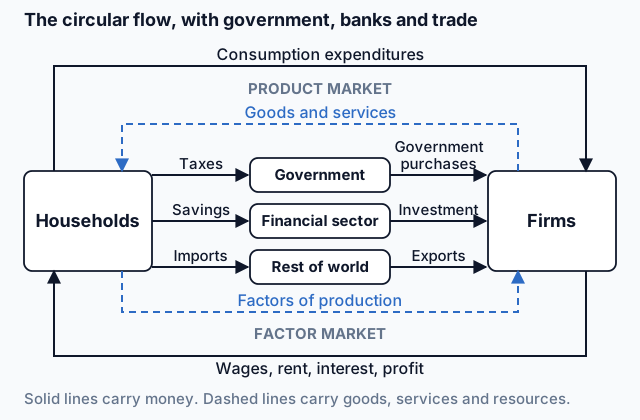
| Circular flow diagram | A model in which money flows from households to firms as spending and back to households as income, while goods, services and resources flow the opposite way. | Money and real things travel the loop in opposite directions, so in the factor market it is firms that pay households wages, rent, interest and profit for land, labor and capital. |
| Expenditures approach | Measuring GDP by adding consumption, investment, government purchases and net exports: C + I + G + (X − M). | Imports are subtracted, not added, because spending on goods made abroad is already inside C, I and G, so a table with more imports than exports gives negative net exports. |
| Income approach | Measuring GDP by adding the incomes earned producing the output: wages, rent, interest and profit. | Transfer payments such as pensions, and payments between firms for parts, are not income earned producing output, so adding them to wages, rent, interest and profit overstates GDP. |
| Value-added approach | Measuring GDP by adding, for every producer, its sales minus what it paid other firms for materials. | Each firm subtracts only what it paid other firms for materials, never its own wages or profit, and it subtracts the price of what it actually bought, such as the lumber, not the logs inside it. |
| Nominal GDP | GDP valued at the prices of the year in which the output was produced. | When a question gives one year's quantities and prices, nominal GDP is each final good's quantity times that same year's price, with intermediate goods such as yarn left out. |
 Tap to open the picture full size
Part 1 Think first One jar, three sales
Guess before you learn. A wrong guess still makes the answer stick.
Predict first
This year a farm sells $300 of tomatoes to a salsa company. The company turns them into jars of salsa and sells the jars to grocery stores for $1,000. The stores sell those jars to shoppers for $1,600. By how much do these sales add to the country's output for the year?
In short. Gross domestic product (GDP) is the market value of all the final goods and services produced in a country in a given period, usually a year.
- In the circular flow, money spent on goods and services comes back as income to the households that supplied the resources, so total spending on final output equals total income.
- GDP can be measured three ways: by adding spending on final output, by adding the incomes earned producing it, or by adding the value each producer adds.
- Nominal GDP values each year's output at the prices it sold for that year.
Part 2 Learn it Four short ideas, each checked as you go
2a. Final output only
Gross domestic product (GDP) is the market value of all final goods and services produced in a country in a given year. Each part of that sentence keeps something out.
Final means bought by the user who keeps it. Engines a boat builder buys are an intermediate good: their value is already inside the price of the boats, so counting both would count the engines twice. A pizza oven a restaurant buys is final, even though a business bought it, because the restaurant keeps and uses it. Spending by firms on new capital like that is investment.
Produced in that year keeps out used goods. A secondhand piano was counted in the year it was built.
Goods and services keeps out payments that buy neither. Stocks and bonds are claims on money, not output. A Social Security check is a transfer payment: the government pays it without buying anything in return.
Goods made this year and not yet sold still count. They sit in the firm's inventory, and GDP counts them as investment.
Quick check · Sort it
Each of these happens in 2026. Tap a transaction, then tap where it belongs.
Counted in 2026 GDP
Not counted in 2026 GDP
2b. Spending comes back as income
The circular flow diagram shows why GDP can be counted as spending or as income. Start with two groups. Households own the economy's resources: land, labor and capital. Firms use those resources to make goods and services.
They meet in two markets. In the factor market, households sell the use of their land, labor and capital to firms, and firms pay them wages, rent, interest and profit. (Profit goes to the households that own the firms.) In the product market, households spend that income on the goods and services firms make.
Follow the money and it runs in a loop: firms pay households, then households pay firms. Goods, services and resources travel the same loop the opposite way.
That loop is the reason the diagram matters. Every dollar spent on a final good ends up as somebody's wages, rent, interest or profit, so a year's total spending on final output equals that year's total income.
Quick check · Fill the statement
Tap a blank, then tap a phrase.
In the factor market, households sell to firms and are paid . They spend that money on goods and services, which is why a year's total spending on final output equals its total . Money and goods travel the loop in directions.
2c. Government, banks and other countries
The full diagram adds three more sectors. Each one takes money out of the household loop and has a way to send money back to firms.
Government. Households and firms pay taxes to government, and government spends on goods and services such as roads and fire trucks. That spending is government purchases.
The financial sector. Households rarely spend all their income. What they keep is savings, held in banks and other financial firms. Those firms lend it to businesses that buy new capital, such as machines and buildings. That spending is investment.
The rest of the world. Households spend some of their income on goods made abroad. Those are imports, and that money goes to foreign firms, not domestic ones. Buyers in other countries spend on goods made here. Those are exports, and that money comes in to domestic firms.
Quick check · Match
Tap a flow in the circular flow diagram, then tap what it is.
2d. Three ways to add up GDP
Spending, income and production are one flow seen from three sides, so there are three ways to measure GDP. Done right, they give the same total.
The expenditures approach adds spending on final goods and services by the four groups in the diagram:
GDP = C + I + G + (X − M)
C is consumption by households, I is investment by firms, G is government purchases, and X − M is net exports, exports minus imports. Imports are subtracted because C, I and G already include spending on goods made abroad, and those are not this country's output.
The income approach adds the incomes earned producing that output: wages, rent, interest and profit. (Official accounts also make a few adjustments, such as for equipment wearing out, which these lessons leave out.)
The value-added approach adds what each producer adds: its sales minus what it paid other firms for materials. Summed over every stage, that gives the final price with nothing counted twice.
Added up at the prices of the year itself, the total is nominal GDP.
Quick check · Calculate
In 2026 the firms of Thornvale, a small country, paid $620 million in wages, $45 million in rent, $70 million in interest and $165 million in profit to the households that own them. Firms also paid one another $350 million for parts and materials, and the government paid retirees $90 million in pensions. Using the income approach, what was Thornvale's GDP in 2026, in millions of dollars?
Part 3 Watch it done One economy, three measurements
Watch each step, then do the last one yourself.
An island has three businesses. This year a cotton farm sells all its cotton to a T-shirt maker for $400, and a dye works sells all its dye to the same T-shirt maker for $100. The T-shirt maker sells all its shirts to households for $1,000. The farm and the dye works buy nothing from other firms. The farm pays $300 in wages and keeps $100 as profit; the dye works pays $70 in wages and keeps $30 as profit. The T-shirt maker pays $380 in wages, $50 in rent and $20 in interest, and keeps $50 as profit. There is no government and no trade. Measure the island's GDP all three ways, starting with value added.
Step 1 · The value-added rule
Each business adds its sales minus what it paid other firms for materials. Its own wages, rent, interest and profit are not subtracted.
Why this step?
Why are a business's wages, rent, interest and profit not subtracted from its sales?
They pay households for the labor, land and capital the business itself used. That is the value the business creates. Only materials bought from other firms were produced somewhere else, so only those come out.
Step 2 · The farm and the dye works
Neither one bought anything from another firm, so each adds its full sales: the farm adds $400 and the dye works adds $100. The T-shirt maker's turn is yours.
Your step · Calculate
Finish the value-added approach. The T-shirt maker buys $400 of cotton from a farm and $100 of dye from a dye works, and it sells its shirts to households for $1,000. How much value does the T-shirt maker add, in dollars?
dollars
Value added comes to $400 + $100 + $500 = $1,000. Now check it the other two ways.
Expenditures. Only one sale goes to a final user: households pay $1,000 for shirts. Nobody invests, and there is no government and no trade, so GDP = C = $1,000. The cotton and the dye are not added on top, because they are intermediate goods already inside that $1,000.
Income. The farm pays $300 + $100, the dye works $70 + $30, and the T-shirt maker $380 + $50 + $20 + $50. Those add to $1,000 as well.
All three give the same GDP, because each counts the same year's output from a different side of the circular flow.
Part 4 Try it Work it backward
The expenditures formula runs in both directions. If you know GDP and all but one of its parts, the missing part is whatever makes the total come out. Watch the sign of net exports when imports are bigger than exports.
Try it · Calculate
In 2026 the country of Ulvik had a GDP of $2,400 billion. Consumption was $1,620 billion, government purchases were $480 billion, exports were $210 billion and imports were $290 billion. Using the expenditures approach, how much was investment in 2026, in billions of dollars?
Part 5 Explain it Write it the way the exam asks
Nothing you type leaves this page.
Free response is 33.35% of the exam score. This one is shaped like Question 2, Short.
Free-response practice · Question 2 style
In 2026 the country of Tallis produced 2,000 sweaters, sold at $45 each, and 5,000 haircuts, sold at $20 each. Its yarn mills also sold 4,000 skeins of yarn, at $6 each, to the sweater makers. Nothing else was produced. (a) Calculate Tallis's nominal GDP in 2026. Show your work. (b) A Tallis family sells its six-year-old car to a neighbor for $6,000 in 2026. Will Tallis's 2026 GDP increase, decrease, or stay the same as a result? Explain. (c) Suppose the sweater makers had also produced 300 more sweaters in 2026 that were still unsold at the end of the year. Calculate how much larger Tallis's 2026 nominal GDP would be. Show your work. (d) Using your answer to part (a), identify the total income households in Tallis earned in 2026 as wages, rent, interest and profit.
Model answer
(a) Only final goods and services count, and the yarn is an intermediate good inside the price of the sweaters. Nominal GDP = (2,000 × $45) + (5,000 × $20) = $90,000 + $100,000 = $190,000. (b) GDP stays the same. The car was produced in an earlier year, so selling it again is not new production in 2026. (c) 300 × $45 = $13,500 larger. (d) $190,000, because every dollar spent on final output is paid out as wages, rent, interest or profit.
Score your own answer. This is a self-check, not a grade. Tick each point your answer makes.
Part 6 Check yourself Measure a real economy
Read the table first, then answer both questions from it.
These are United States figures for the year 2025, in billions of current dollars, from the U.S. Bureau of Economic Analysis as published on FRED by the Federal Reserve Bank of St. Louis (data updated September 30, 2026; annual series PCECA, GPDIA, GCEA, EXPGSA and IMPGSA; transfer receipts are the 2025 annual average of the monthly series PCTR). Each is rounded to the nearest billion.
| Item | Amount |
|---|---|
| Personal consumption expenditures | 20,870 |
| Gross private domestic investment | 5,557 |
| Government consumption expenditures and gross investment | 5,355 |
| Personal current transfer receipts (such as Social Security and unemployment benefits) | 4,914 |
| Exports of goods and services | 3,341 |
| Imports of goods and services | 4,262 |
Case question 1 · Calculate
Using the expenditures approach and the table of United States figures for 2025, what was U.S. GDP in 2025, in billions of dollars?
Case question 2 · Multiple choice
In the table of United States figures for 2025, why is the $4,262 billion of imports subtracted when GDP is found by the expenditures approach?
The rest stand on their own and do not use the case.
Check yourself · Decide and justify
A furniture company makes 800 sofas in 2026. By December 31 it has sold 650 of them, and 150 are still in its warehouse. Do the 150 unsold sofas count in 2026 GDP?
Which reason supports your choice?
Check yourself · Spot the error
A logging company, which buys no inputs from other firms, sells $150 of logs to a sawmill. The sawmill sells the lumber it cuts to a cabinet maker for $400, and the cabinet maker sells a finished cabinet to a family for $1,000. A student used the value-added approach. Tap the first line that goes wrong.
Part 7 Keep it Keep it
From 1.1 Scarcity · Sort it
Tap a resource, then tap the kind of economic resource it is.
Land
Labor
Capital
From 1.6 Market Equilibrium, Disequilibrium, and Changes in Equilibrium · Match
Weekly car washes in one town. Tap a price, then tap what the market has at that price.
In three lines
- GDP is the market value of the final goods and services a country produces in a year.
- In the circular flow, spending on final output comes back as income, so the two totals match.
- Expenditures, income and value added are three ways to measure the same GDP.
Exam strategy for this topic
- Section I, Multiple Choice: 60 questions in 70 minutes.
- Section II, Free Response: 3 questions in 60 minutes.
- This lesson's Explain it is shaped like free-response question 2, Short.
- A four-function calculator is allowed on both sections of the exam.
Before you add anything, cross out every item that is not a final good or service made this year: intermediate goods, transfer payments, stocks and used goods. Then write out the multiplication and addition that get you to the total.
Questions students ask
Why do the three ways of measuring GDP give the same number?
They count one flow from three sides. Every dollar spent on a final good ends up as somebody's wages, rent, interest or profit, and the value each producer adds sums to the final price. Official accounts make a few adjustments, such as for equipment wearing out, but the idea holds.
Do goods made this year but not yet sold count in this year's GDP?
Yes. GDP measures production, so unsold goods count in the year they are made, entered as investment in the firm's inventories.
If a business buys something, is it always an intermediate good?
No. A pizza oven a restaurant keeps and uses is final output, counted as investment. Engines a boat builder puts into its boats are intermediate, because their value is already inside the price of the boats.
Why are Social Security checks left out of GDP?
They are transfer payments, so the government gets no good or service in return. When retirees spend the money, that spending shows up in consumption.
How do I find investment if I know GDP and the other parts?
Find net exports first and keep the sign, then solve C + I + G + (X − M) for I. If GDP is $1,500 billion, C is $1,000 billion, G is $300 billion, exports are $150 billion and imports are $200 billion, net exports are negative $50 billion, so I = $1,500 − $1,000 − $300 + $50 = $250 billion.
Course alignment, for teachers
AP Macroeconomics topic 2.1, Unit 2: Economic Indicators and the Business Cycle.
- Skill 1.A: Describe economic concepts, principles, or models.
This lesson maps all 3 essential knowledge statements of the topic to the part that teaches each one: 3 are checked by a scored question. The map is in the lesson file.