Unit 2 · Topic 2.2 · about 30 minutes · 7 parts · 10 scored checks, 2 of them multiple choice, plus 2 from earlier lessons
AP Macroeconomics 2.2: Limitations of GDP
Unit 2: 12 to 17% of the multiple-choice section
What you'll be able to do
- Describe the limitations of GDP, the production it leaves out and what it cannot show.
Key vocabulary
| Term | What it means | The exam trap |
|---|---|---|
| Gross domestic product (GDP) | A measure of the final output of the economy: the market value of the final goods and services produced in a country in a year. | Rebuilding after a hurricane adds to GDP while the homes the storm destroyed are never subtracted, so a rise in GDP is not proof that people are better off. |
| Nonmarket transactions | Productive work that is never bought or sold, such as unpaid household work and volunteering, so GDP does not count it. | Switching from a paid yard service to doing the same yard work yourself makes measured GDP fall, so the answer that GDP stays the same because the work still gets done is wrong. |
| Underground economy | Market sales that are hidden from official records, such as unreported cash work or illegal sales, so GDP misses them. | Unreported cash jobs are market transactions, not nonmarket ones, so a roofer paid off the books belongs to the underground economy rather than with unpaid household work. |
| Per capita GDP | GDP divided by the population, the output per person used to compare the average standard of living. | Total GDP can rise while per capita GDP falls, so when the population grows faster than output, the average standard of living fell by this measure. |
 Tap to open the picture full size
Part 1 Think first Same care, different count
Guess before you learn. A wrong guess still makes the answer stick.
Predict first
Two families on the same street each need a toddler looked after on weekdays. The Adeyemis pay a licensed daycare $1,100 a month. In the Brennan house, a grandmother gives the same care at home for free. When the government adds up this year's GDP, whose child care is included?
In short. GDP is a useful measure of how much a nation produces, but it has limits: it misses some production and says little about how well people live.
- Some real production never reaches the count, either because it is never sold or because its sale is hidden.
- The average person's standard of living is judged by GDP per person, not by total GDP.
- GDP leaves out other things people value, such as free time, a clean environment and how output is shared.
Part 2 Learn it Four short ideas, each checked as you go
2a. Work no one pays for
GDP adds up the market value of the final goods and services a country produces in a year. The word that matters here is market. GDP counts what is bought and sold, because a sale leaves a price and a record that can be added up.
A lot of useful work is never sold. A parent cooks dinner, a teenager mows the family lawn, a neighbor drives a friend to the doctor, a volunteer coaches Saturday soccer. Each one produces a real service, and each would show up in GDP if someone were paid to do it. Done for free, it is a nonmarket transaction, and GDP leaves it out.
That makes GDP move in odd ways. When a family stops paying for a service and does the work itself, measured GDP falls, even though just as much work gets done. When a family starts paying for something it used to do itself, GDP rises with no extra work at all.
So GDP undercounts what a country really produces, and it undercounts most where people do a lot for themselves and for each other.
Quick check · Decide and justify
The Alvarez family paid a landscaping company $300 a month to keep up their yard. This year they cancel the service and do the same yard work themselves, and the yard looks exactly as it did. A student says measured GDP does not change, because the same work still gets done. Is the student right?
Which reason supports your choice?
2b. Sales no one reports
The underground economy is a second gap, and a different kind. Here something really is sold. A house painter takes cash and never reports the job. A restaurant pays a dishwasher off the books. Someone sells a product that is illegal to sell. Each is a market transaction, with a buyer, a seller and a price, but no record reaches the people who add up GDP, so it goes uncounted.
Keep the two gaps apart:
- Nonmarket work is never sold at all. A grandmother's child care has no price.
- Underground activity is sold, but hidden. The painter's job had a price; nobody reported it.
Both make GDP smaller than what a country really produces, and both can change how GDP moves. If a crackdown gets cash workers to report their pay, measured GDP rises even when no more painting gets done.
Some things GDP skips on purpose, and those are not limitations. Buying shares of stock or a used car adds nothing to this year's production, so GDP is right to leave them out.
Quick check · Multiple choice
Which of the following is included when a country measures its GDP?
2c. More output, or more for each person?
Even counted perfectly, total GDP answers a narrow question: how much did the whole country produce? A country with more people will usually produce more, so total GDP says little about how much each person has.
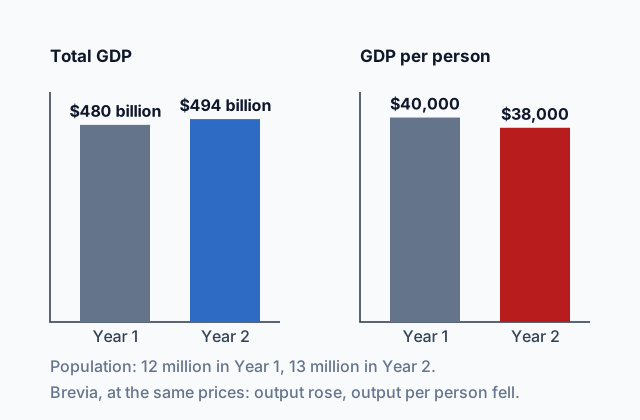
That is why the standard of living of the average person is judged by per capita GDP, which is GDP divided by the population. In the diagram, Brevia's GDP rises from $480 billion to $494 billion, about 3 percent. Its population rises from 12 million to 13 million, about 8 percent. GDP per person goes from $480 billion ÷ 12 million = $40,000 to $494 billion ÷ 13 million = $38,000. Output grew, and the average person's share of it shrank.
Two habits keep this right. When the question is about living standards, compare per capita GDP, never the totals. And make sure both years' GDP is measured at the same prices. If prices rose, GDP can climb with no more goods at all; 2.6 shows how to take prices out, which gives real GDP.
Quick check · Fill the statement
Tap a blank, then tap a phrase.
In Bexley last year, GDP measured at the same prices both years rose 2 percent and the population rose 5 percent. The number to judge the average standard of living by is , which last year, so by that measure the average person was .
2d. What else GDP cannot see, and why we still use it
Per capita GDP is still a count of goods and services, and how well people live depends on more than that.
Take free time. If people start retiring at 60 instead of 65, the country produces less and GDP falls. The retirees may well be better off. GDP puts no value on their free afternoons.
Pollution runs the other way. A chemical plant that doubles its output adds all of it to GDP, and the smog over the town next door subtracts nothing.
Per capita GDP is also an average. If the gains go to a few families at the top, the average rises while most families see no change.
Two quieter gaps: a phone that does far more for the same price is not fully counted as more output, and rebuilding after a flood adds to GDP while the homes the flood destroyed are never subtracted.
None of this makes GDP useless. It is measured the same way every quarter, so a change in it fairly shows whether the economy is producing more or less. That makes GDP a useful indicator of a nation's economic performance. For well-being, economists add other measures. The United Nations' Human Development Index, for example, combines national income per person with life expectancy and years of schooling.
Quick check · Match
Tap a situation, then tap what GDP misses in it.
Part 3 Watch it done What GDP sees in one household's week
Watch each step, then do the last one yourself.
In one week the Reyes household has five jobs done. A cleaning service is paid $90 and bills the household. A plumbing company is paid $120 by card. A math tutor is paid $60 in cash and never reports it. The family mows its own lawn (a lawn service would charge $50). A grandparent watches the children for free (a sitter would charge $180). How much of this work does GDP count, and how much does it leave out?
Step 1 · Set the test
Ask two things of each job. Was it sold? And did the sale go on record? GDP counts a job only when both answers are yes. The cleaning service was paid and bills the household, so its $90 is counted.
Why this step?
Why is a payment alone not enough for GDP to count a job?
GDP is added up from records of sales. A job paid for in cash that nobody reports leaves no record, so GDP misses it just as it misses unpaid work.
Step 2 · Value what GDP misses
A job GDP misses still has a value. Price unpaid work at what a business would charge for it, and an unreported sale at what was actually paid. The family's own lawn mowing was never sold, so it is $50 of work GDP misses.
Your step · Calculate
In one week the Reyes household has five jobs done. A cleaning service is paid $90 and bills the household. A plumbing company is paid $120 by card. A math tutor is paid $60 in cash and never reports it. The family mows its own lawn (a lawn service would charge $50). A grandparent watches the children for free (a sitter would charge $180). Valuing unpaid work at what a business would charge and unreported sales at the price paid, what is the dollar value of the household's work that GDP leaves out?
dollars
Part 4 Try it Measured GDP against what really happened
Each event below happens on its own, in a country that measures GDP at current prices. Decide what it does to measured GDP this year. Watch for events where the measure moves but the amount of goods and services produced does not.
Try it · Sort it
A country measures its GDP at current prices. Tap an event, then tap what it does to measured GDP this year, with everything else unchanged.
Measured GDP rises
Measured GDP falls
Measured GDP does not change
Part 5 Explain it Write it the way the exam asks
Nothing you type leaves this page.
Free response is 33.35% of the exam score. This one is shaped like Question 3, Short.
Free-response practice · Question 3 style
In the country of Ravensby, GDP measured at Year 1 prices was $900 million in Year 1 and $945 million in Year 2. The population was 30,000 in Year 1 and 35,000 in Year 2. (a) Calculate Ravensby's per capita GDP in Year 2. Show your work. (b) Did the standard of living of the average person in Ravensby increase, decrease, or stay the same from Year 1 to Year 2? Explain. (c) Suppose many retired accountants in Ravensby begin preparing their neighbors' tax returns for free, and the neighbors stop paying tax preparers. Will Ravensby's measured GDP increase, decrease, or stay the same? Explain.
Work part (a) on paper, then type your answers here.
Model answer
(a) $945 million ÷ 35,000 = $27,000 per person. (b) It decreased. Per capita GDP fell from $900 million ÷ 30,000 = $30,000 in Year 1 to $27,000 in Year 2, because the population grew faster than GDP. (c) Measured GDP decreases. The paid tax preparation was a market transaction counted in GDP, but the free work that replaces it is a nonmarket transaction, which GDP does not count, even though the same returns get prepared.
Score your own answer. This is a self-check, not a grade. Tick each point your answer makes.
Part 6 Check yourself Judge living standards from the data
Read the table first, then answer both questions from it.
Kestria, a fictional country, measures its GDP at Year 1 prices in both years, so a change in its GDP is a change in the goods and services produced, not in prices.
| Measure | Year 1 | Year 2 |
|---|---|---|
| GDP (billions of dollars, Year 1 prices) | 210 | 216 |
| Population (millions) | 7.0 | 7.5 |
Case question 1 · Calculate
Using Kestria's table, what was Kestria's per capita GDP in Year 2, in dollars?
Case question 2 · Multiple choice
Using per capita GDP as the measure of the average person's standard of living, which conclusion about Kestria from Year 1 to Year 2 is correct?
The rest stand on their own and do not use the case.
Check yourself · Spot the error
After a hurricane, a coastal state spends $2 billion rebuilding homes and roads the storm destroyed. A student explained what this does to GDP and to how well people live. Tap the first line with a mistake.
Check yourself · Decide and justify
Ashby and Ostrel are countries of the same size. In each, households pay for 50,000 home repairs a year, such as fixing leaks and patching walls, at the same prices. In Ashby, most repair workers are paid in cash and never report the jobs. In Ostrel, repairs are paid by card and every job is reported. A student says the two countries' GDP figures show the same amount of home repair. Is the student right?
Which reason supports your choice?
Part 7 Keep it Keep it
From 2.1 The Circular Flow and GDP · Calculate
In 2026 the firms of Thornvale, a small country, paid $620 million in wages, $45 million in rent, $70 million in interest and $165 million in profit to the households that own them. Firms also paid one another $350 million for parts and materials, and the government paid retirees $90 million in pensions. Using the income approach, what was Thornvale's GDP in 2026, in millions of dollars?
From 1.2 Opportunity Cost and the Production Possibilities Curve (PPC) · Sort it
Each country makes only two goods. Tap a situation, then tap where the country's production sits compared with its PPC.
On the PPC
Inside the PPC
Outside the PPC
In three lines
- GDP counts goods and services sold in markets, so unpaid work and unreported sales are left out.
- Per capita GDP, not total GDP, measures the average person's standard of living.
- GDP tracks a nation's output well, but not leisure, pollution, quality or who gets the output.
Exam strategy for this topic
- Section I, Multiple Choice: 60 questions in 70 minutes.
- Section II, Free Response: 3 questions in 60 minutes.
- This lesson's Explain it is shaped like free-response question 3, Short.
- A four-function calculator is allowed on both sections of the exam.
For a living-standards question, work out per capita GDP for both years, write both numbers down, and say which way it moved before you draw a conclusion.
Questions students ask
If GDP misses so much, why do economists still use it?
It is measured the same way every quarter, so a change in it fairly shows whether the economy is producing more or less. That makes it a useful indicator of economic performance, even though it says little about well-being.
Is the underground economy the same thing as illegal activity?
Not only. It includes illegal sales, but also legal work paid in cash and never reported, like a painter who takes cash for a job. What puts a sale underground is that it is hidden from official records.
Does GDP count volunteer work?
No. Volunteering is unpaid, so it is a nonmarket transaction and GDP leaves it out, even though the help is real.
Is leaving out stock purchases and used cars a limitation of GDP?
No. Neither adds to this year's production, so GDP is right to leave them out.
How do I calculate per capita GDP when GDP is in billions and population is in millions?
Write both as full numbers first, or remember that billions divided by millions gives thousands. For example, $90 billion ÷ 4 million = $22,500 per person.
Course alignment, for teachers
AP Macroeconomics topic 2.2, Unit 2: Economic Indicators and the Business Cycle.
- Skill 1.D: Describe the similarities, differences, and limitations of economic concepts, principles, or models.
This lesson maps the one essential knowledge statement of the topic to the part that teaches each one: 1 is checked by a scored question. The map is in the lesson file.