Unit 2 · Topic 2.3 · about 30 minutes · 7 parts · 12 scored checks, 2 of them multiple choice, plus 2 from earlier lessons
AP Macroeconomics 2.3: Unemployment
Unit 2: 12 to 17% of the multiple-choice section
What you'll be able to do
- Define the labor force, the unemployment rate and the labor force participation rate, explain how changes in employment and the labor market move both rates, and calculate both rates.
- Describe the limitations of the unemployment rate.
- Define the types of unemployment and the natural rate of unemployment, and explain changes in the types of unemployment.
Key vocabulary
| Term | What it means | The exam trap |
|---|---|---|
| Labor force | Everyone who is employed plus everyone who has no job but is actively looking for work. | Retirees, students who are not job hunting and anyone else not looking for work are outside the labor force, so they belong in neither the top nor the bottom of the unemployment rate. |
| Unemployment rate | The percentage of the labor force that is out of work: unemployed divided by the labor force, times 100. | Dividing by the adult population instead of the labor force is the usual slip: 2,400 job seekers in a labor force of 50,000 is 4.8 percent, whatever the total number of adults. |
| Labor force participation rate | The percentage of the adult population that is in the labor force. | Adults who leave the labor force stay in the denominator, so when workers retire the participation rate falls even though the adult population has not changed. |
| Discouraged workers | People who want a job but have stopped looking because they believe none is available, so they are not counted in the labor force. | Giving up the job search moves a person out of the labor force, so the unemployment rate falls even though nobody found work. |
| Frictional unemployment | Unemployment of people who are between jobs or entering the labor force and are searching for a match. | A new graduate looking for a first job, or someone who quit to move, is frictionally unemployed, because their skills are wanted and they are searching for a match. |
| Structural unemployment | Unemployment of people whose skills or location do not match the jobs available, often after a lasting change in technology or demand. | Permanent changes, like power plants switching away from coal or travel bookings moving online, cause structural unemployment; a job that should return when spending recovers is cyclical instead. |
| Cyclical unemployment | The deviation of the actual unemployment rate from the natural rate, caused by changes in spending across the whole economy. | Cyclical unemployment is not part of the natural rate: it is the actual rate minus the natural rate, and it turns negative when the actual rate dips below the natural rate. |
| Natural rate of unemployment | The unemployment rate that exists when the economy produces full-employment real output, equal to frictional plus structural unemployment. | Layoffs from a fall in spending across the economy leave the natural rate unchanged, because it counts only frictional and structural unemployment. |
 Tap to open the picture full size
Part 1 Think first Five hundred retirements
Guess before you learn. A wrong guess still makes the answer stick.
Predict first
A town has 20,000 people in its labor force, and 1,000 of them have no job and are looking for work. This month 500 people who had jobs at the town's paper mill retire, and the mill does not replace them. Nobody else's situation changes. What happens to the town's unemployment rate?
In short. The unemployment rate is the percentage of the labor force, everyone working or actively looking for work, that has no job.
- The labor force participation rate is the percentage of the adult population that is in the labor force.
- Discouraged workers and part-time workers who want full-time work are why the measured rate is criticized for understating joblessness.
- The natural rate of unemployment is frictional plus structural unemployment, and cyclical unemployment is the actual rate minus the natural rate.
Part 2 Learn it Four short ideas, each checked as you go
2a. Three groups of adults
A labor survey puts every adult into exactly one of three groups.
- Employed: did paid work in the survey week. Part-time work counts, even a few hours.
- Unemployed: had no job, was available to work, and actively looked for work recently.
- Not in the labor force: had no job and was not looking. Retirees, students who are not job hunting, people caring for family full time, and people who have given up looking all land here.
The labor force is the employed plus the unemployed: everyone working or trying to.
Two rates come from these groups, and each has its own denominator. The unemployment rate is the percentage of the labor force that is out of work: unemployed ÷ labor force × 100. The labor force participation rate is the percentage of the adult population that is in the labor force: labor force ÷ adult population × 100. In U.S. figures the adult population means people 16 and older who are not on active military duty or living in an institution such as a prison.
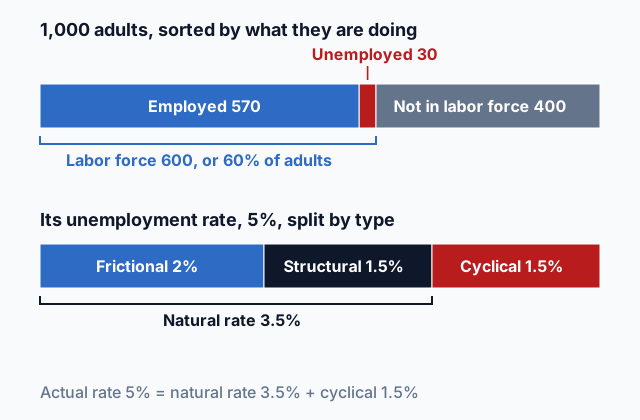
The top bar of the picture works one through: 30 unemployed in a labor force of 600 is a 5% rate, and 600 of 1,000 adults is 60% participation.
Quick check · Fill the statement
Tap a blank, then tap the words that complete the definitions.
The labor force is everyone who has a job plus everyone who has no job and is . The unemployment rate divides the number unemployed by , and the labor force participation rate divides the labor force by .
2b. Running the numbers in either direction
Sometimes you get counts and need the rates. Just as often you get rates and have to work back to a count. Every direction uses the same three facts:
- labor force = employed + unemployed
- unemployed = unemployment rate × labor force
- labor force = participation rate × adult population
Take Corwin, an invented city with 500,000 adults, a participation rate of 62% and an unemployment rate of 5%.
- Labor force: 0.62 × 500,000 = 310,000.
- Unemployed: 0.05 × 310,000 = 15,500.
- Employed: 310,000 − 15,500 = 294,500.
Step 2 multiplies by the labor force, not the population. Taking 5% of all 500,000 adults gives 25,000, which treats every retiree and student as a job hunter.
When a table lists people by status, add only the rows of people working and people looking to get the labor force. Rows such as "retired" or "no job, not looking" stay out of the unemployment rate completely. They still count in the adult population, so they matter for the participation rate.
Quick check · Calculate
Adrona, an invented country, has an adult population of 2,400,000. Its labor force participation rate is 65% and its unemployment rate is 6%. How many people in Adrona are unemployed?
2c. When the rate moves, and what it misses
Because the rate is a fraction, it moves when either part of it moves.
- A worker is laid off and starts job hunting: the top grows and the labor force is unchanged, so the rate rises.
- An unemployed person finds a job: the top shrinks, so the rate falls.
- Employed people retire: the top is unchanged and the labor force shrinks, so the rate rises and participation falls.
- Unemployed people stop looking: they leave the top and the bottom, so the rate falls, and participation falls too.
That last group are discouraged workers: people who want a job but have stopped looking because they believe none is available. The rate drops when they give up, even though nobody found work. This is one reason the measured unemployment rate is criticized for understating joblessness.
Part-time workers open the same blind spot from the other side. Someone who wants full-time work but can find only 10 hours a week counts as employed, and the hours they cannot get never show up in the rate.
Quick check · Decide and justify
In Fenmore County, 1,200 people who were counted as unemployed stop looking for work because they believe no jobs are available. Nobody finds a job, and the county's unemployment rate falls. Does the lower rate show that fewer people in Fenmore County are without jobs?
Which reason supports your choice?
2d. Three types, and the natural rate
Economists sort unemployment into three types by what caused it.
- Frictional: people between jobs or just starting out, searching for a good match. A graduate sending out applications is frictionally unemployed.
- Structural: people whose skills or location no longer fit the jobs on offer, often because technology or what buyers want changed for good.
- Cyclical: people out of work because spending across the whole economy fell in a downturn. When spending recovers, those jobs come back.
The natural rate of unemployment is the rate that exists when the economy produces its full-employment real output. It equals frictional plus structural unemployment. It is never zero, because somebody is always switching jobs, and it drifts slowly as the labor force changes in age or skills.
Cyclical unemployment is how far the actual rate sits from the natural rate. In the bottom bar of the picture, frictional 2% plus structural 1.5% gives a natural rate of 3.5%. The actual rate is 5%, so cyclical unemployment is 5% − 3.5% = 1.5%. In a boom the actual rate can dip below the natural rate, and the gap turns negative. An actual rate above the natural rate means real output below potential output, the shortfall 2.7 measures as the output gap.
Quick check · Sort it
Tap a worker, then tap the type of unemployment that describes them.
Frictional
Structural
Cyclical
Part 3 Watch it done A town survey with a retired row
Watch each step, then do the last one yourself.
A survey of every adult in Ridgeport, an invented town, finds 41,200 people working full time, 6,400 working part time, 2,400 with no job and looking for work, 9,800 with no job and retired, and 7,200 with no job and not looking (students and caregivers). Find Ridgeport's unemployment rate.
Step 1 · Count the employed
Everyone with a paid job counts, part time included: 41,200 + 6,400 = 47,600 employed.
Why this step?
Why do the 6,400 part-time workers count as employed?
The survey asks whether a person did paid work, not how many hours. Some of them may want more hours, which is a limit of the measure, but they have jobs.
Step 2 · Build the labor force
Add only the people looking for work: 47,600 + 2,400 = 50,000 in the labor force. The 9,800 retirees and the 7,200 who are not looking have no job, but they are not trying to get one, so they stay out.
Step 3 · Set up the rate
The unemployment rate puts the job seekers over the labor force and multiplies by 100. The town's 67,000 adults in all matter only for the participation rate, so leave that total out of this one.
Your step · Calculate
A survey of every adult in Ridgeport finds 41,200 people working full time, 6,400 working part time, 2,400 with no job and looking for work, 9,800 with no job and retired, and 7,200 with no job and not looking. What is Ridgeport's unemployment rate, as a percent?
%
Part 4 Try it New numbers, both directions
Try it · Multiple choice
Halbeck, an invented country, has 80,000 adults: 48,880 employed, 3,120 unemployed and looking for work, and the rest not in the labor force. Then 3,200 of the employed workers retire, and no one is hired to replace them. Nothing else changes. What are Halbeck's unemployment rate and labor force participation rate after the retirements, to one decimal place?
Some reports skip the head counts and give the rates by type instead. Then the work is all in which rates sit inside which. Structural and frictional unemployment are already inside the natural rate, and cyclical unemployment is what the actual rate adds on top of it.
Try it · Calculate
Wenlow's statistics office reports a natural rate of unemployment of 4.5%, a structural unemployment rate of 1.5% and a cyclical unemployment rate of 2.5%. What is Wenlow's actual unemployment rate, as a percent?
Part 5 Explain it Write it the way the exam asks
Nothing you type leaves this page.
Free response is 33.35% of the exam score. This one is shaped like Question 3, Short.
Free-response practice · Question 3 style
In Tessaly, the adult population is 40 million, the labor force participation rate is 60%, the unemployment rate is 7%, and the natural rate of unemployment is 4.5%. (a) Calculate the number of people in Tessaly who are unemployed. Show your work. (b) Calculate the number of people in Tessaly who are employed. Show your work. (c) Identify Tessaly's cyclical unemployment rate. (d) Firms in Tessaly lay off more workers as spending across the economy falls further. Will the natural rate of unemployment increase, decrease, or stay the same? Explain.
Model answer
(a) Labor force = 0.60 × 40 million = 24 million. Unemployed = 0.07 × 24 million = 1.68 million. (b) Employed = 24 million − 1.68 million = 22.32 million. (c) Cyclical unemployment = 7% − 4.5% = 2.5%. (d) It stays the same. Layoffs caused by falling spending across the economy are cyclical unemployment, and the natural rate includes only frictional and structural unemployment.
Score your own answer. This is a self-check, not a grade. Tick each point your answer makes.
Part 6 Check yourself Do the survey's own arithmetic
Work from the table: both questions use its three rows.
These are the U.S. household survey figures for September 2026, from the Bureau of Labor Statistics' Employment Situation report released October 2, 2026. They were read from the St. Louis Fed's FRED database (series CNP16OV, CE16OV and UNEMPLOY) on October 14, 2026. Counts are in thousands of people, and the adult population is the civilian noninstitutional population aged 16 and over. BLS rounds each figure on its own, and the population figure is not seasonally adjusted while the other two are.
| Group | People (thousands) |
|---|---|
| Adult population | 275,554 |
| Employed | 163,152 |
| Unemployed | 7,109 |
Case question 1 · Calculate
In September 2026 the U.S. household survey counted 163,152 thousand people employed and 7,109 thousand unemployed, out of an adult population of 275,554 thousand. What was the unemployment rate, as a percent? Give at least one decimal place.
Case question 2 · Calculate
In September 2026 the U.S. household survey counted 163,152 thousand people employed and 7,109 thousand unemployed, out of an adult population of 275,554 thousand. What was the labor force participation rate, as a percent? Give at least one decimal place.
The rest stand on their own and do not use the case.
Check yourself · Spot the error
Pelton's actual unemployment rate is 7.5%, its cyclical unemployment rate is 2% and its frictional unemployment rate is 3.5%. A student worked out Pelton's structural unemployment rate. Tap the first line that goes wrong.
Check yourself · Match
Each change happens on its own, with everything else in the economy held the same. Tap a change, then tap what happens to the unemployment rate and the labor force participation rate.
Check yourself · Multiple choice
Over twenty years, a much larger share of a country's workers gets trained in the skills its growing industries hire for. Nothing else about its labor force changes. What most likely happens to the country's natural rate of unemployment?
Part 7 Keep it Keep it
From 2.2 Limitations of GDP · Spot the error
After a hurricane, a coastal state spends $2 billion rebuilding homes and roads the storm destroyed. A student explained what this does to GDP and to how well people live. Tap the first line with a mistake.
From 1.2 Opportunity Cost and the Production Possibilities Curve (PPC) · Match
Tap an event, then tap what it does to a country's PPC for wheat and computers.
In three lines
- The unemployment rate is the unemployed as a percentage of the labor force, and the participation rate is the labor force as a percentage of adults.
- Discouraged workers and part-time workers who want full-time work make the measured rate understate joblessness.
- The natural rate is frictional plus structural unemployment, and cyclical unemployment is the actual rate minus the natural rate.
Exam strategy for this topic
- Section I, Multiple Choice: 60 questions in 70 minutes.
- Section II, Free Response: 3 questions in 60 minutes.
- This lesson's Explain it is shaped like free-response question 3, Short.
- A four-function calculator is allowed on both sections of the exam.
Write down the labor force as a number before you compute either rate, since it is the bottom of the unemployment rate and the top of the participation rate. When a question asks what happens to a rate, say which part of the fraction changed.
Questions students ask
Does a part-time worker count as employed?
Yes. The survey asks whether a person did paid work, not how many hours. Someone who wants full-time work but gets 10 hours a week counts as employed, which is one reason the measured rate understates joblessness.
Can the unemployment rate rise when nobody loses a job?
Yes. If employed people retire, the labor force shrinks while the number of job seekers stays the same. In a town with 1,000 job seekers in a labor force of 20,000, 500 retirements raise the rate from 5 percent to about 5.1 percent.
Why is the natural rate of unemployment never zero?
Somebody is always between jobs or has skills that no longer fit, so frictional and structural unemployment never disappear. Full employment means no cyclical unemployment, not no unemployment.
Can the natural rate of unemployment change?
Yes, slowly, as the labor force changes. If far more workers are trained in the skills growing industries hire for, structural unemployment shrinks and the natural rate falls with it.
How do I find the number unemployed when I am given only rates?
Go through the labor force. With 5 million adults, a participation rate of 64 percent and an unemployment rate of 5 percent, the labor force is 0.64 × 5,000,000 = 3,200,000 and the unemployed are 0.05 × 3,200,000 = 160,000.
Course alignment, for teachers
AP Macroeconomics topic 2.3, Unit 2: Economic Indicators and the Business Cycle.
- Skill 1.B: Identify an economic concept, principle, or model illustrated by an example.
This lesson maps all 7 essential knowledge statements of the topic to the part that teaches each one: 7 are checked by a scored question. The map is in the lesson file.